







ScaleFlux stands out as one of the few storage companies that designs and builds its own SoC controllers entirely in-house. This gives the company full control over both hardware and firmware, allowing it to fine-tune performance, latency, and efficiency to levels that off-the-shelf controllers can't match. Originally rooted in computational storage, ScaleFlux has applied that expertise to develop modern enterprise SSDs with smarter, more efficient in-house controller designs.
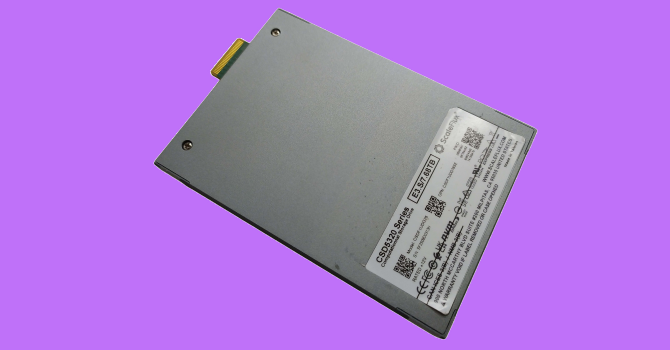
The ScaleFlux CSD5000 series marks the company's entry into the PCIe 5.0 enterprise SSD segment, introducing multiple 1-DWPD SKUs such as the CSD5520, CSD5510, and the CSD5320, which is the model tested today. All drives in this lineup feature a fully proprietary design, built around ScaleFlux's in-house controller and the latest-generation NAND flash, covering a wide range of form factors and capacities.
Another interesting aspect of the ScaleFlux CSD5000 SSD lineup is that ScaleFlux was the first company to collaborate with the Open Compute Project (OCP) by openly sharing detailed product information, which SSD manufacturers traditionally do not disclose. Many of the technical details presented in this review were made possible thanks to their participation in the OCP.
The compression used by the ScaleFlux SSD is fully transparent to the user and handled entirely by the drive itself. From the system's perspective, the SSD behaves like any standard NVMe device, no special configuration, drivers, or software are required. Internally, the controller analyzes data in 4 KB blocks and decides whether each block can be compressed. If it can, the compressed version is stored; if not, the data is written in its original form, with no impact on compatibility or behavior.
This entire process is implemented directly in hardware rather than firmware, ensuring extremely low latency. Read operations add only single-digit microseconds, while write operations are fully pipelined and effectively invisible to the host. The real benefits depend on the type of data being written: already compressed content such as images or videos sees little improvement, while text-based or zero-padded data can compress very efficiently. Because compression operates at a fixed 4 KB granularity, the SSD maintains competitive IOPS regardless of data compressibility.
Any space saved through compression effectively acts as additional over-provisioning, which dramatically reduces garbage collection activity. This leads to substantial gains in sustained random write performance, lower tail latency, and significantly improved endurance. In fact, with a realistic 2:1 compression ratio, the drive's lifespan can increase dramatically, reaching effective endurance levels well above 3-DWPD, a figure normally associated only with very high-end enterprise SSDs.
The CSD5320 is available in several formats, including U.2, U.3, E1.S (9.5 mm and 15 mm), and the E3.S version tested in this review. ScaleFlux offers this lineup in 3.84 TB, 7.68 TB, and 15.36 TB capacities, though the E3.S model is limited to 7.68 TB and 15.36 TB variants. When we received our 7.68 TB unit for testing, it was priced around $880; however, due to the recent surge in demand for NAND flash and DRAM-based products, pricing has increased substantially.
While ScaleFlux does not publish an official MSRP, the manufacturer indicated that the current pricing environment is extremely unstable, with retail pricing hovering around $0.25 per GB, placing the 7.68 TB model at approximately $1,920, though this is subject to change in the coming months. Current market listings reflect this volatility, with prices ranging from well over $1,500 up to $2,500 depending on the seller and purchase volume. We also found several gray-market resellers offering these units in the $2,000 to $2,500 range, highlighting the premium often charged by non-official distribution channels.
All CSD5320 SSDs are rated for 1 DWPD endurance, but what's particularly interesting is that ScaleFlux provides performance and endurance figures in two configurations, with and without compression. When compression is enabled, the SSD's throughput and efficiency noticeably increase.
| Specifications: ScaleFlux CSD5320 | |
|---|---|
| Brand: | ScaleFlux |
| Model: | CSDF1UDG76SE |
| Capacity: | 7680 GB (7152 GB usable) 7% overprovisioning |
| Controller: | ScaleFlux FX5016 |
| Flash: | Sandisk 3D eTLC BiCS8 1 Tb (FYU6_1T) 218-Layer SDUFKDMB 1T00 4481Y1EQGOON |
| DRAM: | 24 GB LPDDR5 16 GB (1× 16 GB) LPDDR5X-8533 SK Hynix H58G78BK8BX-144 8 GB (1× 8 GB) LPDDR5X-7500 SK Hynix H58G66BK7BX-067 |
| Sequential Read Speeds: | 13,000 MB/s |
| Sequential Write Speeds: | 9,300 MB/s |
| Random Read Speeds: | 3,100 K IOPS (C.R. 1:1) 3,200 K IOPS (C.R. 2:1) |
| Random Write Speeds: | 370 K IOPS (C.R. 1:1) 1,000 K IOPS (C.R. 2:1) |
| Endurance: | 21,000 TBW - 1.0 DWPD (C.R. 1:1) 142,000 TBW - >3.0 DWPD (C.R. 2:1) |
| MTBF: | 2 Million |
| Form Factor: | EDSFF E3.S 7.5 mm |
| Interface: | PCIe Gen 5 x4, NVMe 2.0 |
| Firmware: | U0000215 |
| Warranty: | Five years |
| Price at Time of Review: | $1920 |
此内容由惯性聚合(RSS阅读器)自动聚合整理,仅供阅读参考。 原文来自 — 版权归原作者所有。