





 84
Unboxing & Photos »
84
Unboxing & Photos »

We have with us the new AMD Ryzen 7 7700X3D, part of the 2026 refresh of AMD's desktop lineup. It is based on the older Zen 4 microarchitecture, but comes supercharged with 3D V-Cache and is aimed squarely at a lower price point. The 7700X3D was announced earlier this year, alongside the 5800X3D AM4 10th Anniversary Edition. Reviving the 5800X3D might look like AMD selling nostalgia, but it makes real sense given today's market: with DDR5 prices up nearly 5x on the back of the AI-inferencing boom, DDR4 platforms are popular again. The 7700X3D, meanwhile, targets a price-performance sweet spot that lines it up against Intel's recently launched Core Ultra 7 270K Plus.
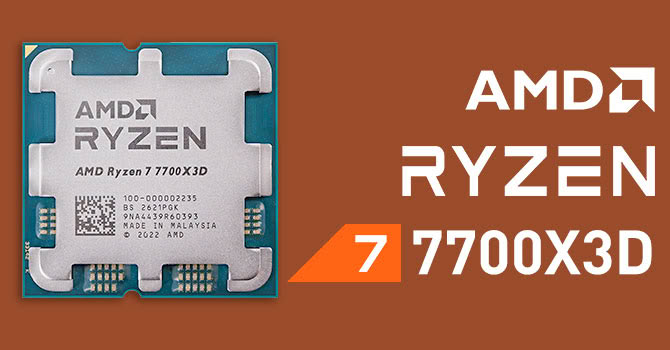
The Ryzen 7 7700X3D launches at $330, putting it just above Intel's Core Ultra 7 270K Plus, which currently streets for $310. AMD's goal is a chip that beats the Intel part in gaming while still sitting well below the Ryzen 7 9850X3D at around $490. In essence, the 7700X3D is a downclocked version of AMD's previous-generation gaming flagship, the Ryzen 7 7800X3D—which makes that chip, rather than the Intel part, its most revealing comparison, since it streets for only about $20 more. The wrinkle is availability: the 7800X3D appears to be winding down and may be nearing end-of-life, so the 7700X3D looks less like a rival to it than its lower-cost Zen 4 X3D successor, keeping the option on the shelf once remaining 7800X3D stock sells through.
AMD configured the Ryzen 7 7700X3D with a 4.00 GHz base frequency and a 4.50 GHz maximum boost. For comparison, the 7800X3D launched at 4.20 GHz base and 5.00 GHz boost—so the 7700X3D gives up 500 MHz at the top of its range. The 8-core/16-thread chip carries 1 MB of L2 cache per core and 96 MB of shared L3—32 MB on-die plus 64 MB on a stacked 3D V-Cache die, addressed as a single contiguous cache.
The Ryzen 7 7700X3D is compatible with all Socket AM5 motherboards, spanning AMD 600-series and 800-series chipsets. AMD standardized USB BIOS flashback, so getting an aftermarket motherboard to work with a 7700X3D should be fairly straightforward. The processor features the same 120 W TDP as the 7800X3D and current 9850X3D, so the cooling requirements should be the same. In terms of I/O, you get a dual-channel DDR5 memory interface, and a 28-lane PCI-Express Gen 5 root complex, from which 24 lanes are usable—16 towards the PEG slot, and two Gen 5 x4 links for CPU-attached M.2 NVMe slots.
| Price | Cores/ Threads | Base Clock | Max. Boost | L3 Cache | TDP | Architecture | Process | Socket | |
|---|---|---|---|---|---|---|---|---|---|
| Intel Core i5 | |||||||||
| Core i5-12400F | $170 | 6/12 | 2.5 GHz | 4.4 GHz | 18 MB | 65 W | Alder Lake | 10 nm | LGA 1700 |
| Core i5-13400F | $250 | 6+4/16 | 2.5/1.8 GHz | 4.6/3.3 GHz | 20 MB | 65 W | Raptor Lake | 10 nm | LGA 1700 |
| Core i5-12600K | $310 | 6+4/16 | 3.7/2.8 GHz | 4.9/3.6 GHz | 20 MB | 125 W | Alder Lake | 10 nm | LGA 1700 |
| Core i5-13600K | $320 | 6+8/20 | 3.5/2.6 GHz | 5.1/3.9 GHz | 24 MB | 125 W | Raptor Lake | 10 nm | LGA 1700 |
| Core i5-14600K | $250 | 6+8/20 | 3.5/2.6 GHz | 5.3/4.0 GHz | 24 MB | 125 W | Raptor Lake | 10 nm | LGA 1700 |
| Intel Core Ultra 5 | |||||||||
| Core Ultra 5 245K | $180 | 6+8/14 | 4.2/3.6 GHz | 5.2/4.6 GHz | 24 MB | 159 W | Arrow Lake | 3 nm | LGA 1851 |
| AMD Ryzen 5 | |||||||||
| Ryzen 5 8500G | $150 | 6/12 | 3.5 GHz | 5.0 GHz | 16 MB | 65 W | Phoenix 2 | 4 nm | AM5 |
| Ryzen 5 5600X | $180 | 6/12 | 3.7 GHz | 4.6 GHz | 32 MB | 65 W | Zen 3 | 7 nm | AM4 |
| Ryzen 5 7600 | $210 | 6/12 | 3.8 GHz | 5.1 GHz | 32 MB | 65 W | Zen 4 | 5 nm | AM5 |
| Ryzen 5 7600X | $170 | 6/12 | 4.7 GHz | 5.3 GHz | 32 MB | 105 W | Zen 4 | 5 nm | AM5 |
| Ryzen 5 9600X | $180 | 6/12 | 3.9 GHz | 5.4 GHz | 32 MB | 65 W | Zen 5 | 4 nm | AM5 |
| Intel Core i7 | |||||||||
| Core i7-12700K | $340 | 8+4/20 | 3.6/2.7 GHz | 5.0/3.8 GHz | 25 MB | 125 W | Alder Lake | 10 nm | LGA 1700 |
| Core i7-13700K | $420 | 8+8/24 | 3.4/2.5 GHz | 5.4/4.2 GHz | 30 MB | 125 W | Raptor Lake | 10 nm | LGA 1700 |
| Core i7-14700K | $380 | 8+12/28 | 3.4/2.5 GHz | 5.6/4.3 GHz | 33 MB | 125 W | Raptor Lake | 10 nm | LGA 1700 |
| Intel Core Ultra 7 | |||||||||
| Core Ultra 7 265K | $300 | 8+12/20 | 3.9/3.3 GHz | 5.5/4.6 GHz | 30 MB | 250 W | Arrow Lake | 3 nm | LGA 1851 |
| Core Ultra 7 270K Plus | $310 | 8+16/24 | 3.7/3.2 GHz | 5.5/4.7 GHz | 36 MB | 250 W | Arrow Lake Plus | 3 nm | LGA 1851 |
| AMD Ryzen 7 | |||||||||
| Ryzen 7 5700G | $210 | 8/16 | 3.8 GHz | 4.6 GHz | 16 MB | 65 W | Zen 3 + Vega | 7 nm | AM4 |
| Ryzen 7 5700X | $220 | 8/16 | 3.4 GHz | 4.6 GHz | 32 MB | 65 W | Zen 3 | 7 nm | AM4 |
| Ryzen 7 7700 | $280 | 8/16 | 3.8 GHz | 5.3 GHz | 32 MB | 65 W | Zen 4 | 5 nm | AM5 |
| Ryzen 7 7700X | $240 | 8/16 | 4.5 GHz | 5.4 GHz | 32 MB | 105 W | Zen 4 | 5 nm | AM5 |
| Ryzen 7 9700X | $310 | 8/16 | 3.8 GHz | 5.5 GHz | 32 MB | 65 W | Zen 5 | 4 nm | AM5 |
| Ryzen 7 5800X | $220 | 8/16 | 3.8 GHz | 4.7 GHz | 32 MB | 105 W | Zen 3 | 7 nm | AM4 |
| Ryzen 7 5800X3D | $420 | 8/16 | 3.4 GHz | 4.5 GHz | 96 MB | 105 W | Zen 3 | 7 nm | AM4 |
| Ryzen 7 7700X3D | $330 | 8/16 | 4.0 GHz | 4.5 GHz | 96 MB | 120 W | Zen 4 | 5 nm | AM5 |
| Ryzen 7 7800X3D | $350 | 8/16 | 4.2 GHz | 5.0 GHz | 96 MB | 120 W | Zen 4 | 5 nm | AM5 |
| Ryzen 7 9800X3D | $450 | 8/16 | 4.7 GHz | 5.2 GHz | 96 MB | 120 W | Zen 5 | 4 nm | AM5 |
| Ryzen 7 9850X3D | $490 | 8/16 | 4.7 GHz | 5.6 GHz | 96 MB | 120 W | Zen 5 | 4 nm | AM5 |
| Intel Core i9 | |||||||||
| Core i9-12900K | $430 | 8+8/24 | 3.2/2.4 GHz | 5.2/3.9 GHz | 30 MB | 125 W | Alder Lake | 10 nm | LGA 1700 |
| Core i9-13900K | $610 | 8+16/32 | 3.0/2.2 GHz | 5.8/4.3 GHz | 36 MB | 125 W | Raptor Lake | 10 nm | LGA 1700 |
| Core i9-14900K | $470 | 8+16/32 | 3.2/2.4 GHz | 6.0/4.4 GHz | 36 MB | 125 W | Raptor Lake | 10 nm | LGA 1700 |
| Intel Core Ultra 9 | |||||||||
| Core Ultra 9 285K | $500 | 8+16/24 | 3.7/3.2 GHz | 5.7/4.6 GHz | 36 MB | 250 W | Arrow Lake | 3 nm | LGA 1851 |
| AMD Ryzen 9 | |||||||||
| Ryzen 9 5900X | $280 | 12/24 | 3.7 GHz | 4.8 GHz | 64 MB | 105 W | Zen 3 | 7 nm | AM4 |
| Ryzen 9 7900 | $430 | 12/24 | 3.7 GHz | 5.4 GHz | 64 MB | 65 W | Zen 4 | 5 nm | AM5 |
| Ryzen 9 7900X | $320 | 12/24 | 4.7 GHz | 5.6 GHz | 64 MB | 170 W | Zen 4 | 5 nm | AM5 |
| Ryzen 9 7900X3D | $700 | 12/24 | 4.4 GHz | 5.6 GHz | 128 MB | 120 W | Zen 4 | 5 nm | AM5 |
| Ryzen 9 9900X | $330 | 12/24 | 4.4 GHz | 5.6 GHz | 64 MB | 120 W | Zen 5 | 4 nm | AM5 |
| Ryzen 9 5950X | $430 | 16/32 | 3.4 GHz | 4.9 GHz | 64 MB | 105 W | Zen 3 | 7 nm | AM4 |
| Ryzen 9 7950X | $510 | 16/32 | 4.5 GHz | 5.7 GHz | 64 MB | 170 W | Zen 4 | 5 nm | AM5 |
| Ryzen 9 7950X3D | $700 | 16/32 | 4.2 GHz | 5.7 GHz | 128 MB | 120 W | Zen 4 | 5 nm | AM5 |
| Ryzen 9 9950X | $510 | 16/32 | 4.3 GHz | 5.7 GHz | 64 MB | 170 W | Zen 5 | 4 nm | AM5 |
| Ryzen 9 9950X3D | $670 | 16/32 | 4.3 GHz | 5.7 GHz | 128 MB | 170 W | Zen 5 | 4 nm | AM5 |
| Ryzen 9 9950X3D2 | $900 | 16/32 | 4.3 GHz | 5.6 GHz | 192 MB | 200 W | Zen 5 | 4 nm | AM5 |


此内容由惯性聚合(RSS阅读器)自动聚合整理,仅供阅读参考。 原文来自 — 版权归原作者所有。