

惯性聚合 高效追踪和阅读你感兴趣的博客、新闻、科技资讯
阅读原文 在惯性聚合中打开

推荐订阅源

WordPress大学
WordPress大学
D
Darknet – Hacking Tools, Hacker News & Cyber Security
Hacker News: Ask HN
Hacker News: Ask HN
N
News and Events Feed by Topic
Forbes - Security
Forbes - Security
The Last Watchdog
The Last Watchdog
TaoSecurity Blog
TaoSecurity Blog
Schneier on Security
SecWiki News
SecWiki News
V
Vulnerabilities – Threatpost
Project Zero
Project Zero
O
OpenAI News
W
WeLiveSecurity
Security Archives - TechRepublic
Exploit-DB.com RSS Feed
H
Hacker News: Front Page
Cisco Talos Blog
Cisco Talos Blog
Spread Privacy
Spread Privacy
Help Net Security
Help Net Security
P
Privacy & Cybersecurity Law Blog
K
Kaspersky official blog
S
Security @ Cisco Blogs
Latest news
Latest news
AWS News Blog
AWS News Blog
U
Unit 42
Martin Fowler
Martin Fowler
阮一峰的网络日志
阮一峰的网络日志
S
Secure Thoughts
CTFtime.org: upcoming CTF events
Application and Cybersecurity Blog
Know Your Adversary
Know Your Adversary
Scott Helme
Scott Helme
博客园 - 司徒正美
B
Blog RSS Feed
C
Check Point Blog
Hacker News - Newest:
Hacker News - Newest: "LLM"
D
Docker
Google Online Security Blog
Jina AI
Jina AI
aimingoo的专栏
aimingoo的专栏
Recent Commits to openclaw:main
Last Week in AI
Last Week in AI
月光博客
月光博客
C
CXSECURITY Database RSS Feed - CXSecurity.com
S
SegmentFault 最新的问题
NISL@THU
NISL@THU
T
The Blog of Author Tim Ferriss
C
Cisco Blogs
Attack and Defense Labs
小众软件
小众软件

Flight Plan News | The HinduBusinessLine

Boeing bids farewell to ‘Queen of the skies’ Why do planes dump excess fuel in the sky? Compliance with regulation: Staying ahead is key Why has private capital not been taken to Indian aviation Global shipping lines look skywards Why opening the emergency door mid-flight is not possible Reviving businesses will benefit from air cargo’s growth How do commercial aircraft navigate? Air India’s roadmap can be tricky to pull off Navigating newer disruptions with maximum agility Why do plane crashes happen? Post-pandemic, OTAs are coming of age Air infrastructure plans should be future-proof Airlines’ performance metrics may need an overhaul Why do planes leave a white trail behind them? 5 things Indian airlines must do to break their way out of pandemic blues Hope you never get into a ‘coffin corner’ while flying Mission to Net Zero: Aviation’s focus on making sustainable connections Blockchain: Piloting the future of aviation Chicken gun test: Saving jets from bird strikes Will Akasa Air’s contra bet on Boeing 737 Max instead of Airbus pay off? Slots scarcity hits Indian airlines’ flight roadmap Cabin crew with an invisible cape Yoke vs. sidestick: Jury still out on what works best for pilots Redressing flaws: IndiGo needs to tweak its way The art of avoiding accidents in air Travel now, pay later Thrust reversal in aircraft Regaining momentum during turbulent times Mishandled baggage rates spike UDAN flies high despite the odds Decarbonising flying Airlines test willingness to pay higher airfares Do pilots really need to be good at maths? Electric aircraft set to transform urban mobility Leisure travel seeing a V-shape recovery How cabin pressure plays a key role Evolution of security in aviation Sustainable aviation fuels could be a game-changer Deep diving into design philosophies Insolvency of aircraft operator: default remedies. Domestic airline industry may face a rejig First-ever gravity-defying plane swap set for April 24 In case the engine gives out Corporate travel is unlikely to reach pre-Covid levels Aviation industry shifts focus to digital Short-haul flights redefining air travel No turning back Another tough year for airlines Unmanned Flying Objects, at your service Women who fly Making a comeback Profits offer hope of soft landing to Spicejet From geopolitics strife to a war of words between two aviation giants Air crew at higher risk Next order of business for Tata Sons Breaking down airline engineering and maintenance As India builds its newest airports, it needs robust, fail-proof SOPs Lost your baggage in transit? You might find it in Alabama Deep tech is helping airlines sustain operations during Covid Demand for more flight schools soars Robust flight plans can keep airlines afloat 2022 holds promise for the airline sector Omicron: Airlines on a wing and prayer A380: How Airbus forecast misfired Those magnificent flying machines Start-up founders onboard pvt jets A frequent flier’s tip on flying Greenfield airports on a slippery runway Air India sale: Who will bag the Maharaja's crown? Tech adoption will not lead to loss of jobs Reskilling of airline workforce needed Airbus responds to COP26 IFSC: Aircraft leasing gets a big boost Pick the rear seats to fly safe India ahead in tech to make airports safer Pandemic: Contactless technology on an overdrive Domestic air travel leads airline recovery: Boeing Gearing up to fly twice as fast as sound Where an aircraft goes to rest Indian aviation: A study in paradox Walking through a new airport experience The making of ‘agile’ airlines ‘The challenge was in getting the aircraft’s custom clearance’ No low-cost airline in India Bad flying conditions Regional airlines ailing despite UDAN scheme As the price of aviation turbine fuel soars, airlines’ finances spin out of control Becoming Atmanirbhar Why Mount Everest is a no-fly zone Distance training for Air Asia pilots IndiGo and SpiceJet Q4 results Covid-19 compliant airlines Wanted: A booster dose for airlines A lift for MRO A time when hijackings were dime-a-dozen in the US Opening up Indian skies to drone technology What commercial airlines can do to extend the longevity of their fleet Empathy is the need of the hour
Embraer expects capacity dynamics to tilt demand in its favour
By K Giriprakash · 2022-09-18 · via Flight Plan News | The HinduBusinessLine
Embraer E-195 E 2 aircraft: The first viewing of the new Brazilian manufacturer’s aircraft soon after arrival at the Wings India 2020 international exhibition at Begumpet Airport in Hyderabad on March 12, 2020

Embraer E-195 E 2 aircraft: The first viewing of the new Brazilian manufacturer’s aircraft soon after arrival at the Wings India 2020 international exhibition at Begumpet Airport in Hyderabad on March 12, 2020 | Photo Credit: NAGARA GOPAL

The history of the Brazilian aeroplane maker, Embraer, in India has been tumultuous. Uneven ups and downs.

Some of the earliest commercial airlines in India to choose Embraer were Paramount Airways and Air Costa, both of which are now defunct.

Cheap tickets and the option of a window or aisle seat, Embraer's main selling point, were available on both carriers. Nonetheless, the airlines went out of business within few years because of issues with leasing companies. So happy was Air Costa with Embraer's performance, that it ordered 50 Embraer E-jets E2 worth $3 billion, but it had to be cancelled after the airline folded up.

Star Air, another regional airline, began service with Embraer ERJ145 aircraft two years after Air Costa ceased operations. With the recent decision to induct two more E175s to its fleet, Embraer might just be finding its feet again in the Indian market.

The plane maker’s top bosses are confident that it has a bright future, shedding a tentativeness that seemed to overshadow their earlier forays in India. “The country is adding new airports and expanding existing ones, providing greater access to Tier II and III cities. This presents opportunities to grow their fleet and enhance connectivity across the country.” Raul Villaron, Vice-President, Asia Pacific for Embraer Commercial Aviation, told BusinessLine.

The ATR challenge

Comparing Embraer's jets against ATRs, the regional turboprops from the family of a joint venture between two European aeronautical heavyweights, Airbus and Leonardo, was one of the most significant challenges confronting the company in India. ATRs could make a difference in the Indian aviation market due in part to the company's commitment to establishing an assembly operation in India if more turboprops were bought. Moreover, with a connection to Airbus, it was easier to persuade the airlines to combine it with the popular A320s for regional routes, despite the criticism that one of its popular models, the ATR42, was not as economical on regional roads as was believed.

The turboprop solution?

Embraer has finally discovered a solution to this problem. It’s E-Jets E2 aircraft and planned introduction of a modern turboprop aircraft. “Designed for domestic and regional operations, the E-Jets E2 aircraft has a maximum flight time of six hours and specialises in establishing and expanding new routes. This makes the E2 an attractive platform for connecting metro to non-metro and between non-metro cities in India, which will be the key growth drivers in the coming years,” Villaron stated.

The projected debut of turboprop could alter the competitive landscape for Embraer. It is anticipated to deliver a jet-like experience with better passenger experience and a step ahead in sustainability; it would be the first aircraft designed from the beginning for 100 per cent SAF (Sustainable Aviation Fuel) operations. The turboprop would also provide the lowest solutions for fuel consumption, emissions, airport noise footprint, and trip and seat costs. Embraer is also seeking global strategic collaborations for the turboprop programme, including possible Indian partners, an opportunity that would be difficult to pass up.

“The largest market in India is the market for regional airlines, which Star Air uses well. Once Embraer's new turboprop model enters service, it will be quite popular. Embraer must focus on the regional jet market to connect cities in Tiers II and III. Their entry into the turboprop industry will be a welcome option to ATR and Q 400,” Arun Lohiya, Chief Operating Officer,CAD Ventures Pvt Ltd, said.

But critics claim that the turboprops could become extinct with the market maturing, turning first-time flyers into frequent flyers.
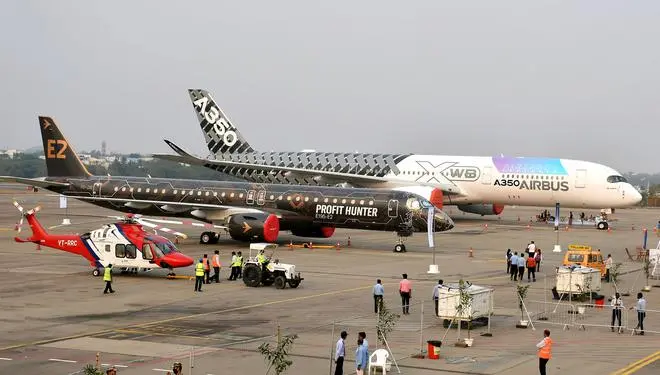
An Airbus A350 aircraft, Embraer largest commercial aircraft, the E195-E2 and VT-RRC helicopter models on the tarmac.

An Airbus A350 aircraft, Embraer largest commercial aircraft, the E195-E2 and VT-RRC helicopter models on the tarmac. | Photo Credit: NAGARA GOPAL

The road ahead

Yet, Embraer believes that it has a good chance of selling more of its aircraft in India. “Airlines exist to provide a service while also making a profit. Flight data research revealed that even before Covid, 50 per cent of domestic flights in India departed with only 90 to 150 passengers (aircrafts in India have an average of 180 seats); aircrafts are flying with many seats unoccupied. This continual imbalance between demand and capacity costs airlines money, eroding yields and, ultimately, profits. Regional jets, such as our E-Jets E2 family of aircraft, provide airlines with the flexibility to place the aircraft on strategically important routes where demand is currently thin,” pointed out Villaron.

Even though Embraer is banking on more connections between metro and non-metros to expand the market for its aircraft, it will be the first to admit that the situation is improving,  and the forecast is positive, but placing new aircraft orders remains difficult while cash conservation restrictions remain in place. The Brazilian plane maker will need to work hard to sell its aircraft in a market considered as one of the world's most complex and difficult markets to sell regional jets.

Published on September 18, 2022