






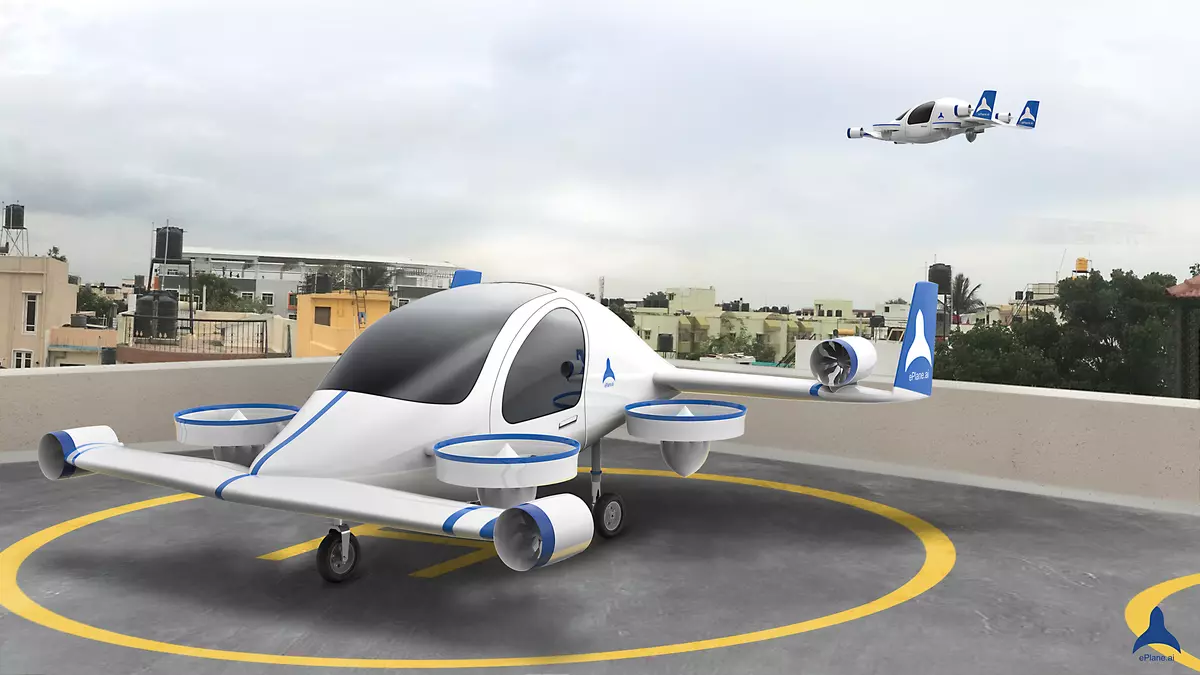
eVTOL: Fitted with smaller propulsion units driven by electric motors
Google Co-Founder Larry Page, LinkedIn Co-Founder Reid Hoffman and Zinga founder Mark Pincus and companies like Uber, Airbus, Boeing, Honda and American Airlines believe the future of urban transport will be a tiny electric aircraft which can carry a maximum of six passengers and a pilot to ferry them from their homes to offices and back.
Back home, corporate charter jet company, JetSetGo, expects to pump in a large part of the $200 million it plans to raise shortly for investing in electric aircraft called eVTOLs (electric vertical take-off and landing aircraft) to ferry passengers, while an IIT Madras-incubated startup, ePlane Company has recently tested a prototype in Dubai of its electric aircraft which it expects to launch soon.
Across the world, 10 international start-ups have pulled in $10 billion to develop and build these aircraft, which they believe will revolutionise urban air mobility. Most of the funding has come from investors such as Page, Hoffman, Pincus and a host of companies like Airbus and others.
Last week, the Indian civil aviation minister, Jyotiraditya Scindia — back from his tour to the US and Canada — made a strong pitch to bring eVTOLs to India. He said he had asked the US-based start-up Beta Technologies to explore the Indian market to launch eVTOLs.
eVTOLs are designed to pick up passengers from rooftops of their apartment blocks to ferry them across the city to their respective offices or entertainment centres. ePlane Company’s electric aircraft — being developed by two Chennai-based scientists — can carry two passengers and fly at an altitude of 0.5 km to 2 km at a speed of 200 km per hour. On a single charge, it can make 15 trips to 20 trips, covering a total of 200 km.
“The target rate most OEMs are looking at is $2,00,00 to $5,00,00 per machine and the expected fare can be twice that of an Uber. The market potential is huge. It can actually replace taxi service and reduce travel time by 10 times,” Kanika Tekriwal, Founder, JetSetGo, which counts former cricketer Yuvraj Singh as one of its investors, told BusinessLine.
“If the vision becomes reality, hundreds of eVTOLs will swarm over the skies of a big city during a typical rush hour, whisking small numbers of passengers at per-kilometre costs no greater than those of driving a car,” IEEE Spectrum wrote in an article on its website.
The fact is that it is closer to becoming a reality. According to various reports, Embraer Eve Air Mobility is learnt to have signed contracts with 17 companies for over 1,700 eVTOLs valued at $5 billion in January this year. In June, Vertical Aerospace is learnt to have announced pre-orders for 1,000 eVTOLs from American Airlines, Virgin Atlantic and aircraft lessor, Avalon Holdings. The Chennai-based ePlane company recently announced a $5 million pre-series A funding from a consortium of investors.
“The ePlane e200 is an electric VTOL i.e. it takes off and lands vertically like a drone/helicopter and travels through the air like an airplane at an altitude of 500m agl (above ground level). It will pick and drop passengers from their rooftop(s)/terrace(s) with no additional infrastructure requisites,” explains Satyanarayanan Chakravarty, the co-founder of ePlane.
He said the company has tested a scaled-down prototype and expects to have its first cargo plane ready as early as next year. The cargo carrier is expected to be rolled out by February 2023, and the passenger version is expected by December 2024.
According to eVTOL.com, unlike conventional helicopters, which rely on internal combustion engines and mechanical transmissions to drive their large main rotors, eVTOL aircraft typically have multiple smaller propulsion units driven by electric motors. These propulsion units can be placed almost anywhere on an aircraft, a concept called distributed electric propulsion (DEP) or “power-by-wire.” DEP enables tremendous design flexibility and unconventional configurations that were never possible before, eVTOL.com’s note to investors said.
Beta Technologies’ Alia, uses four overhead propellers for vertical take-offs and landings and a rear-mounted pusher propeller for forward flight. In cruise flight, the lift is provided entirely by the wing and the overhead propellers are stowed in a fixed position for aerodynamic efficiency.
With the Indian government backing the introduction of eVTOLs, more manufacturers are expected to show interest in setting up a base here and a further policy push in terms of opening up airspace for such electric aircraft will certainly be a game-changer for the urban transport mobility.
Published on May 15, 2022
此内容由惯性聚合(RSS阅读器)自动聚合整理,仅供阅读参考。 原文来自 — 版权归原作者所有。