


You must have gone through this at least once in your life, where you waited for a website to load and felt like giving up midway before it even showed up. It happens with a lot of WordPress sites, too. Google has made a free tool called PageSpeed Insights, which is used to find out how slow or fast your site is. When you type in your website’s link and hit enter, it scores your website out of 100, along with the list of reasons why your site might be loading slowly.
However, that list is full of confusing words like “Largest Contentful Paint” or “Cumulative Layout Shift” and if you’ve never built a website before, these terms will not make any sense to you. But don’t worry, this guide will explain what all of it means in plain, simple language and show you exactly how to fix it, step by step.
PageSpeed Insights is a free tool offered by Google. It analyzes any webpage and scores it based on how fast it loads and how smoothly it runs once it’s loaded. It matters a lot, especially for WordPress sites, as they rely on themes, plugins, and backend codes that can affect the website’s performance if it’s not managed well.
This tool breaks your site’s performance into a set of measurements called Core Web Vitals. It is Google’s way of measuring what a “good” user experience actually feels like. Slow load times reflect poorly on your website, frustrate your users, and hurt your search rankings too. A fast-loading site performs better and keeps people around.
Before getting into fixes, it helps to know what you’re actually being scored on. Here’s the short version.
| Metric | What It Measures | Good Score |
| Largest Contentful Paint (LCP) | How fast the biggest visible element loads | Under 2.5 seconds |
| First Input Delay (FID) | How quickly the site responds to a click or tap | Under 100 milliseconds |
| Cumulative Layout Shift (CLS) | How much the page jumps around while loading | Below 0.1 |
| Interaction to Next Paint (INP) | How smoothly the page reacts after interaction | Lower is better |
| First Contentful Paint (FCP) | Time until the first bit of content appears | As fast as possible |
| Time to First Byte (TTFB) | How fast your server responds to the first request | Lower is better |
These six numbers together make Google’s report card for your site’s user experience.
You don’t need multiple expensive software to figure out what is wrong with your website. The PageSpeed Insights tool along with a free website speed test like GTmetrix will tell you almost everything you need to know. You just have to type in your website URL, both tools then scan your site and give you a list of things that have been dragging your score down.
Once you find out what’s broken, next comes how to actually fix it. Below are the types of problems that you’re likely to encounter and how to fix them.
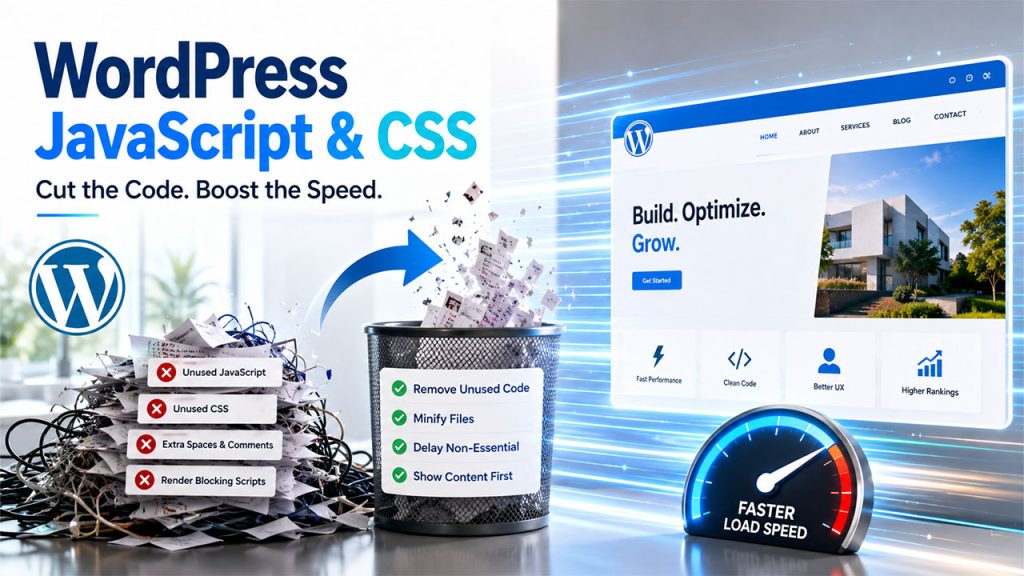
JavaScript and CSS are responsible for building the structure and interactivity of your pages. However, they are also common reasons behind your slow scores. A theme or plugin loads extra code on pages which are not necessary.
When someone visits your site, their browser sends a request to your server and waits for a response. Taking too long to process that request delays everything else no matter how optimized the rest of your page is.
This is also where a slow DNS lookup tends to hide. Before your browser can even talk to your server, it has to translate your domain name into an IP address, and if that step drags, your whole site feels sluggish before a single byte of content loads.

Images are usually the single biggest contributor to page weight. For instance, if your blog post has a handful of photos that are not optimized, it can easily double or triple its load time compared to one with properly sized images.
Browser caching stores some specific files such as images, CSS, JavaScript directly in a visitor’s browser, so their device doesn’t have to re-download everything each time they come back. It is one of the most common reasons why website loads slowly.
If you’ve tried all of this and your WordPress website slow performance still hasn’t improved much, take a step back and check if it’s a structural issue like your hosting environment or a conflict between your plugins rather than any single error that PageSpeed Insights flagged.
By fixing PageSpeed Insights errors, we don’t mean you have to score perfect 100. This number is not as important as how your site actually feels to your real visitor. You must fix the root cause, not just its symptoms. A site that’s slow due to a sluggish server needs a completely different fix than one weighed down by oversized images, and confusing the two just wastes your time.
Work through the categories one at a time, and you’ll likely see your score climb without ever having to touch even a single line of code. And if you still feel stuck, bring in an experienced WordPress developer to handle the trickier server-side fixes. Sometimes, it is the fastest path to a faster site.
Anything above 90 is considered excellent, though scores in the 70s and 80s are still perfectly workable for most sites.
No. most fixes, like image compression, minification, and caching, can be done manually or through your hosting provider.
Often it comes down to unoptimized images, too many active plugins, or a slow server response time rather than the theme itself.
Yes, it gives you two separate scores, since mobile devices typically load pages more slowly than desktops.
Yes. if your domain takes too long to resolve to your server’s IP address, it delays everything else on the page, including your Time to First Byte.
此内容由惯性聚合(RSS阅读器)自动聚合整理,仅供阅读参考。 原文来自 — 版权归原作者所有。