








Many fintech products fail not because of weak technology but because users struggle to trust, understand, or navigate them. Effective UX design simplifies complex financial processes, reduces friction, improves onboarding, and helps customers feel confident when managing their money. As competition in fintech grows, user experience is becoming one of the strongest differentiators.
The fintech industry has transformed the way people manage money, invest, borrow, and make payments. Every year, new startups enter the market with innovative products that promise to improve financial experiences through automation, artificial intelligence, embedded finance, and digital-first services.
Yet despite strong technology, many fintech products struggle to achieve sustainable adoption.
This challenge is often surprising to founders and product teams. Significant resources are invested in infrastructure, compliance, integrations, and feature development. The product launches successfully, but customer acquisition costs remain high, onboarding completion rates disappoint expectations, and retention metrics fail to improve.
In many cases, the underlying issue is not technological capability but user experience.
Financial products operate in a highly sensitive environment where trust, clarity, and confidence directly influence customer behavior. When users encounter confusion, uncertainty, or friction, they often abandon a product regardless of how powerful its technology may be.
Understanding the relationship between design and adoption has become essential for fintech companies seeking long-term growth.
Unlike many consumer applications, fintech products require users to make decisions involving money, risk, and personal information.
Customers frequently need to:
Each action requires trust.
When users feel uncertain about what will happen next, adoption rates decline.
The challenge becomes even greater because financial services often involve complex terminology, regulatory requirements, and workflows that are difficult for average users to understand.
Design plays a critical role in translating this complexity into intuitive experiences.

Many fintech teams focus heavily on functionality while underestimating the business impact of usability.
Poor UX can affect:
| UX Issue | Business Impact |
| Complex onboarding | Lower conversion rates |
| Confusing navigation | Reduced engagement |
| Lack of transparency | Lower trust |
| Poor transaction feedback | Increased support requests |
| Difficult verification processes | Higher abandonment rates |
The financial consequences can be significant.
A product that loses users during onboarding may spend considerably more on customer acquisition without improving growth outcomes.
Similarly, unclear interfaces can increase support costs and reduce customer satisfaction.
Trust influences almost every financial decision users make.
Customers need confidence that:
Unlike social media or entertainment applications, fintech products cannot rely solely on engagement features.
Users evaluate trust continuously throughout their journey.
This is one reason many scaling financial companies choose to work with a fintech design agency that understands both financial regulations and customer psychology. Specialized expertise helps teams design experiences that communicate reliability while simplifying complex financial workflows.
Trust is not created through marketing claims alone. It emerges from hundreds of small interactions throughout the product experience.
Many fintech products require identity verification, document uploads, and regulatory compliance procedures.
While these requirements are unavoidable, the experience surrounding them can significantly impact conversion rates.
Users are more likely to complete onboarding when they understand:
Clear communication reduces uncertainty.
Financial products often present large amounts of data.
Balances, transactions, fees, analytics, investment performance, and account details can quickly overwhelm users.
Effective design prioritizes information based on user goals rather than displaying everything simultaneously.
Simplicity improves comprehension.
Unexpected fees, unclear transaction statuses, and hidden conditions damage trust.
Users expect transparency throughout the financial journey.
Simple explanations often outperform complicated disclosures.
Mobile banking and financial management have become the default behavior for many consumers.
If a product performs poorly on mobile devices, adoption suffers.
Responsive interfaces, intuitive navigation, and fast performance have become baseline expectations.
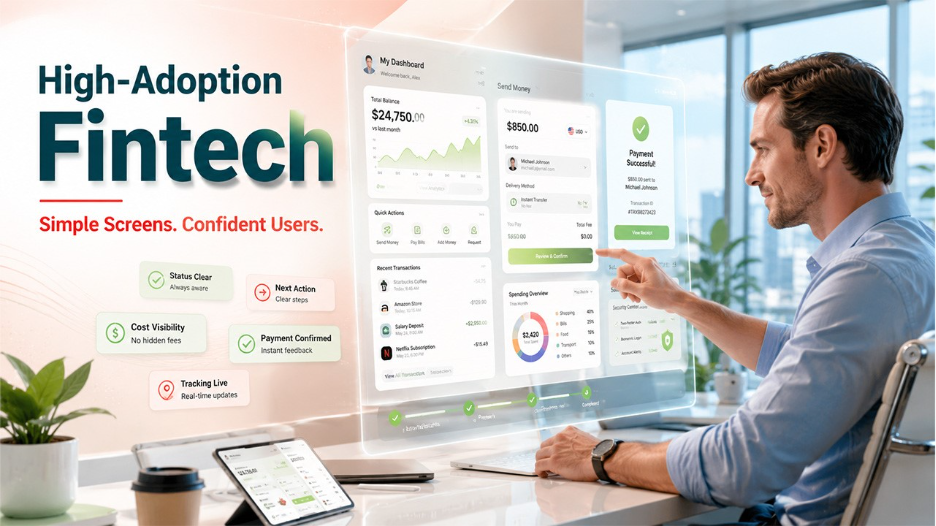
Successful fintech products share several common characteristics.
Users always understand:
Clarity reduces anxiety.
Instead of forcing users to interpret complex financial information, they simplify decisions through effective information architecture and thoughtful design.
Users can focus on goals rather than navigating complexity.
Customers want reassurance that actions have been completed successfully.
Confirmation messages, progress indicators, and transaction tracking improve confidence.
Consistent interfaces help users develop familiarity.
When actions behave predictably, trust increases.
The fintech market continues to become more competitive.
Products increasingly offer similar functionality, pricing structures, and technical capabilities.
As feature parity expands, customer experience becomes a primary differentiator.
Organizations that make financial services easier to understand often achieve stronger adoption than competitors with more advanced technology but weaker usability.
This shift has elevated UX design from a tactical function to a strategic business advantage.
Technology remains essential for fintech innovation, but technology alone rarely guarantees adoption.
Customers choose products they trust, understand, and enjoy using.
The most successful fintech companies recognize that user experience is not simply a design concern—it is a growth driver that influences acquisition, retention, customer satisfaction, and long-term business performance.
As the industry evolves, the ability to transform financial complexity into intuitive user experiences will continue to separate market leaders from the rest.
此内容由惯性聚合(RSS阅读器)自动聚合整理,仅供阅读参考。 原文来自 — 版权归原作者所有。