








You know that moment when a website just stalls? You click, and click again, wondering if it’s your internet or theirs. Nine times out of ten, it’s not your connection; it’s a database somewhere struggling to keep up. That’s exactly the problem database optimization exists to solve.
It should be noted that optimizing a database is not a process like car tuning. It is done periodically to make sure that everything works right. As more and more data piles up and as user traffic changes, the way data storage and retrieval should be changed.
In this blog, we’ll walk through what database optimization actually means in practice, why it matters more than most people realize, and the real techniques that keep systems fast even when everything else is under pressure.
At its core, database optimization is the practice of improving how a database stores, retrieves, and processes information so it can deliver fast, consistent performance. It’s not about one big fix; it’s about trimming unnecessary work whenever it hides: how the engine chooses execution plans, how the schema is structured, how storage is organized, and how indexes get used.
This is when database performance tuning becomes particularly important. Instead of focusing on individual problems caused by some slow queries, tuning focuses on the entire database infrastructure.
In addition, it does not stop there. Over time, database sizes grow, applications become more sophisticated, and AI-driven operations increase their load. Thus, optimization must be repeated again and again rather than implemented once and forever.
It is no secret that database optimization forms the basis of any high-performing database, whether relational or open-source.
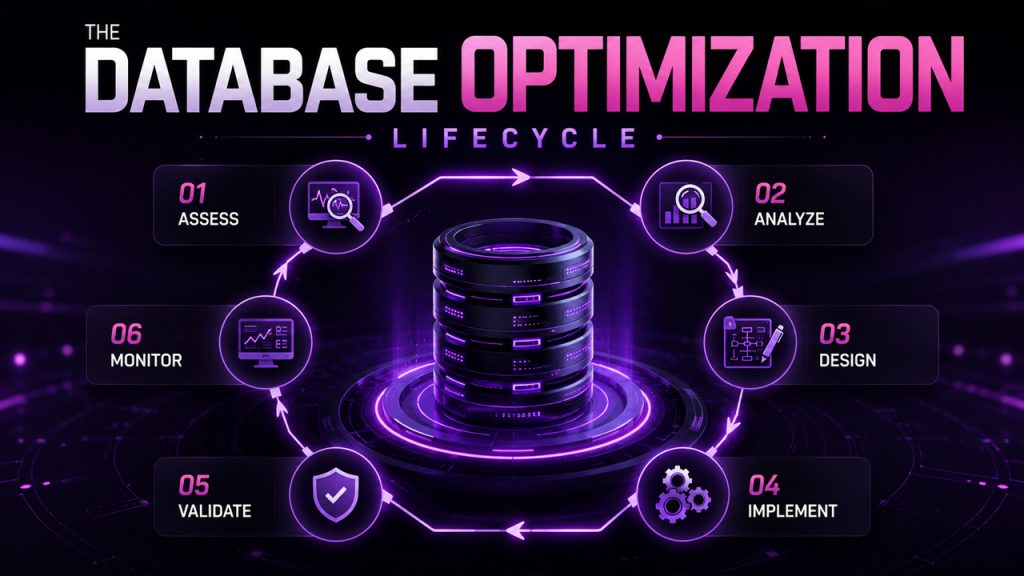
Database optimization isn’t a single action; it’s a repeatable cycle that teams run through again and again as conditions shift:
Assess: Look at current performance using signals like query latency and workload patterns.
Analyze: Figure out where the slowdown is actually coming from: queries, indexing, or data layout.
Design: Plan targeted fixes that reduce unnecessary work inside the engine.
Implement: Roll out those changes gradually, rather than all at once, to keep risk low.
Validate: Compare results against the original baseline to confirm things actually improved.
Monitor: Keep watching performance over time, since workloads never stay static for long.
This optimization cycle guarantees stability amid changing conditions, and it is critical in any system that relies on analytics and machine learning features, which need consistent performance underneath.
Once a database is properly tuned, the improvements show up almost everywhere:
Cleaner execution plans mean fewer wasted scans and steadier response times, even as demand increases.
time apps: Catching and smarter indexing shorten the path between a request and its answer, which matters most for dashboards and live services.
Well-tuned databases use less compute and storage to do the same amount of work, which directly helps control cloud costs.
Proper tuning reduces lock contention and concurrency issues right when reliability matters most.
Fast, predictable data retrieval is essential for anything built on retrieval-augmented generation or vector search.
Put together, these benefits are exactly why database performance optimization has become less of a nice-to-have and more of a baseline expectation for any team running data-heavy systems.
Despite every effort put into monitoring it, ensuring the fast operation of a database is often not an easy task, as there are always several factors that may come into play:
If too many requests are made simultaneously, the engine may suffer from blocking and write slowdowns when processing under high concurrency.
Things like nested subqueries, unbounded scans, and excessive joins scale poorly as data grows, and this is exactly where Slow MySQL Queries become a familiar headache for a lot of teams.
The absence or incorrectness of indexes forces the engine to use more expensive paths for data retrieval; at the same time, overindexing silently increases storage expenses.
The misalignment of the partitioning and outdated sharding distributes the related data all around the storage space, thus making it harder to retrieve it.
Lack of visibility on performance metrics makes teams react to the problem rather than preventing it in advance.
It is intriguing to note that these problems are not confined to larger-scale systems alone. For instance, when we talk about an issue such as the WordPress Runtime Error, it arises from the same set of problems: inefficient queries and lack of indexing.
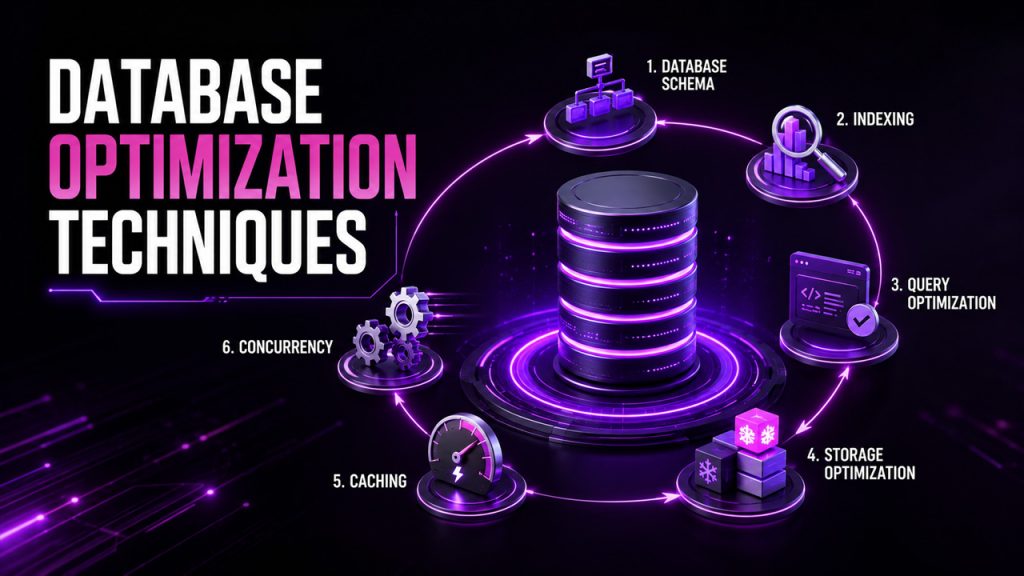
There are just a few key techniques that constitute almost all of the optimization:
Good utilization of normalization, keys, and schema, which could be defined by using Database Design Patterns, defines the ability of the engine to access and build necessary information.
Usage of clustered, composite, or filtered indexes allows direct access to needed data rather than scanning all information.
Optimizing queries and selecting proper indexes is needed to allow the optimizer to select a better plan.
Proper placement of data according to its “temperature”, keeping hot data to get quick access and archiving cold data, reduces extra I/O.
Keeping results of frequently requested queries close to the engine saves the effort of calculating those queries over and over again.
Multiversion Concurrency Control allows performing reads and writes concurrently. Together, these are the real, practical database optimization techniques teams lean on daily, not abstract theory, but concrete adjustments that compound into meaningfully faster systems.
All this will not work without observability. High observability provides people with information they need to detect potential issues even before users detect something wrong, e.g., latency trends, I/O operations, CPU utilization, and replication delay.
Instead of periodic checks, modern IT infrastructure uses constant monitoring, live dashboards, and alarms that can detect anomalies instantly. In the case of the cloud, this includes cost metrics. Unexpected costs or auto-scaling events usually mean the same inefficiencies as slow queries do.
Without observability, it is impossible to act before an outage happens and not only to fix but also to prevent them. Thus, it is not some additional feature but an integral part of every optimization process.
Ultimately, database optimization should not be an effort that is checked off on a list once and then forgotten. Rather, it is a process that needs to be repeated to make sure that the system is fast, stable, and able to withstand whatever future challenges come its way. Be it query optimization, storage design, or watching for performance indicators, each of the efforts helps prevent the system from getting slowed down.
The benefit goes much farther than most people realize. In many cases, the root causes of sluggish enterprise software, slow queries, ineffective indexes, and other issues that may be encountered can be the same factors that cause WordPress Runtime Errors to appear on individual websites.
Approach database optimization as maintenance and not just a single attempt at problem solving, and it will turn from a burning issue into a base for the whole thing to stand on.
Database optimization can be described as the process of improving the way a database functions and performs to deliver consistent results at an acceptable speed regardless of the changes in the amount of data and traffic.
The two terms are quite close, as performance tuning is considered to be the particular activity within the whole process of optimization.
Some of the most common methods of database optimization include indexing, query tuning, schema design, cache implementation, and storage structure adjustment, all aiming at addressing the specific cause of database performance decrease.
In most cases, factors such as bad indexing, ineffective queries, and storage fragmentation become the main reasons why the speed of the database operations starts decreasing.
Optimization of the database cannot be performed only once. It should be a process carried out regularly since workloads and demands keep changing all the time Optimization.
此内容由惯性聚合(RSS阅读器)自动聚合整理,仅供阅读参考。 原文来自 — 版权归原作者所有。