






Java has been without a doubt one of the most popular programming languages for decades. A large part of that popularity can be traced to its object-oriented foundation. If you are preparing for a technical interview or developing your own Java application, understanding OOPS Concepts in Java is one of the first milestones that you need to pass. Such concepts transform how Java is structured, reused, and maintained across real-world apps, from enterprise software to Android applications. In this guide, let us break what this concept is in a beginner-friendly language, so you can go from theory to practical understanding without getting confused with jargon.
OOPS Concepts in Java, stands for Object-Oriented Programming System in Java. Conceptually, OOPs refer to a programming approach created around objects instead of logic or functions alone. Instead of writing a long code, OOPs-based program sorts code around real-world entities that carry both behavior and data together.
Two terms exist at the heart of this approach:
Each object in Java is generated from a class utilizing the new keywords, and it inherits the methods and structure defined with it. This is the foundation that makes Java code reusable, modular, and simpler to scale as apps evolve, irrespective of whether you are developing a simple utility or working through organized data structures as your codes become increasingly complex.
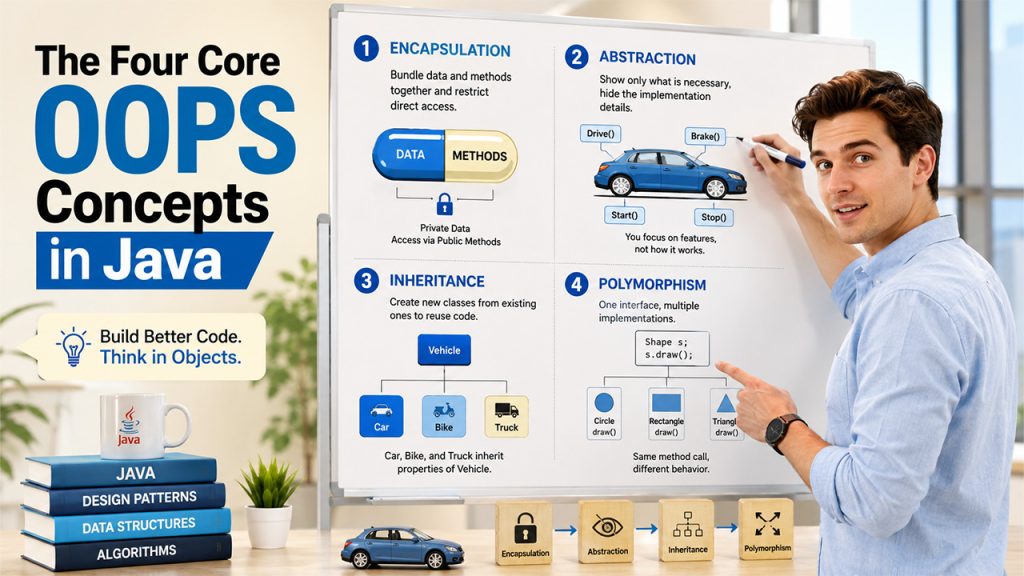
Once you are familiar with objects and classes, the next step is understanding the four pillars that make sure that object-oriented programming in Java is effective. Every pillar solves a distinct problem in design.
Encapsulation combines methods and data that work on it into a single unit, often a class, while limiting direct access to that data from outside. In Java, this is generally done by:
This secures integrity of data and makes code simpler to maintain, since changes inside a class affects the rest of the app.
Abstraction means showing only the key features of an object while making other implementation details hidden. A straightforward analogy is an ATM: users can easily interact with the help of a few screens and buttons without understanding the internal operations of the machine.
In Java, you can implement abstraction through:
Inheritance enables one class to get the methods and properties of another through the extends keyword, showing an is-a relationship. It minimizes repeated code and provides more effective organization across such related classes. Java supports distinct types, which are as follows:
Polymorphism means different forms, where the similar method behaves in a different way depending on the object calling it. Java executes this through:
Together, such four pillars create the backbone of robust and effective Java application. If you are preparing for the interview, it is also helpful to know how a Java runtime environment actually executes your compiled code.

Understanding OOPS Concepts in Java is not just an exercise in academics; it impacts directly how scalable and maintainable your code becomes over time. A few possible benefits are:
Simultaneously, object-oriented coding has an initial learning curve, and small programs carry unnecessary structural overhead sometimes. Developers generally weigh such trade-offs as per the complexity and size of the project. Developing comfort with such concepts also combines well with consistent hands-on practice, whether through solving structured coding challenges or enhancing your skills by working on applied exercises on platforms providing coding practice.
OOPS Concepts in Java — objects, classes, encapsulation, inheritance, abstraction, and polymorphism create the foundation that most of the Java applications are then developed on. Once these ideas are understood well, reading as well as writing code becomes greatly more intuitive, since you begin recognizing how real-world entities map onto class structures. Irrespective of whether you are developing your own Java application or preparing for technical interviews, revisiting such core principles consistently along with regular coding practice, will boost both your fundamentals and your confidence as a specialized developer in Java.
此内容由惯性聚合(RSS阅读器)自动聚合整理,仅供阅读参考。 原文来自 — 版权归原作者所有。