






The development of AI and data science has transformed how we gain insights from data. In healthcare, AI tools are being used in the development of new treatments as researchers apply machine learning methods to datasets. However, applying AI in healthcare also brings risks, particularly when systems amplify existing biases in data or design.
In our fourth seminar in our current series on teaching about AI in the arts, humanities, and sciences, Kathy Jessen Eller (The Concord Consortium) introduced the Data Science, AI & You (DSAIY) programme, a high school curriculum that helps students critically evaluate the role of data and AI in healthcare.

Kathy began her seminar by arguing that for many students who use AI tools in their coursework, questions remain about whether they are critically evaluating the tools’ outputs. Students may or may not check an AI-generated answer against primary sources to see if the answer is accurate. There is also growing concern that students’ use of AI tools lets them offload cognitive work rather than engage in deeper thinking. This presents a challenge for educators: how do we help students use AI productively while still supporting them to develop the critical judgement needed to evaluate its outputs?
To tackle this challenge, Kathy and her colleagues have developed the Data Science, AI & You (DSAIY) programme (pronounced ‘Daisy’). DSAIY is a semester-long high school curriculum designed to introduce students to AI by actively engaging them in the machine learning process.
The programme introduces machine learning as the engine behind many AI tools, and introduces the concept of bias through real-world examples. Students use a variety of tools to collect and prepare data, train, test, and evaluate models. It culminates in an ‘AI-a-thon’ where young people work in cross-disciplinary teams alongside data scientists, clinicians, and their own teachers to gain real-world experience.
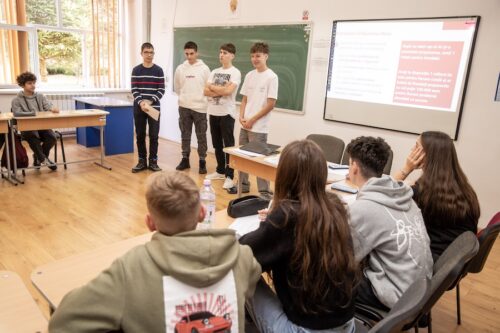
At the time of the seminar, 11 teachers had delivered the programme to over 800 students across a variety of settings in Rhode Island, USA. Teachers are heavily supported with four days of professional development and ongoing technical assistance throughout implementation. The students that took part had a wide variety of prior experience, including many with no prior background in computer science or statistics. Female participation is notably high; one teacher even remarked that the course saw more girls enrolled than any of his other computer science classes.
In DSAIY, students experience the full machine learning pipeline from data collection and data preparation, to modeling and deployment. Using Python, they train and test simple machine learning models on authentic healthcare data. The aim of the programme is to move students from basic graphing to evaluating complex models, transitioning them from merely plotting data to deeply reasoning about it.
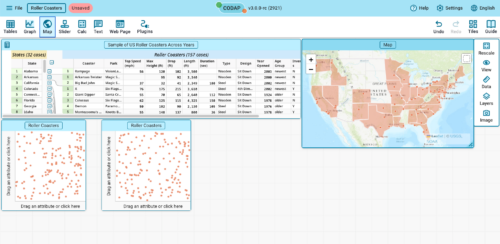
The programme makes use of CODAP (the Common Online Data Analysis Platform), a free, web-based tool developed by The Concord Consortium. CODAP provides an interactive, highly visual environment that lowers the barrier to entry. Students can visualise large datasets and click into individual data points, allowing them to see individual cases within a larger dataset.
The curriculum uses real-world examples from healthcare to introduce concepts of bias and fairness. For example, students learn about pulse oximeters, which estimate blood oxygen levels. However, as these use red and infrared light, readings can vary depending on skin pigmentation, which can lead to inaccurate readings.
Students also collect their own blood oxygen data and plot it using CODAP to observe variability. They consider the accuracy of their measurements and grapple with the ethics of removing outliers from a dataset. This led to students asking critical questions about the makeup of their datasets, the context in which data are collected, and the implications of how data are used in healthcare.
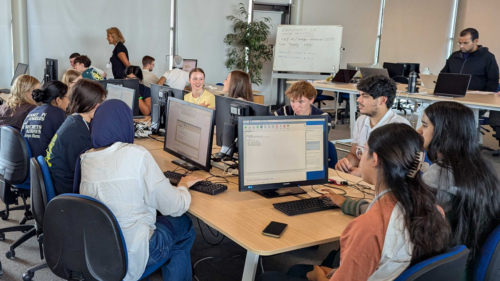
Through the DSAIY programme, Kathy reported that students developed stronger data reasoning skills, gained a deeper awareness of inherent AI biases and risks, and built confidence in public speaking and collaborating with others. Students were also highly engaged and appreciated the focus on real-world healthcare applications and their social implications.
Kathy concluded the seminar by arguing that AI literacy must start with data literacy. When students learn to examine, question, and reason about the data behind AI technologies, they develop the critical thinking skills needed to engage with outputs from real-world systems or everyday technologies like ChatGPT. This can then help them evaluate both the trustworthiness of these tools and their role in important decision-making processes.
You can watch the seminar here:
If you are interested in learning more about Kathy’s work, you can read about the DSAIY programme here or you can read the paper here. You can also learn about CODAP, the data visualisation tool featured in this seminar here.
In our current seminar series, we’re exploring how AI is taught across the curriculum. In our next seminar on Tuesday 14 July at 17:00–18:30 BST, we welcome Dan Verständig (Goethe University Frankfurt) who will explore the connection between Social explainable AI (Social XAI) and Critical Computational Literacy (CCL). To take part in the seminar, click the button below to register. We hope to see you there.
The schedule of our upcoming seminars is available online. You can catch up on past seminars on our blog and on the previous seminars and recordings page.
此内容由惯性聚合(RSS阅读器)自动聚合整理,仅供阅读参考。 原文来自 — 版权归原作者所有。