


Experience AI equips young people with a meaningful understanding of artificial intelligence (AI) and machine learning by giving educators the knowledge and confidence to teach these topics in ways that suit their classrooms.
Whether you’re introducing AI to learners for the first time, helping them deepen their understanding, exploring generative AI with them, or integrating AI literacy across the curriculum, Experience AI offers you all the resources you need for free.
Since we started publishing Experience AI resources in 2023, they have been downloaded over a million times in 195 countries, and we have worked with partner organisations in more than 40 countries to train educators to teach AI literacy. Thanks to partners, we have learned a lot about how teachers around the world use the resources in their classrooms, and this has given us direction for what new resources to develop.
Many teachers looking for AI literacy resources are not computing specialists and have very busy timetables. Under pressure to deliver more content without more instructional time, what educators need are resources they can integrate into what they already teach. To support them, we’re now offering an updated suite of Experience AI resources that make AI literacy more accessible, flexible, and relevant.
The resources include those co-developed by the Raspberry Pi Foundation and Google DeepMind, alongside those developed independently by the Raspberry Pi Foundation.
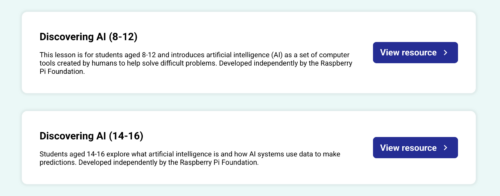
The new Discovering AI resources, aimed at learners aged 8–12 and learners aged 13–16, are single lessons for introducing the fundamental ideas behind AI. They support educators with learners who have little or no prior knowledge of AI, and include engaging, age-appropriate activities.
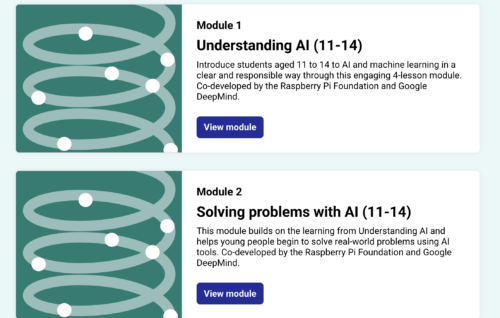
From there, our updated Foundations of AI units let teachers support their learners to develop a deeper understanding of how AI systems work, how they’re trained, and how they can be applied to real-world problems.
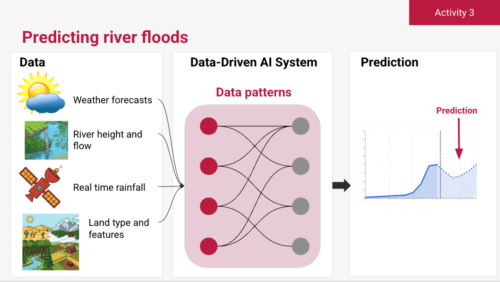
And a new and growing collection of thematic resources supports teachers and learners to explore AI through cross-subject topics such as creativity, the environment, and critical thinking.
Experience AI now fully reflects our belief that AI literacy needs to be cross-curricular. Application of AI technologies isn’t limited to neat domains or subjects, so learners’ opportunities to understand them shouldn’t be either.
Education systems vary significantly between countries, and in most national curricula, AI literacy is not yet clearly defined. Nevertheless, teachers are both under pressure to deliver this new topic area in their limited classroom time, and eager to rise to the challenge to support their learners.

So we asked ourselves: how can we help educators to teach AI literacy in any subject without additional lesson time, when we cannot create specific resources for every subject in every education system?
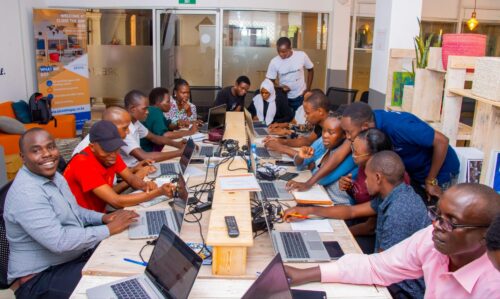
Our answer came from educators themselves. Through our network of global partners, we learned that teachers were not waiting for us to tell them in what subjects the Experience AI resources belonged. They were already adapting them to teach AI literacy in all sorts of contexts. For example, we saw that some educators adapted the resource on AI and ecosystems, which we had developed for Biology classrooms, for their Geography classrooms, where it supported similar learning goals.
This insight into teachers’ classroom practice prompted us to change our approach.
Now, rather than designing resources for a single subject, we design and organise them in themes that fit across subjects, such as environment, creativity, ethics, and critical thinking. So a resource for exploring the environmental impact of AI data centres could be used in Geography, Physics, Citizenship, or Business Studies classrooms. An activity about AI-generated media could prompt discussions in Digital Literacy, Art, or Computing lessons. The same material supports different curricular goals, depending on how teachers choose to use it.
A key advantage of this new thematic approach is flexibility. Our thematic resources support teachers to:
Like all Experience AI materials, the new resources:
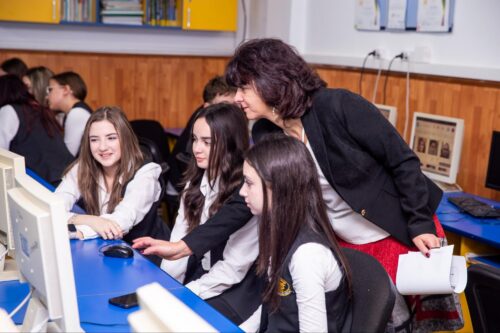
While Experience AI will continue to focus on core AI literacy concepts — how AI systems work, how they are used, and how to think critically about them — the resources we offer will increasingly be:
In this way, we aim to make teaching AI literacy practical and achievable for every educator, regardless of their subject specialism or previous experience of using or teaching about AI.
We’ve tested the new thematic resources with our Experience AI partner, Digital Moment in Canada, who also co-created our Social Media and Flood Forecasting units. Educators’s feedback shows that they value the added flexibility and find the new materials easier to bring into their teaching.
With our new approach, we’re able to offer a more flexible Experience AI programme that supports a wider range of educators, however they want to bring AI literacy into their classrooms.
If you use the resources in your classrooms, please tell us what you think. We’ll continue refining and expanding the Experience AI programme and resources in response to feedback from educators and partners around the world.
Get in touch and share your stories of using Experience AI in the classroom via our email: advocacy@experience-ai.org
此内容由惯性聚合(RSS阅读器)自动聚合整理,仅供阅读参考。 原文来自 — 版权归原作者所有。