


BloombergNEF published its new US data center capacity forecast on July 21, 2026, packed full of new analysis and insights about developers, timelines, regional market dynamics and on-site power considerations. Here are our key takeaways.
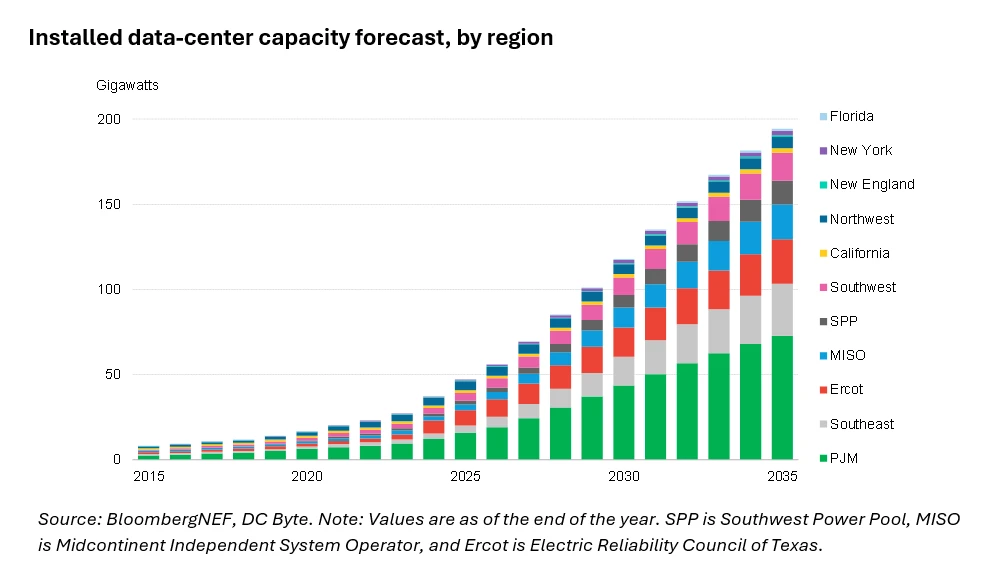
1. Our forecast has gone up again. BloombergNEF’s forecasted 2030 installed US data center capacity is now 118 gigawatts (GW), an upwards revision of 52% compared to our December 2025 forecast. We expect 194GW of data centers to be online in the US by 2035 – an 83% upward revision.
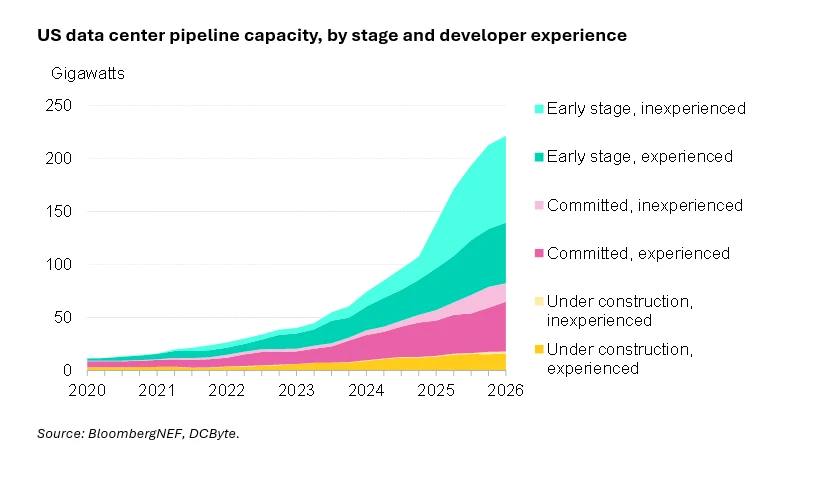
There are a number of reasons for the increase in BNEF’s forecast. The biggest is that the announced data center pipeline in the US has grown by a further 101GW since December 2025, pushing up the amount of capacity likely to come online by 2030.
Most public forecasts of US data center capacity have also been revised up in the past year, underlining the level of uncertainty around how much capacity will get built, and how many of the data centers being commissioned and built in the US are now ‘gigascale’.
2. We’ve integrated an AI chip scenario for the first time. To provide an upper bound on how much the pipeline could grow, BNEF has produced a second scenario based on Bloomberg Intelligence’s AI chip sales outlook (Terminal clients can access this here). BNEF’s AI chip scenario indicates there could be as much as 325GW of data center power capacity added globally between 2023-2033, if there were no other constraints. Of this, BNEF expects 207GW to go to the US.
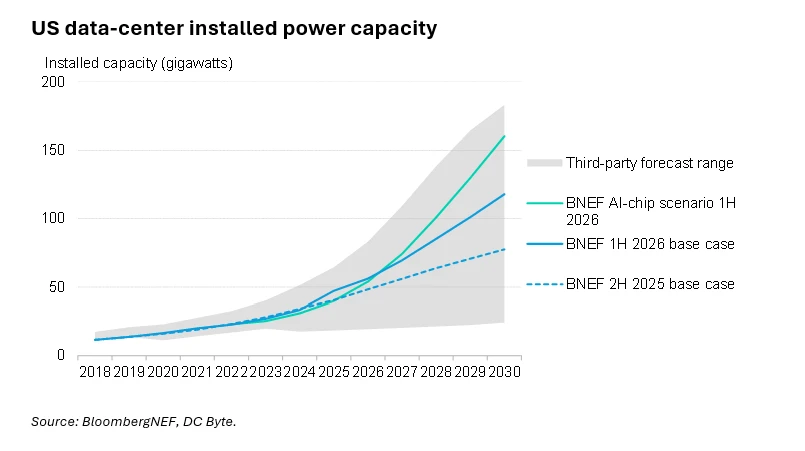
This means there is a 63GW gap in capacity between what AI chip shipments imply should get built in the US by 2033, and what BNEF’s data center forecast says will actually get built, due to energy constraints. The real shortfall is larger, as the AI-chip scenario only models demand from AI servers. There are a few factors that could close this gap:
- Chips are replaced more rapidly, to make way for newer, more efficient hardware
- A greater share of chips is deployed outside the US
- Fewer chips than currently modelled end up being purchased
- Data centers and power capacity are developed at unprecedented rates to make room for all these chips.
3. We have split out developer type in the forecast for the first time, an increasingly important differentiation. Hyperscaler capacity triples over the next decade in our outlook, but non-hyperscaler capacity nearly quintuples, driven by an increasing number of giga-campuses. While hyperscalers – specifically Microsoft, Meta, Alphabet and Amazon Web Services – have faster development timelines, most new capacity added to our project pipeline is actually non-hyperscalers. By 2035, hyperscaler capacity reaches 57GW, compared with 138GW for non-hyperscalers. Separating the types of developers is increasingly important as a wave of first-time data center owners enters the market.
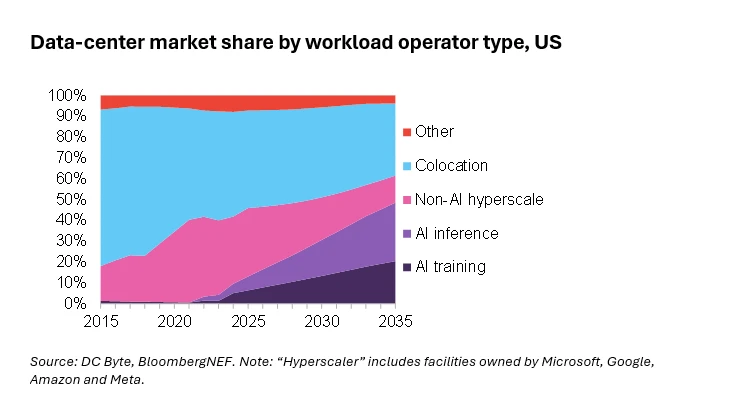
Data center market share by workload and operator type matters for both siting strategy and energy consumption, as different workloads have different utilization profiles. BNEF expects AI training and inference to account for more than half of total US data center capacity, followed by colocation.
4. We recognize there is a new developer risk at the giga-scale campus level. This time around BNEF dug into the details of the largest 150 projects announced in the US to understand the nuance of developer type, and regional considerations. We found that 52 of the largest 100 projects in the US are announced by companies that have never built one before, accounting for 87GW. This may not lead to cancellations but it increases execution risk. Even developers with experience are likely to face new challenges. For the 100 largest projects, the median developer scaling factor – the ratio between a given project and the largest project previously delivered by its developer – rose from 2.1 in 1Q 2015 to 8.7 in 4Q 2025.
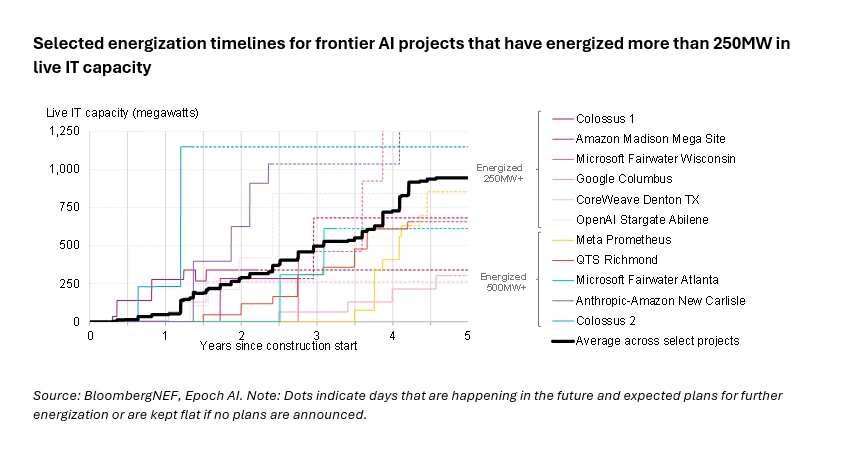
5. Development timelines are shortening and this impacts our forecast. Development timeline is defined as the preconstruction and construction phases. A gap is becoming increasingly obvious between the development timeline for hyperscalers vs non-hyperscalers. Hyperscalers are now taking 5.3 years for development, compared to non-hyperscalers taking 8.4 years. The gap is most stark in the preconstruction phase (3 years versus 5.7 years), implying that operator type matters most before a project breaks ground, while, historically, execution risk narrows once construction begins. Although BNEF is monitoring key markets such as West Texas where execution risk may be rising.
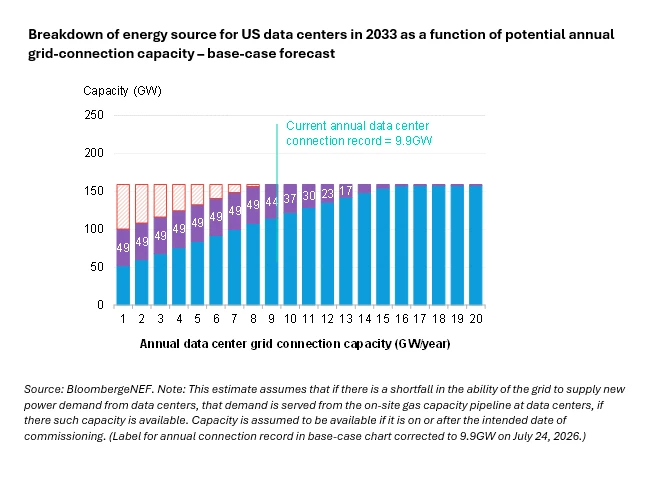
6. On-site gas generation must play a significant role if BNEF’s US data center forecast is to be met. While there is 124GW of announced on-site gas plant capacity being built for data centers, we have only mapped 56% of this to a target commissioning date. The most new data center demand that the US power grid has connected in one year is estimated by BNEF as 10GW. If this rate does not accelerate, 48GW of on-site gas needs to be built by 2035 to meet BNEF’s base-case data center forecast.
BNEF does not believe there is enough credible on-site gas capacity announced to meet the AI-chip scenario without a significant increase in the grid’s ability to connect new data centers. There are however 50GW of speculative on-site gas projects announced with no associated timeline, providing some extra head room for the AI-chip scenario to be met by data center build.
Related Content
The latest from BloombergNEF delivered to your inbox
Sign up for BNEF’s free newsletter.