










KEY TAKEAWAYS
- Despite numerous tariffs targeting energy transition sectors and other global markets, US policy failed to stifle overall trade in products central to the energy transition.
- Persistent overcapacity, fueled by Chinese overinvestment, continues to compress margins for clean-tech manufacturers across batteries, solar and electric vehicles.
- Conflict in the Middle East has underscored the fragility of conventional fossil-fuel supply chains, and will likely accelerate the transition to lower-carbon technologies.
LONDON, May 27, 2026 – Global shipments of clean-energy products reached $479 billion in 2025, an annual rise of 1% across clean-tech, battery metals, and grid equipment. This increase represents an overall rebound in trading volumes, which slipped 7% from 2023 to 2024. BloombergNEF’s Energy Transition Supply Chains 2026 report, released today, finds that cross-border clean-tech trade went up in 2025, despite the US reinstating and revising numerous tariffs across energy transition sectors.
Global supply chains have become an increasingly important focus for the energy industry in recent years, as volatile trade policies and geopolitical conflicts have come to the fore. As investors seek to reduce risk and shield themselves from market volatility, the fragility of conventional fossil-fuel supply chains could accelerate the shift toward lower-carbon technologies and drive greater international trade in clean-energy goods like solar cells and modules, batteries, and electric vehicles.
The Iran conflict has driven global fossil-fuel prices sharply higher, hitting Asian and African countries – which tend to be major net importers of oil and gas – hardest. Elevated prices will likely boost clean-tech imports in emerging economies the world over. Historical BNEF data suggests countries more dependent on fuel imports have tended to see stronger growth in imports of solar equipment, batteries and EVs. Pakistan stands out: In 2022, solar module imports jumped 189% to $1 billion, partly driven by the global fuel-price shock following Russia’s invasion of Ukraine. Small-scale solar installs in the country reached a record 18.3GW in 2025 after years of steady growth, fueled by high electricity tariffs linked to costly liquefied natural gas imports, as well as persistent power outages and load-shedding. Though it is still too early to assess the war’s effect on clean-tech demand, the world is already experiencing a jump in Chinese exports of key energy transition products.
“As conflict in the Middle East persists, many markets are doubling down on the deployment of clean technology to improve their energy security and resilience,” said Antoine Vagneur-Jones, head of trade and supply chains at BNEF and lead author of the report. “This presents a huge opportunity for manufacturers to expand exports of the equipment and products required to power the energy transition.”
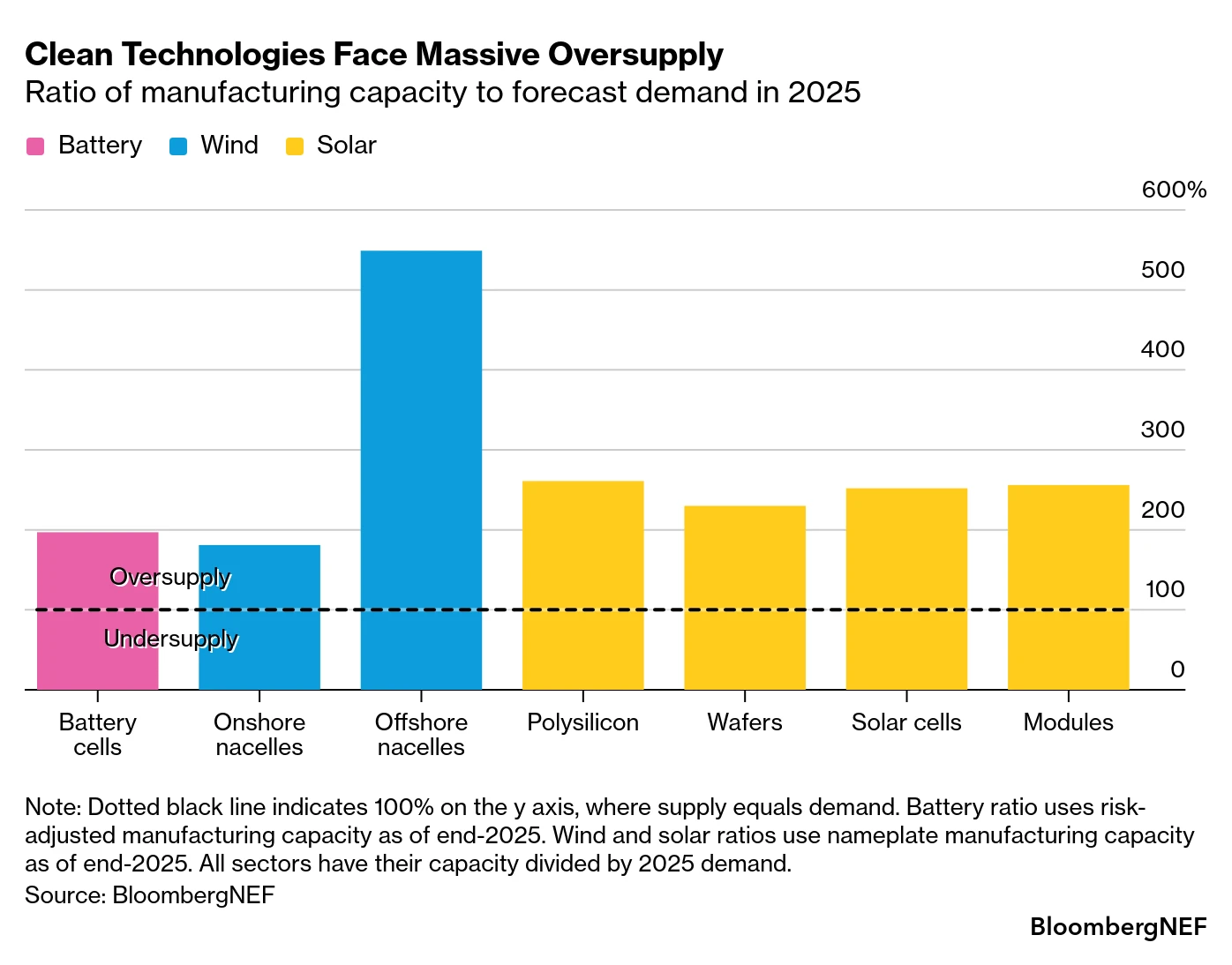
Overcapacity remains a critical feature of global supply chains, mainly fueled by Chinese overinvestment, and continues to compress margins for key clean-tech products. This extends across clean-tech sectors, with the world hosting more than 200% of manufacturing capacity needed to meet global demand across the entire value chain. Wind and battery markets are also notably oversupplied. Expanding capacity outside of China is now compounding a global supply glut. Markets like Southeast Asia, India, and Turkey, for example, are all growing solar manufacturing hubs along with budding economies like Egypt and Ethiopia.
One of the key aspects of the report is an analysis of efforts to onshore manufacturing. Despite the introduction of numerous policy frameworks across Western nations, there is little chance of the US and the EU competing on the global stage as exporters. Factory capacity in both markets has increased, but expansions have been concentrated downstream, and many previously announced projects now face delays or cancellations due to slow demand, shifting policies, and intensifying competition.
Even though overcapacity persists, clean-energy equipment prices are not declining as rapidly as in recent years. Solar prices continued to drop in 2025, though the rate of decline slowed, mainly due to rising prices of silver. Battery pack prices fell from $118 per kilowatt-hour in 2024 to $108/kWh, although here, too, prices fell more slowly than in the past, largely due to elevated battery-metal prices. Onshore wind equipment prices even rose slightly as turbine makers hoped to make up for previous losses.
Other key findings from BloombergNEF’s Energy Transition Supply Chains 2026 include:
- Global solar trade is now more oriented toward midstream solar cells than downstream photovoltaic modules, reflecting the rapid expansion and diversification of final module assembly outside China. Solar cells made up 44% of global cell and module trade in 2025, up from 25% the year prior. Overall solar shipments fell ahead of 2026, a year when BNEF had projected solar deployment to decline.
- India’s solar manufacturing push has been successful with downstream overcapacity and midstream investment positioning it as a potential exporting giant, competing directly with China. Turkey has also emerged as a potential rival exporter.
- Most internationally traded lithium-ion batteries are bound for use in electric vehicles, but the share of batteries serving stationary energy storage systems is rising as installations grow worldwide. Energy storage systems made up 29% of overall battery shipments within the segment, growing 64% year-on-year.
- Economies exposed to high fossil-fuel prices (like Southeast Asian markets Cambodia, Laos, and Vietnam), may be primed to ramp imports quickly. These nations are also employing policies to accelerate clean-tech uptake, to combat rising gasoline, diesel, and other fuel costs.
BloombergNEF clients can find the full report and full data viewer on bnef.com and the Bloomberg Terminal.
Media Contact
About BloombergNEF
BloombergNEF (BNEF) is a strategic research provider covering global commodity markets and the disruptive technologies driving the transition to a low-carbon economy. Our expert coverage assesses pathways for the power, transport, industry, buildings and agriculture sectors to adapt to the energy transition. We help commodity trading, corporate strategy, finance and policy professionals navigate change and generate opportunities.
About Bloomberg
Bloomberg is a global leader in business and financial information, delivering trusted data, news, and insights that bring transparency, efficiency, and fairness to markets. The company helps connect influential communities across the global financial ecosystem via reliable technology solutions that enable our customers to make more informed decisions and foster better collaboration. For more information, visit Bloomberg.com/company or request a demo.
Related Content
The latest from BloombergNEF delivered to your inbox
Sign up for BNEF’s free newsletter.