





September 16, 2026
By BNEF Summit Team
India is one of the world’s fastest-growing major energy markets, one of the largest importers of oil and gas, and an increasingly important hub for clean energy manufacturing. These realities ran through the discussions at the BNEF Summit New Delhi 2026. After a year in which the Strait of Hormuz shock pushed oil prices up 30% and the rupee down 7%, conversations centered around what the world’s most populous country needs to build next to strengthen “energy security”, and who pays for it? Six themes emerged from the discussions.
1. Energy security now means more than barrels, but it also requires more barrels
India has spent an average of more than $10 billion a month on crude oil imports every year since 2023. Girish Tanti, co-founder of Suzlon Group summed up the situation bluntly: “We still depend about 75% on imports for our oil and 50% on our gas…”. The fix for that vulnerability, he said, is stronger reserves and inventories, not just good relationships with suppliers.
Girish Tanti, Co-founder, Suzlon Group
This thinking already shows up in policy. The government is building reserves, expanding refining, diversifying import sources and reviving domestic production. India is the world’s fourth-largest refining hub, and this capacity is set to expand to around 290 million metric tons by end of 2027. The same security logic is driving indigenized clean-tech supply chains and gigawatt-hours of battery storage.
India’s limited oil storage capacity is pushing companies to secure supply a different way. ONGC’s Executive Director, Bijay Rajeeve, made a similar point during one of the deep-dive sessions: “We don’t have so much storage anywhere…So we have to buy equity oil outside.” Security now means owning a stake in supply, not just stockpiling it.
2. Renewables have quietly become a security story, not just a climate one
India’s Secretary for New and Renewable Energy, Santosh Kumar Sarangi, IAS, underlined the shift: “Renewables will become a critical component of India’s energy security in future.”
Santosh Kumar Sarangi, IAS, Secretary, Ministry of New & Renewable Energy, Government of India
The logic is straightforward. The more reliably renewables and storage can keep the grid firm around the clock, the less India needs to lean on imported gas or diesel to do that job. The proof that this is now commercially viable, not just theoretically possible, is already showing up in auction results. A recent SECI tender for round-the-clock power supply – with “90% assured power availability during the peak six hours” – cleared at “about 5 rupees 25 paise” (5.5 US cents), which is among the lowest firm-power tariffs discovered in the country.
Tata Power‘s Chief Executive Officer and Managing Director, Praveer Sinha made a similar point. If you bundle solar, wind, battery storage and pumped hydro into firm power: “I will give you power at 5 rupees or 6 rupees, 25 years, no questions asked…” As storage costs fall and renewable fleets scale, the debate is shifting from whether clean power can be reliable to how quickly it can be deployed.
3. Smarter capital deployment, not capital volume, is the real constraint
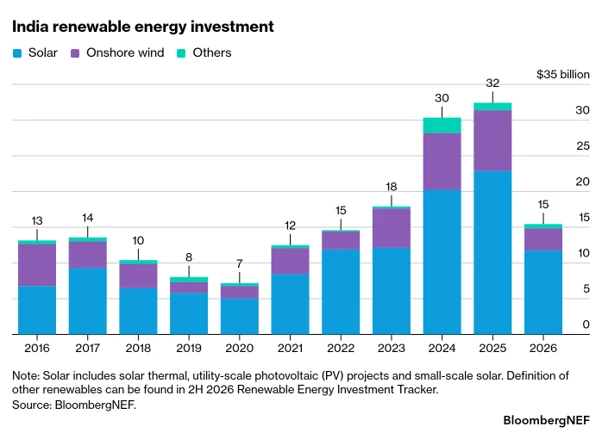
India’s clean-energy investment needs are massive. BloombergNEF’s Energy Transition Scenario (ETS), which models a transition led by market forces rather than policy, shows solar and wind will take in investment of $150 billion (real 2025) by 2030. Meeting that scale isn’t just about injecting more capital, but deploying smarter de-risking structures.
Highlighting the urgency, HSBC‘s Managing Director & Head of Banking, Ajay Sharma, said: “Capital, banks of all shapes and forms… we need to figure out how to tap every possible dollar, rupee, yen that’s available out there… the risks are very different from traditional project financing. So should there be a different way of looking at how we allocate risk capital as banks and financial institutions.”
Ajay Sharma, Managing Director & Head of Banking, HSBC India
The right de-risking framework can be transformative across the transition. Aanchal Jain, chief executive officer at PMI Electro Mobility Solutions, noted that once the government backed e-bus tenders with a payment guarantee, financing cycles fell from six months to just over one month.
4. Nuclear stops being aspirational and starts facing commercial discipline
Nuclear is the newest entrant to that same security push. India is aiming for 100 gigawatts by 2047 from under 9GW today. What makes that even plausible is the Shanti Act, the law approved by both houses of India’s parliament in 2025, that opens the country’s nuclear sector to private and foreign participation for the first time. Developers, including Adani and Jindal Steel, are now selecting their own sites and raising their own capital, building standardized 700-megawatt reactors across multiple locations. Reactor development was primarily led, financed and coordinated by the government earlier.
Jindal Steel‘s President & Head of Sustainability and Decarbonization, Naveen Ahlawat, whose company is targeting 18GW of power for its own steel operations, put the real test in blunt commercial terms: “The five rupees 25 paise that SECI has just come out with, and 6 rupees for a thermal power plant… the levelized cost of energy, I have to compete with them.”
The other test is speed. India’s reactors have historically taken 10 to 12 years to be built, about double the time that China’s takes. Developers are betting the new fleet model can close that gap.
5. Data centers are becoming an energy-security opportunity
BloombergNEF expects data center power demand in India to rise ninefold over the next decade, but this may be the wrong thing to worry about. The real constraint is infrastructure, and data centers can anchor new investment in generation and transmission that benefits the rest of the grid too, developers said.
Google‘s Commercial Head, APAC Clean Energy and Power, Srinath Iyer said that when a hyperscaler signs long-term contracts for clean power at scale, it helps anchor renewable capacity that might not otherwise get built. “We should not confuse cost or cheap with value… the value that we can bring by enabling all of this to the Indian grid is in terms of energy security, diversification of the supply mix, and potentially balance of payment benefits,” he said.
The bottleneck flagged repeatedly on the panel wasn’t generation, but transmission. Schneider Electric‘s Executive Vice President, Manish Pant, highlighted India’s growth needs. “Today in India, we consume 1,500 kilowatt hours per capita. The average of the world is 3,000. We got to go there. Data center, no data center. I think we need it for the quality of life of our people,” he said.
Manish Pant, Executive Vice President, Schneider Electric
6. Energy security is pulling oil and gas into the same conversation as clean energy
Oil and gas were framed as partners in the security story at the summit, not competitors. ONGC‘s Executive Director, Bijay Rajeev, reframed what India optimizes for. It isn’t price alone, he said, but “availability, affordability, adaptability, and autonomy.”
Reliance‘s Senior Vice President & Head of Gas, Amit Mehta, pointed to the two systems already working side by side rather than competing, arguing that “gas plus renewable power in data centers could be a good solution” for new demand.
TotalEnergies‘ India Country Chair, Sangkaran Ratnam, pointed to the 30% stake that ONGC, Bharat Petroleum and Oil India hold jointly in Mozambique LNG as evidence of the country’s broader effort to diversify its energy sources, calling it “a landmark moment where India has gone from just a procurement exercise to a strategic national purchasing option.”
To dive deeper into these themes and more, watch a selection of videos from the BNEF Summit New Delhi. The annual summit brought together almost 500 stakeholders in-person and remotely, including energy, industry, transport and technology companies as well as investors, financiers and policymakers. The next BNEF Summits will take place in London on Oct. 19-20, Houston on Nov. 11 and Shanghai on Dec. 1-2.
Sign up for BNEF’s free newsletter.
此内容由惯性聚合(RSS阅读器)自动聚合整理,仅供阅读参考。 原文来自 — 版权归原作者所有。