










KEY TAKEAWAYS
- BloombergNEF’s New Energy Outlook 2026: Japan finds that despite Japan’s declining population, electricity demand begins to recover, driven by the rise of data centers and electrification of the transport sector.
- An accelerated energy transition boosts Japan’s energy security, while increased electrification reduces exposure to imported fossil fuels and global commodity-price shocks.
Tokyo, September 16, 2026 – Japan is a resource-poor industrial country heavily dependent on imported energy, secured through long-term contracts and investments in energy projects overseas. BloombergNEF’s (BNEF) latest report, New Energy Outlook 2026: Japan, examines how the country can navigate the interconnected challenges of energy security, economic competitiveness and climate mitigation.
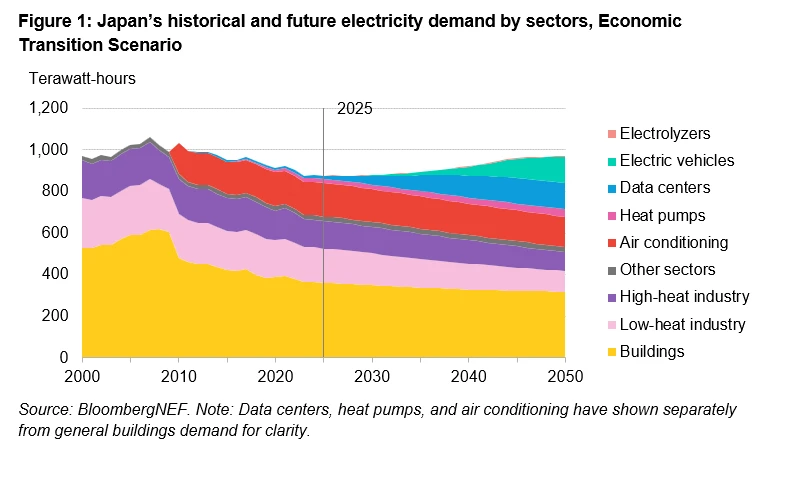
While electricity demand in Japan has been stagnant for years, that era is ending, due to the growth in demand for data centers and electrified transport. BNEF expects data center electricity demand to increase by 60TWh from 2025 levels by 2035 and exceed 100TWh of net demand by 2043. In the longer term electric vehicles will become the bigger incremental source of demand, using an additional 42TWh/year of electricity by 2040 and becoming the largest source of new demand by 2048, reaching 112TWh. Increased electrification reduces Japan’s exposure to imported fossil fuels and global price shocks for commodities like oil, gas and coal.
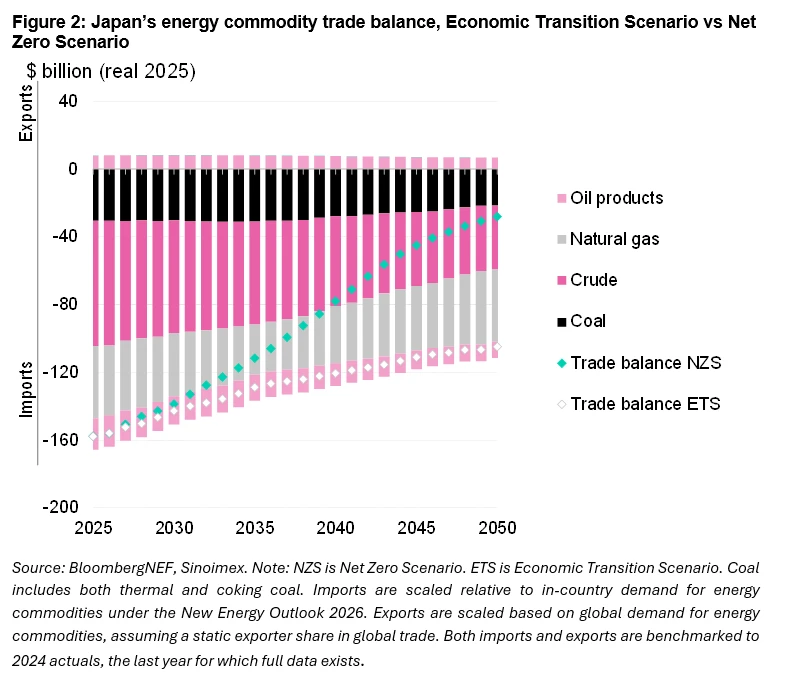
In BNEF’s Economic Transition Scenario (ETS), which maps out a base case for how the energy system could evolve by 2050, Japan’s energy independence improves significantly, with energy imports falling from 4% of the country’s GDP today to 2.7% by 2035 and 1.6% by 2050. This change is driven primarily by lower fossil-fuel consumption as sectors like road transport increasingly electrify. At the same time, Japan is trying to build domestic clean tech supply chains, focused on offshore wind and batteries, which can be deployed to improve the country’s overall energy resilience.
Umer Sadiq, Japan Analyst at BloombergNEF and lead author of the report, said: “Japan’s energy transition is entering a fundamentally different phase. After decades of stagnant or declining electricity demand, data centers, electrification of transport and industry are putting growth back on the agenda. On the other side, many of the technologies needed to cut emissions can also help unlock this growth opportunity, strengthening Japan’s energy security and reduce exposure to imported fossil fuels.”
Taishin Noble, Japan Analyst at BloombergNEF, and co-author of the report said: “Japan’s transport transition accelerates even in our base case as electric vehicles become more competitive. By 2050, oil use in transport falls by almost half. This has implications well beyond emissions, reducing dependence on imported oil and making transport an increasingly important part of Japan’s wider energy-security story.”
As electrification in Japan accelerates, investment in the country’s power grid will also expand due to needs from generation, storage and demand-side assets. This is further amplified as this adoption becomes more geographically dispersed. Japan’s grid requires $389 billion in investment between 2026 and 2050 in the Economic Transition Scenario, split nearly evenly between transmission and distribution lines. Over this period, 53% of spending will go to current grid asset replacement while 14% and 33% will go to new connections and system reinforcements, respectively.
Kokona Ota, Japan Clean Power Analyst at BloombergNEF, and co-author of the report said: “Even in our base case, Japan’s power system changes significantly. Renewable capacity continues to grow and reaches 68% of national installed capacity by 2050, batteries expand more than sixfold, and the grid requires accelerated investment through 2050 as electrification and more distributed generation reshape the system. The key challenge is not just adding new generations, but building the networks and flexibility needed to integrate it reliably.”
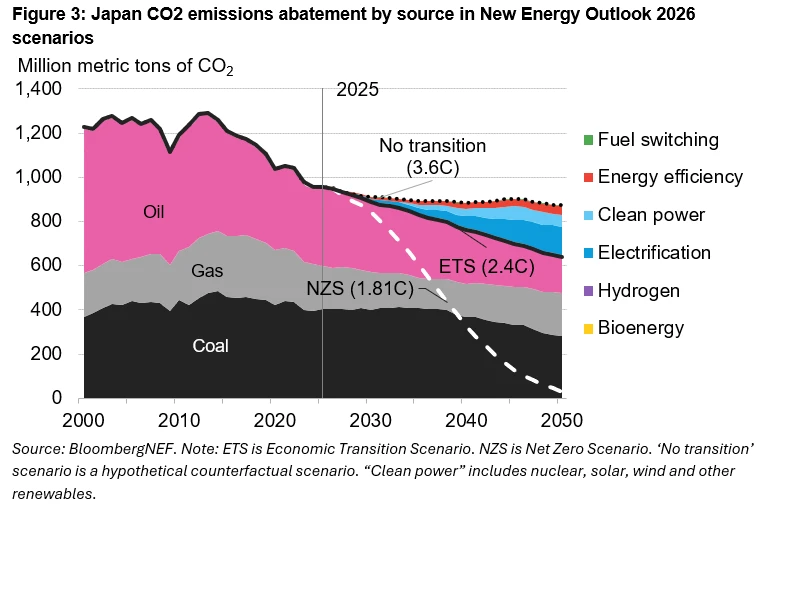
Japan aims to reduce its greenhouse gas emissions by 73% by 2040, compared to 2013 levels, based on its Nationally Determined Contribution (NDC) submitted to the United Nations Framework Convention on Climate Change (UNFCCC). BNEF’s analysis finds that an economically driven decarbonization would miss the target, with the country only reducing its emissions by around 30% from 2013 levels by 2030. To reach Japan’s 2040 targets, faster deployment of low-carbon technologies in the power and heavy industry sectors is critical.
Other key findings from the report include:
- Japan liquefied natural gas contracted data shows that country’s current contract volume until 2035 comes from a smaller number of other markets than in the past, with the US increasing in importance as a trade partner. This change reflects the broader US-Japan economic relationship, with Japanese companies seeking greater access to the US market.
- Gas demand rises from 2035 after sustained decline, as gas power plants replace retiring coal and nuclear plants in the ETS. By 2050, gas demand reaches 99 billion cubic meters, driven mainly by the power sector.
- Power demand from data centers accelerates in the 2030s as AI adoption expands, especially for corporate demand and in large scale industrial applications.
Get the executive summary
The report will be sent to your email after completing the form.
Would you like to be contacted by a representative to learn more about BloombergNEF's solutions and services?
Which industry best describes your organization?
How would research and data on energy, commodities, and emerging technologies support your work?
Stay informed
Yes, subscribe me to receive the BNEF Month in Review, our monthly newsletter.
By submitting this information, I agree to the privacy policy and to learn more about products and services from Bloomberg.
Media contact
Oktavia Catsaros
BloombergNEF
ocatsaros@bloomberg.net
About BloombergNEF
BloombergNEF (BNEF) is a strategic research provider covering global commodity markets and the disruptive technologies driving the transition to a low-carbon economy. Our expert coverage assesses pathways for the power, transport, industry, buildings and agriculture sectors to adapt to the energy transition. We help commodity trading, corporate strategy, finance and policy professionals navigate change and generate opportunities.
About Bloomberg
Bloomberg is a global leader in business and financial information, delivering trusted data, news, and insights that bring transparency, efficiency, and fairness to markets. The company helps connect influential communities across the global financial ecosystem via reliable technology solutions that enable our customers to make more informed decisions and foster better collaboration. For more information, visit Bloomberg.com/company or request a demo.
The latest from BloombergNEF delivered to your inbox
Sign up for BNEF’s free newsletter.
Related content