


BofA says it has enabled the construction of over 5 gigawatts of data center projects globally over the last 18 months. It is positioning itself to be a one-stop shop for “integrated financing solutions across sustainable, digital and core infrastructure sectors.” Fang, a member of the bank’s Management Committee, also co-heads the Global Capital Solutions business set up last fall. “For hyperscalers and developers, our team serves as a central point of coordination, bringing together expertise from across the firm to structure tailored capital solutions,” she said.
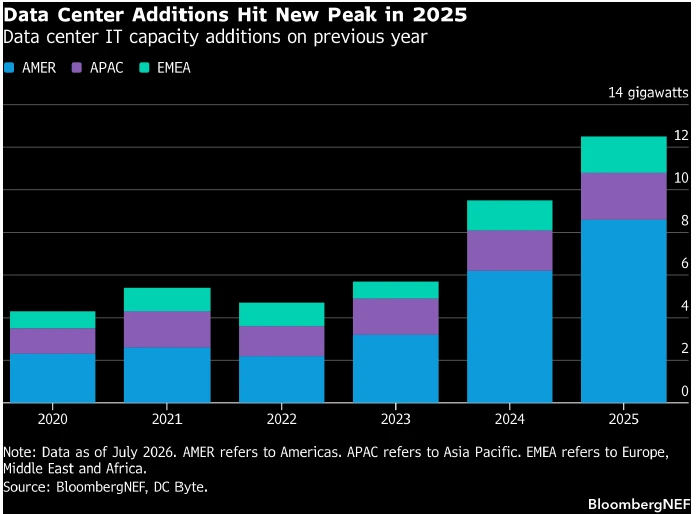
Data center additions have soared since the advent of ChatGPT and agentic AI, with activity concentrated in the US. The total power drawn by compute equipment at data centers globally crossed 60 gigawatts at the end of 2025, with over 12 gigawatts of demand added over the year, according to the latest BNEF update. Power grids are struggling as a result, and rising power bills have angered consumers. The most recent pushback against data centers came from the state of New York, which announced a one-year moratorium on hyperscale facilities. The total power use by US data centers is expected to more than double by 2030, reaching 118 gigawatts in BNEF’s base case.
A: Capital availability is not the limiting factor.
Investor demand for high-quality digital and energy infrastructure projects remains strong, particularly where experienced developers and creditworthy off takers are involved.
Trillions of dollars are already deployed across US Treasuries, municipal bonds, and investment-grade and high-yield credit markets. We are also seeing an increasing number of data center projects successfully accessing these capital pools beyond traditional bank construction loans. As the asset class matures, the breadth and sophistication of available financing solutions continue to expand.
The primary constraints are now real-world execution challenges. While capital remains abundant, the pace of growth will be determined by the availability of power infrastructure, skilled labor, equipment and supply chains.
A: Projects are not being overbuilt yet. As demand for computational power continues to accelerate, development is being naturally constrained by several critical factors, including power availability, memory and chip supply, skilled labor shortages, transmission and interconnection capacity, cooling requirements, water infrastructure, and community support. Industry data indicates that only a limited portion of announced projects advance to the construction stage, underscoring the practical challenges of delivering large-scale infrastructure at speed.
Rather than viewing the supply-demand gap as a negative, it should be recognized as an opportunity to prioritize high-quality projects, allocate capital more efficiently, and focus on infrastructure that can be delivered reliably and sustainably.
From a sustainable infrastructure financing perspective, AI also presents a meaningful opportunity to improve energy system efficiency. AI workloads can be dynamically aligned with renewable energy generation, helping balance supply and demand while reducing renewable curtailment. For example, AI training tasks can be shifted to regions experiencing surplus renewable generation and scaled back in areas facing power constraints.
As such, investment and development decisions will increasingly focus on those platforms and technologies that deliver higher computational output with lower energy consumption, positioning assets for stronger long-term competitiveness.
A: Some jurisdictions may lean more heavily on regulatory approaches, while the US has historically favored incentive-based, market-driven policies to encourage investment and innovation.
That said, as decisions are made around future data center development, three critical areas need to be addressed: energy consumption, operational efficiency and long-term community impact. These facilities are long-lived infrastructure assets, often operating for more than 30 years, meaning today’s siting, design, and energy choices will shape costs, reliability, and stakeholder perceptions for decades.
At the same time, rapid advances in chip design, computing architecture, and power and cooling technologies are significantly increasing the amount of compute delivered per unit of energy consumed.
Over time, improved efficiency could reduce the need for additional power generation capacity, lower operating costs, and help address community concerns about the energy footprint of large-scale data center projects.
A: This deal originated last July, and we executed in April, so it was roughly a nine-month process. Related Digital, a subsidiary of Related Companies focused on developing data centers and digital infrastructure, secured Oracle as the anchor tenant at its Michigan site and worked with the local utility DTE, to tap into excess power. That was a huge differentiator because it meant no new generation was required, only incremental battery storage and substation connectivity was needed.
The key question for the Michigan transaction was how to most efficiently raise $14 billion of debt. With Related Digital and Blackstone funds serving as equity partners, the sponsor initially favored a syndicated construction loan approach due to its established track record in large-scale infrastructure. We assembled a bank syndicate, but given the significant size of the financing, some lenders expressed concerns about capacity.
That led us to a critical decision: continue pursuing the traditional bank construction market or explore a different path. In early January, we pivoted to bond discussions with Pimco [Pacific Investment Management Co.], with the view that this could be structured as long-term debt from the outset, eliminating the need for a3-year construction loan followed by a separate refinancing post construction.
The result was an innovative 19-year term financing structure with callability starting in year three. The fixed coupon investment provided investors with an attractive risk premium relative to the standard hyperscaler credit instruments while preserving the sponsors’ flexibility to refinance should that become feasible.
Beyond the financing aspect, the project stood out for its infrastructure and sustainability characteristics. The site benefited from existing excess grid capacity, eliminating the need for new power generation and enabling a faster path to development. Battery storage, closed-loop cooling technology, and proactive community engagement further strengthened the project’s long-term sustainability profile.
In hindsight, the decision to pivot proved to be the right choice.
A: The Michigan transaction is one of the largest transactions we have led as sole structuring agent. We have participated in other transactions as part of the lending and advisory group but being able to drive this project from start to finish was a particularly important milestone for us.
A: We are very active in financing across the entire AI infrastructure ecosystem, including data centers, power, chips and equipment for hyperscalers, developers, infrastructure investors, utilities and power providers. It comes down to developing innovative financing solutions to support the next generation of digital infrastructure. In addition to traditional balance sheet construction loans, we are increasingly utilizing project bonds, equipment and inventory leasing structures, and securitized products to respond to the scale and evolving needs of this ecosystem. Successful execution depends on close collaboration across banking, capital markets and project finance teams. By integrating expertise across these disciplines, we can deliver tailored, scalable financing solutions and respond quickly to changing market conditions and client needs.
A: Yes. We extended a bridge loan, which has since been fully repaid. We retain limited exposure related to the debt interest reserve, which is typical for banks involved in the structuring.
A: Activity levels have increased materially, with inbound interest on chips and equipment financing exceeding data center shell financings. The scale of AI capex is unprecedented and AI adoption rates continue to surprise to the upside with a documented shortage of compute capacity. The top four US hyperscalers have guided capex to $700+ billion for 2026 which is an approximately 75% increase from 2025 and estimates continue to revise upward with each quarter. For chips, BofA Research estimates that the total addressable market for AI accelerators (GPUs and AI specific ASICs, or Application-Specific Integrated Circuits) will be $1.1 trillion in 2030 from $200 billion of sales in 2025 and an estimated $380 billion sales this year. Our commitments have grown alongside that demand, reflecting the scale of investment required to support the AI and digital infrastructure buildout. At the same time, we remain disciplined in our approach – focused on capital recycling and velocity and managing exposures within our risk appetite while preserving significant capacity to support future growth.
We positioned to be selective and are prioritizing partnerships with world-class sponsors and developers. When you drill down, hyperscalers and AI customers are focused on the same fundamentals as we are: certainty of delivery, strong execution capabilities, minimizing construction risk, permitting readiness and reliable access to power. Success increasingly depends on bringing all of those elements together to ensure projects can be delivered on time and at scale.
A: Last fall, the firm asked me to take on an additional role to co-run the Global Capital Solutions business, while continuing to drive our progress in global infrastructure and sustainable finance. This evolution strengthens our ability to provide integrated financing solutions across sustainable, digital, and core infrastructure sectors, spanning the full capital structure and both public and private markets for our strategic clients.
For hyperscalers and developers, our team serves as a central point of coordination, bringing together expertise from across the firm to structure tailored capital solutions. This platform enables us to offer clients amore holistic perspective and a broader range of capabilities to address increasingly complex infrastructure needs.
A: A major difference is speed and scale. The financing is often done across the three categories – energy and power, the data center shell, and the chips plus equipment – so we need to be proficient in all three. There are also important tax and accounting considerations.
A: Our global deal pipeline remains robust across all three segments. A substantial portion of current activity is focused on data center construction, and energy and power financing supporting that development; however, financing demand related to chip deployments has increased significantly recently.
A: It depends on the context. When viewed against AI’s long-term potential to drive productivity gains, improve efficiency, and accelerate breakthroughs in areas such as healthcare, scientific research, and education, I do not see it as a bubble. We are still in the early stages of development and adoption, and many would argue that the full implications and applications of AI have yet to be realized. It’s also important to note that there are major differences than precedent bubbles such as the dot-com boom and bust.
Specifically, we are starting from a very healthy base which is the credit strength and profitability of the main source of capital expenditures. The top four hyperscalers are all AA- credits and above and the three largest AI focused chip designers are rated A- and above as well and even with the increases in capex, they continue to be strong credits with significant operating cash flows.
From an infrastructure and financing perspective, however, the pace and scale of investment and capital needs are unprecedented. That level of growth naturally raises questions about how demand, technology, and infrastructure capacity will evolve over time. As with any transformative technology cycle, there will be winners and losers. Our role as a bank is to be disciplined and selective, focusing on projects with strong sponsors, durable demand, and efficient infrastructure design.
A: From 2021 to 2025, we mobilized and deployed $924 billion in sustainable finance, putting us more than halfway toward our 10-year, $1.5 trillion goal, and demonstrating that financial performance and impact can go hand in hand. A significant portion of that activity has been driven by renewable energy, which continues to be among the most cost-effective, scalable, and rapidly deployable sources of new power generation. The growth of AI and digital infrastructure has provided tailwinds for renewable energy and storage projects, as well as newer forms of baseload power such as advanced geothermal and nuclear and SMR [Small Modular Reactors]technologies.
A: Generally speaking, equity investors in large-scale infrastructure and data center developments may expect capital recovery over a period ranging from approximately five to 15 years, depending on the specific characteristics and economics of the asset and the debt financing available. However, the timing of returns varies widely depending on financing costs and lease terms, which differ across projects.
此内容由惯性聚合(RSS阅读器)自动聚合整理,仅供阅读参考。 原文来自 — 版权归原作者所有。