





惯性聚合 高效追踪和阅读你感兴趣的博客、新闻、科技资讯
阅读原文 在惯性聚合中打开

推荐订阅源

S
Securelist
V
V2EX
MongoDB | Blog
MongoDB | Blog
量子位
J
Java Code Geeks
GbyAI
GbyAI
Attack and Defense Labs
Y
Y Combinator Blog
T
The Blog of Author Tim Ferriss
cs.CV updates on arXiv.org
博客园 - 叶小钗
Exploit-DB.com RSS Feed
Cloudbric
Cloudbric
Recorded Future
Recorded Future
月光博客
月光博客
Help Net Security
Help Net Security
K
KPMG report finds enterprise disconnect between AI and its ROI | CIO
N
Netflix TechBlog - Medium
M
MIT News - Artificial intelligence
N
News and Events Feed by Topic
阮一峰的网络日志
阮一峰的网络日志
The Register - Security
Scott Helme
Scott Helme
Google DeepMind News
W
WeLiveSecurity
G
Google Developers Blog
T
Troy Hunt's Blog
CTFtime.org: upcoming CTF events
I
InfoQ
S
SegmentFault 最新的问题
G
GRAHAM CLULEY
C
Check Point Blog
Project Zero
Project Zero
有赞技术团队
有赞技术团队
B
Blog RSS Feed
大猫的无限游戏
大猫的无限游戏
P
Privacy International News Feed
AI
AI
Threat Intelligence Blog | Flashpoint
F
Full Disclosure
C
CXSECURITY Database RSS Feed - CXSecurity.com
H
Hackread – Cybersecurity News, Data Breaches, AI and More
H
Hacker News: Front Page
S
Secure Thoughts
罗磊的独立博客
T
Threat Research - Cisco Blogs
aimingoo的专栏
aimingoo的专栏
博客园_首页
宝玉的分享
宝玉的分享
C
Cybersecurity and Infrastructure Security Agency CISA

The JetBrains Blog

Kotlin Turns 15: Celebrate the Kotlin Effect - The JetBrains Blog PhpStorm 2026.2 is Now Out - The JetBrains Blog Key Takeaways From PHPverse 2026 - The JetBrains Blog What's New in IntelliJ IDEA 2026.2 - The JetBrains Blog What’s fixed in IntelliJ IDEA 2026.2 - The JetBrains Blog CLion 2026.2 Is Here - The JetBrains Blog DataGrip 2026.2: AI Agent Skills, MCP Tools and CLI Commands for Data Source Management, Bundled JDBC Drivers, and Improved Session Control - The JetBrains Blog Download WebStorm 2026.2: TypeScript 7 Support, AI, and more GoLand 2026.2 Is Now Available! - The JetBrains Blog Code in Space: Redefining Tech Creation with AI and XR - The JetBrains Blog Rider 2026.2 Release Candidate Is Out! - The JetBrains Blog ReSharper 2026.2 Release Candidate Released! - The JetBrains Blog JetBrains GameDev Days 2026 – Call for Speakers - The JetBrains Blog MPS 2026.1 Has Been Released! - The JetBrains Blog IntelliJ Scala Plugin 2026.2 Is Out! - The JetBrains Blog What's New in ReSharper 2026.2 for VS Code-compatible editors  - The JetBrains Blog Debugging for .NET in VS Code and Cursor: The #1 Requested Feature Is Here - The JetBrains Blog dotInsights | July 2026 - The JetBrains Blog The History of Kodee, Kotlin’s Mascot - The JetBrains Blog JetBrains Academy – June Digest - The JetBrains Blog Introducing the Kotlin Benchmark for AI Coding Agents - The JetBrains Blog Best Object Detection Models for Machine Learning in 2026 - The JetBrains Blog What's Next for TeamCity – CI/CD by JetBrains - The JetBrains Blog The Benchmark Meaning Gap - The JetBrains Blog JetBrains AI for Teams and Organizations: From Fragmented AI Usage to Coordinated Software Development - The JetBrains Blog Java Annotated Monthly – July 2026  - The JetBrains Blog Shift-Left with JetBrains Qodana Natvis Comes to Linux and macOS: Visualize Your C++ Types Without Writing a Single Data Formatter - The JetBrains Blog Speaking to AI Agents like Cavemen Saves 65% of Tokens. We Test. In Conversation With the Golden Kodee Winners - The JetBrains Blog Toolbox App 3.6: Smarter Storage Cleanup, Windows installation diagnostics, and More - The JetBrains Blog IntelliJ IDEA 2026.1.4 Is Out! - The JetBrains Blog TeamCity 2026.1.2 and 2025.11.6 Are Now Available - The JetBrains Blog JetBrains Engineering Hiring Process Guide Kotlin Comes to BlueJ - The JetBrains Blog Improving Embedded Software Quality With Parasoft C/C++test, CLion, and AI - The JetBrains Blog Kodee’s Kotlin Roundup: Kotlin Turns 15, Kotlin 2.4.0, and the Kotlin Toolchain - The JetBrains Blog GitHub Copilot now an Integrated Agent in JetBrains IDEs - The JetBrains Blog JetBrains Air lands on Windows - The JetBrains Blog The Role of Static Code Analysis in Fintech Compliance Kotlin Notebook Sunset - The JetBrains Blog Open-Sourcing the LSP Client API in IntelliJ IDEA 2026.2 - The JetBrains Blog The Dev Containers Story: Introducing EelApi for Plugin Authors - The JetBrains Blog Cursor's $60B Acquisition - Qodana Codex is now the recommended agent in JetBrains IDEs - The JetBrains Blog SSH Connections Are Moving to JetBrains Daemon in the Toolbox App 3.6 EAP - The JetBrains Blog Your AI Agent Keeps Missing The Real Bottleneck. JetBrains Rider Can Fix It Now. - The JetBrains Blog Rust Web Development 2026: The Problems Nobody Talks About Our Research on Membership Inference Attacks and Preventing Privacy Leaks - The JetBrains Blog Explicit Lazy Imports Are Coming to Python 3.15 - The JetBrains Blog Kotlin Toolchain 0.11: The Next Step for Amper - The JetBrains Blog YouTrack Helpdesk Now Includes Customer Groups - The JetBrains Blog How to Win a Hackathon: Notes From the Judging Table - The JetBrains Blog How We Measure the ROI of JetBrains IDEs - The JetBrains Blog AWS Image Builder Plugin for TeamCity - The JetBrains Blog PHP Version Migration | Jetbrains Qodana Bamboo End of Life: How to Prepare and Choose the Right CI/CD Replacement - The JetBrains Blog Structuring IntelliJ Plugins with Optional Content Modules - The JetBrains Blog YouTrack Security Update: Upgrade Required for YouTrack Server - The JetBrains Blog Qodana Is a Finalist in the 2026 CODiE Awards for Best DevOps Tool - The JetBrains Blog JetBrains Marketplace Ecosystem Security Update: Addressing Malicious Third-Party AI Plugins - The JetBrains Blog Your JetBrains IDE Expertise, Now on LinkedIn - The JetBrains Blog The JetBrains AI Coding Agent moves to general availability Step Rejection Fine-Tuning: Squeezing More Signal from Noisy Agent Trajectories - The JetBrains Blog The Anthropic Debate - The Qodana Blog dotInsights | June 2026 | The .NET Tools Blog Inside JetPride: How JetBrains Employees Built an LGBTQIA+ Community | The Life at JetBrains Blog MPS 2026.1 Release Candidate Arrives | The MPS Blog Best Python AI Frameworks in 2026 | The PyCharm Blog Contribute to the State of PHP Survey | The PhpStorm Blog The Rules of Zero, Three and Five - The Qodana Blog Modern C++ Support in CLion: What’s New | The CLion Blog Agentic AI Governance: Designing for Accountability and Control | The JetBrains AI Blog JetBrains Plugin Developer Conf 2026 – Call for Speakers | The JetBrains Platform Blog Fewer False Positives in RustRover 2026.2|The RustRover Blog Rider 2026.2 EAP 5: Code Quality Checks for Your AI Agents, and More. | The .NET Tools Blog Why Zig Isn’t 1.0 (Yet) | The JetBrains Blog Java Annotated Monthly – June 2026  | The IntelliJ IDEA Blog IntelliJ IDEA 2026.1.3 Is Out! | The IntelliJ IDEA Blog RustRover at RustWeek 2026 | The RustRover Blog WPF Hot Reload Is Here: Edit Your XAML and Watch It Update Live in Rider | The .NET Tools Blog Kotlin 2.4.0 Released | The Kotlin Blog IntelliJ IDEA 2025.3.6 Is Out! | The IntelliJ IDEA Blog Async VFS Content Writes - What Plugin Authors Need to Know | The JetBrains Platform Blog Top Agentic Frameworks for Building Applications 2026 | The PyCharm Blog Toolbox App 3.5: Better Remote Development Observability, More Reliable Enterprise Configuration, and Smoother Everyday Interactions | The Toolbox App Blog Stop Pasting Tokens: OAuth2 Login for JetBrains IDE Plugins | The JetBrains Platform Blog Fix Common TypeScript Issues | The Qodana Blog Mellum2 Goes Open Source: A Fast Model for AI Workflows | The JetBrains AI Blog What Does It Actually Take for an IDE to Understand Rust? Hibernate 7.4 New Features | The IntelliJ IDEA Blog How We Use AlphaEvolve to Make Complex IDE Algorithms Faster | The JetBrains AI Blog JetBrains Academy – May Digest | The JetBrains Academy Blog TeamCity 2026.1.1 Is Now Available | The TeamCity Blog The Upcoming Sunset of DataSpell | The DataSpell Blog Deprecating dotMemory Unit | The .NET Tools Blog Koog 1.0 Is Out: Stable Core, Better Interop, and Multiplatform Observability | The JetBrains AI Blog Introducing the Cloud9 JetStream Theme for JetBrains IDEs | The JetBrains Blog Build a Live Object Detection App for the Reachy Mini With TensorFlow and PyCharm | The PyCharm Blog IntelliJ IDEA 2026.2 EAP Is Open | The IntelliJ IDEA Blog
How AI Agents Can Work with TeamCity | The TeamCity Blog
Sergei Ugdyzhekov · 2026-05-26 · via The JetBrains Blog
Teamcity logo

Powerful CI/CD for DevOps-centric teams

AI TeamCity

How AI Agents Can Work with TeamCity

TL;DR: At some point, we crossed an interesting threshold. AI agents can now set up TeamCity build configurations and even full build chains, add build features, and configure parameters.

This works because TeamCity documentation is structured and accessible through MCP via Context7, and because agents can rely on tools like the TeamCity CLI and the teamcity-cli skill.

I ran a couple of experiments recently to see how far this can go in practice.
#1 In search of a solution

First, I asked ChatGPT to come up with a solution for a customer request.

ChatGPT read TeamCity documentation via Context7 and proposed a setup that included:

  • multiple build configurations
  • two aggregate builds
  • two build chains combining them
  • triggers based on file extensions
  • artifact and snapshot dependencies

So far, this is what you would expect from a capable LLM: a reasonably solid design.

Then I passed this solution to Codex and asked it to actually set everything up in TeamCity Nightly, in my personal sandbox project.

Five minutes later, I had a working demo.

There were some mistakes, but they were fixed in a few more minutes. Codex used the TeamCity REST API and executed the setup step by step via teamcity api commands, effectively reproducing the entire configuration from the original description.

The interesting part here is not that the configuration was correct on the first try. It was not.

The interesting part is how quickly the agent could:

  • apply the configuration
  • observe what did not work
  • adjust and retry

What matters here is that the gap between describing a pipeline and actually having it running is now very small. The agent does not stop at producing a plan. It executes it and iterates until the result is usable.

At this point, the agent is not just describing a solution. It is implementing and refining it.

#2 Go project

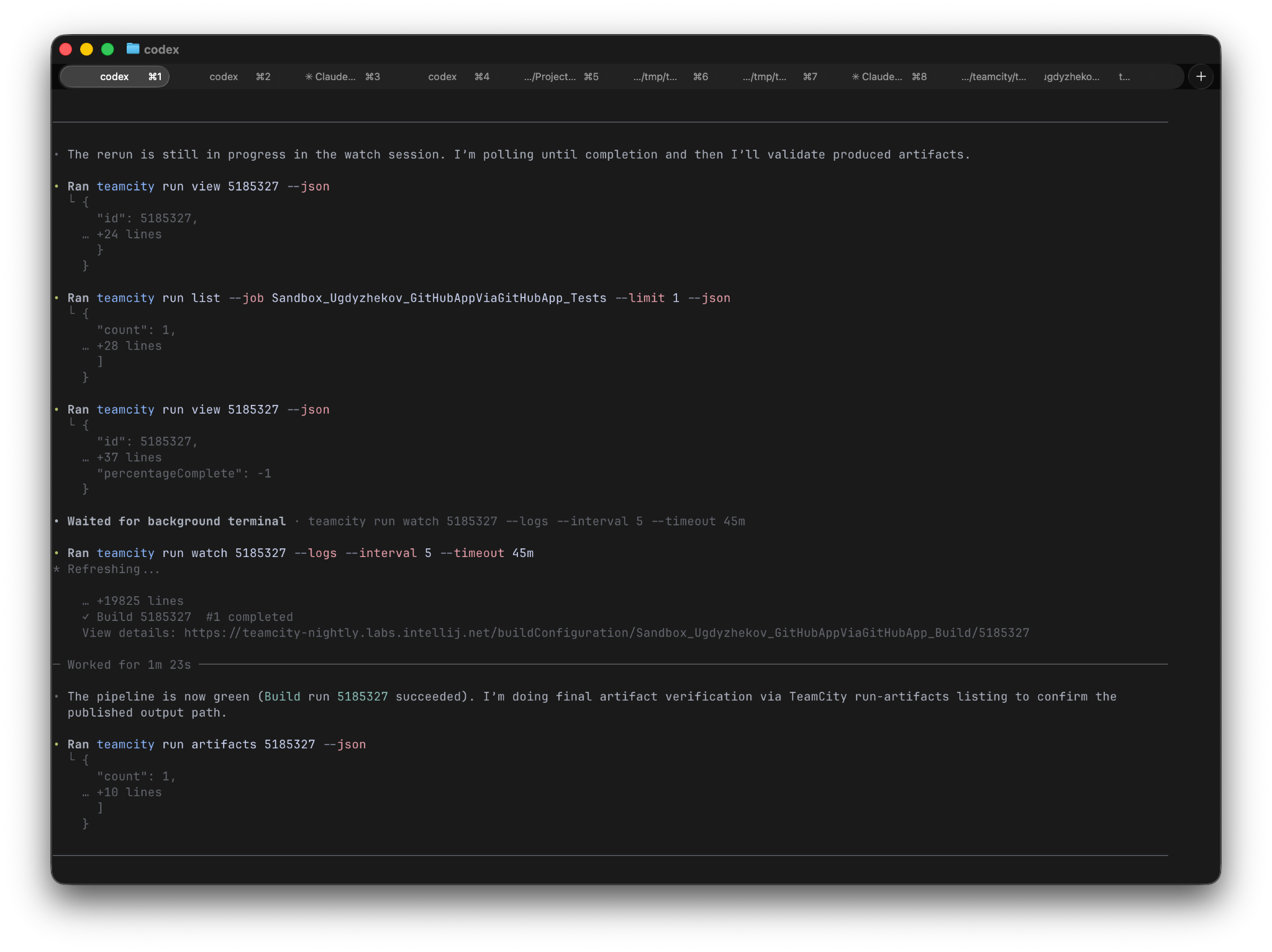
In the second experiment, I cloned a small personal Go project from GitHub and asked Codex to set up CI for it in TeamCity.

It created a simple pipeline with “Tests” and “Build” configurations.

One funny detail: it managed to reuse my GitHub PAT from the gh utility to create the VCS root. “Stole” is not exactly the right word here, but it definitely felt funny.

The success condition was simple: the build should be green.

It was not.

After a few attempts, the agent figured out that Go was missing in the build agent environment. It then modified the build steps to work around this and retried until the build passed.

In other words, the agent is not just configuring TeamCity. It is working towards a goal and adapting its actions based on what happens during the build.

After reviewing the result, I noticed that Go tests were not reported properly in TeamCity.

I pointed this out.

The agent updated the configuration, added the required build feature, and on the next run the test results were reported correctly.

What these experiments show

In both cases, the agent followed a similar pattern:

  • read documentation
  • propose a solution
  • apply it through the API
  • observe the result
  • iterate until the goal is reached

This loop is the main difference compared to earlier experiments with LLMs.

Instead of stopping at “here is how you could configure it”, the agent continues until the system actually works. This turns CI configuration into an iterative process that can converge on its own, instead of stopping at a static definition written upfront.

Conclusion

TeamCity works with AI agents, and AI agents can meaningfully help configure it. But the more interesting finding is how they go about it.

In both experiments the same pattern emerged: the agent didn’t stop at producing a configuration. It applied it, watched what happened, and kept adjusting until the pipeline ran. That feedback loop, which normally requires a developer to run the pipeline, read the output, fix something, and run it again, was happening inside the system on its own.

That said, these are early results. Agents need clear goals, good documentation, and a controlled environment to operate in.  Setup tasks that used to take several manual iterations can now converge faster, with the agent handling much of the cycle.

Subscribe to TeamCity Blog updates

Discover more