



惯性聚合 高效追踪和阅读你感兴趣的博客、新闻、科技资讯
阅读原文 在惯性聚合中打开

推荐订阅源

Hacker News: Ask HN
Hacker News: Ask HN
月光博客
月光博客
Martin Fowler
Martin Fowler
人人都是产品经理
人人都是产品经理
有赞技术团队
有赞技术团队
Hugging Face - Blog
Hugging Face - Blog
T
Tailwind CSS Blog
爱范儿
爱范儿
博客园_首页
Last Week in AI
Last Week in AI
N
Netflix TechBlog - Medium
NISL@THU
NISL@THU
H
Help Net Security
A
Arctic Wolf
K
Kaspersky official blog
Y
Y Combinator Blog
G
GRAHAM CLULEY
T
Threatpost
I
Intezer
Attack and Defense Labs
Jina AI
Jina AI
Recent Announcements
D
Docker
博客园 - 聂微东
让小产品的独立变现更简单 - ezindie.com
www.infosecurity-magazine.com
GbyAI
GbyAI
The Hacker News
The Hacker News
C
Cyber Attacks, Cyber Crime and Cyber Security
Help Net Security
Help Net Security
Microsoft Azure Blog
G
Google Developers Blog
F
Fortinet All Blogs
S
Security Affairs
Security Archives - TechRepublic
量子位
AWS News Blog
AWS News Blog
Google DeepMind News
罗磊的独立博客
V
Vulnerabilities – Threatpost
阮一峰的网络日志
阮一峰的网络日志
T
Tor Project blog
freeCodeCamp Programming Tutorials: Python, JavaScript, Git & More
H
Hacker News: Front Page
Security Latest
Security Latest
The Cloudflare Blog
cs.CV updates on arXiv.org
M
MIT News - Artificial intelligence
B
Blog
云风的 BLOG
云风的 BLOG

The JetBrains Blog

Kotlin Turns 15: Celebrate the Kotlin Effect - The JetBrains Blog PhpStorm 2026.2 is Now Out - The JetBrains Blog Key Takeaways From PHPverse 2026 - The JetBrains Blog What's New in IntelliJ IDEA 2026.2 - The JetBrains Blog What’s fixed in IntelliJ IDEA 2026.2 - The JetBrains Blog CLion 2026.2 Is Here - The JetBrains Blog DataGrip 2026.2: AI Agent Skills, MCP Tools and CLI Commands for Data Source Management, Bundled JDBC Drivers, and Improved Session Control - The JetBrains Blog Download WebStorm 2026.2: TypeScript 7 Support, AI, and more GoLand 2026.2 Is Now Available! - The JetBrains Blog Code in Space: Redefining Tech Creation with AI and XR - The JetBrains Blog Rider 2026.2 Release Candidate Is Out! - The JetBrains Blog ReSharper 2026.2 Release Candidate Released! - The JetBrains Blog JetBrains GameDev Days 2026 – Call for Speakers - The JetBrains Blog MPS 2026.1 Has Been Released! - The JetBrains Blog IntelliJ Scala Plugin 2026.2 Is Out! - The JetBrains Blog What's New in ReSharper 2026.2 for VS Code-compatible editors  - The JetBrains Blog Debugging for .NET in VS Code and Cursor: The #1 Requested Feature Is Here - The JetBrains Blog dotInsights | July 2026 - The JetBrains Blog The History of Kodee, Kotlin’s Mascot - The JetBrains Blog JetBrains Academy – June Digest - The JetBrains Blog Introducing the Kotlin Benchmark for AI Coding Agents - The JetBrains Blog Best Object Detection Models for Machine Learning in 2026 - The JetBrains Blog What's Next for TeamCity – CI/CD by JetBrains - The JetBrains Blog The Benchmark Meaning Gap - The JetBrains Blog JetBrains AI for Teams and Organizations: From Fragmented AI Usage to Coordinated Software Development - The JetBrains Blog Java Annotated Monthly – July 2026  - The JetBrains Blog Shift-Left with JetBrains Qodana Natvis Comes to Linux and macOS: Visualize Your C++ Types Without Writing a Single Data Formatter - The JetBrains Blog Speaking to AI Agents like Cavemen Saves 65% of Tokens. We Test. In Conversation With the Golden Kodee Winners - The JetBrains Blog Toolbox App 3.6: Smarter Storage Cleanup, Windows installation diagnostics, and More - The JetBrains Blog IntelliJ IDEA 2026.1.4 Is Out! - The JetBrains Blog TeamCity 2026.1.2 and 2025.11.6 Are Now Available - The JetBrains Blog JetBrains Engineering Hiring Process Guide Kotlin Comes to BlueJ - The JetBrains Blog Improving Embedded Software Quality With Parasoft C/C++test, CLion, and AI - The JetBrains Blog Kodee’s Kotlin Roundup: Kotlin Turns 15, Kotlin 2.4.0, and the Kotlin Toolchain - The JetBrains Blog GitHub Copilot now an Integrated Agent in JetBrains IDEs - The JetBrains Blog JetBrains Air lands on Windows - The JetBrains Blog The Role of Static Code Analysis in Fintech Compliance Kotlin Notebook Sunset - The JetBrains Blog Open-Sourcing the LSP Client API in IntelliJ IDEA 2026.2 - The JetBrains Blog The Dev Containers Story: Introducing EelApi for Plugin Authors - The JetBrains Blog Cursor's $60B Acquisition - Qodana Codex is now the recommended agent in JetBrains IDEs - The JetBrains Blog SSH Connections Are Moving to JetBrains Daemon in the Toolbox App 3.6 EAP - The JetBrains Blog Your AI Agent Keeps Missing The Real Bottleneck. JetBrains Rider Can Fix It Now. - The JetBrains Blog Rust Web Development 2026: The Problems Nobody Talks About Our Research on Membership Inference Attacks and Preventing Privacy Leaks - The JetBrains Blog Explicit Lazy Imports Are Coming to Python 3.15 - The JetBrains Blog Kotlin Toolchain 0.11: The Next Step for Amper - The JetBrains Blog YouTrack Helpdesk Now Includes Customer Groups - The JetBrains Blog How to Win a Hackathon: Notes From the Judging Table - The JetBrains Blog How We Measure the ROI of JetBrains IDEs - The JetBrains Blog AWS Image Builder Plugin for TeamCity - The JetBrains Blog PHP Version Migration | Jetbrains Qodana Bamboo End of Life: How to Prepare and Choose the Right CI/CD Replacement - The JetBrains Blog Structuring IntelliJ Plugins with Optional Content Modules - The JetBrains Blog YouTrack Security Update: Upgrade Required for YouTrack Server - The JetBrains Blog Qodana Is a Finalist in the 2026 CODiE Awards for Best DevOps Tool - The JetBrains Blog JetBrains Marketplace Ecosystem Security Update: Addressing Malicious Third-Party AI Plugins - The JetBrains Blog Your JetBrains IDE Expertise, Now on LinkedIn - The JetBrains Blog The JetBrains AI Coding Agent moves to general availability Step Rejection Fine-Tuning: Squeezing More Signal from Noisy Agent Trajectories - The JetBrains Blog The Anthropic Debate - The Qodana Blog dotInsights | June 2026 | The .NET Tools Blog Inside JetPride: How JetBrains Employees Built an LGBTQIA+ Community | The Life at JetBrains Blog MPS 2026.1 Release Candidate Arrives | The MPS Blog Best Python AI Frameworks in 2026 | The PyCharm Blog Contribute to the State of PHP Survey | The PhpStorm Blog The Rules of Zero, Three and Five - The Qodana Blog Modern C++ Support in CLion: What’s New | The CLion Blog Agentic AI Governance: Designing for Accountability and Control | The JetBrains AI Blog JetBrains Plugin Developer Conf 2026 – Call for Speakers | The JetBrains Platform Blog Rider 2026.2 EAP 5: Code Quality Checks for Your AI Agents, and More. | The .NET Tools Blog Why Zig Isn’t 1.0 (Yet) | The JetBrains Blog Java Annotated Monthly – June 2026  | The IntelliJ IDEA Blog IntelliJ IDEA 2026.1.3 Is Out! | The IntelliJ IDEA Blog RustRover at RustWeek 2026 | The RustRover Blog WPF Hot Reload Is Here: Edit Your XAML and Watch It Update Live in Rider | The .NET Tools Blog Kotlin 2.4.0 Released | The Kotlin Blog IntelliJ IDEA 2025.3.6 Is Out! | The IntelliJ IDEA Blog Async VFS Content Writes - What Plugin Authors Need to Know | The JetBrains Platform Blog Top Agentic Frameworks for Building Applications 2026 | The PyCharm Blog Toolbox App 3.5: Better Remote Development Observability, More Reliable Enterprise Configuration, and Smoother Everyday Interactions | The Toolbox App Blog Stop Pasting Tokens: OAuth2 Login for JetBrains IDE Plugins | The JetBrains Platform Blog Fix Common TypeScript Issues | The Qodana Blog Mellum2 Goes Open Source: A Fast Model for AI Workflows | The JetBrains AI Blog What Does It Actually Take for an IDE to Understand Rust? Hibernate 7.4 New Features | The IntelliJ IDEA Blog How We Use AlphaEvolve to Make Complex IDE Algorithms Faster | The JetBrains AI Blog JetBrains Academy – May Digest | The JetBrains Academy Blog TeamCity 2026.1.1 Is Now Available | The TeamCity Blog The Upcoming Sunset of DataSpell | The DataSpell Blog Deprecating dotMemory Unit | The .NET Tools Blog Koog 1.0 Is Out: Stable Core, Better Interop, and Multiplatform Observability | The JetBrains AI Blog Introducing the Cloud9 JetStream Theme for JetBrains IDEs | The JetBrains Blog Build a Live Object Detection App for the Reachy Mini With TensorFlow and PyCharm | The PyCharm Blog IntelliJ IDEA 2026.2 EAP Is Open | The IntelliJ IDEA Blog How AI Agents Can Work with TeamCity | The TeamCity Blog
Fewer False Positives in RustRover 2026.2|The RustRover Blog
Manuel Ceron · 2026-06-09 · via The JetBrains Blog
Rust logo

Focus on what matters

RustRover

Fewer False Alarms, Better Coding Flow in RustRover 2026.2

False positives interrupt your workflow. In RustRover 2026.1, we reduced them by up to 25% in real projects, so you’ll see fewer misleading warnings, more relevant suggestions, and smoother completion. Read on to learn what causes false positives and how we’ve been fixing them.

What are false positives?

The term false positive is used in many fields, including healthcare, finance, cybersecurity, and software development. A false positive occurs when a system incorrectly reports a problem that does not actually exist. In software development, this usually means that a tool reports an error, warning, or threat even though the code or system is functioning correctly.

What are false positives in RustRover?

In RustRover, a false positive happens when the IDE highlights something as an error even though the project compiles and runs successfully. For example, you may see red code in the editor while cargo build and cargo check report no issues. This can make it harder to trust IDE diagnostics and may interrupt your development flow.
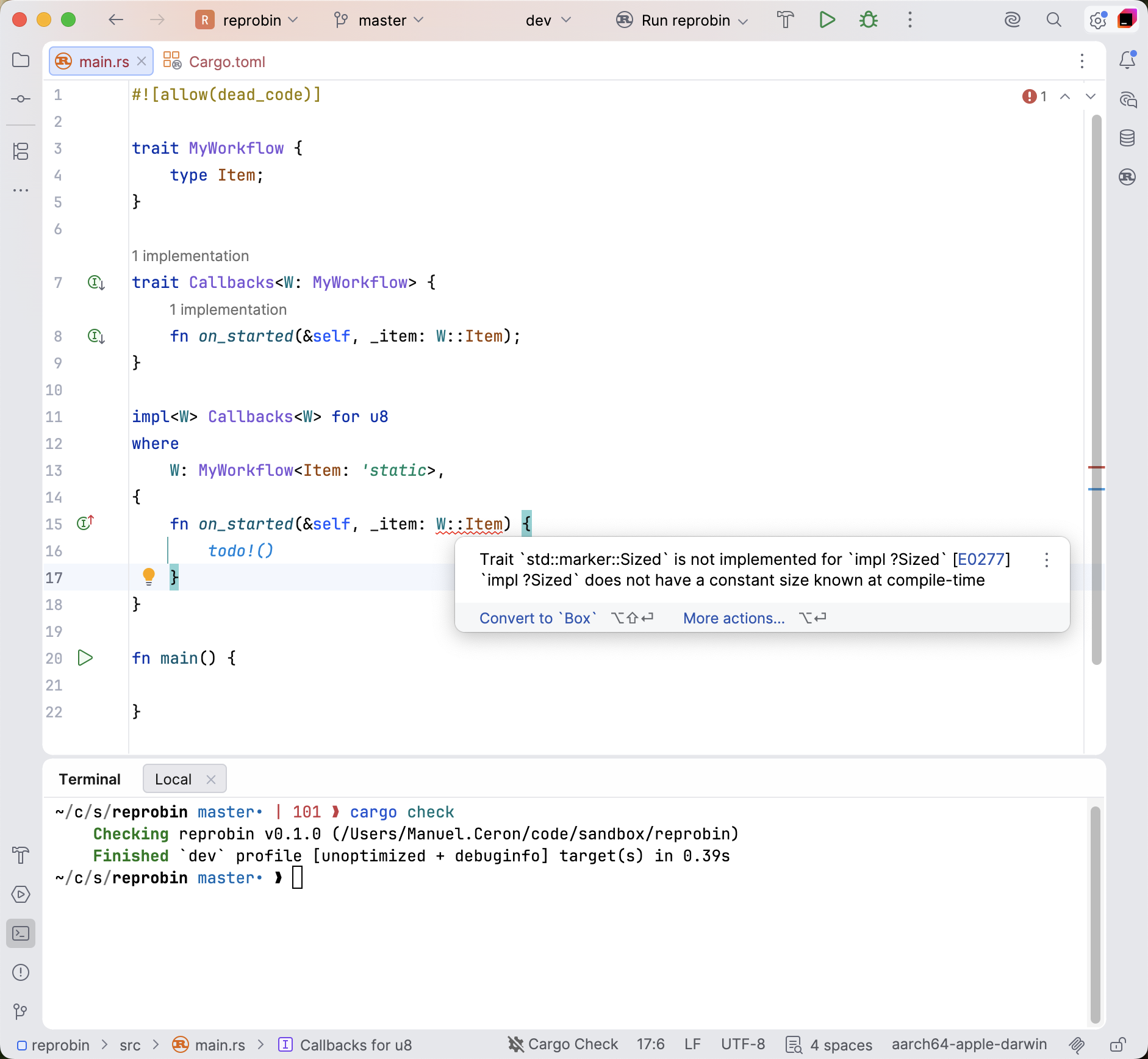
false positives

Why does RustRover have false positives?

By default, RustRover highlights problems in two different ways:

  1. After editing code, RustRover runs cargo check (or optionally cargo clippy) to detect compiler errors and warnings.
  2. RustRover also has its own code analysis engine. This engine parses the code, performs name resolution and type inference, and provides editor features such as highlighting, completion, navigation, inspections, and quick-fixes.

Sometimes RustRover’s internal analysis engine behaves differently from the compiler. When its logic does not perfectly match the compiler’s behavior, false positives can appear.

Why does RustRover have its own code analysis engine?

If RustRover’s code analysis can produce false positives, why not rely entirely on cargo check? There are several important reasons.

IDE features require deep code understanding

RustRover needs code analysis for much more than error highlighting. Features such as code completion, Go to Definition, Find Usages, refactorings, quick-fixes, type hints, and macro expansion support all require a deep understanding of the code structure.

To provide these features, RustRover parses the source code into a syntax tree, resolves identifiers, and infers types. The Rust compiler can report errors and warnings, but it’s not designed to power interactive IDE features. That’s why IDEs such as RustRover and rust-analyzer require their own analysis engines. RustRover’s analysis engine is developed independently and is not based on rust-analyzer.

The IDE must work on broken code

The compiler often stops after encountering an error and may not continue analyzing unrelated parts of the project. IDE analysis must be more resilient. It needs to continue understanding the codebase even when some parts are incomplete or incorrect.

IDEs and compilers have different priorities

RustRover’s analysis needs to react instantly while you type. To achieve this, the IDE often analyzes only the affected parts of the project instead of rebuilding entire crates. This difference in priorities explains why IDE analysis and compiler behavior are sometimes not perfectly aligned.

How do we find false positives?

False positives are essentially bugs in the IDE’s analysis engine. We identify them in several ways:

User reports

Many false positives are reported by users in our issue tracker. This is extremely valuable because it helps us identify problems affecting real-world workflows. However, some reports can be difficult to reproduce, which makes debugging more challenging.

Anonymous usage statistics

RustRover can compare the output of our analysis engine with the output of cargo. This helps us measure how often false positives appear, although it does not provide enough information to reproduce the issues directly.

Running the Rust compiler’s test suite

We run the Rust compiler’s test suite against our own analysis engine. These tests are often small and isolated, making them useful for identifying specific problems. However, many compiler tests focus on edge cases that rarely appear in production code.

Testing open-source crates

One of the most effective approaches is running RustRover’s analysis on large collections of open-source crates and comparing the results with cargo. This allows us to:

  • Reproduce real issues.
  • Estimate the impact of each bug.
  • Test popular ecosystems.
  • Verify that fixes do not introduce regressions.

Fixing false positives in RustRover

Reducing false positives is one of the most common requests we receive from users. After the release of RustRover 2025.2, we assembled a dedicated task force focused specifically on identifying and fixing false positives. We concentrated on two main sources: user-reported issues and large-scale open-source crate analysis.

Inspired by the Rust compiler’s crater project, we built an internal system that runs RustRover’s analysis against thousands of open-source crates and reports mismatches between IDE diagnostics and compiler output. This system helps us identify high-impact problems much faster and continuously improve the accuracy of RustRover’s code insight.

Our goal is simple – make IDE diagnostics more trustworthy so developers can stay focused on writing Rust code. 

How you can help

While we’ve made good progress, there is still a long way to go, and our work on reducing false positives will continue in future releases. If you notice any false positives, please report them in our issue tracker so we can continue improving RustRover’s code insight.

Subscribe to Rust Blog updates

Discover more