




惯性聚合 高效追踪和阅读你感兴趣的博客、新闻、科技资讯
阅读原文 在惯性聚合中打开

推荐订阅源

AI
AI
小众软件
小众软件
让小产品的独立变现更简单 - ezindie.com
月光博客
月光博客
云风的 BLOG
云风的 BLOG
Recorded Future
Recorded Future
Apple Machine Learning Research
F
Fortinet All Blogs
罗磊的独立博客
爱范儿
爱范儿
GbyAI
GbyAI
Stack Overflow Blog
Stack Overflow Blog
MongoDB | Blog
MongoDB | Blog
D
Docker
C
CXSECURITY Database RSS Feed - CXSecurity.com
Spread Privacy
Spread Privacy
Recent Announcements
酷 壳 – CoolShell
酷 壳 – CoolShell
G
GRAHAM CLULEY
A
About on SuperTechFans
C
Cisco Blogs
The Register - Security
OSCHINA 社区最新新闻
OSCHINA 社区最新新闻
B
Blog
Project Zero
Project Zero
V
V2EX
K
Kaspersky official blog
P
Privacy International News Feed
博客园 - 叶小钗
I
Intezer
T
Threatpost
The GitHub Blog
The GitHub Blog
CTFtime.org: upcoming CTF events
V
Vulnerabilities – Threatpost
D
Darknet – Hacking Tools, Hacker News & Cyber Security
C
Cybersecurity and Infrastructure Security Agency CISA
Cyberwarzone
Cyberwarzone
Microsoft Azure Blog
N
Netflix TechBlog - Medium
Application and Cybersecurity Blog
博客园 - 【当耐特】
P
Proofpoint News Feed
L
Lohrmann on Cybersecurity
S
Schneier on Security
cs.AI updates on arXiv.org
F
Full Disclosure
The Cloudflare Blog
P
Palo Alto Networks Blog
K
KPMG report finds enterprise disconnect between AI and its ROI | CIO
T
Tenable Blog

BloombergNEF

Sustainable Aviation Fuel Price Outlook: Leveling Off | BloombergNEF Energy Transition Impacts: Sector and Country Impacts from a Demand-Driven Model | BloombergNEF BloombergNEF Turkey Transition Factbook 2026: Clean Power Growth Positions Turkey for the Next Phase of Its Energy Transition | BloombergNEF Competitiveness, Cost and Climate: Five Themes From the BNEF Summit Amsterdam | BloombergNEF Electric Vehicle Outlook | BloombergNEF BloombergNEF’s Electric Vehicle Outlook 2026: Global EV Sales Set For Another Record-Breaking Year, But Growth in Some Major Markets Slows | BloombergNEF Mexico Transition Factbook 2026 Have Oil Prices Already Peaked? Three Things to Know Liebreich: The Great Clean Energy Acceleration 2.0 Global Clean-Energy Trade Rebounds to $479 Billion in 2025 Despite Tariffs and Geopolitical Turmoil: BloombergNEF New Energy Outlook 2026 New Energy Outlook 2026 BloombergNEF’s New Energy Outlook 2026: Transition to Newer Technologies, Expanded Electrification to Strengthen Nations’ Energy Security Energy Transition Bank Financing Struggles to Pull Ahead of Fossil Fuels in Asia Data Centers and the Future of Energy Storage Data Centers and the Future of Energy Storage Energy Storage Enters the 100-Gigawatt Era: Three Things to Know AI Data Centers, Energy and Finance: Dispatch from the BNEF Summit New York 2026 Nuclear Fusion Powers Up for Commercial Breakthrough BNEF Talk: Copper’s World of Wires, Wheels and Worries EU Carbon Border Tariff Is Reshaping Industrial Trade Flows BloombergNEF Announces 12 Climate Innovators as Winners of its 2026 Pioneers Award NEO 2025 New Energy Outlook 1 NEO Clean Power Is Up and Will Get a War Boost: Three Things to Know No, Iran War Won’t Boost Clean Hydrogen – Except in China The Petrochemicals Shock That Is Already Rippling Through Plastics AI Data Center Build Advances at Full Speed: Five Things to Know Iran Rattles Saudi’s Red Sea Oil Reset. Here’s What’s at Stake Bloomberg Appoints Albert Cheung CEO of BloombergNEF Oil Math of Releasing 400 Million Barrels: Three Things to Know Chinese Turbine Suppliers Seize the Spotlight as Global Wind Power Installations Hit All-Time High, BloombergNEF Report Shows New Data Center Hotspots Are Emerging: Four Things to Know Oil Products Arbs and Flows: All Eyes On Strait of Hormuz
Solar Set to Rule World’s Power Supply: Three Things to Know | BloombergNEF
iterhorst · 2026-07-09 · via BloombergNEF

July 8, 2026

By Vandana Gombar, Senior Editor, BloombergNEF

Solar is set to oust coal as the leading generator of electricity within six years, BloombergNEF finds in its latest energy transition outlook, despite a first ever slight dip in installations in 2026.

“Solar is the cheapest source of power in many countries, and is proving the easiest and fastest to deploy,” said Jenny Chase, BNEF’s clean power specialist. “Its role in the global energy mix will be substantial, ushering in a new age where power is cheap whenever the sun shines.”
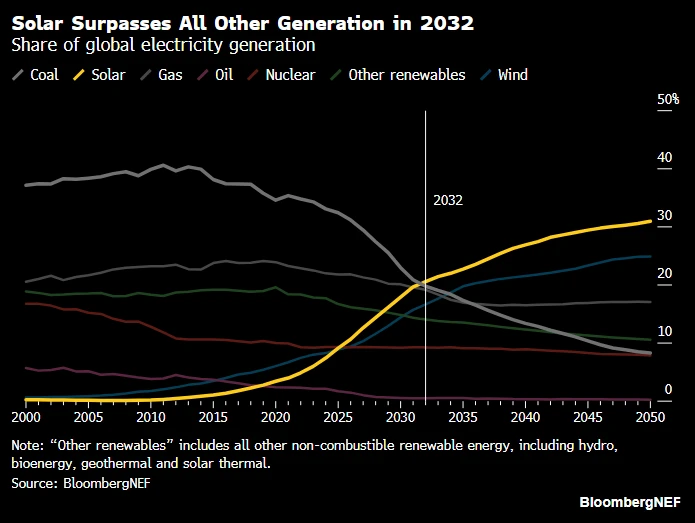
“Solar and batteries will transform world power markets in the next 10 years,” Chase said, though trade barriers may slow progress in markets that implement them. Revenue cannibalization is also an issue as low power prices at peak generating periods hit developers’ revenues. Batteries help mitigate that problem but at higher levels of deployment, their utilization falls, which weakens their economic case.

1. Solar’s steady growth

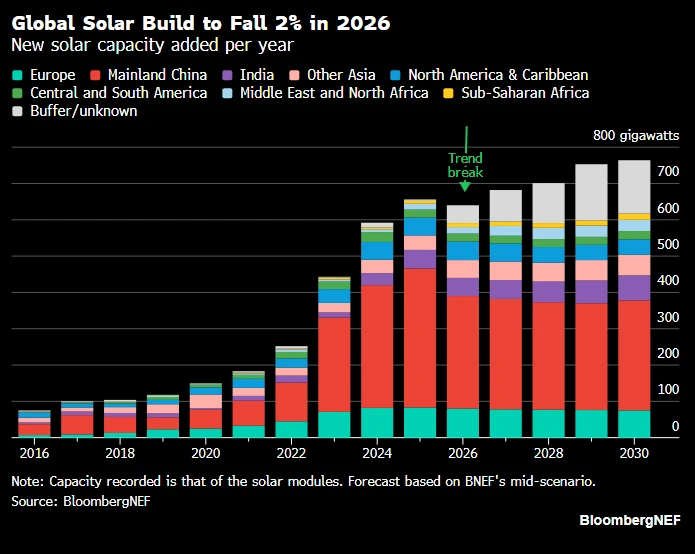
Solar has charted a steady growth path over the last two decades, with more capacity added every year compared to the one before. The pace of global annual installations jumped from less than 100 gigawatts in 2016 to over 650 gigawatts last year. However, BNEF sees 640 gigawatts of solar installations this year, the first year-on-year dip. Growth in installations resumes again from 2027.
2. Cost of solar

Fixed-axis PV is the cheapest source for new generation, and will remain so this year, with onshore wind a close second, according to the most recent global levelized cost of electricity benchmarks from BNEF.

Coal is almost double the cost of these cost-competitive two technologies, and is even higher than battery storage, which has seen the most dramatic fall in costs over the last few years.
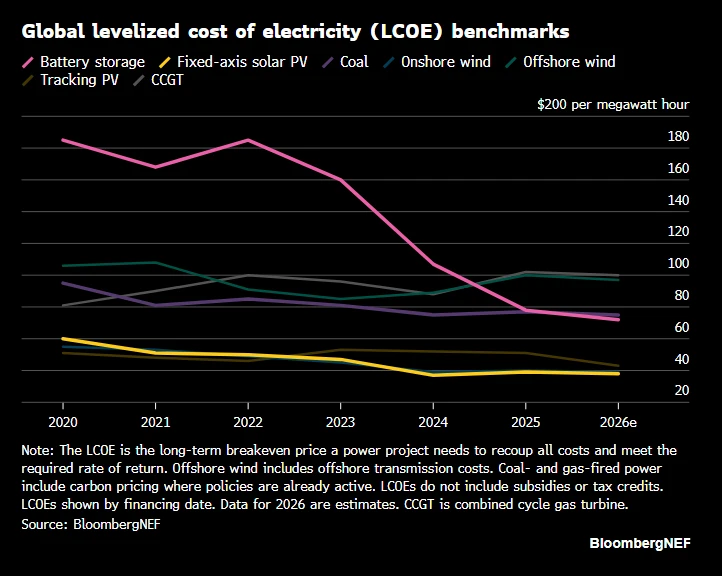
The highest cost technologies are gas (combined cycle gas turbine) and offshore wind.

3. Largest solar markets – China, India, US

China is the largest market for solar by far, followed by an eclectic list of countries with India, the US and Germany next in line in terms of gigawatts expected to be installed this year. Pakistan rounds out the top five economies for solar. The next set of five includes Brazil, Japan and Saudi Arabia.

Concerns around growth in solar usually focus on China’s dominance of equipment manufacturing. Quite a few countries have launched incentive programs to encourage domestic assembly of modules, the manufacture of cells and wafers, or the production of polysilicon.
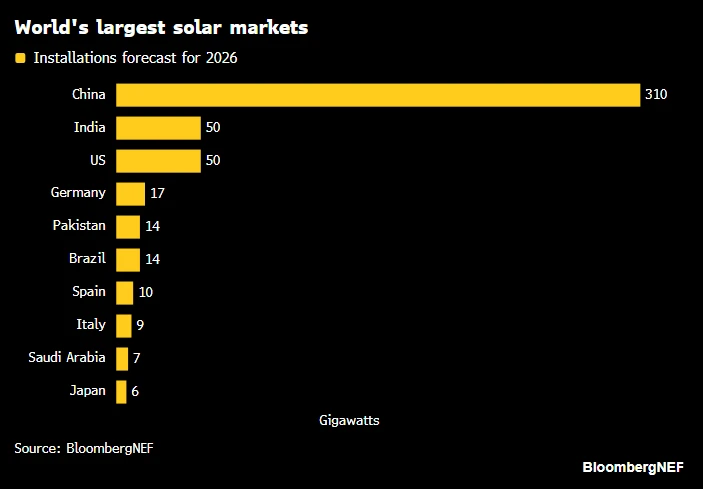
As many as 46 markets around the world will install over a gigawatt of solar each in 2026.

Related Content

The latest from BloombergNEF delivered to your inbox

Sign up for BNEF’s free newsletter.