

惯性聚合 高效追踪和阅读你感兴趣的博客、新闻、科技资讯
阅读原文 在惯性聚合中打开

推荐订阅源

H
Hackread – Cybersecurity News, Data Breaches, AI and More
让小产品的独立变现更简单 - ezindie.com
V
V2EX
T
The Blog of Author Tim Ferriss
腾讯CDC
Hugging Face - Blog
Hugging Face - Blog
雷峰网
雷峰网
爱范儿
爱范儿
GbyAI
GbyAI
H
Help Net Security
I
InfoQ
罗磊的独立博客
酷 壳 – CoolShell
酷 壳 – CoolShell
钛媒体:引领未来商业与生活新知
钛媒体:引领未来商业与生活新知
cs.AI updates on arXiv.org
人人都是产品经理
人人都是产品经理
J
Java Code Geeks
Microsoft Security Blog
Threat Intelligence Blog | Flashpoint
N
Netflix TechBlog - Medium
Last Week in AI
Last Week in AI
宝玉的分享
宝玉的分享
云风的 BLOG
云风的 BLOG
Project Zero
Project Zero
P
Privacy & Cybersecurity Law Blog
A
Arctic Wolf
Know Your Adversary
Know Your Adversary
G
Google Developers Blog
freeCodeCamp Programming Tutorials: Python, JavaScript, Git & More
T
Tor Project blog
V
Vulnerabilities – Threatpost
Y
Y Combinator Blog
WordPress大学
WordPress大学
V
Visual Studio Blog
博客园_首页
G
GRAHAM CLULEY
K
Kaspersky official blog
T
Tailwind CSS Blog
T
Threat Research - Cisco Blogs
博客园 - Franky
D
Docker
Security Latest
Security Latest
I
Intezer
有赞技术团队
有赞技术团队
Application and Cybersecurity Blog
博客园 - 【当耐特】
B
Blog RSS Feed
T
The Exploit Database - CXSecurity.com
cs.CV updates on arXiv.org
OSCHINA 社区最新新闻
OSCHINA 社区最新新闻

Comments for The Eclectic Light Company

Should you try Golden Gate beta? Solutions to Saturday Mac riddles 367 In the shadow: Diego Velázquez Comment on Last Week on My Mac: Freshen up your documents by David Comment on Happy 250th birthday America 2 by mac Happy 250th birthday America 1 Brushstrokes: Portraits 1760-1877 Spotlight and Core Spotlight are different Comment on Sort order, collation and the Finder by eyelessjerry Comment on Apple has just released macOS 26.5.2 Tahoe by Derek Currie Great Ladies of Impressionism: Marie Bracquemond Comment on Get more from your Mac’s log by extending its duration by John Gilbert Comment on Keep your Mac cool using physics by F Portraits of trees: Coppices and pollards Comment on Firmware has become complicated again by John Woods Comment on Logistician 1.2 fixes a couple of bugs by info395288a4d1d Comment on What does Activity Monitor measure? by hoakley Last Week on My Mac: Spotlight on semantics An American in Paris: paintings of Henry Ossawa Tanner 1902-1930 An American in Paris: paintings of Henry Ossawa Tanner 1880-1902 Great Ladies of Impressionism: Berthe Morisot 1874-1891 What to do with a hot Mac Deprecations and removals from Golden Gate Brushstrokes: From El Greco to Rembrandt Portraits of trees: Dutch Golden Age How to get the most from SilentKnight 3 Comment on Hero or hooligan: Achilles becomes the warrior by Deborah J. Brasket Solutions to Saturday Mac riddles 365 Comment on SilentKnight 3.0 for Apple silicon Macs running Sequoia and later (full release) by michaelriccioli Comment on Last Week on My Mac: Uncompressed compressed files by fds Comment on Explainer: Memory by jzonedotcom Comment on Colin Campbell Cooper painting America: 1896-1910 by House of Heart Brushstrokes: 16th century What can you do when an app uses too much memory? SilentKnight 3 second beta adds text and JSON reporting In the shadow: Caravaggism What to do with your encrypted HFS+ disks First beta-test version of SilentKnight 3 for Apple silicon Macs Hero or hooligan: Jason and Medea Comment on Fix documents that won’t open as expected using Quarant2 by EcleX Last Week on My Mac: The mystery of Safari’s Web Archives Last Week on My Mac: Why is it so hard to open a document? Explainer: Disk encryption In the shadow: Caravaggio Brushstrokes: innovators of the first century Changing Paintings: 36 Theseus and the Minotaur macOS virtualisation is leaping forward in Golden Gate Why can’t Preview open that PDF? Crossing the Golden Gate, Intel support, and an update to SystHist Reading the Finder’s Get Info dialog In memoriam Mary Cassatt: 2, 1880-81 Last Week on My Mac: What’s in a name? Explainer: Getting a location Get more from Get Info and the Finder’s contextual menu Stop your photos revealing your location Have you saved thousands of versions? Versatility 1.2 might be what you need Apple has released an update to XProtect for all macOS Apple has released macOS Tahoe 26.5.1 Comment on What Location Services do in macOS by Tristan Hubsch Comment on Protect files with the Locked or Immutable flag by markbot2zero Portraits of trees: Introduction Which tasks require mains power? Comment on Online reference to external displays for Apple silicon Macs by Brian What’s in that phishing email? How to search document versions Rubens’ Peace and War Comment on Last Week on My Mac: Syncing metadata in iCloud Drive by hoakley A weekend with Misia: 2 How to search Time Machine backups? Hero or hooligan: Theseus and the sandals How QuickLook provides thumbnails and previews Hunting extended attributes with an update to xattred Saturday Mac riddles 360 Comment on How to preserve versions, and how to create versioned PDFs by markbot2zero Comment on What gets synced in iCloud Drive? by hoakley Solutions to Saturday Mac riddles 359 Last Week on My Mac: snapshots, the elephant in APFS How to check whether Spotlight is getting the right metadata macOS Tahoe no longer fully supports Time Capsules The bicentenary of Frederic Edwin Church: 1857-77 macOS virtual machines and audio-video syncing Comment on Use Finder tags for categories by Chuck Last Week on My Mac: Dependency and skill fade Comment on Virtualisation on Apple silicon Macs is different by AndyS Painting Pandora and her box: 1883-1919 Mac Easter eggs Painting Spring blossom 2 Comment on The macOS Natural Language framework and Nalaprop by Ingo Comment on The MACL extended attribute by hoakley On Reflection: Cézanne Privacy: Which folders are protected in Tahoe? Last Week on My Mac: Root cause analysis and ClickFix Last Week on My Mac: Root cause analysis and ClickFix Last Week on My Mac: Root cause analysis and ClickFix Last Week on My Mac: Root cause analysis and ClickFix Why you can’t trust Privacy & Security How can I now have two apps named Pages? How to survive the loss of Rosetta Use Fallback Recovery on Apple silicon Macs Clean install macOS
Medium and message: Pottery
hoakley · 2026-05-19 · via Comments for The Eclectic Light Company

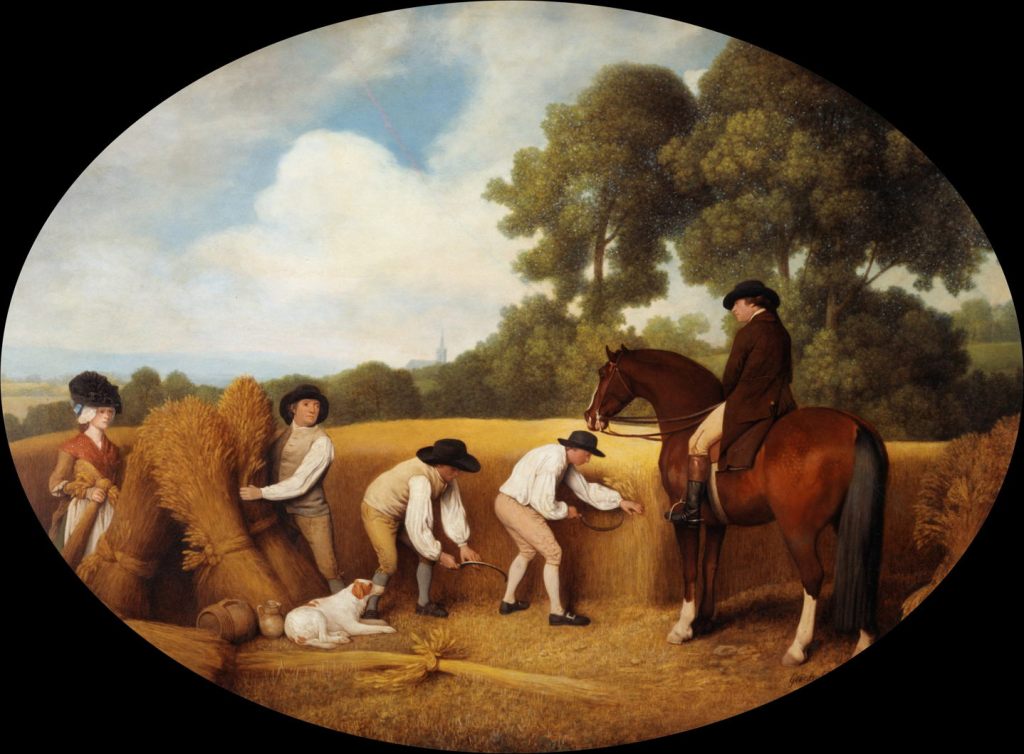
George Stubbs (1724-1806), Reapers (1795), Enamel on Wedgwood biscuit earthenware, 76.8 x 102.9 cm, Yale Center for British Art, New Haven, CT. Wikimedia Commons.

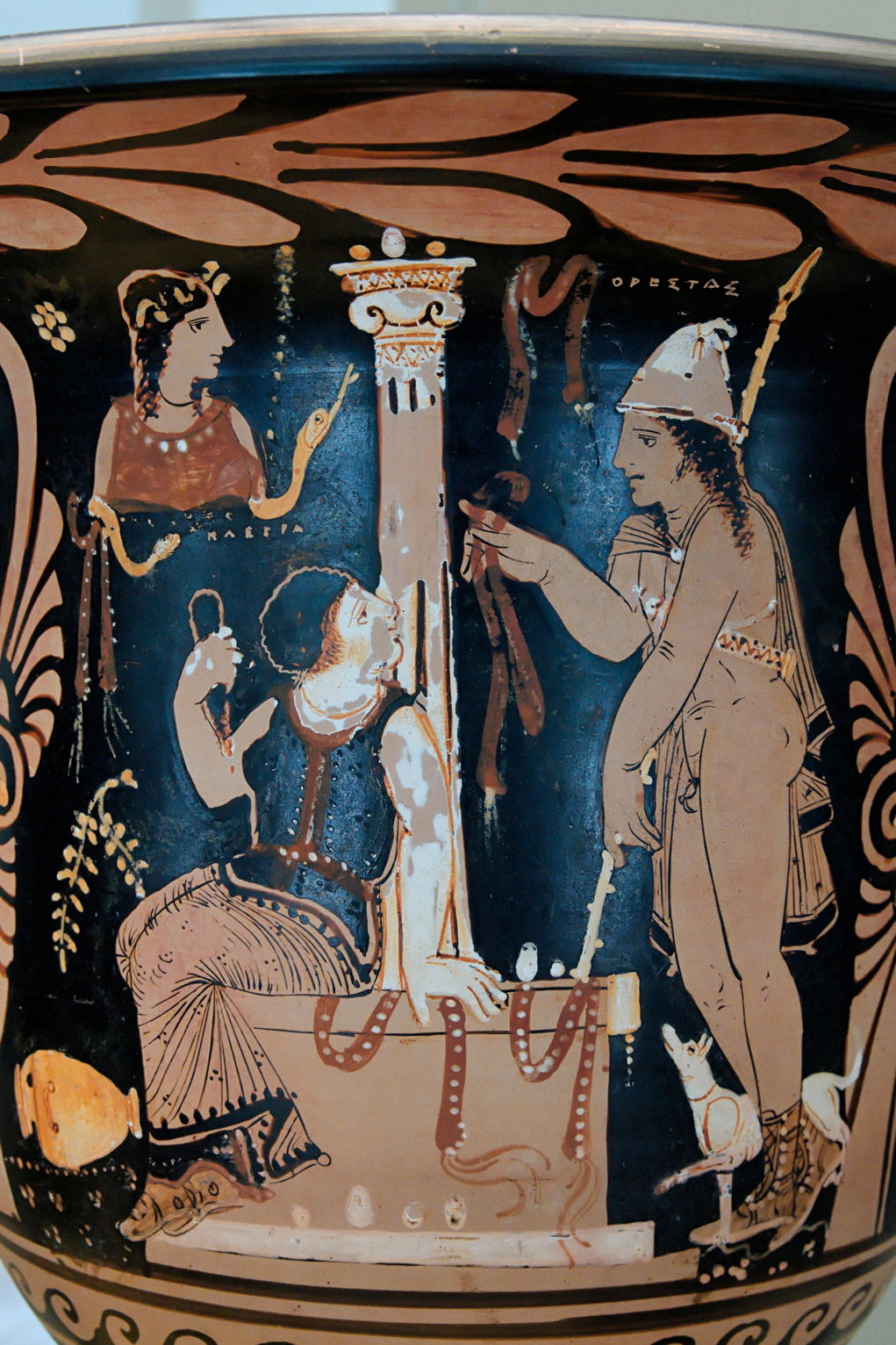
The other three-dimensional objects that are commonly painted more or less artistically are drinking vessels, pots and plates make from clay. With the total loss of paintings from classical Greece, those now form its only record of visual art, and those decorated pots are in many of the best collections of art.
anonoresteselectraspain
Unknown Artist, Meeting of Electra and Orestes at the Tomb of Agamemnon (340-330 BCE), Paestan red-figure bell-krater, Museo Arqueológico Nacional de España, Madrid. Image by Marie-Lan Nguyen, via Wikimedia Commons.

For example, this depiction of the Meeting of Electra and Orestes at the Tomb of Agamemnon from 340-330 BCE shows Orestes meeting his sister Electra at their father’s tomb, on a bell-krater. This type of vessel was used to mix water with wine, and was introduced in the early fifth century BCE. Although not obvious from this view, it has the form of a bell.

Greek pottery was painted using fine-grained clay slip, in either of two techniques. Earlier black-figure technique applied the slip to the areas of the figures, which turned black during three-phase firing. This krater is painted using the later red-figure technique, where the slip is used to turn the background black. Other colours including red and white were also used, as seen here.

During the Middle Ages, Arabic cultures developed a new technique based on glazing the surface of the pottery using tin compounds, to produce an opaque white surface that could be painted using a wide range of coloured glazes. When adopted in Europe, this became known as maiolica, and flourished in the Renaissance.

avellihypermnestra
Francesco Xanto Avelli (c 1487–1542), Hypermnestra Watching Lynceus Take Her Father’s Crown (1537), earthenware plate with tin glaze (maiolica), 2.3 × 25.5 cm, Walters Art Museum, Baltimore, MD. Wikimedia Commons.

This maiolica plate painted by Francesco Xanto Avelli in 1537 shows Hypermnestra Watching Lynceus Take Her Father’s Crown. Lynceus (labelled here as ‘Lino’) has taken Danaus’ crown, and is about to put him to the sword. Hypermnestra stands at a window, most probably not that of a dungeon. Below its lintel is a Cupid bearing the famous saying omnia vincit amor, love conquers all, which actually comes from Virgil’s last Eclogue and is unrelated to the narrative.

calamellicadmusharmonia
Virgiliotto Calamelli (1531-1570), Cadmus and Harmonia (c 1560), Faenza maiolica ceramic, dimensions not known, Museo Internazionale delle Ceramiche, Faenza, Italy. Wikimedia Commons.

Virgiliotto Calamelli’s ceramic telling of Cadmus and Harmonia from around 1560 is a brilliant depiction of Ovid’s story. He chooses a late moment, in which Cadmus’ transformation into a snake is complete, and Harmonia’s has reached her abdomen.

This was followed by the painting of porcelain following existing conventional paintings.

lancretbrotherphilippesgeese
Nicolas Lancret (1690–1743), Brother Philippe’s Geese (c 1736), oil on copper, 27..3 x 35.2 cm, The Metropolitan Museum of Art (Purchase, Walter and Leonore Annenberg and The Annenberg Foundation Gift, 2004), New York, NY. Courtesy of The Metropolitan Museum of Art.

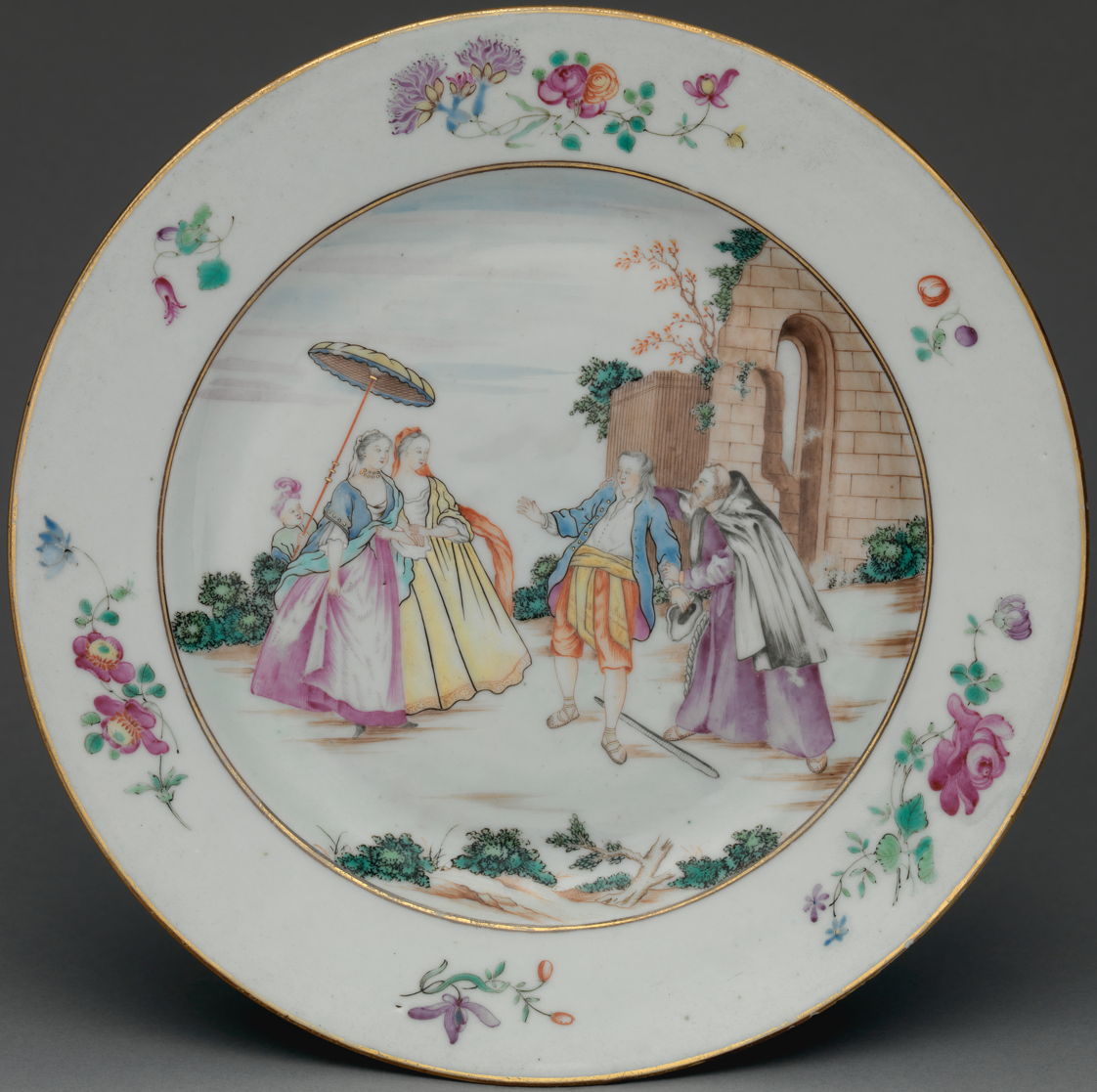
In about 1736, Nicolas Lancret painted the story of Brother Philippe’s Geese in oil on copper, as one of a pair, among a larger group of his paintings of La Fontaine’s fables.
anonafterlancretgeese
Artist not known, Scene from Brother Philippe’s Geese (1745), Chinese painted porcelain plate, 22.9 cm diam, The Metropolitan Museum of Art (Friends of European Sculpture and Decorative Arts Gifts, 2016), New York, NY. Courtesy of The Metropolitan Museum of Art.

That became so popular that it was reproduced in prints, such as those by Nicolas de Larmessin (1684–1755) in which the image is naturally reversed, and here on a porcelain plate exported from China in 1745. This artist could only have worked from one of those prints.

During the eighteenth century, painted porcelain became popular for a wide range of objects.

kordenbuschbaptistery
Georg Kordenbusch (1731-1802), Scenes from the Life of Christ (1750), baptismal bowl, Kunstgewerbemuseum Berlin, Berlin. By User:FA2010, via Wikimedia Commons.

Georg Kordenbusch’s painted baptismal bowl shows four Scenes from the Life of Christ (1750). As these are intended for viewing from above the bowl, and normally by a group gathered around it, the layout of the scenes shouldn’t be orientated for viewing from a single position.

In his earlier years, the great British equestrian painter George Stubbs started painting on enamel, and during the 1770s produced some larger works for Josiah Wedgwood, the successful pottery entrepreneur.

stubbsreapers
George Stubbs (1724-1806), Reapers (1795), Enamel on Wedgwood biscuit earthenware, 76.8 x 102.9 cm, Yale Center for British Art, New Haven, CT. Wikimedia Commons.

Stubbs’ Reapers from 1795 is painted in enamel on Wedgwood biscuit earthenware, and is strongly reminiscent of early harvest paintings of the Brueghels.

varinarm
Anonymous, Figure group Rinaldo and Armida (c 1791-95), moulded lead-glazed earthenware, enamelled in colours, Lakin & Poole, Staffordshire, Victoria and Albert Museum, London. Photo by Andreas Praefcke, via Wikimedia Commons.

Manufactured by Lakin & Poole in the Staffordshire pottery district in England around 1791-95, this moulded lead-glazed earthenware, enamelled in colours, celebrates a scene from Tasso’s epic Jerusalem Delivered, which was being revived at the time.
IF
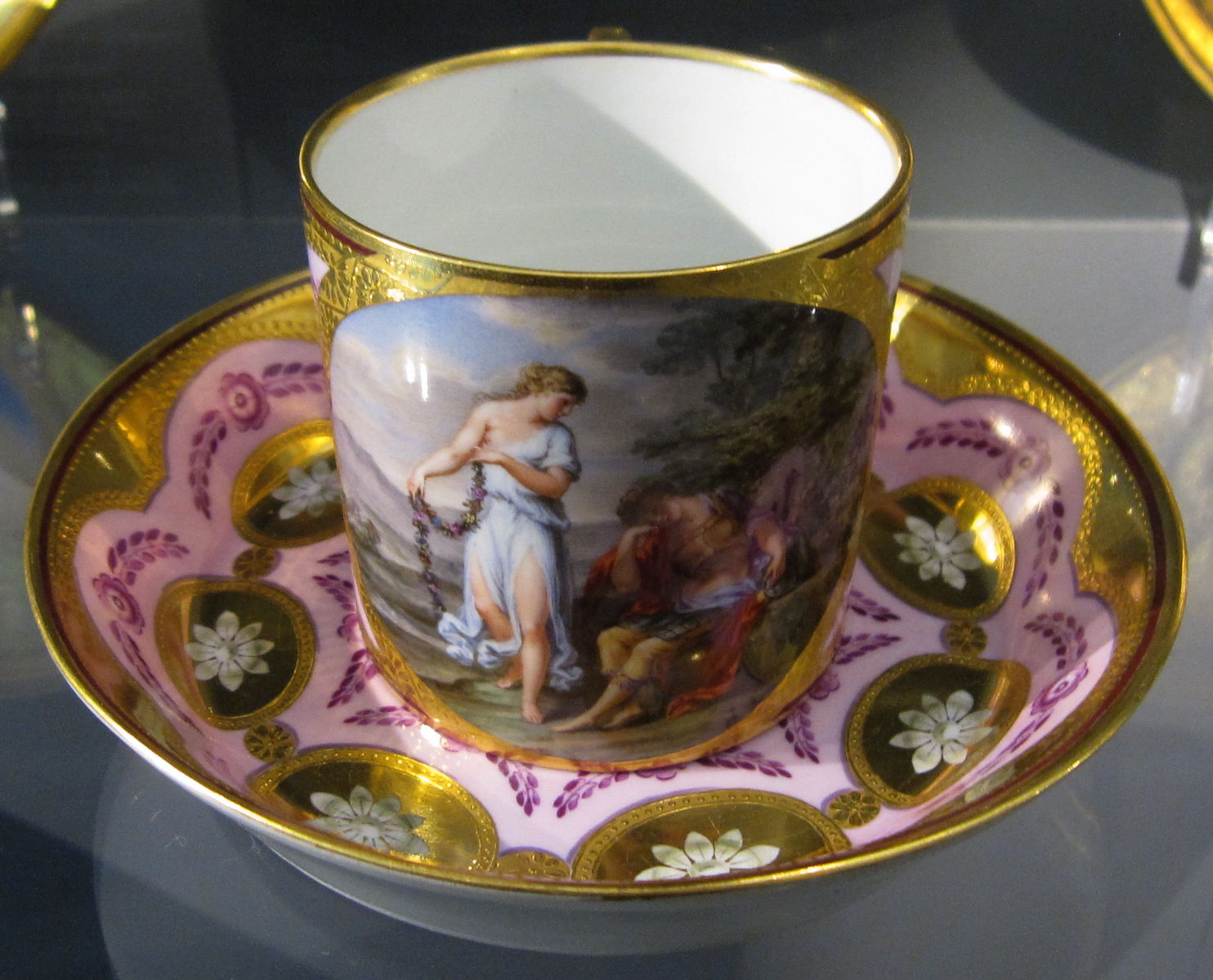
Anonymous, after Angelica Kauffmann, Rinaldo and Armida (c 1798), porcelain cup and saucer, Kaiserliche Porzellanmanufaktur, Wien. Collection of the Prince of Liechtenstein, Vaduz-Vienna. By Gryffindor, via Wikimedia Commons.

Here a painting of a similar theme by the enormously popular Angelica Kauffmann has been enamelled onto a porcelain cup and saucer by Kaiserliche Porzellanmanufaktur, Wien, in about 1798. The image of a Saracen witch entrancing, seducing, and abducting a warrior from the First Crusade may seem strange to accompany your cup of coffee.

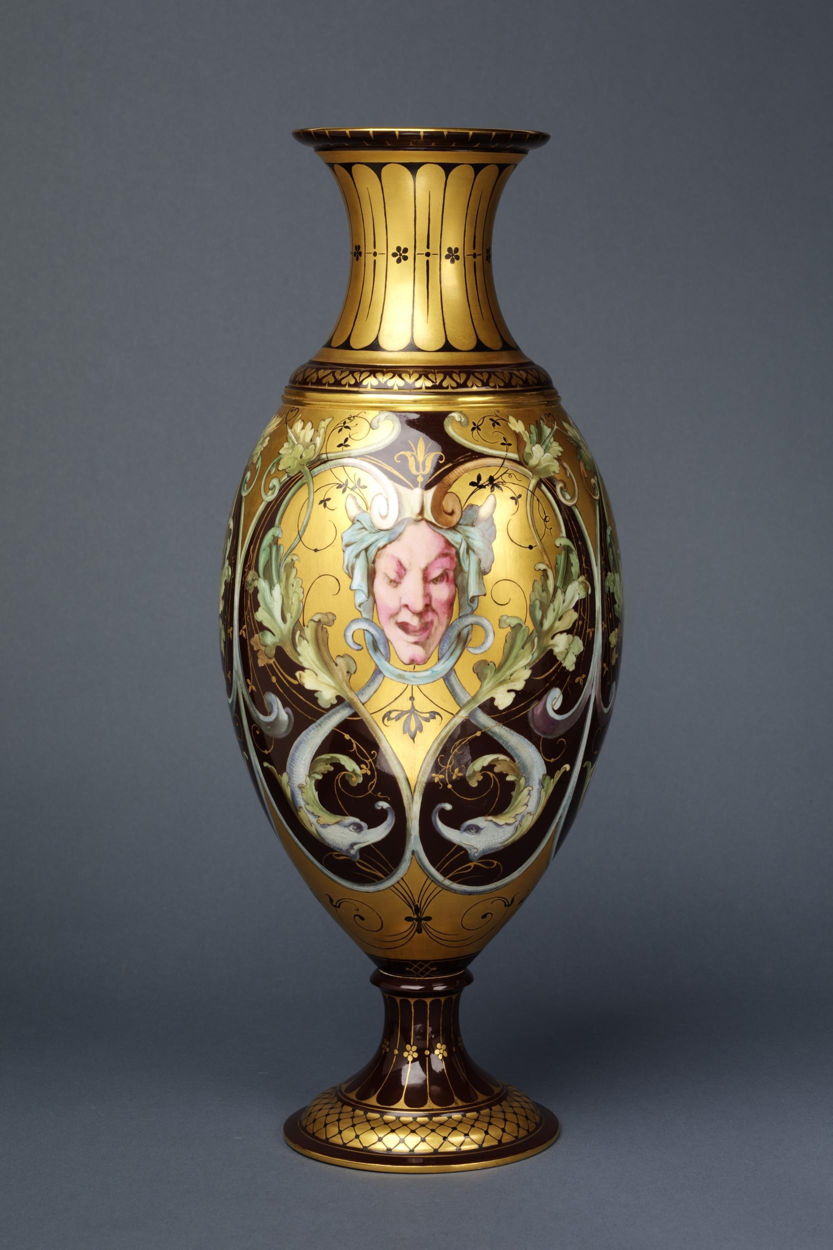
Among those who exhibited at the First Impressionist Exhibition in Paris in 1874 was the highly accomplished painter in enamel Alfred Meyer. He first exhibited in the Salon of 1864, and two years later was awarded a medal for his work shown there. He was an active member of the Impressionist’s company, and following its winding up he joined with Pissarro and others in establishing an alternative group, l’Union, in August 1875, which was structured as a trades union rather than a company.
meyervase
Alfred Meyer (1832-1904), Enamel painting with grotesques and foliate forms, gilded (1866), enamel on porcelain (Sèvres), the Victoria and Albert Museum, London. Courtesy of and © Victoria and Albert Museum, London.

He painted and gilded this on Sèvres porcelain in 1866. He was later appointed Professor at the École Bernard Palissy in Paris, where he rediscovered processes used by the ancient enamelers of the Limousin. He also worked for the Sèvres porcelain factory, the houses of Vever and Falize, as well as independently, and continued to exhibit his work at the Salon.
aguttenudeplate
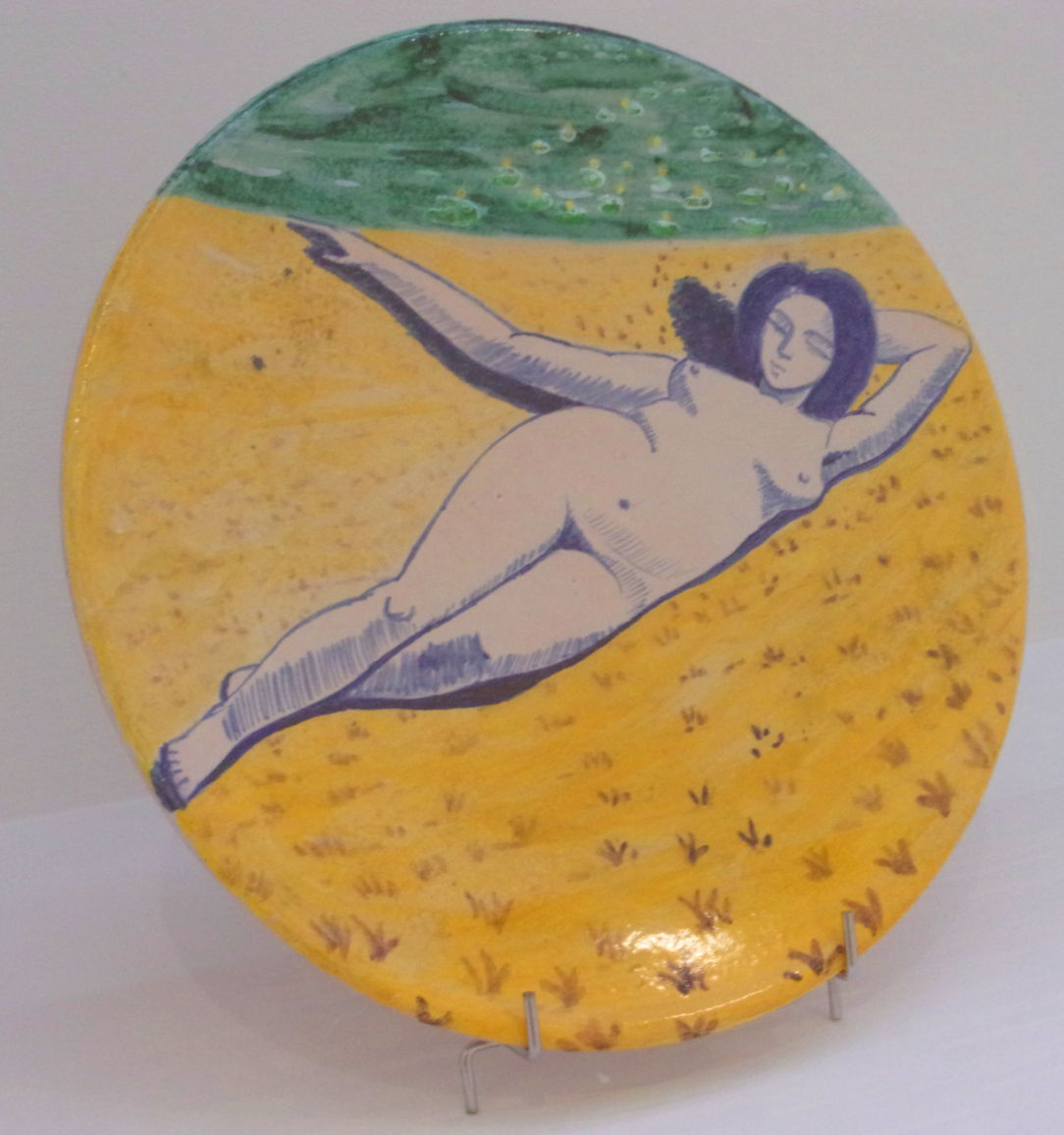
Georgette Agutte (1867–1922), Decorated Plate (1909), paint on pottery, dimensions not known, Musée de Grenoble, Grenoble, France. Image by Milky, via Wikimedia Commons.

Although never popular among painters, there have always been a few who have continued to paint pottery. This nude on a decorated plate was painted by Georgette Agutte in 1909.