










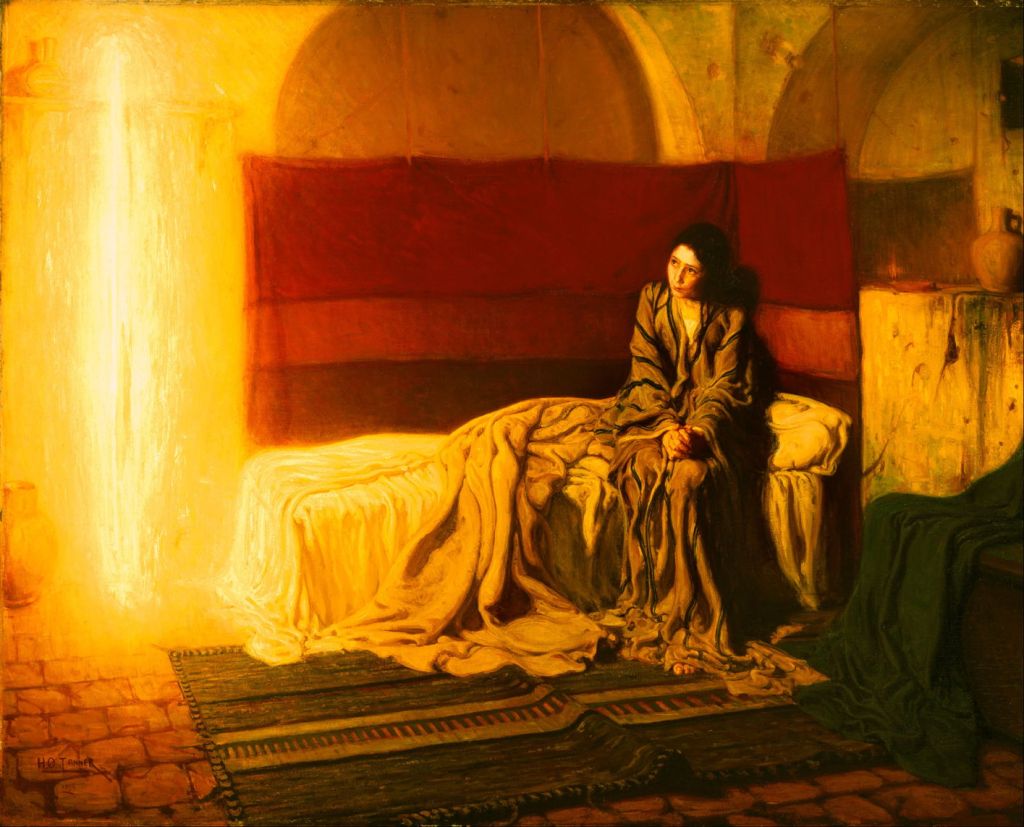
 Henry Ossawa Tanner (1859–1937), The Annunciation (1898), oil on canvas, 144.9 x 181.1 cm,
Philadelphia Museum of Art, Philadelphia, PA. Wikimedia Commons.
Henry Ossawa Tanner (1859–1937), The Annunciation (1898), oil on canvas, 144.9 x 181.1 cm,
Philadelphia Museum of Art, Philadelphia, PA. Wikimedia Commons.
Henry Ossawa Tanner (1859–1937) is one of the five American painters who achieved international fame before the First World War, alongside Benjamin West, James McNeill Whistler, Mary Cassatt and John Singer Sargent. His success is the more remarkable as he was also an African-American. This weekend I celebrate his art with a small selection of his paintings, almost all of which are in the US and never likely to be seen in Europe.
He was born into a well-educated and relatively affluent family in Pittsburgh, PA, his father being a minister in the African Methodist Episcopal (AME) Church who was later elected bishop, although his mother had been born into slavery. He was first inspired to become an artist in 1872, and began painting as an amateur by 1876. He was first apprenticed in the flour trade, and it was only after an illness, in 1878, that his parents agreed to him pursuing a career as a painter.
In 1879, he started studies under the brilliant but controversial Thomas Eakins (1844-1916) at the Pennsylvania Academy of the Fine Arts, in Philadelphia. Although it’s often claimed he was the only black student there at the time, there was at least one other. Eakins had become an enthusiastic photographer, and it’s likely that Tanner also learned photographic techniques under him. Within a couple of months, in early 1880, Tanner was exhibiting in Philadelphia, and had sold his first painting.

The Laundress has been claimed to date from 1880, which would make it one of the earliest of his surviving paintings. It shows not one but three women washing laundry near a homestead in the country, under the dark sky of an approaching storm. Tanner’s brushwork is remarkably painterly, giving the work a distinctly Impressionist look.
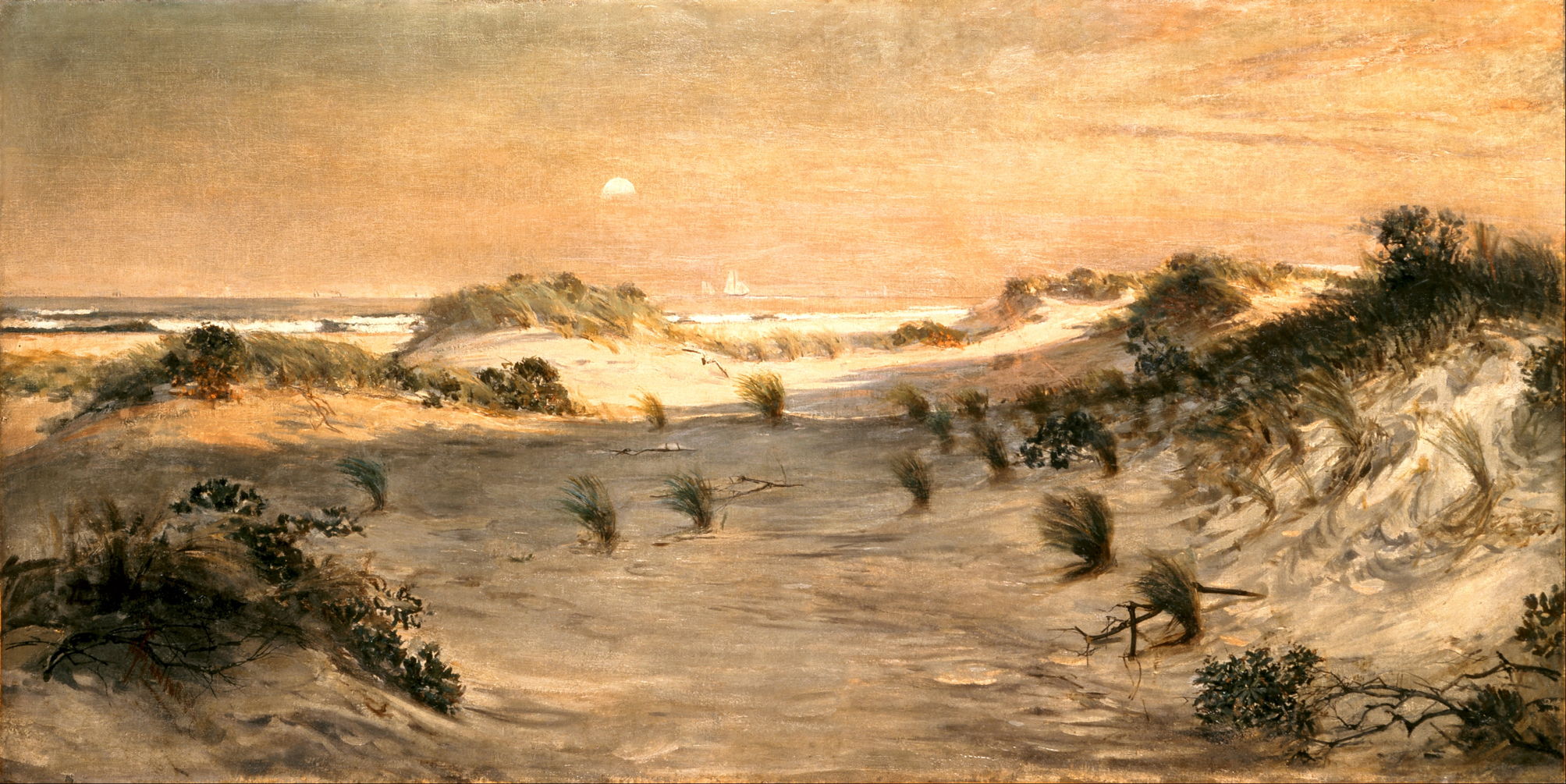
Sand Dunes at Sunset, Atlantic City (c 1885) is better established as one of his early works, and is more thoroughly Impressionist in style, showing a fleeting moment as the sun sinks over the sea. This is now one of the paintings in the collection of the White House in Washington, DC.
In 1885, Tanner exhibited his first painting at the National Academy of Design in New York, where it sold. He was sufficiently encouraged that the following year he rented his first studio in Philadelphia. In 1888, he modelled and cast the bust of his first patron, another bishop of the AME Church. In January 1889, he moved to Atlanta and opened a photographic gallery and studio. Although this helped him make many contacts, as a business it proved unsuccessful, so that autumn he started work as a drawing instructor at Clark University, Atlanta.
He left Atlanta for Rome in January 1891, but when he visited Paris on his way to Italy, he decided to stay there instead. He then started studies at the Académie Julian under Joseph Benjamin Constant and Jean-Paul Laurens. He soon made friends with Rodman Wanamaker, who was running the major US retailer’s branch in Paris and became an important patron.
Like many artists at the time, Tanner spent the summers out of Paris, usually painting in Brittany, until he suffered an episode of typhoid fever in 1893. He returned to the US to recover from that, where one of his paintings was shown at the World’s Columbian Exposition in Chicago.

Spinning By Firelight – The Boyhood of George Washington Gray (1894) is one of a group of genre works painted by Tanner in the mid 1890s, which started with his first truly successful work, The Banjo Lesson (1893). In keeping with the others, this shows the spartan living room of a small, poor country family. It was commissioned by the same George Washington Gray (1834-1913), who was by that time a Chicago Methodist Episcopalian Minister, educator, and social reformer.
In May 1894, Tanner had his first work accepted for exhibition in the Paris Salon; he continued to exhibit there annually until 1914.

The Thankful Poor (1894) is another famous painting from this group. Sometimes claimed to be the first such depiction of an African-American family, Eakins and Hovenden had already painted similar. What is most distinctive about Tanner’s is his conscious effort to counter the caricatures then so popular, and that it was respectful and naturalistic without being patronising.
He sold this painting in the autumn of 1894, to provide funds for his return to Paris.
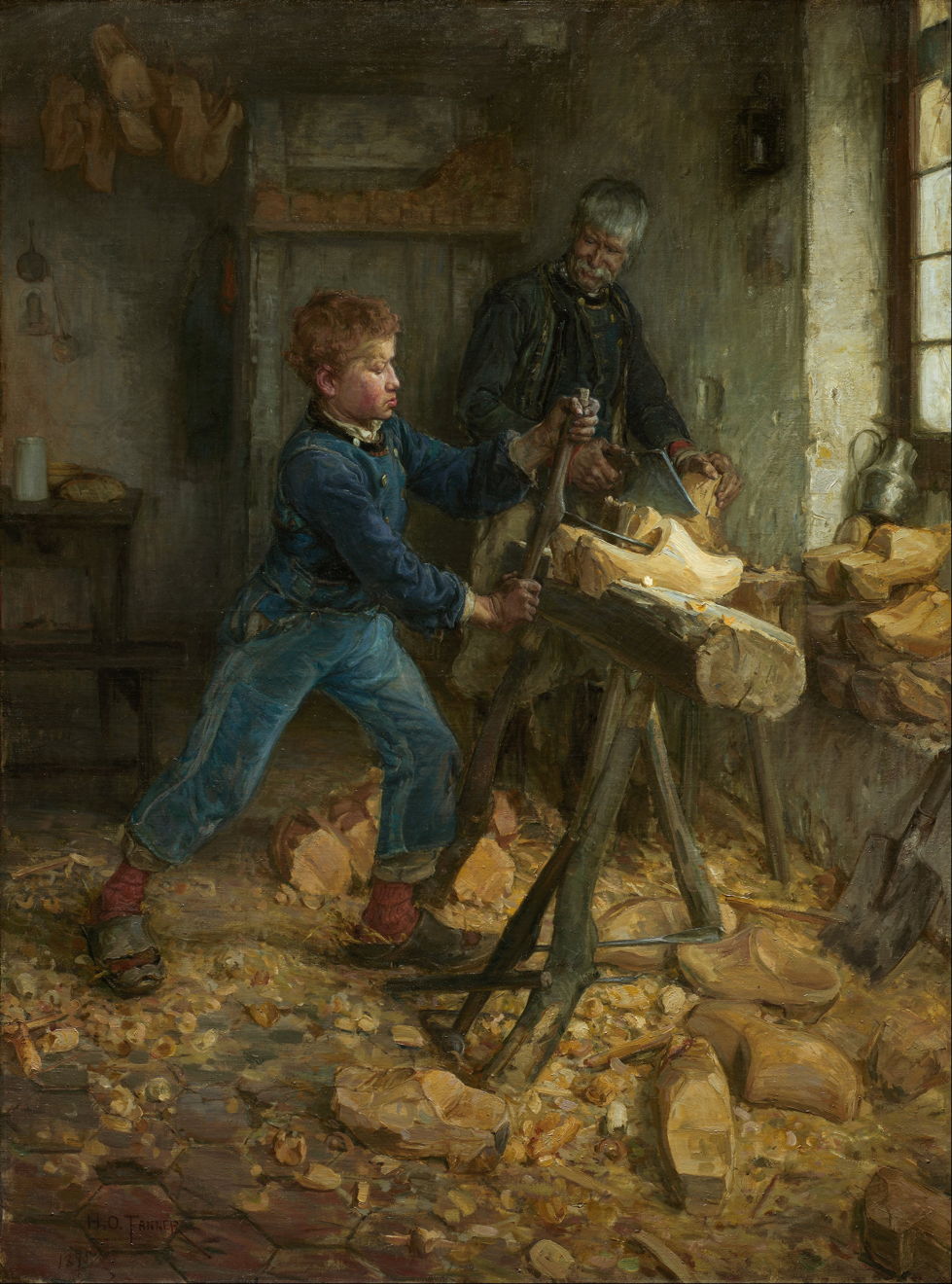
The Young Sabot Maker (1895), shown in the Paris Salon of that year, was one of the last of this small group of genre works, and a reflection on the theme of apprenticeship and learning skills, at a time in Tanner’s career when he felt he had finally completed his own training. Sabots, or clogs, were also an emblem of the working class throughout Europe, particularly in rural Brittany.

Despite being an American and occasionally returning to the US, Tanner lived in and painted France. Although not known for his French landscapes, paintings such as his Les Invalides, Paris (1896) show his developing Post-Impressionist style.

Tanner’s The Resurrection of Lazarus (1896) is the first of his major religious paintings, and an early example of his use of a limited palette. This shows the popular story of Christ bringing Lazarus back to life after he had already been interred in his tomb. His approach is naturalist and a fine example of good painted narrative. He transports the crowd of friends and relatives to the inside of Lazarus’s tomb, and shows the moment of climax as Jesus brings the corpse back to life. This painting was awarded a third-class medal at the Salon the following year, and was purchased by the French state for the Musée du Luxembourg, a great honour for an African-American.
The previous year, his first Daniel in the Lions’ Den (1895) had received critical acclaim at the Salon, but that canvas has been lost since, and wasn’t bought by the state. Marc Simpson provides a detailed account of these works in Marley (2012), which is well worth reading.
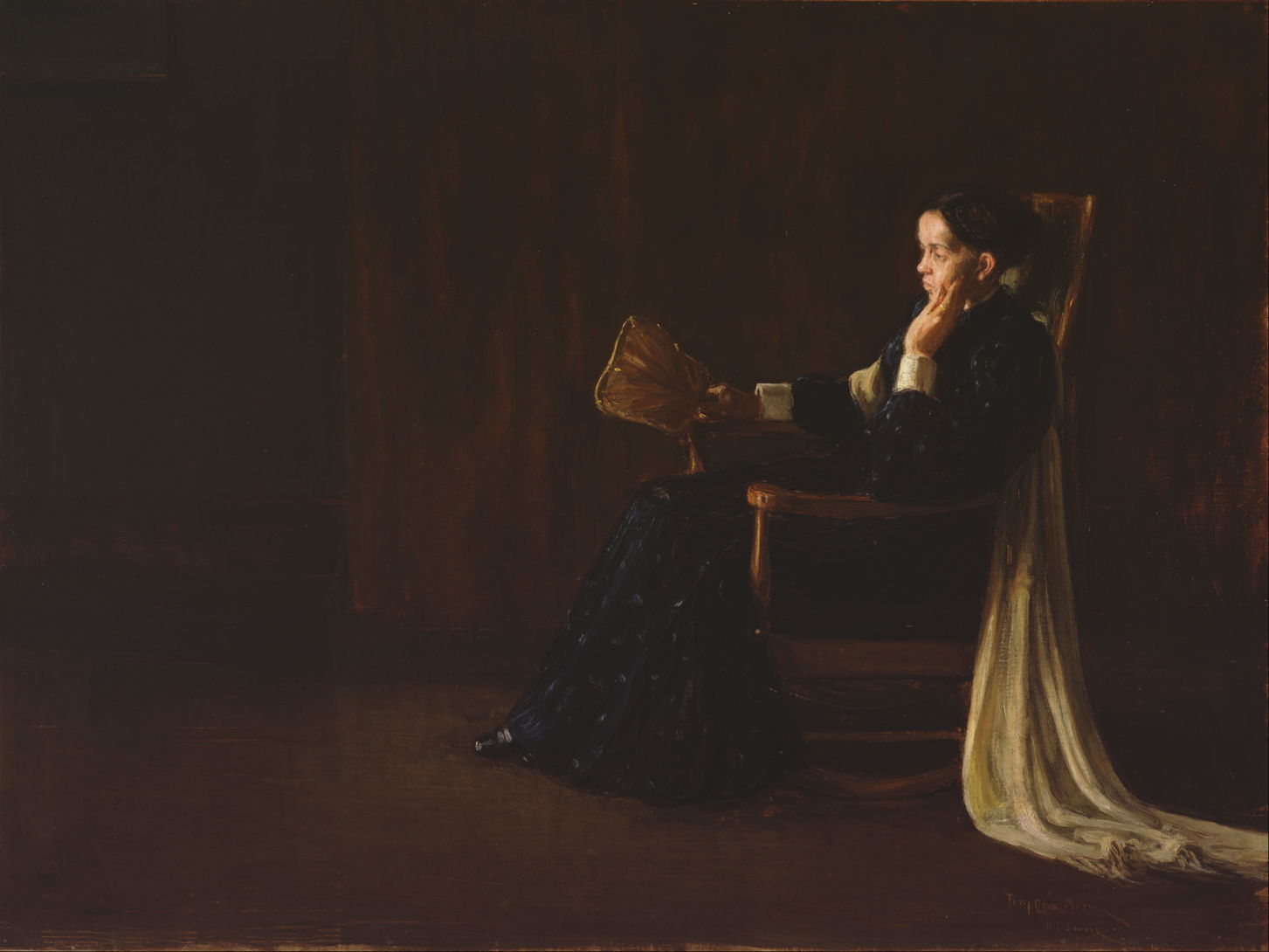
Portrait of the Artist’s Mother (1897) was conversely not intended for public consumption, and as a personal work must rank among Tanner’s best paintings. As a student he must have seen Whistler’s famous portrait of his mother from 1871, which was exhibited in Philadelphia a decade later, when Tanner was a pupil of Eakins. Coincidentally, Whistler’s painting was bought by the French state in the same year that Tanner had arrived in Paris, 1891.
Adopting a similar composition, Tanner’s portrait is both more intimate and sympathetic than Whistler’s, reflecting the contrasting relationships between the artists and their mothers.
That year, Tanner travelled to, and painted in, Palestine and Egypt, thanks to the support of Rodman Wanamaker. On his way back he toured Italy, then in the summer visited the US.
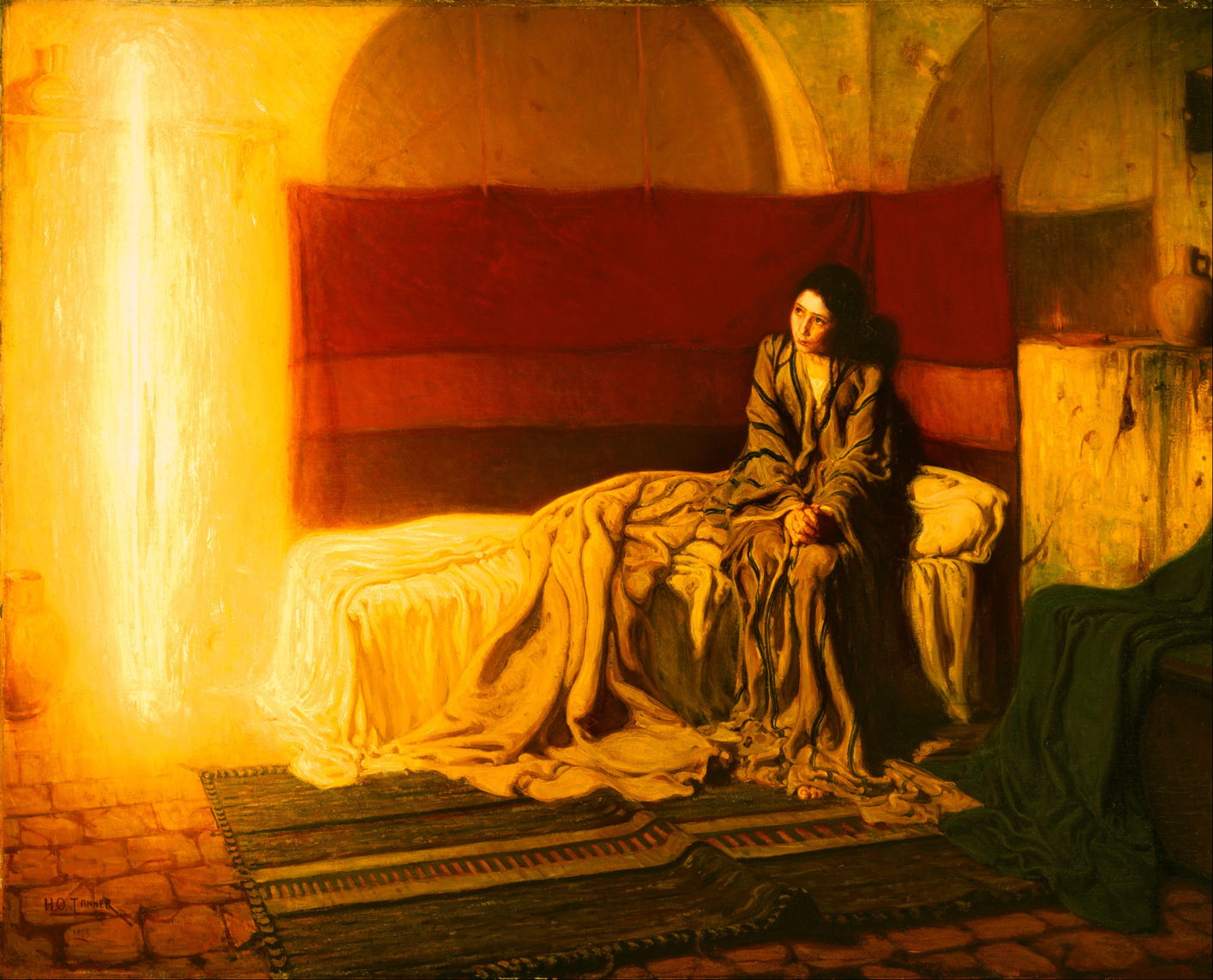
The Annunciation (1898) is one of Tanner’s most unconventional paintings of a thoroughly traditional event, the announcement by the angel Gabriel to the Virgin Mary that she was to conceive and become mother of Jesus Christ. Tanner sets the scene in the private space of Mary’s bedroom, the bedclothes rumpled untidily, and Mary in casual night dress. There is no angel as such, but a dazzling fire of the spirit, forming a subtle crucifix with a shelf behind. This was accepted for the Salon of 1898, and became a popular reproduction in magazines.
Through the winter of 1898-99 he made a second visit to the Middle East, following which he was in London to marry Jessie Macauley Olsson, a Swedish-American opera singer.
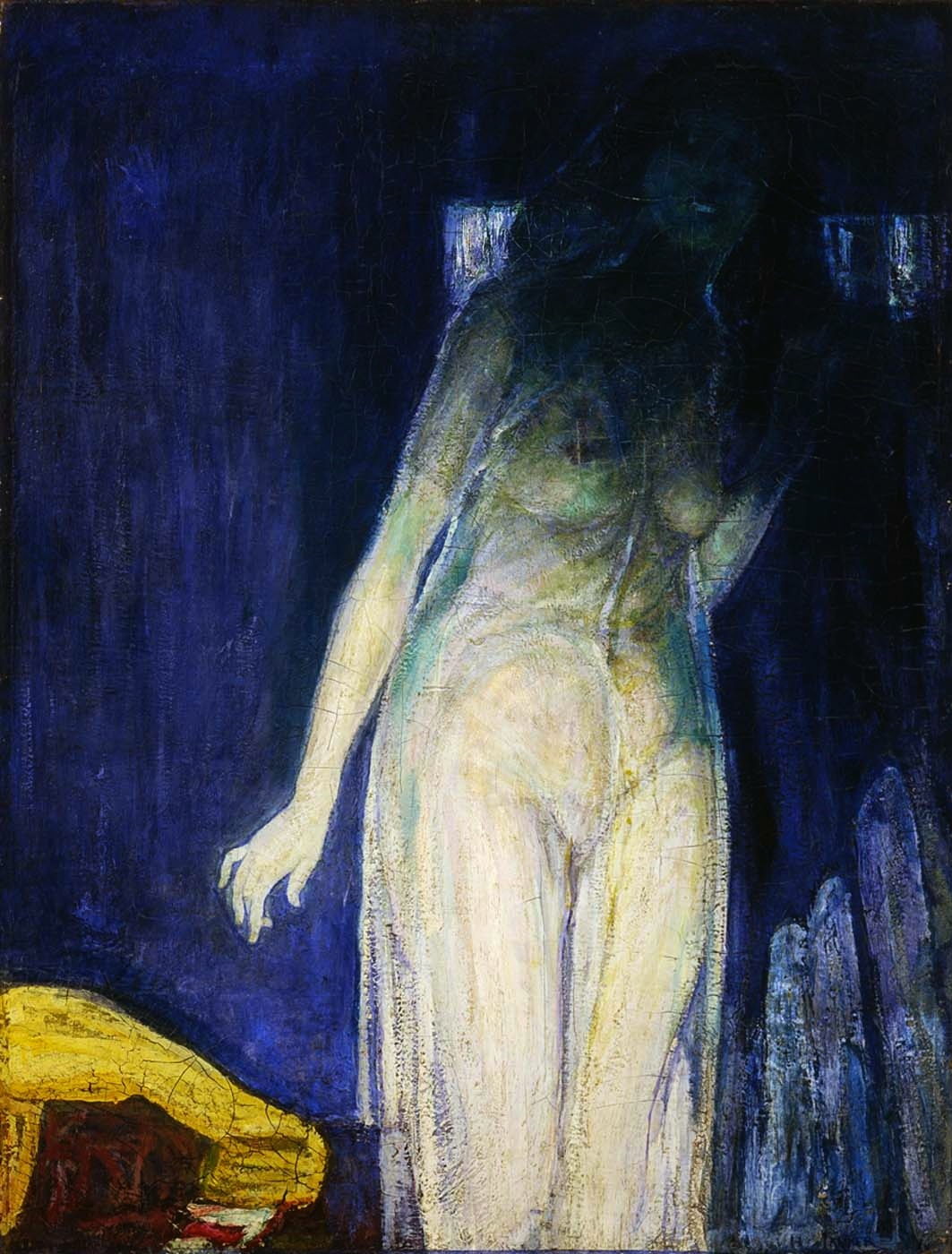
As The Annunciation had explored unusual lighting, so his Salome (c 1900) was a combination of lighting effects, the vogue for Salome (‘Salomania’) at the time, and a famous contemporary dancer who specialised in the use of such lighting effects. Here it isn’t John the Baptist who is decapitated, but apart from the faint flash of her teeth, darkness accomplishes the same for Salome herself. Tanner probably used the new electric lighting to achieve this effect in the studio, and must have come closest to showing a sensuous female figure since his early days as a student painting from casts.
In 1900, his Daniel in the Lions’ Den was awarded a silver medal at the Exposition Universelle in Paris.
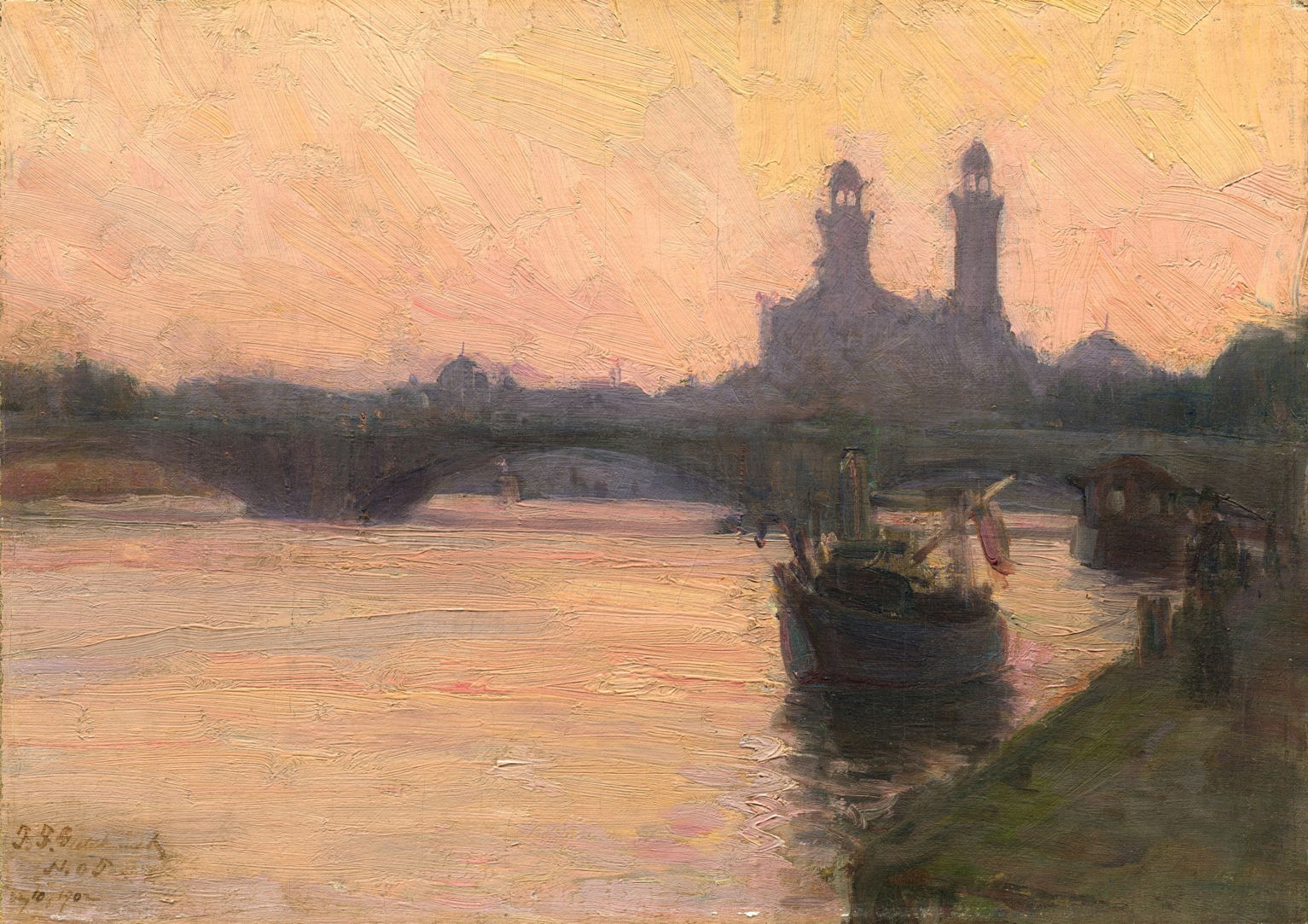
Tanner’s output at this time wasn’t confined to the religious: he continued to paint fine Post-Impressionist landscapes, such as this twilight view of The Seine from about 1902.
References
Marley AO ed. (2012) Henry Ossawa Tanner, Modern Spirit, Pennsylvania Academy of the Fine Arts & University of California Press. ISBN 978 0 520 27075 6.
此内容由惯性聚合(RSS阅读器)自动聚合整理,仅供阅读参考。 原文来自 — 版权归原作者所有。