


惯性聚合 高效追踪和阅读你感兴趣的博客、新闻、科技资讯
阅读原文 在惯性聚合中打开

推荐订阅源

N
News | PayPal Newsroom
I
InfoQ
小众软件
小众软件
T
The Blog of Author Tim Ferriss
WordPress大学
WordPress大学
V
V2EX
G
Google Developers Blog
罗磊的独立博客
量子位
酷 壳 – CoolShell
酷 壳 – CoolShell
N
Netflix TechBlog - Medium
奇客Solidot–传递最新科技情报
奇客Solidot–传递最新科技情报
P
Proofpoint News Feed
M
MIT News - Artificial intelligence
IT之家
IT之家
J
Java Code Geeks
L
LangChain Blog
D
DataBreaches.Net
F
Fortinet All Blogs
B
Blog
博客园 - 叶小钗
人人都是产品经理
人人都是产品经理
aimingoo的专栏
aimingoo的专栏
Google DeepMind News
Engineering at Meta
Engineering at Meta
P
Privacy & Cybersecurity Law Blog
Hacker News - Newest:
Hacker News - Newest: "LLM"
K
Kaspersky official blog
博客园 - 【当耐特】
T
Tenable Blog
AWS News Blog
AWS News Blog
V
Visual Studio Blog
T
Tor Project blog
阮一峰的网络日志
阮一峰的网络日志
H
Heimdal Security Blog
H
Hackread – Cybersecurity News, Data Breaches, AI and More
S
Secure Thoughts
Security Archives - TechRepublic
I
Intezer
Attack and Defense Labs
Webroot Blog
Webroot Blog
Latest news
Latest news
TaoSecurity Blog
TaoSecurity Blog
freeCodeCamp Programming Tutorials: Python, JavaScript, Git & More
Know Your Adversary
Know Your Adversary
CTFtime.org: upcoming CTF events
T
Threatpost
SecWiki News
SecWiki News
S
Security Affairs
H
Help Net Security

Comments for The Eclectic Light Company

Should you try Golden Gate beta? Solutions to Saturday Mac riddles 367 In the shadow: Diego Velázquez Comment on Last Week on My Mac: Freshen up your documents by David Comment on Happy 250th birthday America 2 by mac Happy 250th birthday America 1 Brushstrokes: Portraits 1760-1877 Spotlight and Core Spotlight are different Comment on Sort order, collation and the Finder by eyelessjerry Comment on Apple has just released macOS 26.5.2 Tahoe by Derek Currie Great Ladies of Impressionism: Marie Bracquemond Comment on Get more from your Mac’s log by extending its duration by John Gilbert Comment on Keep your Mac cool using physics by F Comment on Firmware has become complicated again by John Woods Comment on Logistician 1.2 fixes a couple of bugs by info395288a4d1d Comment on What does Activity Monitor measure? by hoakley Last Week on My Mac: Spotlight on semantics An American in Paris: paintings of Henry Ossawa Tanner 1902-1930 An American in Paris: paintings of Henry Ossawa Tanner 1880-1902 Great Ladies of Impressionism: Berthe Morisot 1874-1891 What to do with a hot Mac Deprecations and removals from Golden Gate Brushstrokes: From El Greco to Rembrandt Portraits of trees: Dutch Golden Age How to get the most from SilentKnight 3 Comment on Hero or hooligan: Achilles becomes the warrior by Deborah J. Brasket Solutions to Saturday Mac riddles 365 Comment on SilentKnight 3.0 for Apple silicon Macs running Sequoia and later (full release) by michaelriccioli Comment on Last Week on My Mac: Uncompressed compressed files by fds Comment on Explainer: Memory by jzonedotcom Comment on Colin Campbell Cooper painting America: 1896-1910 by House of Heart Brushstrokes: 16th century What can you do when an app uses too much memory? SilentKnight 3 second beta adds text and JSON reporting In the shadow: Caravaggism What to do with your encrypted HFS+ disks First beta-test version of SilentKnight 3 for Apple silicon Macs Hero or hooligan: Jason and Medea Comment on Fix documents that won’t open as expected using Quarant2 by EcleX Last Week on My Mac: The mystery of Safari’s Web Archives Last Week on My Mac: Why is it so hard to open a document? Explainer: Disk encryption In the shadow: Caravaggio Brushstrokes: innovators of the first century Changing Paintings: 36 Theseus and the Minotaur macOS virtualisation is leaping forward in Golden Gate Why can’t Preview open that PDF? Crossing the Golden Gate, Intel support, and an update to SystHist Reading the Finder’s Get Info dialog In memoriam Mary Cassatt: 2, 1880-81 Last Week on My Mac: What’s in a name? Explainer: Getting a location Get more from Get Info and the Finder’s contextual menu Stop your photos revealing your location Have you saved thousands of versions? Versatility 1.2 might be what you need Apple has released an update to XProtect for all macOS Apple has released macOS Tahoe 26.5.1 Comment on What Location Services do in macOS by Tristan Hubsch Comment on Protect files with the Locked or Immutable flag by markbot2zero Portraits of trees: Introduction Which tasks require mains power? Comment on Online reference to external displays for Apple silicon Macs by Brian What’s in that phishing email? How to search document versions Rubens’ Peace and War Comment on Last Week on My Mac: Syncing metadata in iCloud Drive by hoakley A weekend with Misia: 2 How to search Time Machine backups? Medium and message: Pottery Hero or hooligan: Theseus and the sandals How QuickLook provides thumbnails and previews Hunting extended attributes with an update to xattred Saturday Mac riddles 360 Comment on How to preserve versions, and how to create versioned PDFs by markbot2zero Comment on What gets synced in iCloud Drive? by hoakley Solutions to Saturday Mac riddles 359 Last Week on My Mac: snapshots, the elephant in APFS How to check whether Spotlight is getting the right metadata macOS Tahoe no longer fully supports Time Capsules The bicentenary of Frederic Edwin Church: 1857-77 macOS virtual machines and audio-video syncing Comment on Use Finder tags for categories by Chuck Last Week on My Mac: Dependency and skill fade Comment on Virtualisation on Apple silicon Macs is different by AndyS Painting Pandora and her box: 1883-1919 Mac Easter eggs Painting Spring blossom 2 Comment on The macOS Natural Language framework and Nalaprop by Ingo Comment on The MACL extended attribute by hoakley On Reflection: Cézanne Privacy: Which folders are protected in Tahoe? Last Week on My Mac: Root cause analysis and ClickFix Last Week on My Mac: Root cause analysis and ClickFix Last Week on My Mac: Root cause analysis and ClickFix Last Week on My Mac: Root cause analysis and ClickFix Why you can’t trust Privacy & Security How can I now have two apps named Pages? How to survive the loss of Rosetta Use Fallback Recovery on Apple silicon Macs Clean install macOS
Portraits of trees: Coppices and pollards
hoakley · 2026-06-30 · via Comments for The Eclectic Light Company

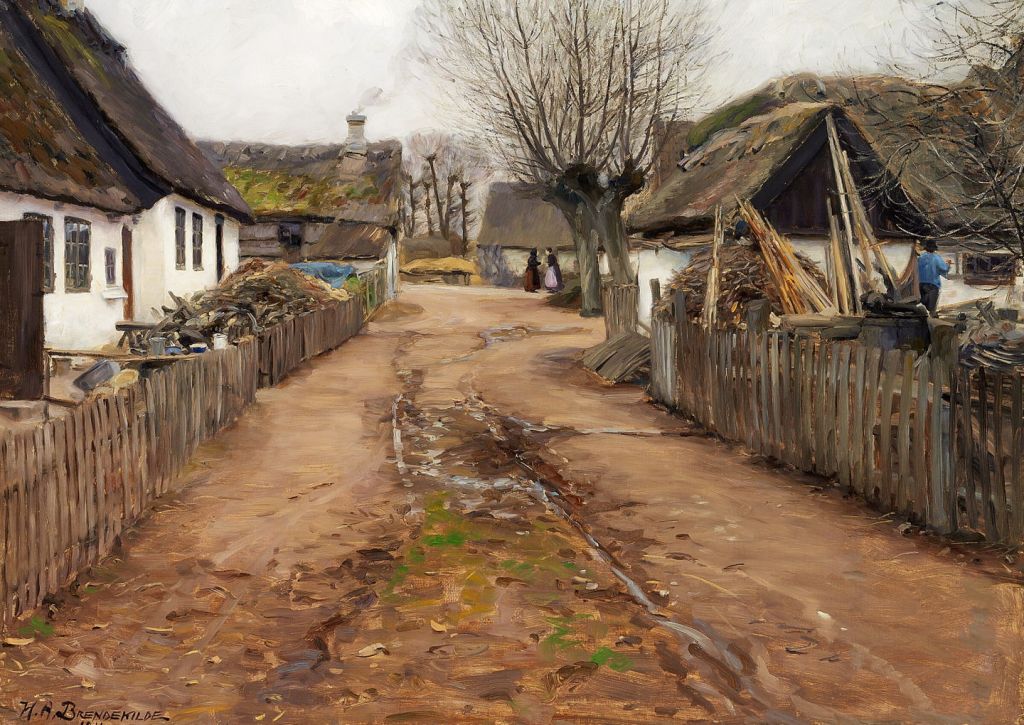
Hans Andersen Brendekilde (1857–1942), Village Scene in the Early Spring (1911), oil on canvas, 62 x 84 cm, location not known. Wikimedia Commons.

Humans have managed trees and woodland since long before recorded history. Two of the common production systems used have been coppicing and pollarding, both involving cutting a tree down to a stump and letting it regrow to produce usable timber. In coppicing, the cut surface of the stump is close to ground level, while pollards are cut well above that, sufficient to prevent animals from eating the new shoots that grow from the stump. Both techniques result in rapid growth of many thin shoots that can be harvested in anything between three to fifty years, to produce poles, staffs, firewood and wood for charcoal production.

For an artist coppice ‘stools’ aren’t attractive to paint. Soon after coppicing, there’s little to see, while mature coppices are dense masses of rising shoots.
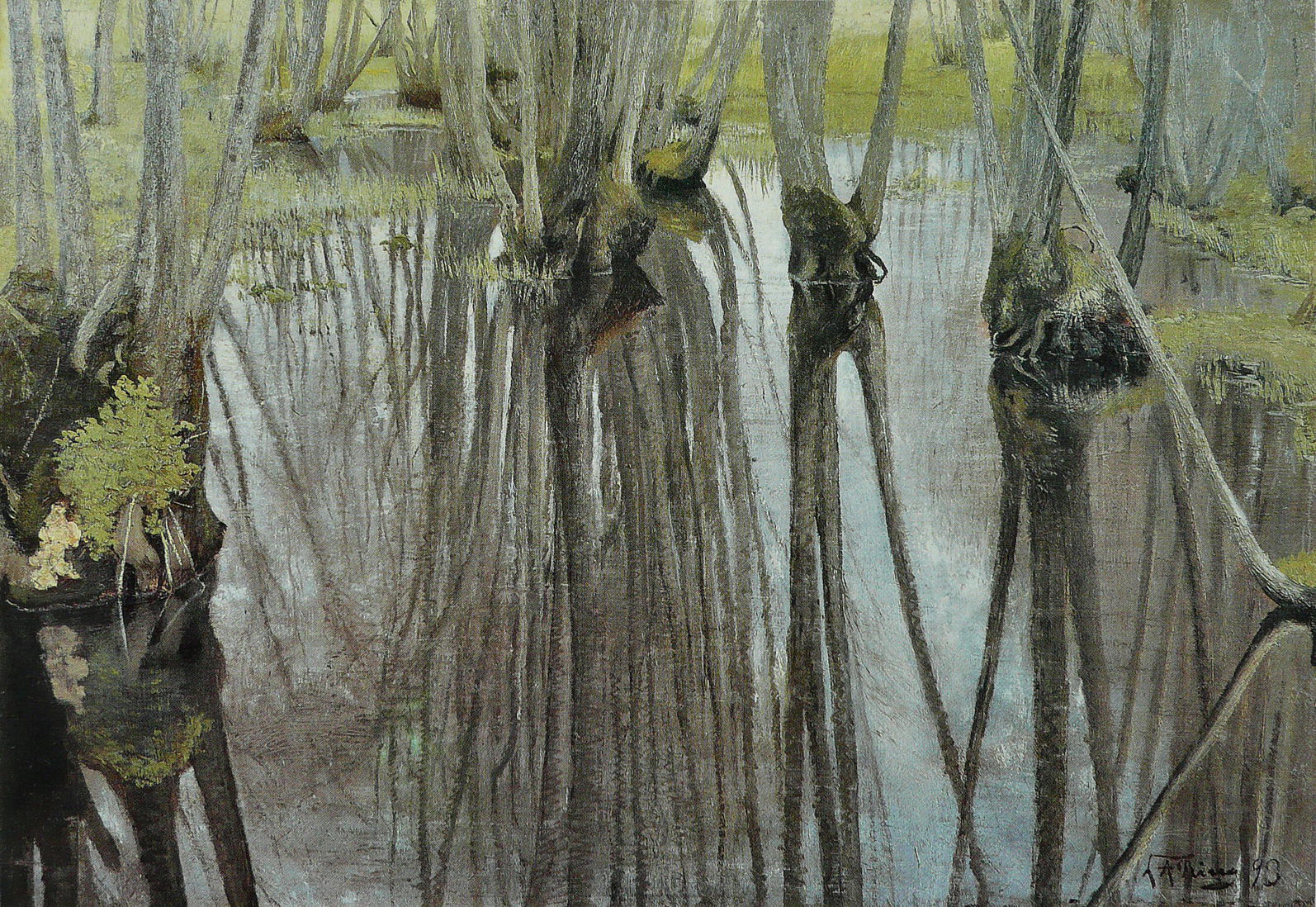
ringaldertrunks
Laurits Andersen Ring (1854–1933), Alder Trunks (1893), oil on canvas, 52.9 x 73.5 cm, Collection of Her Majesty the Queen Margrethe II, Copenhagen, Denmark. Wikimedia Commons.

Laurits Andersen Ring’s Alder Trunks from 1893 is one of relatively few fine paintings of coppices, showing these old alders mainly in reflection. The original trunks were cut just above ground level, and each has now grown multiple shoots that are maturing well.

In contrast pollards appear in many landscape paintings across Europe.
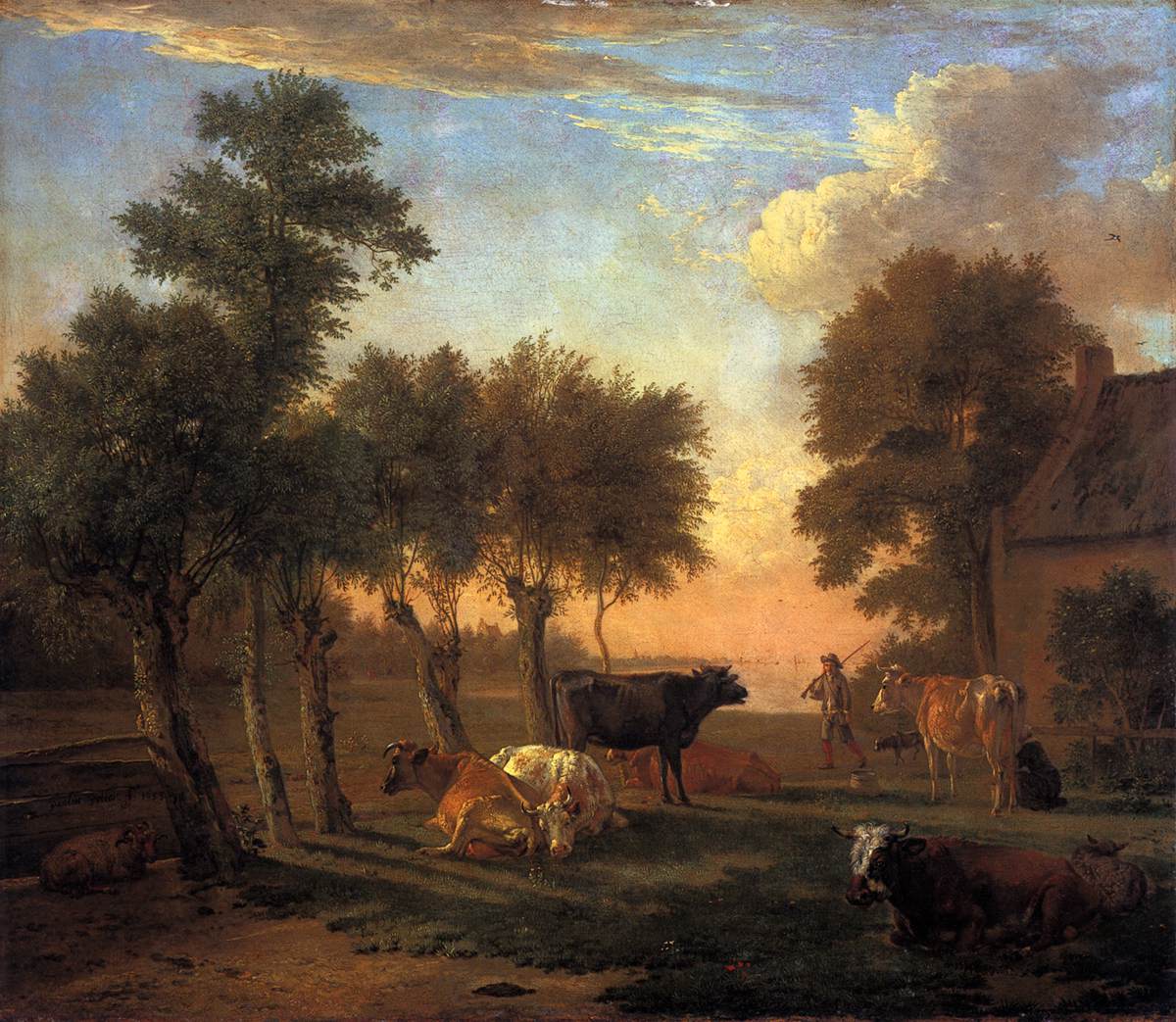
pottercowsgrazingfarm
Paulus Potter (1625–1654), Cows Grazing at a Farm (1653), oil on canvas, 58 x 66.5 cm, Rijksmuseum, Amsterdam. Wikimedia Commons.

Cows Grazing at a Farm (1653) was one of Paulus Potter’s last paintings, and shows an avenue of pollarded trees, cut at a height of about three metres (ten feet) from the ground, to ensure these cattle can’t browse their foliage.
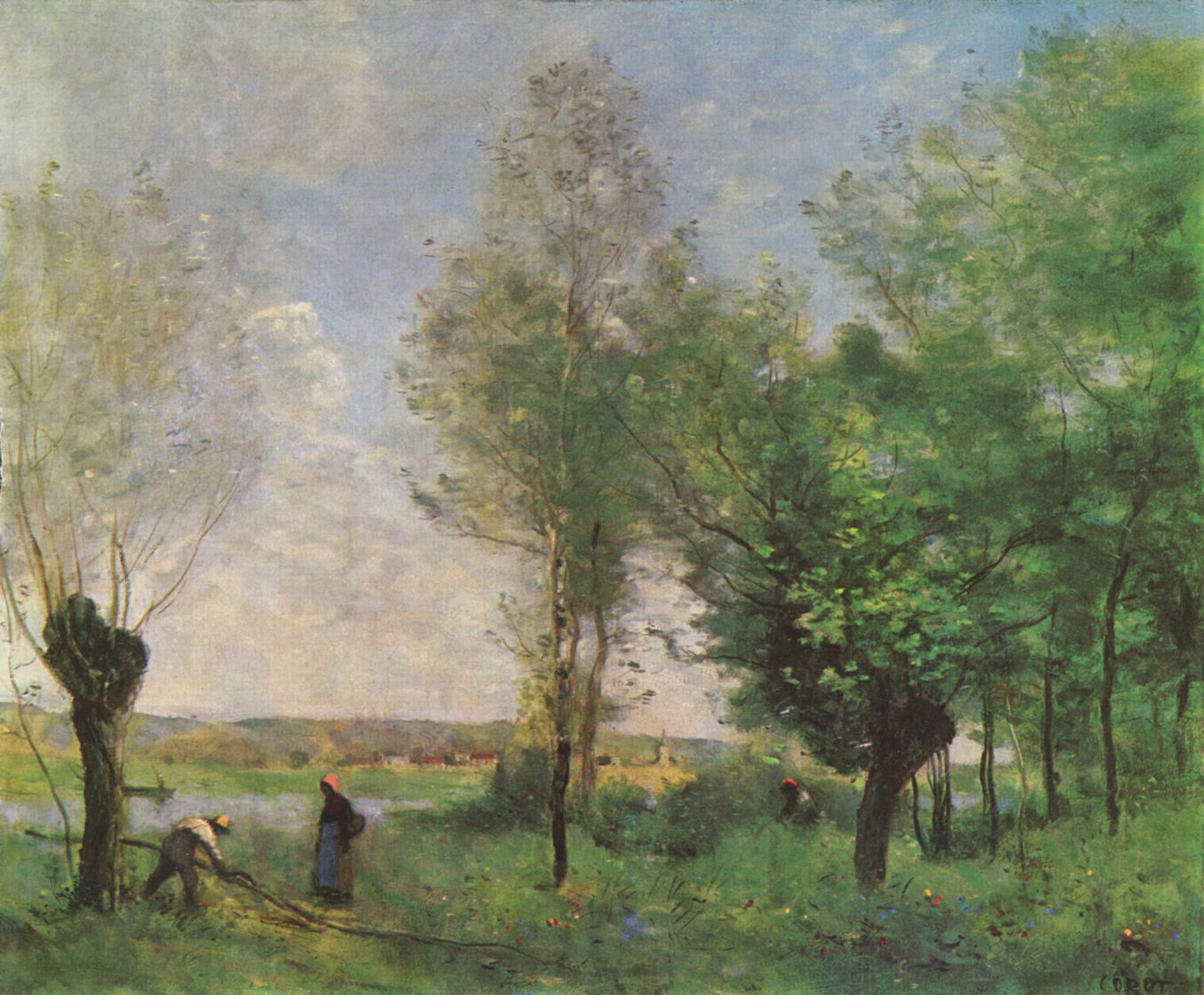
Jean-Baptiste-Camille Corot (1796–1875), Souvenir de Coubron (1872), oil on canvas, 46 x 55.3 cm, Museum of Fine Arts, Budapest. Wikimedia Commons.

Souvenir de Coubron (1872) is one of Camille Corot’s last but finest souvenirs, with a distinctly early Impressionist look. Unlike most of his others, its colours are more saturated and varied, with hats and flowers in bright reds and yellows, and rich greens throughout its lush vegetation. A couple of its trees are pollards, which are relatively unusual in Corot’s paintings. At the left a man is gathering long poles freshly cut from the pollard beside him.

sisleyboatfloodportmarly
Alfred Sisley (1839–1899), Boat in the Flood at Port-Marly (1876), oil on canvas, 50 x 61 cm, Musée d’Orsay, Paris. Wikimedia Commons.

A dense array of pollards are shown partially submerged in Alfred Sisley’s Boat in the Flood at Port-Marly, painted in front of the motif in 1876. Some of these have been allowed to grow higher so they now tower above the rest.

brendekildelaring
Hans Andersen Brendekilde (1857–1942), L.A. Ring Paints at Aasum Smithy (1893), oil on canvas, 107 x 140 cm, location not known. Wikimedia Commons.

Hans Andersen Brendekilde’s L.A. Ring Paints at Aasum Smithy from 1893 features an avenue of old pollards either just coming into leaf in the Spring, or shedding at the start of autumn. It has been common practice to pollard trees that are close to buildings, as in this village, to reduce the risk of damage during storms and provide a convenient supply of firewood. This is in the village of Åsum (or Aasum), to the east of Odense in Denmark.

muenieranglerbystream
Jules-Alexis Muenier (1863–1942), Angler by the Stream (date not known), oil on canvas, 38.5 x 46.5 cm, Private collection. The Athenaeum.

Jules-Alexis Muenier’s undated Angler by the Stream is a pastoral view at the edge of a village, showing a fisherman working the river close to a small wooden bridge. A woman, possibly his wife, is crossing the bridge and appears to have stopped to talk to him from there. Behind her are two magnificent pollards, probably willows, in full leaf.
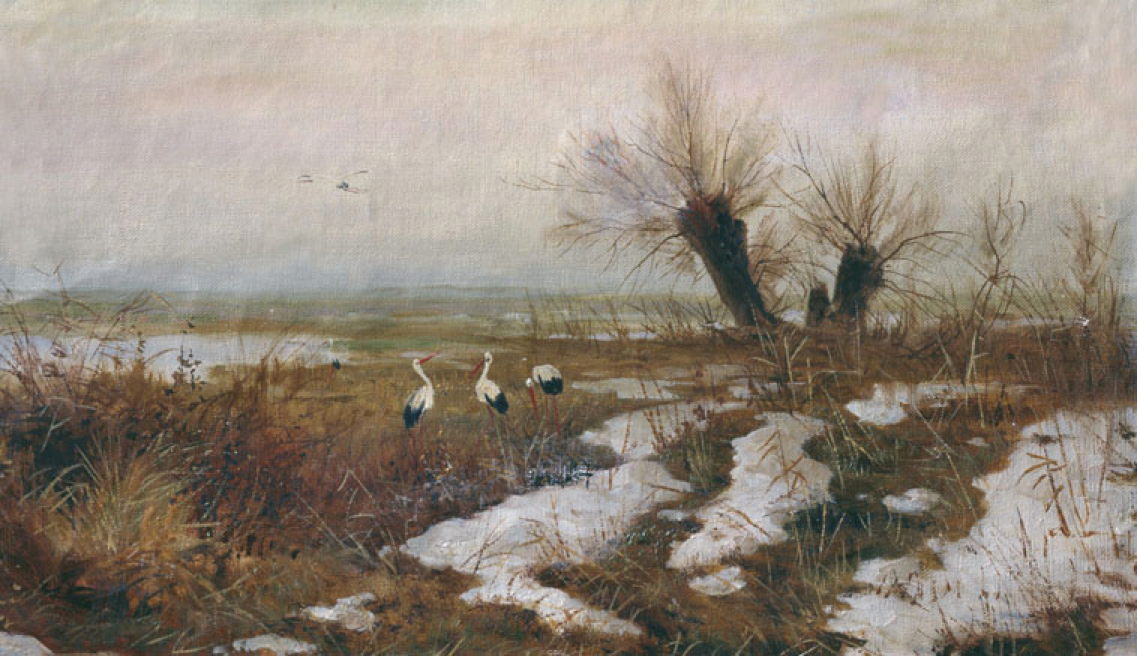
svitoslavskyistorks
Serhii Svitoslavskyi (1857–1931), Landscape with Storks (c 1905), further details not known. Wikimedia Commons.

Serhii Svitoslavskyi’s Landscape with Storks, from about 1905, shows a group of white storks returning to their wetland breeding grounds in Ukraine in the early Spring. Judging by their girths, the prominent pollards must be truly ancient, and must have provided many generations with firewood.

brendekildevillageearlyspring
Hans Andersen Brendekilde (1857–1942), Village Scene in the Early Spring (1911), oil on canvas, 62 x 84 cm, location not known. Wikimedia Commons.

Brendekilde painted this Village Scene in the Early Spring in 1911. The rutted mud track is slowly drying from its winter role as the main drain. A man is out cleaning the tiny windows of his cottage, and two women have stopped to talk in the distance. Smoke curls idly up from a chimney, and two leafless pollards stand waiting for the season to progress.

I finish this short selection with the strangest of them all, found on the shore of a fjord in Norway by Nikolai Astrup.

astrupmarchmorning
Nikolai Astrup (1880–1928), March Morning (c 1920), oil on canvas, dimensions and location not known. Wikimedia Commons.

The motif in Astrup’s March Morning from about 1920 originated from woodcuts based on an earlier painting from 1913, in which he progressively focussed on bare willow twigs. By 1916, those were showing a human form emerging from the willow trunk, from which came this strikingly supernatural painting of an old willow pollard.