


 Henry Ossawa Tanner (1859–1937), Daniel in the Lions' Den (1907-18), oil on paper mounted on canvas, 104.5 x 126.8 cm, Los Angeles County Museum of Art, Los Angeles, CA. Courtesy of Los Angeles County Museum of Art, via Wikimedia Commons.
In 1900, the African-American painter Henry Ossawa Tanner had been awarded a silver medal at the Exposition Universelle in Paris, and his unconventional religious paintings had been winning him acclaim at the Paris Salon. Although he did return to the US occasionally, he had worked in Paris for much of the previous decade.

The Good Shepherd (1902-3) is an example of a painterly and almost monochromatic nocturne used to create ‘atmosphere’ in his religious works of this time.

Abraham’s Oak from 1905 is a similar nocturne showing an ancient oak tree that survived until 1996. Tradition claimed this marked the place where three angels appeared to Abraham, or Abraham pitched his tent. The location is just south-west of Mamre, near Hebron. The story runs that Abraham washed the feet of three strangers who appeared there, and showed them hospitality. They revealed themselves to be angels, and informed Abraham that his wife would become pregnant and bear him a son. This is cited as an example of the importance of showing hospitality to others, although ironically the site is now centre to a dispute between the Russian Orthodox church and Palestinians.
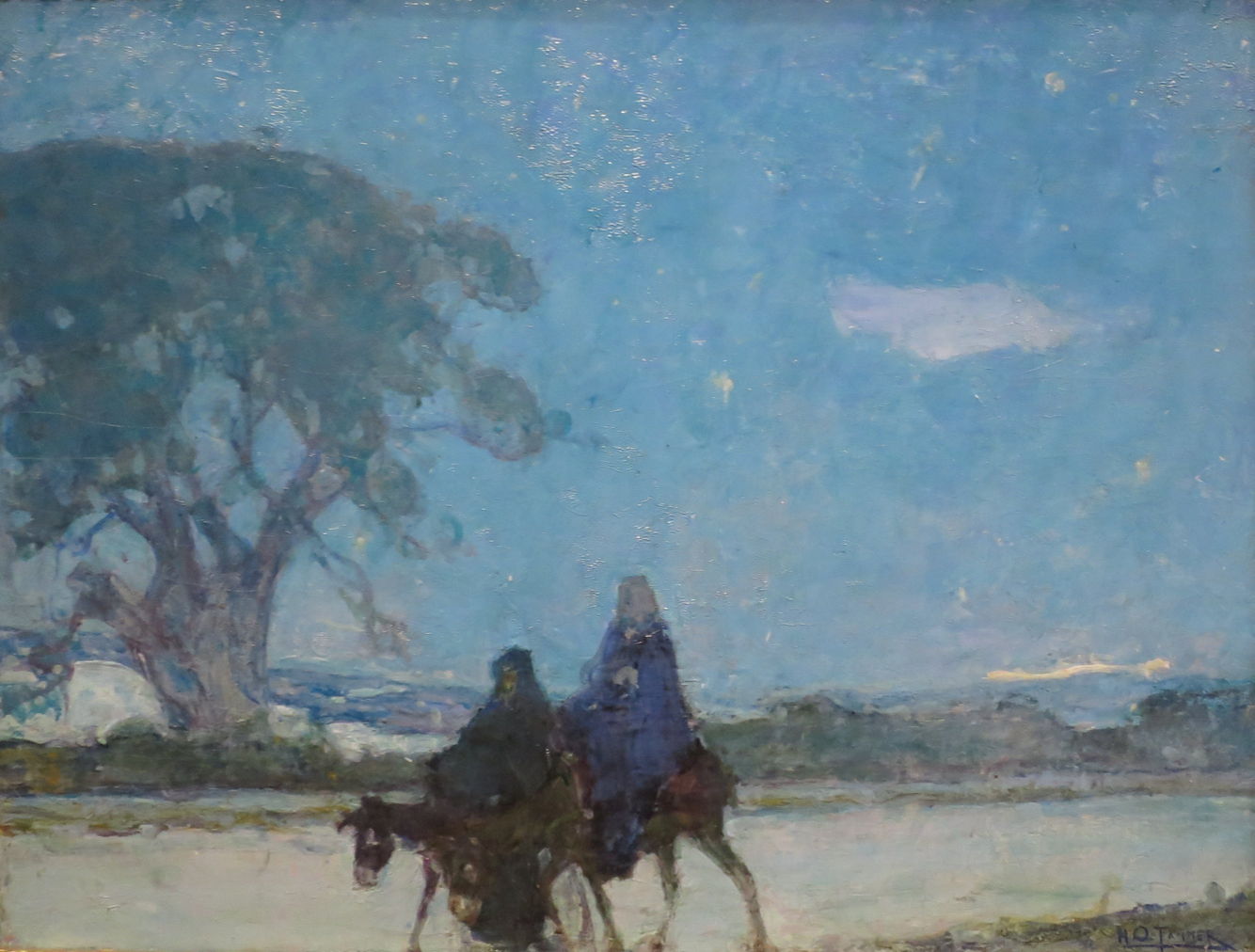
The Flight into Egypt (c 1907) is one of at least two paintings in which Tanner showed Christ’s family fleeing to Egypt to avoid Herod’s imminent massacre of infants, as described in the Gospel of Matthew (2:13-23). This has long been a popular story for paintings, which often incorporate a highly inventive landscape. With his recent experience of travel in both Palestine and Egypt, Tanner has clearly tried to be more geographically appropriate.
In early 1908, Tanner’s travels took him to Algiers. At the end of that year, he had his first major solo exhibition at the American Art Galleries in New York. In the following year, he was elected an associate member of the National Academy of Design, together with Mary Cassatt and George Bellows.

His Angels Appearing before the Shepherds (c 1910) brought his loose brushstrokes, rubbings, and scumbled passages closer to Symbolism, in telling this simple episode from the story of the nativity. He again limits his colours, with a single patch of orange at the lower right, indicating a small open fire, amid an abundance of blues and a few greens.
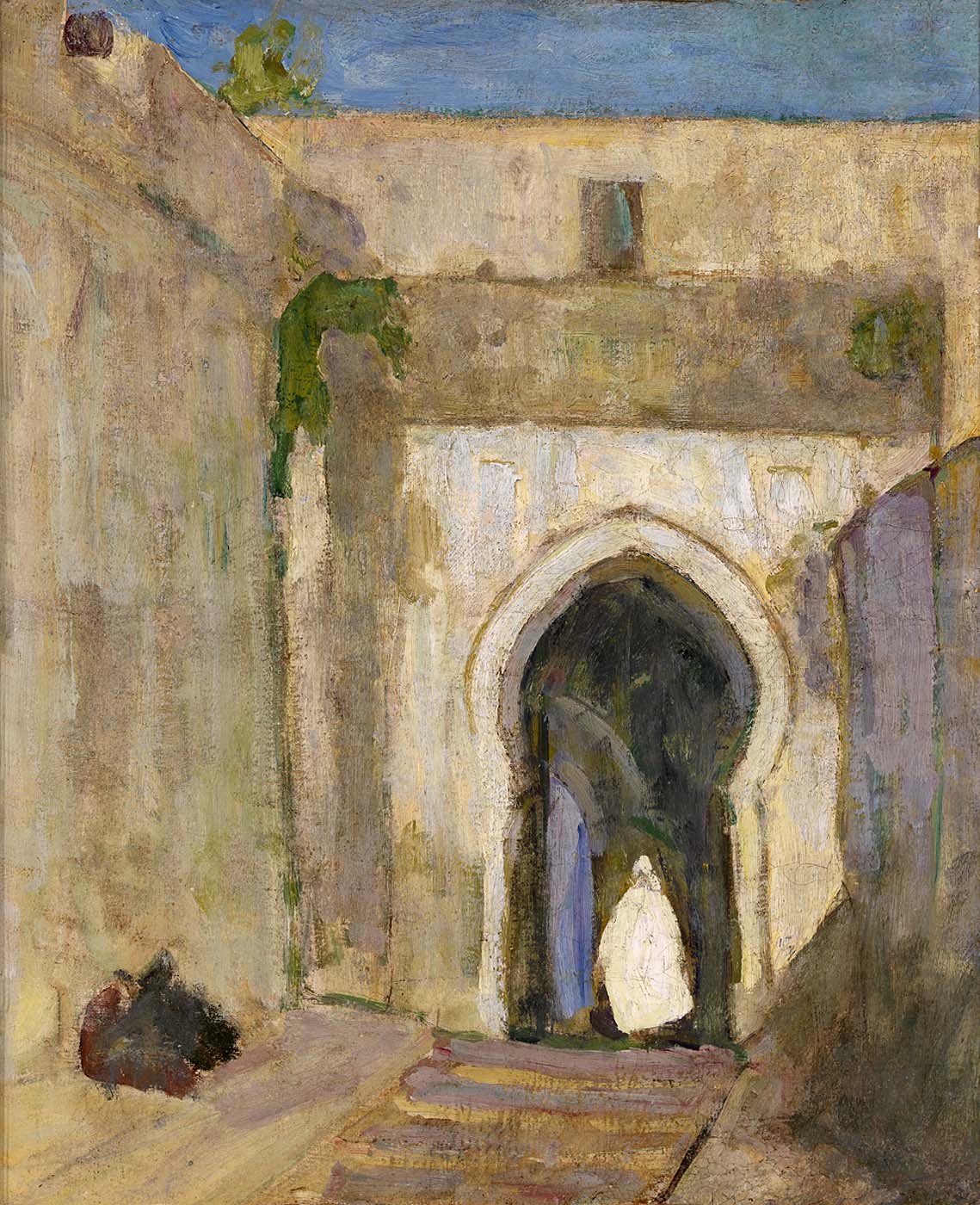
The keyhole-like Gateway, Tangier (c 1910) reveals a fascination with the shape of such entrances in north African architecture, which in turn may allude to Christ’s teachings.

An apparently identical location appeared a couple of years later, in his Entrance to the Casbah (1912). In spite of its similarity with the earlier Gateway, Tangier, it’s presumed he painted this during his return visit to Tangier and other parts of Morocco that year.
Early in 1913, his works were shown in another major solo exhibition at the Thurber Art Galleries in Chicago, followed by a solo in Knoedler’s Gallery, New York.
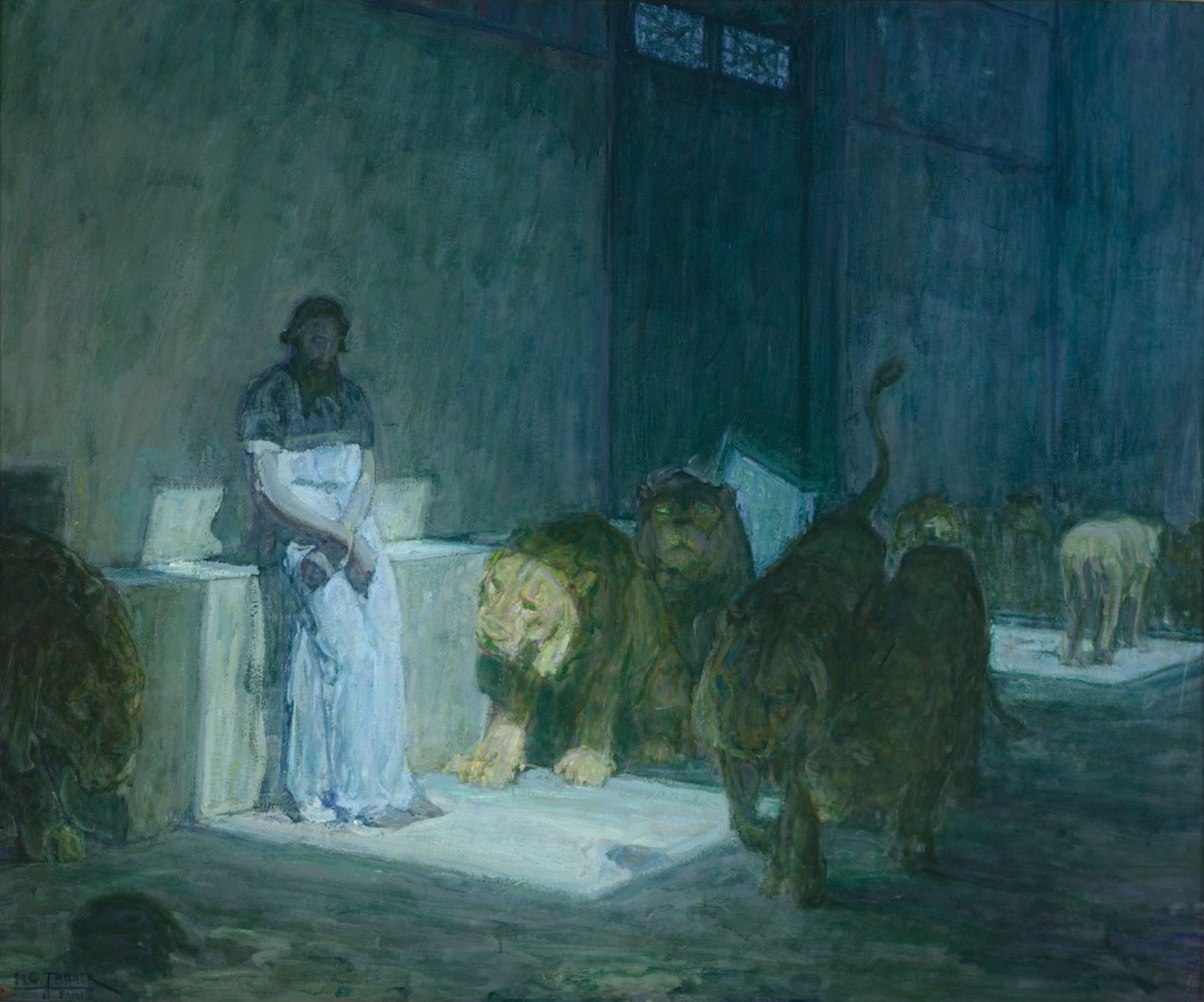
I have been unable to discover when his first painting of Daniel in the Lions’ Den became lost, but between about 1907 and the end of the First World War in 1918, he painted another version with looser brushstrokes, and cropped slightly differently. Tanner had a fondness for painting lions since his student days in Philadelphia, and had at first considered specialising in the painting of animals. Some have suggested that this painting might refer to Androcles and the Lion, Androcles being a slave who gained freedom and success. This is another example of his tightly constrained colour, and his skilled use of light, which must have been key to the original’s successful reception.
At the outbreak of war in 1914, Tanner and his family left France to take shelter in London, but he returned to carry out relief work in France during the autumn of that year. He openly admitted that he found the war very distressing, as he wanted to do something useful to help the war effort. From 1917-19, he did so by serving in France as an officer in the American Red Cross.
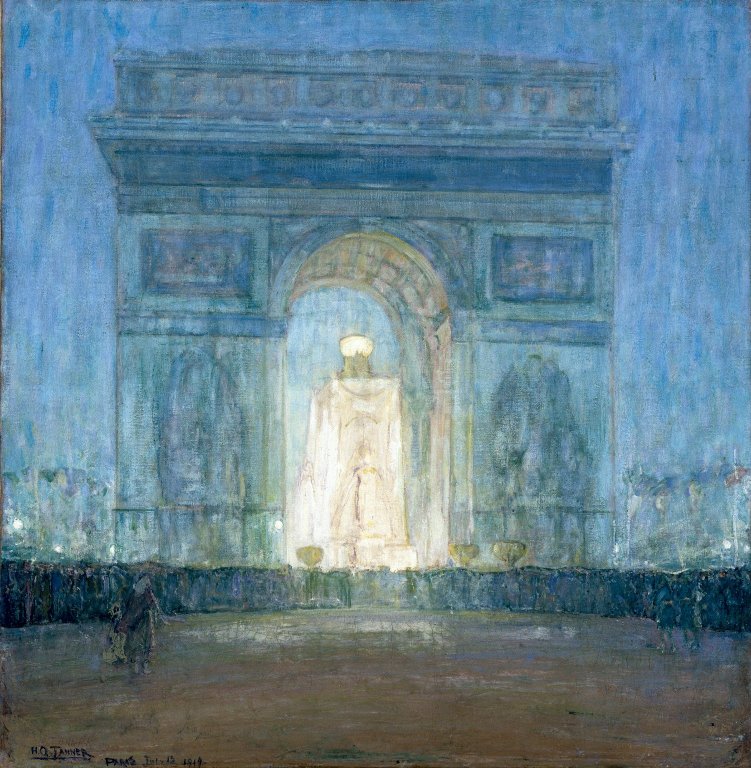
His The Arch (1919) is a record of events in the evening of 13 July 1919, when a cenotaph in memory of French soldiers was built under the Arc de Triomphe in Paris, and was lit dramatically for a large public gathering. His slight readjustment to that reality may have been the symbolic addition of a widow and orphan in the foreground at the left, and a couple of uniformed veterans to the right.

Tanner’s second version of the Flight into Egypt (1923) is also set at night, but is composed to show the Holy Family as a group. Again this uses light skilfully, with the cast shadow creating the effect of a halo around Mary’s head, as she cradles the infant Jesus on her donkey.
That year Tanner received the accolade from the French government of election to the Legion of Honour, but two years later his world collapsed when his wife Jessie died. He found it difficult to paint after that, but recognition and honours continued, and in 1927 he was elected a full academician at the National Academy of Design.

Among the paintings of his final years were several nocturnes on religious themes, and his more apocalyptic The Destruction of Sodom and Gomorrah (1929-30). Unusually he painted this in tempera and varnish on cardboard. In 1930, he exhibited in the Venice Biennale, and died just two years before the next World War, in France where he had painted for over forty-five years.
References
Marley AO ed. (2012) Henry Ossawa Tanner, Modern Spirit, Pennsylvania Academy of the Fine Arts & University of California Press. ISBN 978 0 520 27075 6.
此内容由惯性聚合(RSS阅读器)自动聚合整理,仅供阅读参考。 原文来自 — 版权归原作者所有。