


惯性聚合 高效追踪和阅读你感兴趣的博客、新闻、科技资讯
阅读原文 在惯性聚合中打开

推荐订阅源

Microsoft Azure Blog
博客园_首页
博客园 - Franky
钛媒体:引领未来商业与生活新知
钛媒体:引领未来商业与生活新知
宝玉的分享
宝玉的分享
月光博客
月光博客
酷 壳 – CoolShell
酷 壳 – CoolShell
S
SegmentFault 最新的问题
WordPress大学
WordPress大学
P
Palo Alto Networks Blog
腾讯CDC
I
Intezer
A
Arctic Wolf
Jina AI
Jina AI
OSCHINA 社区最新新闻
OSCHINA 社区最新新闻
爱范儿
爱范儿
Hugging Face - Blog
Hugging Face - Blog
S
Securelist
Simon Willison's Weblog
大猫的无限游戏
大猫的无限游戏
T
Tailwind CSS Blog
Cloudbric
Cloudbric
Apple Machine Learning Research
Last Week in AI
Last Week in AI
博客园 - 司徒正美
C
CXSECURITY Database RSS Feed - CXSecurity.com
Cyberwarzone
Cyberwarzone
T
Threat Research - Cisco Blogs
T
Troy Hunt's Blog
美团技术团队
Application and Cybersecurity Blog
IT之家
IT之家
小众软件
小众软件
T
The Exploit Database - CXSecurity.com
Latest news
Latest news
N
News and Events Feed by Topic
S
Schneier on Security
量子位
罗磊的独立博客
V2EX - 技术
V2EX - 技术
雷峰网
雷峰网
Security Latest
Security Latest
L
LINUX DO - 热门话题
J
Java Code Geeks
博客园 - 【当耐特】
Threat Intelligence Blog | Flashpoint
Hacker News - Newest:
Hacker News - Newest: "LLM"
博客园 - 三生石上(FineUI控件)
The Cloudflare Blog
L
Lohrmann on Cybersecurity

School of Computer Science News

Tepper School of Business and School of Computer Science Partner to Launch AI for Business Executive Education Program Carnegie Mellon Researchers Lead Three DOE Genesis Mission Awards to Advance the Future of AI-Enabled Scientific Discovery Snake Robots Support Earthquake Search and Rescue in Venezuela Lindlbauer Receives NSF CAREER Award for Adaptive Extended Reality Interfaces Fredrikson Earns Test of Time Award for AI Security CMU Advances Defense Manufacturing and Military Education at Pennsylvania Defense and Innovation Summit Looking Ahead: AI Needs UI Liu Receives NSF CAREER Award Carnegie Foundry, Carnegie Mellon and American Drone Manufacturers Launch Initiative to Supercharge America Stepping Toward Better Mobility Natalie Hatcher Turns Closed Doors Into Open Futures for High School Students - The Piper - Carnegie Mellon University When One Drone Isn’t Enough: CMU Builds Swarms for High-Stakes Response Efforts Carnegie Mellon’s Richard King Mellon Hall of Sciences Enters New Phase of Construction Researchers Channel AI To Solve Open Mathematical Problems Fujitsu Joins CMU Robotics Innovation Center The Missing Infrastructure for AI-Powered Robots - Robotics Institute Carnegie Mellon University Carnegie Mellon University Selects OptiTrack as Motion Capture Technology Partner for New Robotics Innovation Center | Optitrack.com | Optitrack.com CMU Team Rises to Amazon Nova AI Challenge - Language Technologies Institute - School of Computer Science - Carnegie Mellon University NoRILLA Wins Global Competition Don’t Let FOMO Be Your Organization’s AI Strategy CMU Researchers Train Robots With Internet Videos - Robotics Institute Carnegie Mellon University Carnegie Mellon and Meta Partner To Develop AI Tools for Emergency Response Singing a New Tune: Computational Music — The Link - The Magazine of CMU's School of Computer Science Pathak Receives 2026 PAMI Young Researcher Award Carnegie Mellon Team Helps Farmers Fight Crop Disease With Robots EcoAssist Shows Devs Greener Ways to Code Bacteria Can Learn and Form Memories Without a Brain Sandholm Receives SIGecom Test of Time Award SURF Grant Powers Research Into the Genetics of Bipolar Disorder Chen Receives NSF CAREER Award for Research in Machine Learning Systems Vatican Calls on Waibel to Help Shape AI Ethics — The Link - The Magazine of CMU's School of Computer Science Frank Pfenning Receives Herbrand Award How Do Boomers Really Feel About AI? Decoding Muscle Fatigue With Radar - Electrical and Computer Engineering - College of Engineering - Carnegie Mellon University Listening to Your Fingertips Test of Time Award - Electrical and Computer Engineering - College of Engineering - Carnegie Mellon University Let Me Entertain You: How SCS Trains the Minds Who Shape How We Play — The Link - The Magazine of CMU's School of Computer Science Delphi Group Uses Data To Forecast the Flu and Other Epidemics Carnegie Mellon extends historic run with its fifth straight MITRE eCTF title NVIDIA Founder, CEO Jensen Huang to Carnegie Mellon University Graduates: ‘Shape What Comes Next’ CMU Researchers Develop AI System to Help Prevent Airport Collisions Kaplow Named 2026 Searle Scholar New CMU Tool Reduces Manual Work To Accelerate Medical Analysis Rosenfeld Named University Professor Work Hard and Dream Harder Xing Named 2026 ISCB Fellow CMU Tool Prevents Anxiety Spirals When Searching for Medical Advice Online Design Tweaks That Keep Students Learning Job Interviews, But Make It a Game Night CyLab study finds “privacy-preserving” tracking alternatives may still expose users Bringing Computational Sciences to Health and Human Services — The Link - The Magazine of CMU's School of Computer Science How Transformational Play Is Shaping CMU’s Next Research Frontier - Center for Transformational Play - Carnegie Mellon University Playing on Common Ground: CMU Monster Game Helps Groups Work Across Differences Fujitsu, CMU Launch Joint Center for Physical AI Pennsylvania Universities and Commonwealth Leaders Launch Keystone AI + Quantum Factory CMU Teams Recognized in Moonshots AI Competition After you’re gone, who gets your passwords? Compeau Inducted Into 2026 AIMBE College of Fellows Chan Wins AHA Career Development Award CMU Tops U.S. News Graduate CS Rankings The AI Is in the Room Bridging the Communication Gap With AI Earbuds that Listen to the Heart - Electrical and Computer Engineering - College of Engineering - Carnegie Mellon University CMU Launches Keystone Astronomy & AI Visiting Fellows Program Obituary: David J. Farber Earned Nickname 'Grandfather of the Internet' CMU Research Challenges Long-Held Ecological Belief of How Rare Species Survive Teaching AI-Generated Scenes To Obey Physics Saxena, Saint Phalle Receive Stehlik Scholarship Application Opens for 2026 LearnLab Summer School AI4BIO Selects Inaugural Projects for Biomedical Discovery - Center for AI-Driven Biomedical Research - School of Computer Science - Carnegie Mellon University MSCF Program Adds Accelerated Option for CMU Undergraduates Akshat Prakash Serano Tannason
When an AI Bot Becomes Your Boss
2026-03-17 · via School of Computer Science News
A study from the Human-Computer Interaction Institute found that AI isn't likely to replace managers in the workplace, but it could help with routine tasks.

The Breakdown

  • Researchers studied AI manager clone agents that learn a supervisor's role and assist in managing workplace tasks.
  • AI may shift — but not replace — management, handling routine tasks while humans focus on interpersonal responsibilities.
  • Study participants saw some potential benefits but worried about impacts on trust, relationships and power dynamics.

 ***

Artificial intelligence isn't likely to replace managers in the workplace, but it can help with routine tasks, a study by researchers in Carnegie Mellon University's School of Computer Science found. 

According to the researchers, AI manager clones — generative AI-powered digital surrogates trained on a manager's communication and decision-making patterns — could handle tedious or impersonal tasks in the workplace so human leaders can focus on mentorship, strategy and connecting with their employees.

They also found that employees often value managers for their emotional intelligence and personal understanding.

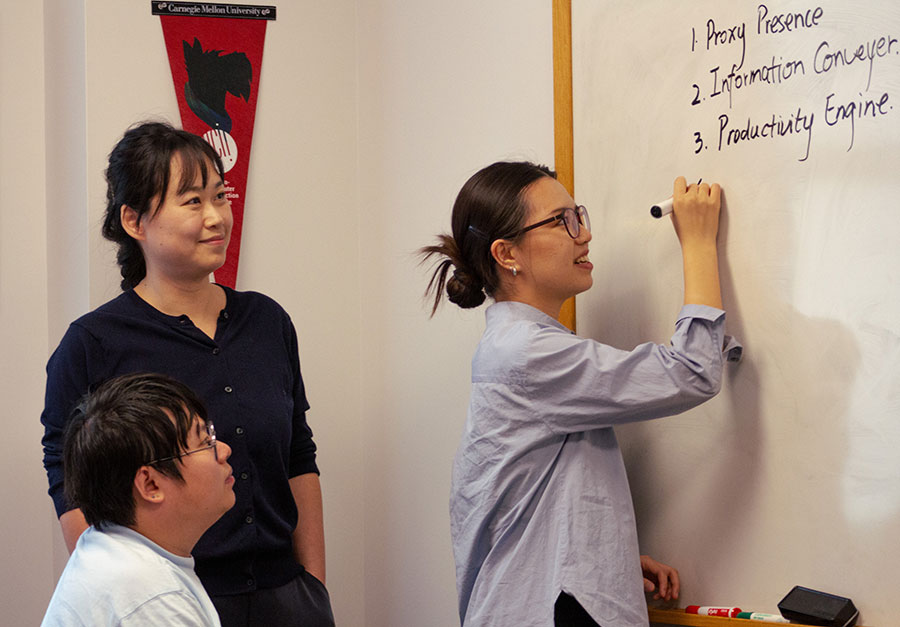
"Through this study, we learned that a lot of managerial work is informational and decision-based, and we've witnessed that AI is good at taking over these tasks," said Qing Hu, who led the study as an intern in the Collective AI Research and Evaluation (CARE) Lab in the Human-Computer Interaction Institute (HCII) and is now a master's student in CMU's School of Design. "However, when speaking with managers and workers, we found that management is also deeply interpersonal. Workers trust their managers, not just because of their decision-making abilities, but also because of the stories and experiences they share. I think what we are likely to see is not the manager disappearing, but their roles shifting."

Some workplaces are already introducing AI manager clones, and their adoption is expected to grow as technology advances. AI manager clones analyze emails, messages and meeting notes to learn how a supervisor communicates and makes decisions. The clone agent can join meetings, answer employees' questions, draft reports, analyze budgets and perform various other tasks. If a manager can't attend a meeting, the clone can join on their behalf.

The researchers interviewed 23 participants, comprising both managers and workers. In each session, they sought to understand how "AI bosses" can transform collaboration, power dynamics and organizational culture.

Participants questioned whether AI systems could ever fully replicate the nuance of human relationships, or if their presence might subtly erode them.

"Our participants expressed mixed sentiments about AI manager clones in the workplace," said Hong Shen, an assistant professor in the HCII and head of the CARE Lab. "While the technology could improve accessibility to busy managers and offers promising use cases, it also raises concerns about power dynamics and workplace relationships. From a human-computer interaction perspective, the findings point to critical design questions: how do we maximize benefits while minimizing risks so these systems are fair, transparent and truly support future work?"

On the practical side, participants recognized that AI manager clones can provide significant advantages. Managers are often overloaded with administrative tasks, and AI clones can provide more immediate responses. Employees might benefit from quicker feedback and consistent communication. AI can also help create a more equitable workplace, with reduced worker-manager hierarchies.

"If the inclusion of AI can diminish or even overturn power structures like leader-worker dynamics, then, as a worker, I'm willing to support anything that can facilitate this transformation," one of the study's participants noted. "In such visions, the absence of managers is not a loss, but a condition for greater happiness, with more room for individuals to exercise agency."

Study participants emphasized that managers should designate certain tasks as "human-only zones," including onboarding, conflict navigation and performance feedback. Workers also envisioned using agents to protect themselves, secure clarity or ensure commitments are honored. Specifically, AI manager clones might be used to clarify ambiguous expectations, document contradictory instructions and buffer emotionally difficult interactions.

"In our paper, we found some risks for workers," said HCII Ph.D. student Qing Xiao. "In the HCII, we place a strong emphasis on worker-centered design and technology for individuals who possess less power and authority. From the 23 participants we interviewed, we found the most resistance from workers, and we want to enhance their ability to maintain authority."

Another key insight from the study is that adoption will likely vary widely across organizations. More traditional workplaces might not trust AI management tools and will resist implementation, whereas technology-driven startups might embrace experimentation. Organizations that clearly communicate how AI tools operate — and where human oversight remains — will most likely find employees more willing to embrace the technology.

"From the business organization point of view, whenever we introduce some sort of technology to the workplace, the company's culture typically plays a role," said Hancheng Cao, an assistant professor at Emory University who collaborated with the CMU researchers on the work. "Some organizations are more conservative or traditional, so they might feel that certain AI use cases are not appropriate. But for other organizations, maybe a startup with tech-savvy individuals, this tool might be better utilized."

The researchers will present their findings at the upcoming Association for Computing Machinery Conference on Human Factors in Computing Systems (CHI 2026) conference in Barcelona.