



惯性聚合 高效追踪和阅读你感兴趣的博客、新闻、科技资讯
阅读原文 在惯性聚合中打开

推荐订阅源

D
DataBreaches.Net
F
Fortinet All Blogs
D
Docker
让小产品的独立变现更简单 - ezindie.com
WordPress大学
WordPress大学
罗磊的独立博客
Y
Y Combinator Blog
Cyber Security Advisories - MS-ISAC
J
Java Code Geeks
T
The Blog of Author Tim Ferriss
U
Unit 42
N
Netflix TechBlog - Medium
OSCHINA 社区最新新闻
OSCHINA 社区最新新闻
V
V2EX
云风的 BLOG
云风的 BLOG
钛媒体:引领未来商业与生活新知
钛媒体:引领未来商业与生活新知
T
Tailwind CSS Blog
Hugging Face - Blog
Hugging Face - Blog
Stack Overflow Blog
Stack Overflow Blog
爱范儿
爱范儿
酷 壳 – CoolShell
酷 壳 – CoolShell
P
Proofpoint News Feed
G
Google Developers Blog
H
Help Net Security

School of Computer Science News

Robotics Innovation Center Earns LEED Platinum Certification for Sustainable Construction AI4MiddleSchools Expands Nationwide Effort To Prepare Students for an AI-Powered Future Carvalho Earns NSF CAREER Award To Study Motivation and Learning Season Three of 'Does Compute' Now Available Rare Ventures Partners Rings NYSE Opening Bell Bringing Images to Life Through Touch - Robotics Institute Carnegie Mellon University Fried Receives NSF CAREER Award - Language Technologies Institute - School of Computer Science - Carnegie Mellon University PAIR Helps Students Find Their Place in AI Research Navigating the AI Era with a CMU Focus on Critical Thinking Kaess Named to Inaugural Chief of Naval Research Fellows Program Navigating the Moon Koedinger Wins Lifetime Achievement Award Carnegie Mellon Names Damion Shelton Associate VP and Executive Director of the Swartz Center for Entrepreneurship Hong Shen Discusses AI Safety at WEF Annual Meeting Erickson Earns NSF CAREER Award - Robotics Institute Carnegie Mellon University Satya Honored With Test of Time Award From Proof to Program: CMU and the Rise of AI-Driven Mathematics SCS Researchers Named to Inaugural ACM SIGSOFT Software Engineering Academy Healthcare Blind Spots: AI Models Prone To Fabricating Diagnoses - Robotics Institute Carnegie Mellon University You Can't Remove Humans From Software Engineering Designing the Future of Tech Governance AI, Single-Cell Technology Reveal How 3D Genome Differs in People With Alzheimer's Disease Tepper School of Business and School of Computer Science Partner to Launch AI for Business Executive Education Program Carnegie Mellon Researchers Lead Three DOE Genesis Mission Awards to Advance the Future of AI-Enabled Scientific Discovery Snake Robots Support Earthquake Search and Rescue in Venezuela Fredrikson Earns Test of Time Award for AI Security CMU Advances Defense Manufacturing and Military Education at Pennsylvania Defense and Innovation Summit Looking Ahead: AI Needs UI Liu Receives NSF CAREER Award Carnegie Foundry, Carnegie Mellon and American Drone Manufacturers Launch Initiative to Supercharge America
Lindlbauer Receives NSF CAREER Award for Adaptive Extende...
Karen Harlan · 2026-07-20 · via School of Computer Science News

Award will support the development of next generation intelligent XR interfaces

David Lindlbauer
Assistant Professor David Lindlbauer

David Lindlbauer, an assistant professor in the Human-Computer Interaction Institute at Carnegie Mellon University, has received a Faculty Early Career Development Program (CAREER) award from the National Science Foundation.

Known as the NSF CAREER award, the honor is the foundation's most prestigious recognition for early-career faculty members who are expected to become academic leaders in their fields. Lindlbauer’s award will support research and education in adaptive extended reality, commonly known as XR.

XR is a broad term for the technologies that blend the digital and physical worlds, including augmented reality, virtual reality and mixed reality.

While laptops and smartphones provide instant access to tools, digital clutter can make it difficult for users to find the right information when they need it most. An XR interface lifts digital elements from the boundaries of flat screens and brings them into physical, 3D spaces.

As designers build the next generation of intelligent systems, adaptive XR interfaces will automatically adjust to the user's surroundings. Some of Lindlbauer’s past projects, including BlendMR and MineXR, have explored personalization to customize the interfaces based on whether the user is at home, in the office, or shared spaces like coffee shops.

“Adaptive interfaces will be at the forefront of how users interact with digital information and AI in a productive, enjoyable, and always-available way,” said Lindlbauer. “Future interactive technologies should consider factors, such as who the user is, where they are, and what they are doing to optimally adapt both the digital content users receive and how it is presented to them.” 

2 side by side classroom photos, all students are wearing AR headsets
Interactive Extended Reality course

“The NSF CAREER award will enable me and my research group, the Augmented Perception Lab, to investigate this new interaction paradigm,” Lindlbauer said. “We will study how users perceive and interact with such systems, develop algorithms to optimally present information to users, and create new evaluation methods to ensure that adaptive interfaces are beneficial for end users.”

He also co-directs the CMU Extended Reality Technology Center (XRTC). Established in 2022, the XRTC pushes the boundaries of immersive technology to transform how people interact with the digital world.

Lindlbauer will integrate his research into university courses, workshops and community outreach efforts. He will establish a comprehensive framework for designing, implementing, and evaluating adaptive XR interfaces, advancing research in human computer interaction and enabling the next generation of context-aware computing systems. For more information about the award, visit the NSF CAREER Award website.

Lindlbauer earned his undergraduate and master’s degrees from the University of Applied Sciences Upper Austria at Hagenberg, a Ph.D. from Technical University Berlin in Germany, and was a postdoctoral fellow at ETH Zurich. His work is published in top-tier HCI venues, such as ACM UIST and CHI, and has attracted media attention in outlets such as MIT Technology Review, Fast Company Design, and Shiropen Japan.
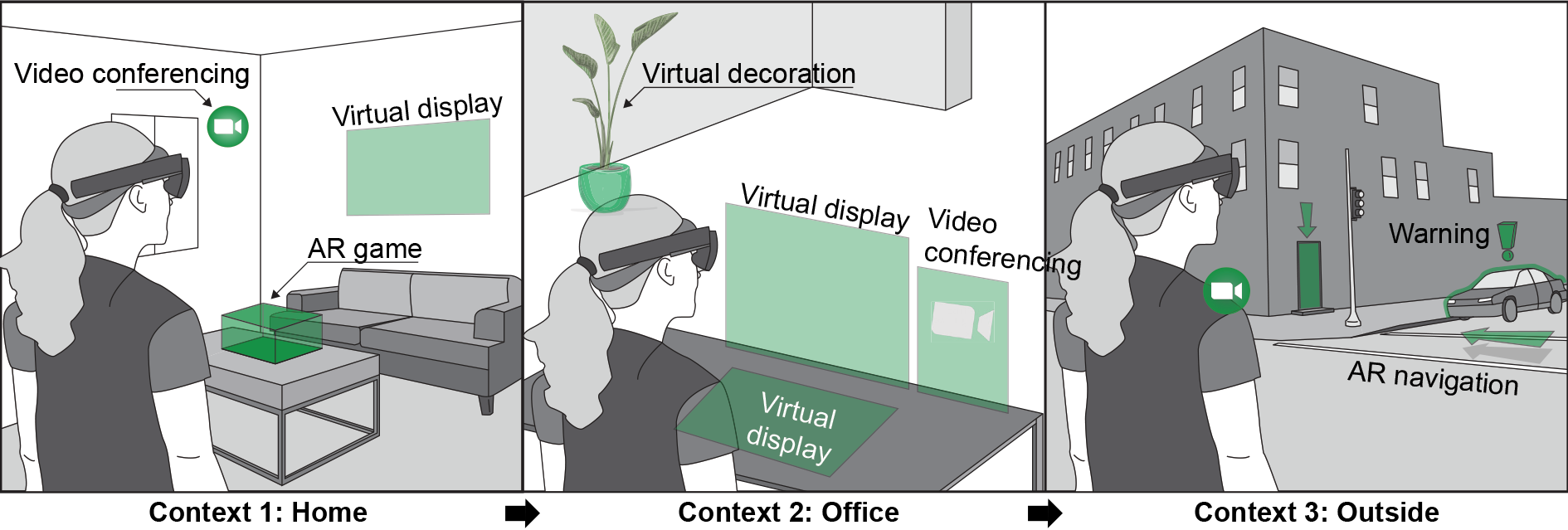
3 panels with illustrations of different XR scenarios of in a home, office or outside

Visual examples of an adaptive XR system that automatically adjusts applications and layout based on the user's location or tasks. For example: 

  • While at home, a game is shown at the living room table and the video conferencing app is shown as a floating icon. 
  • At work, more virtual displays for productivity are available, while the video conferencing app is full screen. 
  • When outside, only minimal information is shown to not disturb users.

Research Areas