


惯性聚合 高效追踪和阅读你感兴趣的博客、新闻、科技资讯
阅读原文 在惯性聚合中打开

推荐订阅源

Cyber Security Advisories - MS-ISAC
U
Unit 42
H
Help Net Security
博客园_首页
雷峰网
雷峰网
CTFtime.org: upcoming CTF events
博客园 - 【当耐特】
Recent Announcements
Recorded Future
Recorded Future
aimingoo的专栏
aimingoo的专栏
爱范儿
爱范儿
C
CXSECURITY Database RSS Feed - CXSecurity.com
The Cloudflare Blog
S
Security @ Cisco Blogs
M
MIT News - Artificial intelligence
Cyberwarzone
Cyberwarzone
Cisco Talos Blog
Cisco Talos Blog
Spread Privacy
Spread Privacy
The GitHub Blog
The GitHub Blog
酷 壳 – CoolShell
酷 壳 – CoolShell
K
Kaspersky official blog
MyScale Blog
MyScale Blog
阮一峰的网络日志
阮一峰的网络日志
C
CERT Recently Published Vulnerability Notes
V
Vulnerabilities – Threatpost
WordPress大学
WordPress大学
C
Cisco Blogs
G
Google Developers Blog
N
News and Events Feed by Topic
P
Palo Alto Networks Blog
Apple Machine Learning Research
Schneier on Security
博客园 - 聂微东
Security Latest
Security Latest
Security Archives - TechRepublic
O
OpenAI News
云风的 BLOG
云风的 BLOG
IT之家
IT之家
PCI Perspectives
PCI Perspectives
Microsoft Security Blog
NISL@THU
NISL@THU
小众软件
小众软件
Scott Helme
Scott Helme
大猫的无限游戏
大猫的无限游戏
L
LINUX DO - 最新话题
Microsoft Azure Blog
Simon Willison's Weblog
N
News and Events Feed by Topic
F
Fortinet All Blogs
The Last Watchdog
The Last Watchdog

School of Computer Science News

Liu Receives NSF CAREER Award Carnegie Foundry, Carnegie Mellon and American Drone Manufacturers Launch Initiative to Supercharge America Stepping Toward Better Mobility Natalie Hatcher Turns Closed Doors Into Open Futures for High School Students - The Piper - Carnegie Mellon University When One Drone Isn’t Enough: CMU Builds Swarms for High-Stakes Response Efforts Carnegie Mellon’s Richard King Mellon Hall of Sciences Enters New Phase of Construction Researchers Channel AI To Solve Open Mathematical Problems Fujitsu Joins CMU Robotics Innovation Center The Missing Infrastructure for AI-Powered Robots - Robotics Institute Carnegie Mellon University CMU Partners WithOptiTrack For Motion Capture Technology in Robotics Innovation Center CMU Team Rises to Amazon Nova AI Challenge - Language Technologies Institute - School of Computer Science - Carnegie Mellon University NoRILLA Wins Global Competition Don’t Let FOMO Be Your Organization’s AI Strategy CMU Researchers Train Robots With Internet Videos - Robotics Institute Carnegie Mellon University Carnegie Mellon and Meta Partner To Develop AI Tools for Emergency Response Singing a New Tune: Computational Music — The Link - The Magazine of CMU's School of Computer Science Pathak Receives 2026 PAMI Young Researcher Award Carnegie Mellon Team Helps Farmers Fight Crop Disease With Robots EcoAssist Shows Devs Greener Ways to Code Bacteria Can Learn and Form Memories Without a Brain Sandholm Receives SIGecom Test of Time Award SURF Grant Powers Research Into the Genetics of Bipolar Disorder Chen Receives NSF CAREER Award for Research in Machine Learning Systems Vatican Calls on Waibel to Help Shape AI Ethics — The Link - The Magazine of CMU's School of Computer Science Frank Pfenning Receives Herbrand Award How Do Boomers Really Feel About AI? Decoding Muscle Fatigue With Radar - Electrical and Computer Engineering - College of Engineering - Carnegie Mellon University Listening to Your Fingertips Test of Time Award - Electrical and Computer Engineering - College of Engineering - Carnegie Mellon University Let Me Entertain You: How SCS Trains the Minds Who Shape How We Play — The Link - The Magazine of CMU's School of Computer Science Delphi Group Uses Data To Forecast the Flu and Other Epidemics Carnegie Mellon extends historic run with its fifth straight MITRE eCTF title NVIDIA Founder, CEO Jensen Huang to Carnegie Mellon University Graduates: ‘Shape What Comes Next’ CMU Researchers Develop AI System to Help Prevent Airport Collisions Kaplow Named 2026 Searle Scholar New CMU Tool Reduces Manual Work To Accelerate Medical Analysis Rosenfeld Named University Professor Work Hard and Dream Harder Xing Named 2026 ISCB Fellow CMU Tool Prevents Anxiety Spirals When Searching for Medical Advice Online Design Tweaks That Keep Students Learning Job Interviews, But Make It a Game Night CyLab study finds “privacy-preserving” tracking alternatives may still expose users Bringing Computational Sciences to Health and Human Services — The Link - The Magazine of CMU's School of Computer Science How Transformational Play Is Shaping CMU’s Next Research Frontier - Center for Transformational Play - Carnegie Mellon University Playing on Common Ground: CMU Monster Game Helps Groups Work Across Differences Fujitsu, CMU Launch Joint Center for Physical AI Pennsylvania Universities and Commonwealth Leaders Launch Keystone AI + Quantum Factory CMU Teams Recognized in Moonshots AI Competition After you’re gone, who gets your passwords? Compeau Inducted Into 2026 AIMBE College of Fellows Chan Wins AHA Career Development Award CMU Tops U.S. News Graduate CS Rankings The AI Is in the Room Bridging the Communication Gap With AI Earbuds that Listen to the Heart - Electrical and Computer Engineering - College of Engineering - Carnegie Mellon University CMU Launches Keystone Astronomy & AI Visiting Fellows Program Obituary: David J. Farber Earned Nickname 'Grandfather of the Internet' CMU Research Challenges Long-Held Ecological Belief of How Rare Species Survive Teaching AI-Generated Scenes To Obey Physics Saxena, Saint Phalle Receive Stehlik Scholarship Application Opens for 2026 LearnLab Summer School AI4BIO Selects Inaugural Projects for Biomedical Discovery - Center for AI-Driven Biomedical Research - School of Computer Science - Carnegie Mellon University When an AI Bot Becomes Your Boss MSCF Program Adds Accelerated Option for CMU Undergraduates Akshat Prakash Serano Tannason
Looking Ahead: AI Needs UI
Karen Harlan · 2026-07-16 · via School of Computer Science News

UI for AI visual, designing interfaces for an AI-native world
UI for AI is a recent HCII independent study that focused on designing better user interfaces for the AI-native world.

There is a distinct tension when opening an artificial intelligence (AI) tool and facing that empty text box with its blinking cursor. What feels like a launchpad of pure possibility to some leaves other users frozen in place.

The cursor blinks slowly. The user pauses.

“What should I ask?,” is a question the students said they heard frequently during their user research. “How do I even start?”

This paralyzing blank page effect is just one of many challenges students found while researching the problems with AI interfaces. They found that the basic blank text box doesn’t give users enough structure to get started, and instead slows them down by increasing their cognitive load.

For the past two semesters, Carnegie Mellon University graduate students have explored this and other aspects of the user interfaces of AI tools during an independent study offering with Dan Saffer, assistant professor of the practice at the Human-Computer Interaction Institute.  

A user interface (UI) is the interactive space where humans and machines communicate – a place where users tell the machine what to do and machines provide feedback and information in response.

Although the blank text box prompt is currently the status quo, Saffer wants companies to move beyond that and invest in their AI tool’s UI design to help users accomplish their goals.

“User interfaces aren’t disappearing; they’re evolving,” said Saffer, who draws parallels to previous UI evolutions when technology shifts. “This isn’t my first rodeo. I was around during the transition from desktop to web and from web to mobile. When mobile became ascendant 20 years ago, we added new UI components to take advantage of what mobile could do. AI is the same. A great UI is more important than ever so that we can understand and use AI effectively, building better mental models of what this technology can and cannot do.”

Saffer, the author of Microinteractions: Designing with Details, breaks down AI with his students as another new technology that needs new interactions and microinteractions.

“AI is bringing four interactions to the foreground,” said Saffer. “Directing - giving the AI instructions; Monitoring - making sure the AI is doing what it said it was going to do; Iterating -  seeing what the AI did and possibly modifying it; and Approving - signing off on the output.”  
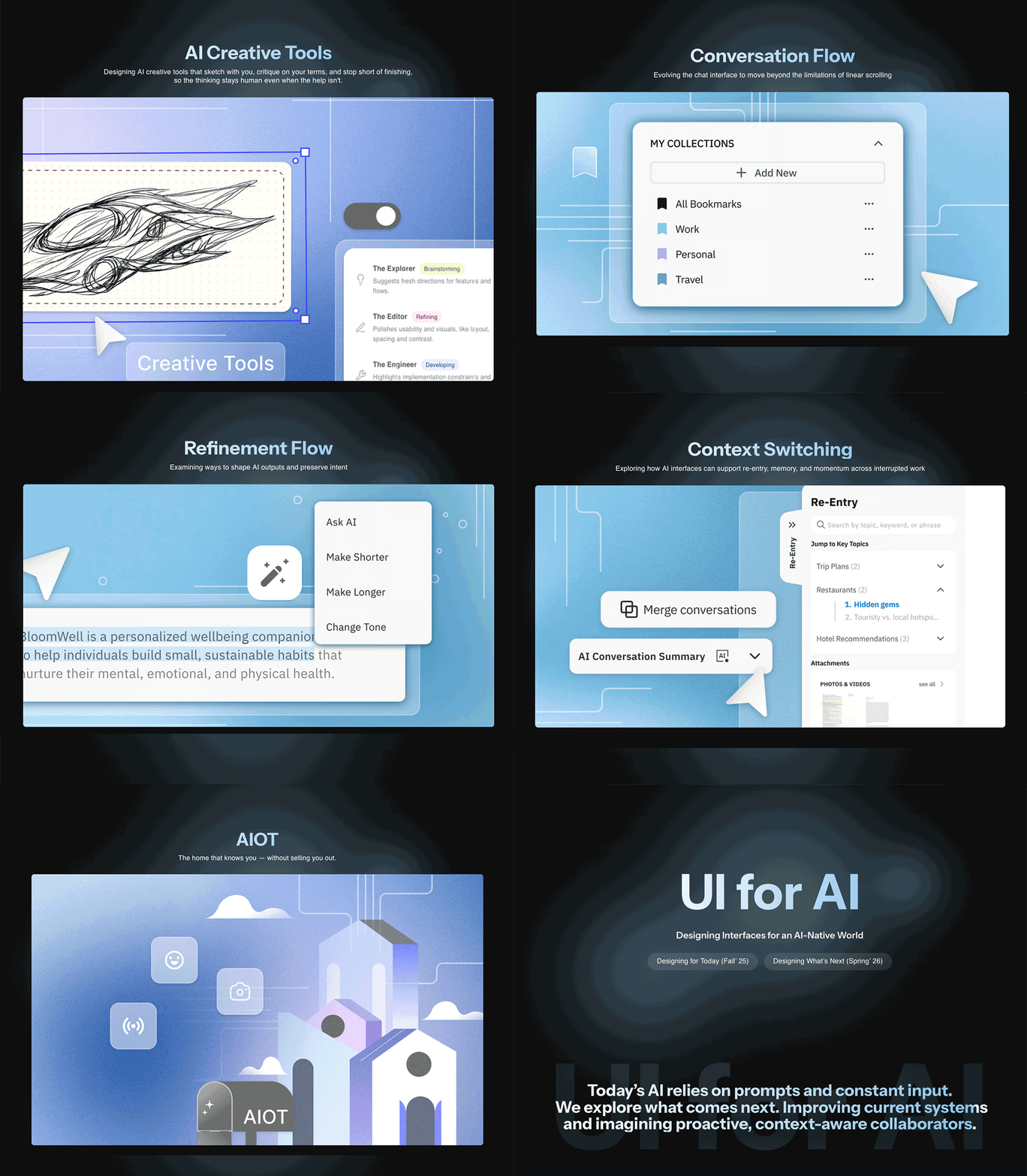
 

a few students' design sketches rotate every 2 seconds in this loop

An image rotation of a few student projects from UI for AI.

In the fall 2025 semester, Saffer led the UI for AI independent study to focus on the current problems users have with AI interfaces. Small teams of students explored a variety of topics, including blank canvases, bookmarks to assist with non-linear workflows, ways to reimagine how AI can support refinement, and memory and privacy options for users to pick up where they leave off.

“If there is one thing that the first semester of UI for AI taught me is that AI really needs UI,” said Saffer. “The different concepts the teams came up with make AI more usable, transparent, understandable and valuable.”

However, while they focused on the present issues of AI interfaces, students were seeing some of their ideas – like AI-generated browser tab clusters – announced by industry in real time. No sooner had the semester ended that something similar, GenTabs, was announced by Google Labs.

“This just means we were on the right track,” said Saffer. “The future has its own timelines.”

So, the rapidly-changing nature of the AI industry inspired Saffer to change the next iteration of the UI for AI offering to imagine what future AI experiences could be like three to five years from now. 

As students in the spring 2026 semester designed what they think will be next in AI interfaces, a few examples explored designs that enhance creative work, AI for smart home environments, and, the very meta, AI that manages your other AI.

Graduate student Cole Biehle (MHCI 2026) took the independent study both semesters.

“So many classes focus on learning about the present and what others have already done. I was really drawn to UI for AI because it provided an opportunity to get out of my comfort zone and not just think about the future, but actually work on a tangible plan for how we can get there,” Biehle said. “It positions us as changemakers for the kind of world that we want to live in, rather than passive observers of what already exists.”

Biehle enjoyed advocating for ideas and communicating values during the group‘s weekly shareouts.

“I also really enjoyed documenting our journey by publishing articles online, which is a great way to receive feedback from professionals and ensure that our contributions are relevant and meaningful to people out in the world,” said Biehle.

Visit the UI for AI website or the UI for AI Medium page for students' projects, prototypes, videos, design principles and articles on how the different concepts were made.
 

Research Areas