









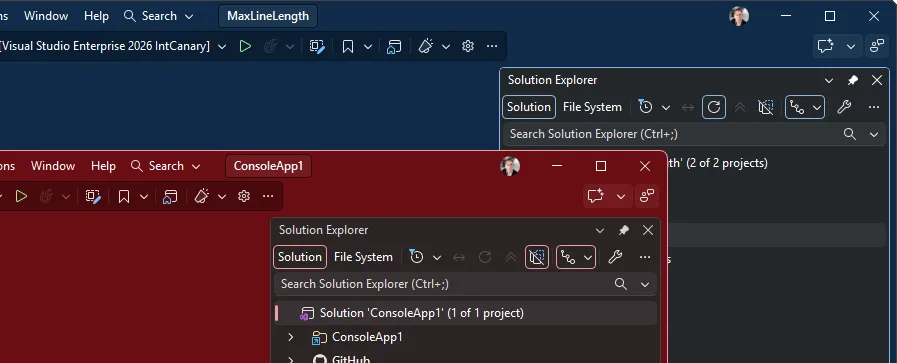
A user asked for per-solution color themes. It already ships, and it goes further than they asked.
You run several instances of Visual Studio side by side, one per solution, and they all look identical. Same taskbar icon, same alt-tab thumbnail, same chrome. So, you land in the wrong one, start typing, and realize thirty seconds later you just edited the wrong repo. Could each solution get its own color theme?
It can. It already does. And the way it works turns out to be more useful than a personal color preference.
How to do it
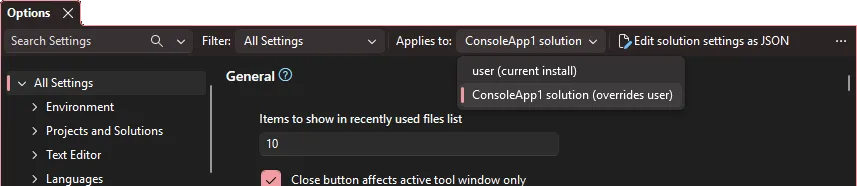
- Open Tools > Options.
- At the top of the window, find the Applies to dropdown and switch it from your user profile to the current solution.
- Change the color theme.
This uses the new settings experience introduced in Visual Studio 2026.
That’s the whole thing. From that point on, every setting you change applies only to the solution that’s open. Close it, reopen it tomorrow, and the theme comes back with it. Open a different solution and you get its color instead.
No restart, no Apply button, no dialog to dismiss. Most setting changes take effect immediately, and the theme is one of them. The window changes color while you’re still looking at it.
Pick colors with real contrast between the solutions you keep open together. Dark for the service, Blue for the client, Light for the sandbox. The goal is telling them apart from your peripheral vision, not having to read the title bar.
Why this works now
The Applies to dropdown isn’t a color feature. It’s the scoping model behind the new settings experience, and the theme just happens to be the most visible thing you can point at it.
In the old Tools > Options, every page owned its own UI, and settings were a flat, global, machine-wide pile. The new experience puts them all in one consistent, searchable surface backed by JSON, and once settings have a real schema, they can have a real scope. “This value, for this solution” becomes something the IDE can express.
So, the color theme is the demo, not the feature. The feature is that settings now have a scope and a file, and a file is something you can put in source control.
The JSON underneath, and why your team cares
Per-solution settings live in a file called settings.VisualStudio.json, in the solution root folder, right next to your .sln or .slnx. That location is the point.
Commit it, and everyone who clones the repo gets the same setup. A new teammate opens the solution on day one and the IDE already looks and behaves the way the team agreed it should, with no onboarding doc that starts with “first, go to Tools > Options and change these nine things.”
Don’t want to impose your taste on everyone? Add it to .gitignore and it stays yours alone. Same feature, same file. One line decides whether it’s a team convention or a personal preference, and you decide it per repo, after the fact, by whether you commit.
If you’d rather work in the raw values than UI, select Edit user settings as JSON from the toolbar. The file opens showing only what you’ve changed from the defaults, not thousands of lines of untouched values. Edit them there directly or copy a single setting to the clipboard to hand to someone else, which beats screenshotting a checkbox into a Teams chat.

One thing to know
Per-solution settings are stored separately from your user settings, so changing the scope doesn’t overwrite the setup you use everywhere else. Switch the Applies to dropdown back to your user profile whenever you want to change the default for all solutions.
That separation also makes experimentation low risk. Give one solution a distinctive theme, see whether it helps, and remove the solution-level value if it doesn’t. Visual Studio falls back to your user setting without requiring you to reconstruct it.
If you want to go further
Long before this shipped, an extension called Solution Colors solved the same problem from a different angle. It’s color only, and it’s more granular: instead of switching the whole theme, it tints specific parts of the IDE per solution, and it can pick a color automatically, so you don’t have to decide anything.
If per-solution themes are enough, use the built-in feature. It’s supported, it syncs, and it’s checkable into source control. If you want finer control over exactly which pixels change color, the extension is still there and still worth a look.
Try it
Open your two most-confusable solutions and give them different themes. Fifteen seconds each, and it pays you back every time you switch windows.
Then, if it’s useful to more than just you, commit settings.VisualStudio.json. Your team gets the same visual cue for free, and the next person who joins never opens the wrong window at all.
If there’s another setting you want scoped per solution, tell us in the comments. The plumbing is there now.