



惯性聚合 高效追踪和阅读你感兴趣的博客、新闻、科技资讯
阅读原文 在惯性聚合中打开

推荐订阅源

H
Hacker News: Front Page
S
Secure Thoughts
N
News | PayPal Newsroom
Exploit-DB.com RSS Feed
T
Threatpost
N
News and Events Feed by Topic
cs.AI updates on arXiv.org
A
Arctic Wolf
Cisco Talos Blog
Cisco Talos Blog
V2EX - 技术
V2EX - 技术
L
LINUX DO - 热门话题
C
Cyber Attacks, Cyber Crime and Cyber Security
P
Proofpoint News Feed
TaoSecurity Blog
TaoSecurity Blog
N
News and Events Feed by Topic
cs.CL updates on arXiv.org
Hacker News - Newest:
Hacker News - Newest: "LLM"
NISL@THU
NISL@THU
H
Heimdal Security Blog
Webroot Blog
Webroot Blog
Martin Fowler
Martin Fowler
The Hacker News
The Hacker News
Engineering at Meta
Engineering at Meta
MongoDB | Blog
MongoDB | Blog
A
About on SuperTechFans
Stack Overflow Blog
Stack Overflow Blog
B
Blog RSS Feed
Vercel News
Vercel News
Blog — PlanetScale
Blog — PlanetScale
Google Online Security Blog
Schneier on Security
Cyberwarzone
Cyberwarzone
小众软件
小众软件
V
V2EX
K
Kaspersky official blog
Security Archives - TechRepublic
博客园 - 三生石上(FineUI控件)
OSCHINA 社区最新新闻
OSCHINA 社区最新新闻
C
Cisco Blogs
S
Schneier on Security
Recorded Future
Recorded Future
阮一峰的网络日志
阮一峰的网络日志
AI
AI
Microsoft Security Blog
H
Help Net Security
Simon Willison's Weblog
I
InfoQ
G
Google Developers Blog
博客园_首页
Hugging Face - Blog
Hugging Face - Blog

BloombergNEF

Sustainable Aviation Fuel Price Outlook: Leveling Off | BloombergNEF Solar Set to Rule World’s Power Supply: Three Things to Know | BloombergNEF Energy Transition Impacts: Sector and Country Impacts from a Demand-Driven Model | BloombergNEF BloombergNEF Turkey Transition Factbook 2026: Clean Power Growth Positions Turkey for the Next Phase of Its Energy Transition | BloombergNEF Competitiveness, Cost and Climate: Five Themes From the BNEF Summit Amsterdam | BloombergNEF Electric Vehicle Outlook | BloombergNEF BloombergNEF’s Electric Vehicle Outlook 2026: Global EV Sales Set For Another Record-Breaking Year, But Growth in Some Major Markets Slows | BloombergNEF Mexico Transition Factbook 2026 Have Oil Prices Already Peaked? Three Things to Know Liebreich: The Great Clean Energy Acceleration 2.0 Global Clean-Energy Trade Rebounds to $479 Billion in 2025 Despite Tariffs and Geopolitical Turmoil: BloombergNEF New Energy Outlook 2026 New Energy Outlook 2026 BloombergNEF’s New Energy Outlook 2026: Transition to Newer Technologies, Expanded Electrification to Strengthen Nations’ Energy Security Energy Transition Bank Financing Struggles to Pull Ahead of Fossil Fuels in Asia Data Centers and the Future of Energy Storage Data Centers and the Future of Energy Storage Energy Storage Enters the 100-Gigawatt Era: Three Things to Know AI Data Centers, Energy and Finance: Dispatch from the BNEF Summit New York 2026 Nuclear Fusion Powers Up for Commercial Breakthrough BNEF Talk: Copper’s World of Wires, Wheels and Worries BloombergNEF Announces 12 Climate Innovators as Winners of its 2026 Pioneers Award NEO 2025 New Energy Outlook 1 NEO Clean Power Is Up and Will Get a War Boost: Three Things to Know No, Iran War Won’t Boost Clean Hydrogen – Except in China The Petrochemicals Shock That Is Already Rippling Through Plastics AI Data Center Build Advances at Full Speed: Five Things to Know Iran Rattles Saudi’s Red Sea Oil Reset. Here’s What’s at Stake Bloomberg Appoints Albert Cheung CEO of BloombergNEF Oil Math of Releasing 400 Million Barrels: Three Things to Know Chinese Turbine Suppliers Seize the Spotlight as Global Wind Power Installations Hit All-Time High, BloombergNEF Report Shows New Data Center Hotspots Are Emerging: Four Things to Know Oil Products Arbs and Flows: All Eyes On Strait of Hormuz
EU Carbon Border Tariff Is Reshaping Industrial Trade Flows
iterhorst · 2026-04-21 · via BloombergNEF

Importing emissions-intensive products into the European Union just got a lot more expensive.

The EU’s carbon market, known as the Emissions Trading System (ETS), is already forcing domestic producers to pay for the carbon they emit.

That could put them at a disadvantage compared with producers outside the bloc. In an effort to equalize this footing, the bloc has instated the Carbon Border Adjustment Mechanism, or CBAM, under which importers must purchase certificates reflecting the embedded emissions of their products.

The mechanism covers selected goods from six emissions-intensive sectors: iron and steel, aluminum, cement, fertilizers, hydrogen and electricity. Importers will face a phased exposure to these costs, aligned with the gradual reduction of free allowances for domestic producers under the ETS.

The policy entered its pricing phase on Jan. 1, 2026. But it remains unclear just how much many importers will need to pay.

Emissions intensity remains the key driver of CBAM costs

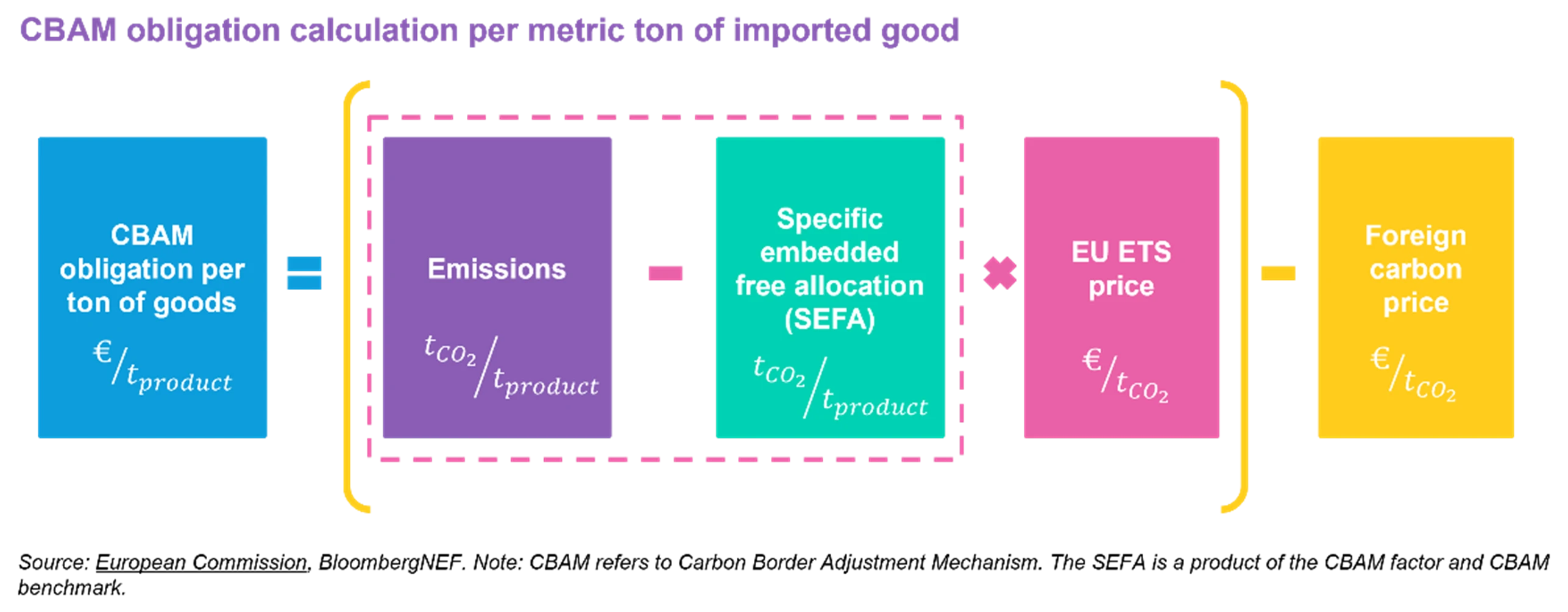
CBAM obligations depend on multiple factors, including embedded emissions of products, market of origin, EU ETS prices and production processes. Among these, emissions values – whether based on European Commission data or verified figures – are likely to be the most significant driver of cost differences across suppliers.

The figure below shows a simplified version of the equation that underpins obligation calculations.
Importers unable to verify their own emissions data will be charged according to default values provided by the European Commission. These could prove to be punitively high – as much as 1.3 times the current import value for goods like cement and clinker. The idea is to encourage companies to report the actual emissions of their products, but it could create a new hierarchy for competitiveness, where verified low-carbon producers could displace unverified or highly polluting suppliers.

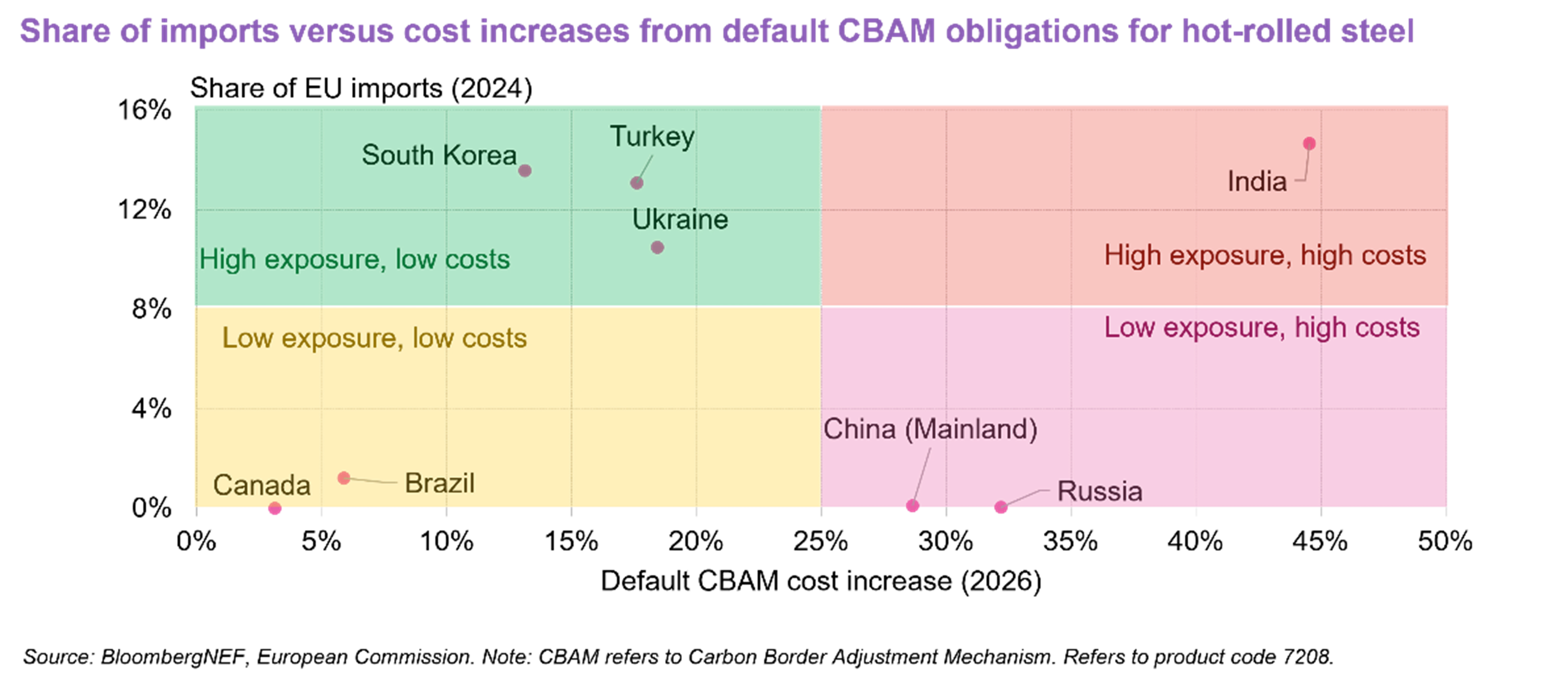
Default obligations also have an uneven impact across markets.

For example, India supplied about 15% of the hot-rolled steel products imported into the EU in 2024 but faces one of the highest default obligations, with costs up to €293 ($343) per metric ton in 2026. By contrast, markets such as South Korea and Turkey face lower default costs but hold similar export shares.
Clients can use BloombergNEF’s EU CBAM Obligation Calculator (EUCBAM 1.0.2) to estimate potential costs across affected products and markets. This Excel-based tool enables users to compare outcomes by market, product, year and carbon pricing scenario.

The video below provides a brief overview of how to use the tool.

Related Content

The latest from BloombergNEF delivered to your inbox

Sign up for BNEF’s free newsletter.