








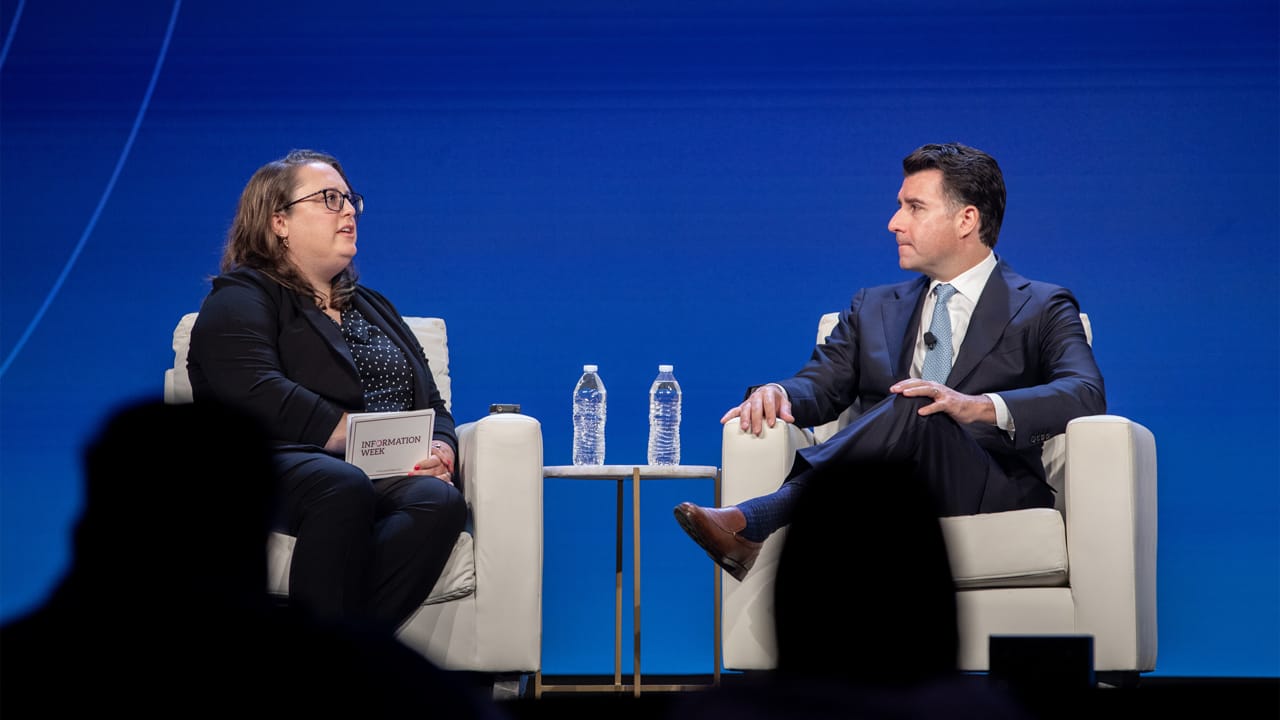
Kelsey Ziser, senior editor at InformationWeek, and Matthew Cimaglia, founder of Quantum Coast Capital, discuss quantum computing at Fiber Connect 2026 this week in Orlando, Fla.Fiber Broadband Association
The quantum computing industry is headed for a major security threat and a growing skills shortage within the next few years.
It's critical for governments and enterprises to start having conversations today around quantum security, as it will be much harder to establish security policies once a quantum security threat arises, said Matthew Cimaglia, founder and managing partner of Quantum Coast Capital (QCC), a quantum computing investment firm. Cimaglia spoke during several fireside chats at this week's Fiber Connect 2026 event in Orlando, Fla.
A quantum security milestone, dubbed "Q-Day," refers to the time when "quantum computers get to a certain place from a computational perspective, [where] it risks RSA being able to be cracked," said Ryan Harring, director of partnerships and alliances at IonQ, in a different fireside chat.
RSA encryption, Harring explained, essentially runs all the security that protects banking systems, healthcare data, private information and government agencies, including the Department of Defense and the Department of Energy (DoE). "This is a big deal and has the federal government turning its head about what to do about this," he said. For its part, IonQ is working on quantum key distribution technologies to improve quantum security.
Related:InformationWeek Podcast: Is quantum computing slumbering?
Ahead of Q-Day, when quantum computers are able to break standard cryptographic algorithms (e.g., RSA and elliptical curve cryptography), organizations like NIST are working on quantum security policies.
"NIST came up with their guidelines, and essentially they're saying that by 2035 public and private infrastructure needs to be converted over to some form of post-quantum cryptography. They have that policy readily available on their website," Cimaglia said. Quantum Insider, a quantum technology news and market intelligence site, has dubbed 2026 the "Year of Quantum Security" as NIST, federal agencies and industry organizations ramp up quantum security initiatives. Network infrastructure providers and enterprises need to focus on quantum security to prepare for Q-Day, Cimaglia said. He added that Quantumsecurity2026.org is a valuable resource for keeping up with quantum security policies.
Quantum computing technologies will affect nearly every industry vertical, Harring said. While quantum computing isn't new, the current "computational capacity growing on these machines is a big change."
The ecosystem around quantum and technologies powered by quantum computing is also changing, Harring said. "There are a lot of other adjacent technologies in the quantum space that are becoming a reality a lot faster than anyone thought — so quantum sensing, quantum networking, photonic interconnects, satellite capabilities, ground satellite communications and security appliances in general," Harring said.
Related:What a CIO Needs to Do Today to Prepare for Quantum Computing
As the quantum computing industry ramps up, it also faces a skills shortage that threatens continued market growth.
"One of the biggest challenges that all quantum companies have, not just IonQ, is that there is not a driving workforce that's been developed yet. There just aren't enough people to work on a lot of these hard problems," Harring said. He added that the industry needs not only skilled quantum physicists but also individuals who can communicate and translate the implications of quantum in a way that's accessible to a broader business audience. The quantum computing industry needs to partner with universities, for example, because "they're the ones who are going to drive that pipeline for the workforce in all kinds of different industry verticals," Harring said. In addition, obtaining National Science Foundation or DOE grants also requires partnerships with universities that have high research activity.
Cimaglia echoed Harring's point that the quantum computing industry benefits from a workforce with varied backgrounds. He said he started QCC in part because he recognized that the industry had a "communications problem."
Related:Oak Ridge Puts Quantum Supercomputer Integration to the Test
"Having a sort of communications background, I act as a Rosetta stone for quantum people and the everyday person," said Cimaglia, referring to his 20-plus years of media and communications experience.
There's a "huge lack of talent in the overall ecosystem for quantum," he added. While there are 30,000 quantum professionals today, the industry will require 250,000 quantum professionals by 2029, he said. (According to Quantum Insider, "Quantum computing will create an estimated 840,000 new jobs by 2035, with 250,000 by 2030.")
Growing the quantum computing workforce will be critical to supporting the business opportunity for enterprises and communication service providers.
"The McKinseys and the BCGs of the world are forecasting $3 trillion worth of economic opportunity by 2035 [for quantum computing]. Also, $500 billion of that opportunity is going to be in logistics and transportation on the optimization side, and another $200 billion roughly calculated for the telecom space," Harring said.
Quantum computing business use cases are already materializing — Cimaglia cited a recent partnership with Florida LambdaRail (FLR).
"About three weeks ago, we signed with the state an agreement to do a fully quantum secured fiber network on the LambdaRail, so it's going to connect all research, research institutions, universities, NASA and there's a number of military applications within the state, as well. We're looking at this as a full-state rollout," Cimaglia said. FLR is a nonprofit research and education fiber network that includes 1,540 miles of dark fiber connecting universities, K-12 schools, healthcare and research facilities, and local government.
The quantum computing opportunity extends beyond Florida, with a number of regions emerging as quantum hubs. This differs from the concentration of tech companies associated with Silicon Valley, Cimaglia explained — the quantum computing opportunity is much more distributed.
"We're seeing Maryland, Florida, Tennessee, Arizona, Colorado, Montana, New Mexico as very high-impact zones around quantum activity," Cimaglia said.

Senior Editor, InformationWeek
Kelsey Ziser is a senior editor at InformationWeek, where she covers C-suite dynamics, data strategies and the evolving cybersecurity threat landscape.
Kelsey also oversees the publication's IT Leaders Fast-5 column, which brings peer insights to IT professionals, and the tech layoffs tracker. She has been with InformationWeek since September 2025.
Before joining InformationWeek, she spent nine years at sister publication Light Reading, reporting on a broad range of topics including smartphones and devices, AI, satellite connectivity and enterprise networking. Kelsey has a Bronze Regional Azbee Award in the Technical Article category. Outside of work, she enjoys reading four (or 12) books at once, watching movies about space travel, crafting and tending to an ever-growing collection of houseplants. Kelsey has a bachelor's degree in journalism and mass communication from UNC-Chapel Hill and is based in Raleigh, N.C. She can be reached at [email protected] or on LinkedIn.
此内容由惯性聚合(RSS阅读器)自动聚合整理,仅供阅读参考。 原文来自 — 版权归原作者所有。