


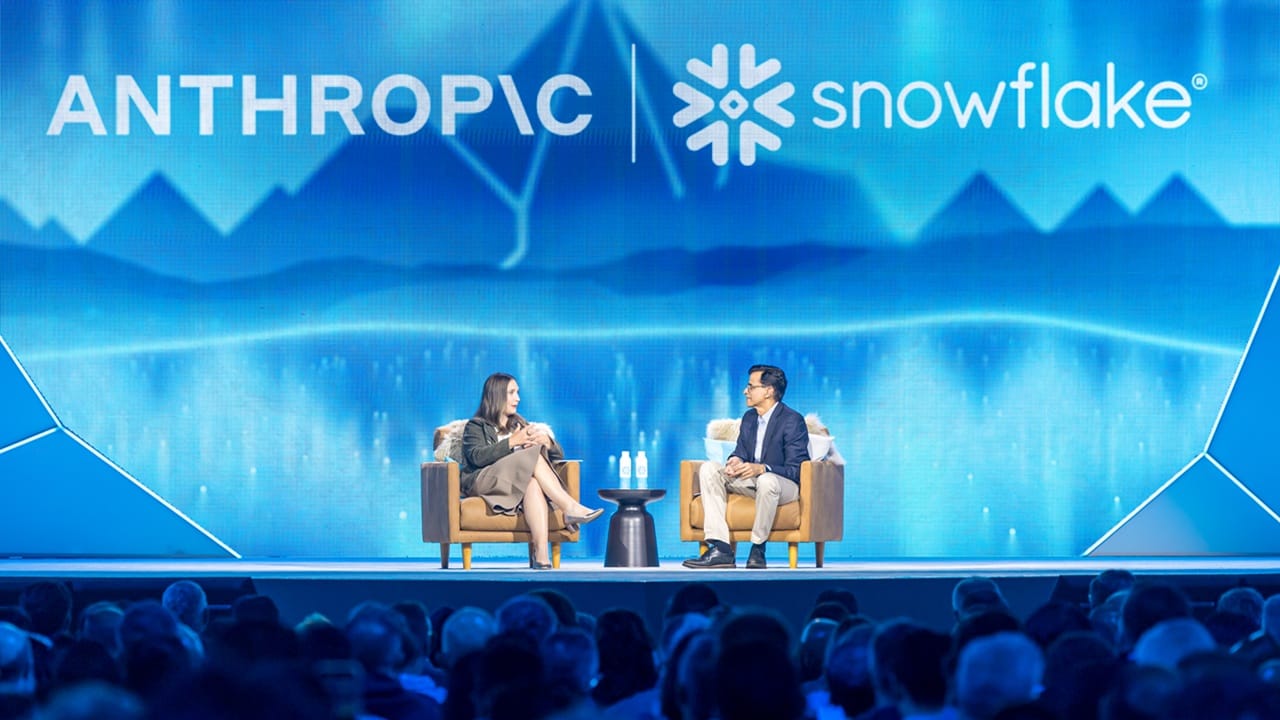
Anthropic President Daniela Amodei, left, and Snowflake CEO Sridhar Ramaswamy participated in a fireside chat at Snowflake Summit 2026 in San Francisco, Calif.Myles Suer/InformationWeek
SAN FRANCISCO — In recent articles, I have looked at the AI-driven changes roiling the entire software industry — from apps to data pipelines and data wrangling to the data platform. This week at Snowflake Summit, I heard from the leaders at Snowflake and Anthropic. What they said matters to everyone, and especially to CIOs, who are trying to figure out where they should invest and how they can position their companies' AI strategies for success amid head spinning change.
One message was crystal clear after listening to Snowflake CEO Sridhar Ramaswamy talk to reporters and market analysts, and hearing Anthropic President Daniela Amodei on the main stage: Both executives conceded they are being shaped by market forces they do not completely control. Each is banking on internal innovation to save them and justify their market valuations, even as they quietly acknowledge that no one really knows where this disruption to the software status quo will end up.
Related:Accenture, Anthropic and the quiet rise of AI integrators
Indeed, no one I've been talking to recently has experienced a technology disruption of this magnitude to technology providers. Here's a recap of their remarks for CIOs.

Snowflake CEO Sridhar Ramaswamy delivers a keynote at Snowflake Summit 2026 in San Francisco, Calif. MYLES SUER/INFORMATIONWEEK
Ramaswamy started his discussion by sharing that this was the company's best quarter ever. However, after saying this, he was extremely circumspect about Snowflake's future, noting that AI has shattered all previous corporate assumptions. "AI is fundamentally taking the cost of making software to zero, and it is going to take years to figure out what it means," he said. He added that Snowflake's core thesis is that the data platform itself will remain vital — though that assumption has yet to be proven in the market. "Our goal is to be a platform where trusted information gets done," he said. "We want to also be the intelligence and context layer."
According to Snowflake's technology presentations, executing on this proposition requires doing two things:
Providing an agentic AI layer designed for data consumers.
Offering alternatives to legacy partners in the areas of data cataloging, data governance, and trust.
Ramaswamy acknowledged that everyone is early on the journey to AI and it is becoming harder to differentiate data platforms. His hope is that AI will continue to have a data platform for managing very large data sets and that adding a value-added agentic AI layer will take hold.
The competitive Catch-22 is that Snowflake's strategy — as alluded to by Ramaswamy — is now the industry standard, with virtually very cloud vendor pursuing this identical path forward. This means that CIOs face a difficult challenge in choosing how to architect their AI data stack.
Related:FinOps: Helpful tool, or a cloud control placebo for CIOs?
Is Snowflake the solution of choice? What I ended up thinking was that Snowflake has taken on too broad a message and is not effectively telling CIOs that it is using its stack to solve two incredibly difficult problems:
Actively building agents aimed at solving the foundational data problems that the vast majority of businesses struggle with. These agents will autonomously fix data quality issues, fix data governance, and more.
Creating agents for users who want to consume data and ask questions about data. This includes the ability to suggest additional follow-up questions.
Together, this Snowflake family of agents will deliver a modern version of self-service BI — or at least that's the aim. One branch will transform how businesses get the data they need to run their business, while the other will transform how everyday users understand and interact with data.
My caution to their team is to focus on the knitting and don't appear to be a general-purpose agent-creating platform.
On stage, Amodei was beaming in the afterglow of filing paperwork earlier in the day for her company to go public with an astronomical valuation approaching one trillion dollars. While the precise numbers will be determined later by market makers, Anthropic's staggering $965 billion valuation places it in the top tier of tech giants alongside Alphabet, Microsoft, and Apple.
Related:How Anthropic is reordering SaaS — and where CIOs go next
In an effort to effectively justify the company's value, she noted that "AI is now a foundational part of every corporate strategy." In sharing Anthropic's progress, she said that while models have gotten so much better recently, the industry still doesn't know where this trajectory is ultimately going.
And, of deep concern to CIOs, Amodei implied that things are changing so fast with foundational models that solutions can become obsolete in a matter of months. Given this velocity, she agreed it was a meaningful question for companies to ask how they can plan and build around what they have today when the underlying technology is changing so fast.
She argued it is critical to balance speed with safety — a clear allusion to her former employer, Open AI. According to Amodei, trust is an accelerant. If CIOs do the safety work, their organizations can actually move faster.
"This is a very challenging time and we are not getting a lot sleep," she admitted, noting that the explosive market growth and heightened market expectations are forcing the company to keep up an unrelenting pace. With their headcount now at 3,500 people, she added, "We are not a small startup anymore."
Given this, I believe market and investor expectations are going to eventually drive Anthropic to move further up the enterprise software stack and challenge the rest of the marketplace.
Like competing vendors, they already have agent-building technology along with prebuilt agents by function and industry, and a growing list of prebuilt connectors. While they have not bought into the data space yet, their current moves are driving the intense market pressure that everyone in the software industry is feeling.
There are many questions that CIOs will want answered. How far will Anthropic go to claim its market position? Armed with such a large valuation, will they use their capital to acquire adjacent companies and assemble a complete enterprise offering? Clearly, data ecosystem mainstays like Snowflake could eventually be in play. But as a VC once told to me, companies must "stay focused on one thing — adding business value".
To ensure that they create unique business value, platforms should focus on the capabilities that from their fundamental right to win — the four or five strengths that differentiate them in a crowded market. For Snowflake, part of doing so involves clearing up its story so it centers clearly on delivering a reliable data stack and truly modern self-service BI.
Meanwhile, the question for Anthropic is whether, as a public entity, it will choose to acquire external pieces of software, such as deterministic model software or a low-code business process platform. Regardless of their path, these moves will impact every company in the software space. While only time will tell how, focused data companies remain the safest bets in the coming transition.

CIO Analyst and Tech Journalist
Myles Suer is a CIO analyst and tech journalist. Recognized by Leadtail as a top CIO influencer, he is the former leader of #CIOChat, a global community connecting CIOs and senior technology leaders. His insights have been featured in publications such as CMSWire, CIO.com, VKTR, and Cutter Business Technology Journal. Suer frequently reviews books on AI, technology, and business strategy from leading publishers, including Harvard Business Review Press, MIT Press, and Columbia University Press. Additionally, he serves as research director at Dresner Advisory Services.
此内容由惯性聚合(RSS阅读器)自动聚合整理,仅供阅读参考。 原文来自 — 版权归原作者所有。