





As I wrote in Oligarchs achieving escape velocity (Sep 10, 2025), a handful of plutocrats now exert outsize influence on our economy, politics, and society. The scale of wealth we’re talking about is hard to imagine, but it’s large enough that a plutocrat’s any whim – no matter how deranged – will be honored.
A good example comes from Peter Thiel, who as I discussed on the Sep 8, 2025 Techtonic has been giving a lecture series about the Antichrist. This four-part lecture series at California’s prestigious Commonwealth Club features Thiel’s thoughts on the biblical Antichrist and the end of time.
You know, just normal tech-industry stuff.
I’ve been wondering what, exactly, Thiel would be saying in these sessions. One’s religious belief is a personal matter, so I wouldn’t criticize Thiel for his own convictions, except that here Thiel is standing at a podium and making it a public matter.
The Wall Street Journal covered the most recent lecture in a Sep 23, 2025 article – here’s a gift link – that includes this (emphasis mine):
In a lecture Monday, he encouraged an audience to continue working toward scientific progress, whether in artificial intelligence or other forms of technology. Fearing or regulating it, or opposing technological progress, would hasten the coming of the Antichrist, Thiel said, according to people who attended.
In other words, anyone who tries to regulate AI, or opposes any technology that Thiel favors, is on the side of the Antichrist.
Like I said, totally normal tech-industry stuff.
Seriously, what is it with the tech billionaires? Cory Doctorow offers an explanation in The billionaires aren’t OK (Sep 24, 2025):
these guys never have to tolerate any criticism. They live in hermetically sealed bubble of sycophancy. This is what makes them so, so stupid . . .
Billionaires are on a relentless quest to isolate themselves from the rest of us. The yacht industry, private space exploration, seasteading, luxury bunkers - their whole thing is escaping the constraints imposed by others. They want to be "sovereign" - that is, toddlers.
Part of Thiel’s message is a particular conception of the future. After all, the Antichrist is supposed to appear at the end of time. This is literally an apocalyptic worldview, suggesting that – in Thiel’s view – regulators and tech critics somehow need to be defeated in a kind of final cosmic battle.
I can’t help thinking that this is all a bit of an overreaction. I mean, sheesh. A few of us advocate for antitrust, for better privacy regulation, and immediately the broligarchs start wailing that it’s Armageddon.
My own conception of the future is a little less extreme. I’m certainly on the side of the reformers, the critics, the privacy advocates – in other words, those Thiel considers the allies of the Antichrist. But I don’t think we’re at a junction of cosmic importance. We need antitrust, privacy regulation, data portability, and more ethical leadership – just as we’ve needed reforms in society for decades. For centuries.
It’s too easy, and more than a little self-centered, to say “now begins the final battle.” The truth is that any reform worth fighting for is likely to take a generation or more. I’ll play a part, I hope – maybe you’ll play a part – and those after us will continue the effort. Declaring that today is Armageddon is a little like saying that the rapture is coming tomorrow: what a coincidence, that the end of time would be scheduled for your personal convenience!
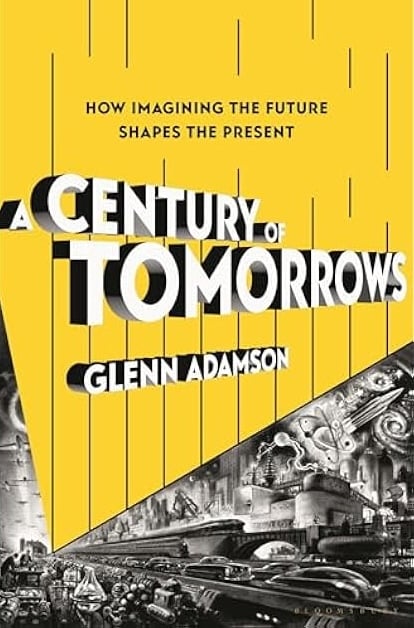
How we conceive of the future affects what we do about it. This is the topic I covered in this week’s Techtonic interview (see episode page or podcast): my guest was Glenn Adamson, author of the book A Century of Tomorrows: How Imagining the Future Shapes the Present, which offers a look at the past 100-or-so years of futurology.
Adamson assigns a guiding metaphor to each era – “machine,” “garden,” and “party” are three of them – ending with our current moment, which he calls the “flood.” This refers to the data deluge that has thrown everything out of whack, vastly increased wealth inequality, and elevated people like Peter Thiel to bray in public about whatever self-serving thought bubbles up into their consciousness.
One recurring character in Adamson’s book is Lewis Mumford, the author and tech critic who I wrote about in Moralists, unite (Oct 7, 2022). I’ll quote again Mumford’s 1963 speech issuing a warning that seems even more prescient today than it did three years ago. Emphasis mine:
From late neolithic times in the Near East, right down to our own day, two technologies have recurrently existed side by side: one authoritarian, the other democratic, the first system-centered, immensely powerful, but inherently unstable, the other man-centered, relatively weak, but resourceful and durable. If I am right, we are now rapidly approaching a point at which, unless we radically alter our present course, our surviving democratic technics will be completely suppressed or supplanted, so that every residual autonomy will be wiped out, or will be permitted only as a playful device of government, like national ballotting for already chosen leaders in totalitarian countries.
Mumford was trying to warn us against a vision of the future – which has become our reality – of tech power joining with authoritarian governmental power. I’m hardly the only one noticing.
Steven Levy’s essay in Wired (Sep 22, 2025), called I Thought I Knew Silicon Valley. I Was Wrong, features a quote from Stanford professor Rob Reich. Today, Reich says,
an extraordinarily tiny number of billionaires who control the information ecosystem have made allyship with the most consequential and fearsome political power in the world. There’s never been a time in history when those things have been combined.
We’ve never seen such concentration of power, ever. No wonder Peter Thiel is comfortably speaking about the end of time: perhaps he thinks that his asymmetric power over the rest of us – from wealth, from surveillance, from monopoly – will be secure for eternity.
He’s wrong, though. It’s a pitiful misreading of the Bible to conclude that “the first” among us – the rich and powerful – are somehow favored by God. And anyway, these aren’t the last days. We’ll still be working for a more just society, and better technology, in a generation, and the one after that. That’s a future I can believe in.
If this resonates with you, join my Creative Good community. We’re on a quest to encourage and amplify the good in tech. You’ll get access to our members-only Forum, and all the Good Reports entries I have put together. And you’ll support my writing here.
Until next time,
-mark
Mark Hurst, founder, Creative Good
Email: mark@creativegood.com
Podcast/radio show: techtonic.fm
Follow me on Bluesky or Mastodon
此内容由惯性聚合(RSS阅读器)自动聚合整理,仅供阅读参考。 原文来自 — 版权归原作者所有。