








“Two of our oldest metaphors tell us that all life is a battle and that all life is a journey,” writes Alberto Manguel in his biography of the Iliad and Odyssey. Perhaps this helps explain the enduring appeal of Homer’s works, all the way from 700-ish BCE through to the present day. All battles in life have echoes of the Iliad, and all journeys can claim kinship with the Odyssey.
The sentiment is made even sharper in the epigraph that starts Manguel’s book:
Every great work of literature is either the Iliad or Odyssey.
– Raymond Queneau
If it’s true of every great work of literature, then in the 2020s – as reading of literature continues to decline – we should apply it also to screen-based storytelling. The obvious example is Christopher Nolan’s Hollywood blockbuster based on the Odyssey, featuring Matt Damon as Odysseus journeying home to Penelope.
I haven’t watched the movie, but I am interested to see this new swell of popular interest in the Odyssey, because I recently completed my own literary journey through Homer. Awhile back I picked up the Iliad, where Odysseus first appears, and accompanied him through his adventures. My journey extended well past the Odyssey.
It started last year when I published an essay called I read all of Plato. Here's what I learned (March 7, 2025), describing my experience reading Plato’s complete works. I ended the essay with this:
I’ve moved on to the Iliad and Odyssey. I consider them recommended by Socrates himself: after all, Plato has him constantly quoting Homer, much like scholars today might quote Shakespeare or the Bible. Once I’ve spent some time with the Trojan War and its aftermath, I may report back.
Manguel’s book says that Homer is quoted over 300 times in Plato’s dialogues. And here we are thousands of years later still retelling the same stories. Homer is worth reading because the epics speak to all of us, across all time and culture. (This, by the way, is one of many reasons why people should celebrate, not whine about, the diverse cast of Nolan’s movie).
So I did indeed spend time with the Trojan War and its aftermath, and a good bit more than that. True to Odysseus’s own journey, I took a rather circuitous path, all ending with a final return home in Dublin, with James Joyce’s Leopold Bloom in Ulysses in the role of Odysseus. Here’s the curriculum I followed, constructed in part with the help of my friend Ed Park:
- The Iliad, by Homer, translated by Richmond Lattimore
- The Odyssey, by Homer, also translated by Lattimore
- Homer’s the Iliad and the Odyssey: A Biography, by Alberto Manguel
- Ancient Greece: A Very Short Introduction, by Paul Cartledge
- Mythology, by Edith Hamilton
- The Origin of Consciousness in the Breakdown of the Bicameral Mind, by Julian Jaynes
- The Aeneid, by Virgil, translated by Shadi Bartsch
- A Companion to James Joyce’s Ulysses, by Patrick Hastings
- Ulysses, by James Joyce
If you’re interested in lacing up your boots to travel alongside Odysseus, either by starting with the Iliad or skipping ahead to the Odyssey, the first question is that of translation. I was happy with Lattimore for both works. But if I had to do it again, I’d consider the translations by Robert Fagles (1990, 1996), Stephen Mitchell (2011 (review), 2013), and Daniel Mendelsohn (Odyssey, 2025). See also A.O. Scott’s NYT video about choosing a translation. Scott brings up Emily Wilson’s Odyssey (2017), which is a little too slimmed-down for my taste. (He also mentions Chapman’s translation from 1615: Keats wrote this about it.)
Whatever translation of Homer you choose, Alberto Manguel’s Biography is a helpful companion volume, showing how the Iliad and Odyssey reappear, over the centuries, just about everywhere: in ancient Rome (notably in Virgil, more on that in a minute), in the early Christian church, in Islam, in English poetry and literature, and so on. The current Hollywood treatment is just the latest of countless works grappling with Homer.
Though the themes are universal, Greece is ever-present as the setting. My digression into Greek history and mythology (Cartledge and Hamilton) provided helpful context about how the Greeks understood the gods, who were always intervening – or being asked to intervene – throughout the epics. (See also John Ruskin’s Queen of the Air about the significance of Greek myths, especially Athena. I read this several years ago, so it’s not listed above.)
On the intervention of the gods, Julian Jaynes’ Origin of Consciousness is provocative, clever, a little wacky at times, and generally indispensable. One major thread in the book is the difference in the Homeric gods’ behavior between the two epics. In the Iliad, the (human) heroes couldn’t seem to make any significant decision without asking for the gods’ help. But by the time the Odyssey appears, Odysseus is making decisions on his own, after which the gods either decide to help or hinder him. This difference between the epics, Jaynes argues, is evidence that human consciousness was developing at exactly the time they were being written. There’s a lot more to the argument, including the left-right neural split, evidence from Mesopotamia and the Old Testament, and a good bit more. But there at the center, as always, stands Odysseus.
Then I jumped to Virgil, the first-century BCE Roman writer, whose Aeneid comes roughly six hundred years after the Iliad. Rome is ascendant, Greece is a client state, and the new emperor – Caesar Augustus – wants to publicly legitimize his rule. So he reaches out to Virgil, who dutifully crafts an epic that presents a glorious origin story for the Roman empire.
It all starts in Troy. Virgil opens the Aeneid at the end of the Iliad, almost like a sequel picks up at the end of the previous installment (though most sequels don’t take 600 years to come out). A key point here is that Virgil wants to present the Romans as the descendants of the Trojans. In the Iliad, the Greeks are the victors, the heroes. Centuries later in the Aeneid, the Trojans are the heroes, as a few live on to eventually found Rome.
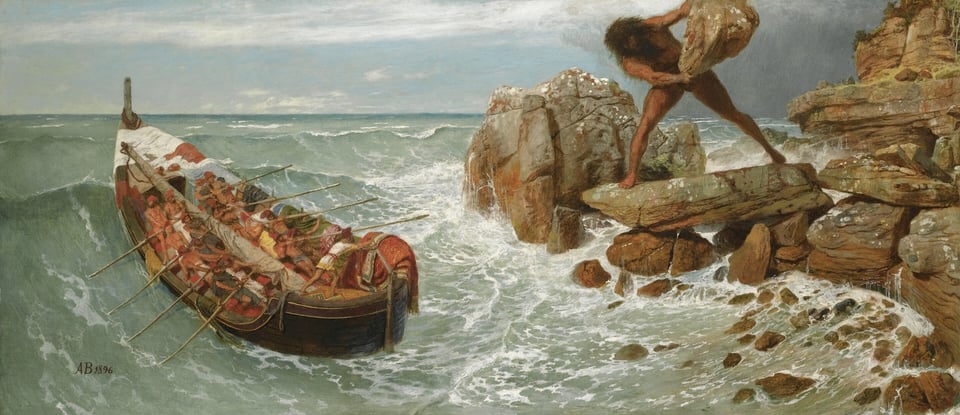
Aeneas and his family escape Troy as the only survivors, boarding a ship to wander the Mediterranean for several years as they search for a new home, avoiding the cyclops and enduring other trials – wait, doesn’t this sound just like the Odyssey? Yes. What Virgil wrote, more or less, is an adaptation of Homer, made to order for the Roman emperor. (And perhaps not always willingly: Shadi Bartsch’s introduction to her excellent translation points out how Virgil left subtle clues in the text to his ambiguous feelings about the Roman empire.)
After Rome, Dublin. My final adventure with Odysseus came in Ulysses, James Joyce’s masterwork based loosely on the Odyssey, depicting Leopold Bloom’s journey around Dublin during a single day in 1904. (Ulysses was the Roman name of Odysseus.) Ulysses has a reputation, deservedly, for abstruse and at times impenetrable language. So here’s what I would tell anyone interested in taking on the book: first, I found it well worth the investment of time and energy; and second, I couldn’t have done it without Patrick Hastings’ companion volume. I would start each chapter of Ulysses by reading as far as I could before getting thoroughly confused; then I would read Hastings up to that point, then switch back to Joyce. Although Ulysses contains many more references and allusions than Hastings can explain in his slim volume, I finished the book with the satisfaction of understanding Bloom’s journey (and that of Stephen Dedalus and Molly Bloom) – and, by extension, that of Odysseus and Telemachus and Penelope.
After reading these nine books, I understand my own journey a bit better, too. The sheer richness of life, Homer and Joyce show us, is impossible to summarize or encapsulate: only the tale of an epic journey can come close to expressing it. To live is to struggle, to endure, to persevere, and somehow, after many years, to find our way home.
But even then it’s not over! Getting home means being able to pull another book off the shelf, sit down in the reading chair, and start a new journey. For now, I haven’t decided what my next literary odyssey will be. I’m open to suggestions – mark at creativegood dot com – though for the moment I’m just trying to finish Anthony Powell’s twelve-volume A Dance to the Music of Time. Although I’d primarily compare it to Proust’s In Search of Lost Time, there are also aspects reminiscent of the Odyssey.
He’s always there, that Odysseus. You just can’t get away from him.
If you enjoyed this column, you can support my writing by joining Creative Good. You’ll get access to the members-only Creative Good Forum, where I post a lot more resources and commentary. Thanks.
Until next time,
-mark
Mark Hurst, founder, Creative Good
Host, Gel conference
Radio show/podcast: techtonic.fm
Email: mark@creativegood.com
Follow me on Bluesky or Mastodon
此内容由惯性聚合(RSS阅读器)自动聚合整理,仅供阅读参考。 原文来自 — 版权归原作者所有。