







I used to believe that running an honest business was a path to long-term success. Treating customers and clients with integrity would build a reputation that would eventually outlast unscrupulous competitors. Word gets out, especially in the information age, and that’s bad news for scammers and con men.
Or so my theory went.
My early, idealistic days from the 1990s came to mind this week as Creative Good, the company I founded in 1997, turned 29 years old. I’m gratified to still be here, advocating for an ethical internet. But it’s hard not to see how the world has changed. Thanks to the rise of social media and AI, carnival barkers and fraudsters are thriving. It’s not just that a few bad guys have struck it rich – instead, the entire economy has been transformed.
Tim Wu calls this “the age of extraction.” In a new book, the Columbia Law professor and former Biden White House official argues that the economy has ceased to be driven by industries providing value to customers through products and services. Instead, led by Big Tech, companies have “focused their attention on reforming their methods of extraction,” taking “as much as possible – data, attention, profit margins – from everyone else.” Companies that aren’t engaged in fleecing, deceiving, addicting, or otherwise exploiting customers are operating at a distinct disadvantage.
Tim was my guest on Techtonic a few days ago. I’d recommend the interview, as well as his book, as it’s one of the best tech books I read last year.
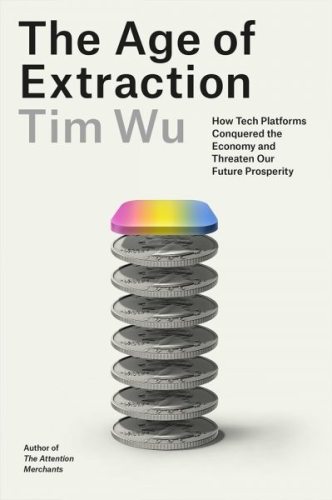
Tim Wu is not alone in pointing out the metastasizing injustice in the economy. His argument is echoed in Cory Doctorow’s Where did the money go? (Jan 8, 2026):
Broadly, these are the two industries in America now: scammers who put Americans into debt, and industries who torment Americans into paying the debt. . . .
There’s a third group that you might call, “People who want to make useful things that we like and pay for.” . . . the problem is that economic growth only comes from the third group. They’re the ones inventing new categories of (useful) products and services that delight their customers and enrich their workers and shareholders (who then buy more things in the economy, keeping the virtuous cycle going).
That third group, the ones actually creating value, are getting harder to find. The scammers are winning.
I’ve touched on this idea myself, writing in Feudal America (Oct 30, 2025) about Disney World’s two-tier approach to customer experience: a frictionless luxury track for a small group of richies, and a degraded (but still expensive) offering for the vast majority of customers.
As I mention in that column, Disney is indicative of, but hardly alone in, the larger trend of exploitation. The Silicon Valley playbook of growth-at-any-cost is spreading to all sorts of industries outside of tech. For example, Tim Wu points out that veterinary practices are getting rolled up by private equity, resulting in higher prices and lower levels of service. And Megan Greenwell, in a recent Techtonic interview, covered private equity’s effects in healthcare, retail, and beyond.
Of course, concerns about technological exploitation are not new. Take this, for example:
The higher aims of ‘technological progress’ are money and ease. And this exalted greed for money and ease is disguised and justified by an obscure, cultish faith in ‘the future.’
That’s Wendell Berry, writing in the 1980s (in “Feminism, the Body, and the Machine”). What Berry warned about 40 years ago – the worship of convenience, the greed – has only grown more real, and more dangerous.
And then there’s that phrase, the “cultish faith in the future.” It makes me think of a moment near the end of “Chinatown,” the classic 1974 film about corrupt water officials in 1930s Los Angeles. The scene shows investigator Jake Gittes, played by Jack Nicholson, confronting the power broker Noah Cross, played by John Huston:
Gittes: How much are you worth?
Cross: I have no idea. How much do you want?
Gittes: Nah, I just wanna know what you’re worth. Over ten million?
Cross: Oh my, yes.
Gittes: Why are you doing it? How much better can you eat? What can you buy that you can’t already afford?
Cross: The future, Mr. Gittes! The future!
Today’s tech oligarchs might say exactly the same thing. “How much better can you eat?” is the wrong question. A billionaire like Zuck or Musk has enough material wealth to fund a dynasty lasting generations. What the oligarchs are still striving for is, tantalizingly, just outside their grasp: full control of the future. And that grasping is, as Wendell Berry points out, precisely what gives rise to the greedy, exploitative behavior of their empires.
Both Tim Wu and Cory Doctorow offer some hopeful visions of the future: Tim advocates for a more balanced economy, while Cory foresees a “post-American internet” offering more opportunity for competition with American monopolies. I’m happy to sign on for both of those, as well as any other ideas that would break Big Tech’s chokehold on our economy, media, education, healthcare system, and so on.
But I have to admit that it’s hard to feel hopeful in moments like this. Just read the headlines: the current occupant of the White House engages in illegal military action in Venezuela, catastrophic threats to our European allies, murderous direction to ICE in Minneapolis, on top of his daily torrent of mendacity and corruption, all of it supported, encouraged, and in some cases funded by his Big Tech patrons. Some days I feel the weight, the sheer weight of it all. As an independent radio host, and an advocate for ethical technology, I feel as out of step with the direction of my country as I have ever been.
I do take comfort in our Creative Good community, where we continue to post resources and links about how to survive this moment. I hope you’ll join us. And I hope that if you or your team could use my strategic advisory help in charting a course forward, you’ll email me.
But after 29 years of Creative Good, I do now wonder what “the future, Mr. Gittes, the future” holds for those of us who want to make tech better.
-mark
Mark Hurst, founder, Creative Good ← please join as a member
Email: mark@creativegood.com
Podcast/radio show: techtonic.fm
Follow me on Bluesky or Mastodon
此内容由惯性聚合(RSS阅读器)自动聚合整理,仅供阅读参考。 原文来自 — 版权归原作者所有。