







A little over a year ago I wrote a book proposal warning against the idolatry of AI systems. I opened with the Bible story of the tower of Babel – you know, the one where people on the plains build a tower in an attempt to produce a common language and rival God. It ends poorly.
Something significant, and probably traumatic, must have taken place for people thousands of years ago to shout at us, through the ages, a simple but urgent lesson: Whatever you do, don’t create a system that links together everyone on earth while acting as a god. Yet here we are, building globe-spanning AI systems and conferring on them decision authority in all sorts of areas.
My book proposal failed to attract interest from the publishers I spoke to (and no hard feelings; I probably need to tighten the pitch a bit more). Yet I still felt that there was some resonance between Babel, idolatry, and all our modern maladies stemming from AI.
Then, this week, Pope Leo’s encyclical arrived. Babel appears in the very first sentence of the roughly 40,000-word document, which goes on to say this:
We must, then, avoid the “Babel syndrome,” namely the idolatry of profit that sacrifices the weak, a uniformity that neutralizes differences, and the pretense that a single language — even a digital one — can translate everything, including the mystery of the person, into data and performance. The risk of dehumanization — of building a future that excludes God and reduces the other to a means — is an ancient and ever-new temptation that today takes on a technical guise.
Yuval Levin, writing in the New Atlantis, praised the encyclical’s invocation of Babel and idolatry, yet wished that it had gone deeper:
from the very outset of Magnifica Humanitas, I wanted the Pope to have much more to say about idolatry than he ultimately did.
Yet if Levin thought the pope didn’t go far enough, there are those who dismiss the pope’s warnings altogether. Here I refer to the AI boosters in Silicon Valley. Cade Metz reported this week (NYT gift link, May 26, 2026) on the discourse in San Francisco, quoting one AI company CEO:
“People are matter-of-factly saying that they are looking to build a machine God . . . They are not saying that ironically or in jest. They are saying it as a matter of fact.”
Well. Totally normal times in the city by the bay.
Metz interviewed the AI faithful at a place called “A.G.I. House,” a $68 million mansion that is used to host meetings and hackathons. People there were unimpressed with the encyclical:
They agreed that Leo’s open letter would have little effect on Silicon Valley, [an A.G.I. House founder] said, but they wondered whether Silicon Valley might have an effect on the pope — if the Vatican might use A.I. technologies to “create a New Jerusalem.”
“A.I. and its capabilities represent something analogous to the Second Coming,” he said.
So, to recap:
The pope issues a warning against turning AI into an idol.
Silicon Valley techies scoff at the pope, saying that they’re too busy creating a machine God that rivals the Second Coming.
The time is coming when we’ll each have to declare our allegiance either to, or against, the Silicon Valley religion. This choice will be independent of whether we align ourselves with any traditional religion, or none at all: the question will simply be, do we put our faith in the ultimate authority of a machine god, built out of computer code and data centers, and owned by billionaire oligarchs?
Call me an apostate, but I can only laugh derisively at the idea. For one thing, it’s hard to look at a pile of linear algebra and call it a god. I can’t even manage to see it as sentient. I mean, it’s essentially a giant spreadsheet – granted, a really, really complicated spreadsheet with colossal requirements for power and water and a goal of manipulating users for the benefit of its oligarch owners – but alive? I just can’t see it.
But wait . . . I just remembered a cheese grater I spotted online. Maybe this changes everything:
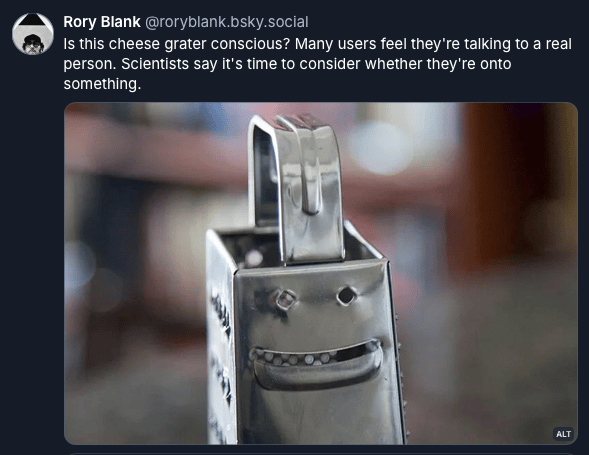
I’m having a bit of fun here, but the question of allegiance will be deadly serious for the billions of people who face it. The tech industry’s propositions about AI are too valuable to be dismissed easily. The ideas of AI-as-alive, AI-as-idol, and AI-as-god have trillions of dollars behind them, so we’ll be dealing with them for years.
Silicon Valley has been working for some time to engage the Vatican on this point. Peter Thiel, for example, is mentioned in this Religion News Service article (May 22, 2026):
Thiel has hosted a series of closed-door talks, including at the Vatican, in which he suggested that calls to regulate AI could be the work of the Antichrist.
Ah yes, the telltale sign of the Antichrist: regulatory guardrails on a dangerous technology.
But the article really focuses on Anthropic, maker of the Claude AI chatbot. Its partnership with the Vatican is close enough that a billionaire cofounder of Anthropic, Chris Oleh, spoke alongside the pope at the announcement of the encyclical.
Oleh is an atheist, but Anthropic has been working hard to ingratiate itself with religious leaders. The article describes how the company recently convened a group to talk about how to align AI with spiritual values.
Among the solutions proposed by faith leaders: offering Claude something like the Catholic sacrament of confession, where the AI can be forgiven.
If you can’t swallow the idea of AI as a god, how about the idea of Claude going to confession? Seeing Claude as a person, or at least as a personality of some sort, is echoed by Oleh’s remarks at the Vatican (also covered by Futurism). He said:
I lead a research team that studies the internal structure of these models — what is actually happening inside them. And I will be honest: we keep finding things that are mysterious, even unsettling. We find structures that mirror results from human neuroscience. We find evidence of introspection. We find internal states that functionally mirror joy, satisfaction, fear, grief, and unease.
In other words, Oleh is saying as he stands next to the pope, our AI sure seems alive.
Babel and idolatry are very much present in our systems today, echoing ancient warnings. What’s new is that the world is hearing the claims of machine sentience, leading to that of a machine god, coming from the podium at the Vatican.
You’re on a free subscription. I hope you’ll support my writing by joining Creative Good – a community where we discuss tech news and commentary every day on the members-only Creative Good Forum. You’re also invited to our community gathering, the Gel 2026 conference, this October 2-3 in upstate New York!
-mark
Mark Hurst, founder, Creative Good
Email: mark@creativegood.com
Podcast/radio show: techtonic.fm
Follow me on Bluesky or Mastodon
此内容由惯性聚合(RSS阅读器)自动聚合整理,仅供阅读参考。 原文来自 — 版权归原作者所有。