







Here’s a story about AI you need to hear. First the bad news, then the good news.
1. AI gets fresh water, while citizens are told to drink sewage
Five years ago the first Big Tech data center appeared in the region of Querétaro in central Mexico. It was for Microsoft. Data centers for Google and Amazon went up soon after. In the years since, nearby villages have experienced more and more power outages, putting pressure on local homes and businesses, even health care facilities. One clinic has had to conduct procedures by flashlight.
And then there’s the water issue. Querétaro’s fresh water resources, already taxed before Big Tech’s arrival, are now under severe pressure – enough, in fact, for the government to come up with a new water-mitigation scheme. It goes like this:
The remaining fresh water goes to the Big Tech companies for their AI data centers, while the citizens get recycled sewage water.
If it sounds like I’m exaggerating, allow me to quote a New York Times article from October 20, 2025:
Teresa Roldán, an activist in Mexico, said she was skeptical of a new proposal in Querétaro to recycle sewage for public drinking water. The government has said the plan would serve citizens and industry, but data center companies already have direct access to groundwater, she said. Residents would end up with filtered sewage water, she said.
Of course, this is an activist’s perspective. The Big Tech companies have their own messaging. Like this:
“We looked deeply and found no indication that our data centers have contributed to blackouts or water shortages in the region,” said Bowen Wallace, Microsoft corporate vice president for data centers in the Americas. “We will always prioritize the basic needs of the community.”
So on one side we have residents claiming that blackouts and water shortages have gotten worse since the Big Tech data centers came to town. And on the other side, Big Tech representatives assure us that everything is fine.
I’m especially struck by the claim that Microsoft “will always prioritize the basic needs of the community.” Because that point – the prioritization of AI versus basic needs – is exactly what is missing in the current AI discourse.
I should say, before going further, that I spoke on Techtonic this week with Paul Mozur, global tech correspondent for the Times, who wrote the article with Adam Satariano and Emiliano Rodríguez Mega. It’s called From Mexico to Ireland, Fury Mounts Over a Global A.I. Frenzy (gift link).
LISTEN: Here’s the episode page for my interview with Paul Mozur, where you can listen and see show links.
Now back to that risible assertion by the Microsoft vice president that the company is prioritizing the basic needs of the community, rather than compromising those needs in favor of profit-seeking, resource-draining data centers.
When the power goes out in a health clinic, and the groundwater is so depleted that residents are drinking filtered sewage, it’s hard to conclude that the “basic needs” of the community are being met.
The situation in Querétaro raises a question that, as I said above, is missing from the conversation about AI: Is it possible for the global AI buildout to benefit everyday citizens, and not just the Big Tech companies and their government partners?
2. A better alternative, from Chile
Mozur, during our interview, gave a hopeful example from Chile. In a separate article (gift link) Mozur describes “the astronomy model,” which required that new installations would benefit locals:
In the 1990s, as foreign astronomers vied to build telescopes in the country’s clear-skied deserts, the government passed a rule: 10 percent of telescope time must go to local researchers. Chile became a global leader in astronomy.

At first glance, that arrangement – forcing Big Tech to benefit the local community – would seem to work well for the AI buildout. According to the article, the Chilean government is working on just such a partnership. But here, too, activists are pointing out the environmental risks:
Many perceived the government’s plans as an effort to court large companies at the expense of public interests. Activists pointed to an environmental rule change that could reduce transparency on water and electricity consumption.
Once again we return to the underlying question of who benefits – cui bono – from this giant investment in AI.
What is all of this for? Why are we building AI? Are there tangible benefits from AI that are worth the investment?
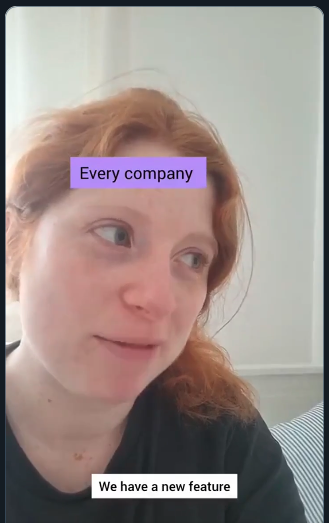
I can’t help but think of the short video I came across online, with a young woman acting out both sides of the AI conversation:
(For something else along the same lines, see the comic about AI peas by Stephen Collins.)
I know that there are some benefits to AI, and there could be more – way more – if the AI space wasn’t dominated by the unethical, ossifying monopolies of Silicon Valley. But for now, we have to evaluate the systems by their real-world effects: not what the companies claim is happening, not what their government sponsors hope will happen, but what people on the ground are actually experiencing.

If residents are forced to drink recycled sewage, while the Big Tech company enjoys access to pure groundwater, that’s wrong. Easy decision.
If the data centers are mostly used to create AI slop, which degrades the media environment, threatens democracy, and elevates the Big Tech companies as the only viable institutions left standing: that’s wrong.
If the electricity draw is such that neighborhoods and hospitals are going dark as a result, and the drain on the grid results in over 20% of all electricity nationwide going to AI data centers – as is already the case in Ireland – that’s just insane.
In short, I don’t see much argument in favor of the arrangement we have today. Big Tech-dominated AI, as it currently stands, isn’t worth much more than the sewage it spews into our feeds. I can only hope – and yes, this is a dream, but worth writing down – that we’ll find the political will to break up the monopolies, strengthen worker rights, and refuse to build more unless and until it benefits communities and ecosystems.
See also:
Techtonic interview with Paul Mozur (November 10, 2025)
Don’t let the data center come to town (October 14, 2025 column)
If this resonates with you, please join my Creative Good community, where we discuss technology its developments every day on the members-only Forum.
Until next time,
-mark
Mark Hurst, founder, Creative Good ← please join as a member
Email: mark@creativegood.com
Podcast/radio show: techtonic.fm
Follow me on Bluesky or Mastodon
此内容由惯性聚合(RSS阅读器)自动聚合整理,仅供阅读参考。 原文来自 — 版权归原作者所有。