








In southwest Memphis sits the Colossus, a giant AI slop factory owned by Elon Musk. Gas-powered turbines at the facility foul the air with “nitrogen oxides and formaldehyde, among other pollutants,” according to CNBC and SELC. This witch’s brew of carcinogens and asthma-inducing chemicals is now in the air of a residential neighborhood.
You might wonder why Musk’s scouts chose southwest Memphis for the Colossus. Capital B News (Apr 29, 2025) says this about the neighborhood, called Boxtown:
Today, 95% of 38,109 residents are Black. The median household income is less than $37,000. The poverty rate is more than 31%.
Ah. Much like Big Tech exploits labor around the world, assigning horrific content moderation tasks to low-cost workers in poor countries, Big Tech data centers are now springing up in vulnerable communities. (See more about Boxtown.) But it’s not just happening in the US.
I came across this graph in Axios (Oct 7, 2025), showing the projected growth in power demands from AI data centers. The disturbingly large estimate for 2060 – over 5,000 terawatt hours – is labelled “rest of world.” As my annotation points out, the size of it seems… bad.
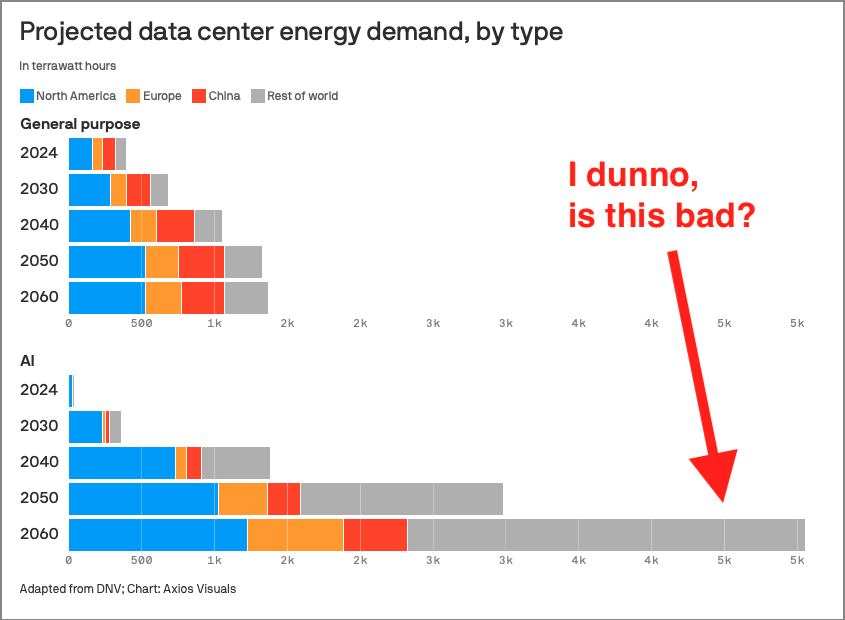
Even more disturbing is that today’s number, the 2024 measurement, is so tiny by comparison. Consider that the state of Virginia already gives over 25% of its electricity to AI data centers (source), and all of that is included in that thin strip of blue by the “2024” label. If the coming years bring the exponential growth shown in the chart, we’re in for an unthinkable amount of waste.
To be fair, those projections might be wildly inaccurate. The AI bubble could pop, as Ed Zitron predicts (Oct 10, 2025), leaving many data centers without enough power, or just not built in the first place.
But in the meantime, the infrastructure of AI is quietly spreading. Such was the premise of my Techtonic episode from Oct 6, 2025. While we’re distracted by daily headlines of outrage and nightmare, Big Tech continues its bid to suck down as much electricity, water, and fresh air as it can – for the enrichment of a tiny few.
Case in point is this example I covered on the show. In An AI data center on Cayuga Lake (by Fernando Figueroa, Brian Crandall, and Megan Zerez in the Ithaca Voice, Sep 12, 2025) we learn that “there’s a plan to use the infrastructure in an old coal-fired power plant on Cayuga Lake to power a data center.”
The article goes on to describe how the data center will be drawing down fresh water from Cayuga Lake, one of the two largest Finger Lakes in central New York State:
The proposed data center will use the plant’s existing water intake system to pull water from the lake to cool computers, but company representatives told town officials the facility does not plan to release warmed water back into the lake.
Instead, their plans currently call for the plant to use an evaporative cooling system, where water taken from the lake would dissipate into the atmosphere.
The fresh water of Cayuga Lake, in other words, is going to be exchanged for digital slop.
And that’s just part of the problem. Consider the downsides of an AI data center:
- 24/7 draw on the local electrical grid
- drain of fresh water from nearby lakes or aquifers
- noise pollution
- disposal of e-waste, as hardware needs constant replacement
- higher electricity bills for nearby residents
All of these downsides, and for what benefit – more psychosis-inducing chatbots? More generative AI sludge? Whatever helpful use cases there may be, without doubt, are outweighed by the primary benefit: enriching the Big Tech CEOs and their financial partners.
Why, then, would these local communities allow data centers in? Because in many cases, the citizens have no choice in the matter; they may not even know that the town is negotiating with a tech company. For example, Why Are Plans for This Alabama Data Center So Hush-Hush? (Word in Black, Sep 30, 2025) explains how, in the majority-Black city of Bessemer, Alabama, “the mayor and others have signed non-disclosure agreements preventing them from talking about” a hyperscale data center planned for the town. It’s the size of 18 Wal-Mart Supercenters and will “consume enough electricity annually to power a city the size of Seattle,” but citizens haven’t heard much about it.
Bessemer isn’t alone. I covered this exact issue on the Aug 14, 2023 Techtonic with Pat Garofalo: Big Tech companies like Amazon force NDAs onto local leaders to prevent them from telling their own constituents about the horrible deal the community is getting.
From MediaJustice (Sep 9, 2025) the report The People Say No: Resisting Data Centers in the South describes the predations of Big Tech on the American South. As the report says:
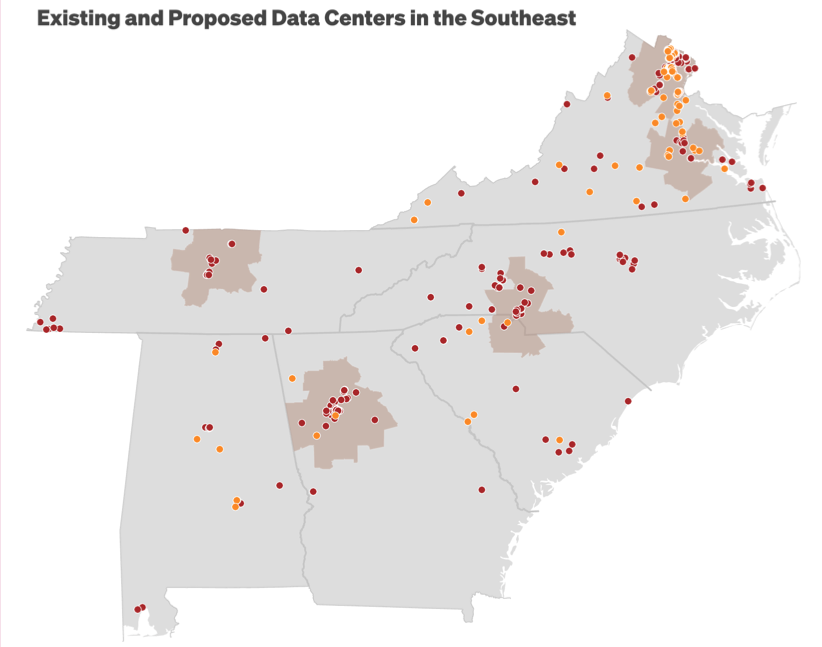
The South is becoming the epicenter of data centers in the U.S. There are larger scale data centers being proposed in states like North Caroline, Arkansas, Louisiana, Mississippi, Virginia, Georgia, South Carolina, Alabama, and Tennessee.
The graphic below, from the Southern Environmental Law Center, shows existing data centers as red dots and proposed data centers as orange dots. (Shaded areas are major metro areas.)
Citizens in these communities are paying dearly for Big Tech’s arrival:
In South Carolina, data centers will account for 65 percent to 70 percent of all new energy usage in the state.
And –
In Georgia, a single facility could consume 9 million gallons per day in Coweta County, one-third of the entire county’s daily water allotment. In Bessemer, Alabama, one data center would require 2 million gallons of water per day, or roughly the same amount of water as two thirds of the city’s population.
The good news is that communities are starting to speak out. The effects, after all, are impossible to ignore. Wanda Mosley, an activist in Georgia, is quoted in the report:
I am not sure which issue troubles me more, the insane amount of water used in communities who do not have enough clean drinking water, or the increase in utility bills for working class people. Both are a tremendous hardship on people trying to survive day to day.
That’s a helpful distillation of the threat from predatory Big Tech companies as they arrive in communities across the country.
It’s a lesson for all of us: Don’t let the data center come to town.
Until next time,
-mark
Mark Hurst, founder, Creative Good
Email: mark@creativegood.com
Podcast/radio show: techtonic.fm
Follow me on Bluesky or Mastodon
此内容由惯性聚合(RSS阅读器)自动聚合整理,仅供阅读参考。 原文来自 — 版权归原作者所有。