惯性聚合 高效追踪和阅读你感兴趣的博客、新闻、科技资讯
阅读原文 在惯性聚合中打开

推荐订阅源

Google DeepMind News
博客园_首页
aimingoo的专栏
aimingoo的专栏
IT之家
IT之家
美团技术团队
GbyAI
GbyAI
博客园 - 司徒正美
Recent Commits to openclaw:main
www.infosecurity-magazine.com
S
Security @ Cisco Blogs
Application and Cybersecurity Blog
Jina AI
Jina AI
The Cloudflare Blog
O
OpenAI News
雷峰网
雷峰网
P
Proofpoint News Feed
Google DeepMind News
Threat Intelligence Blog | Flashpoint
F
Fortinet All Blogs
量子位
C
CERT Recently Published Vulnerability Notes
V
V2EX
J
Java Code Geeks
H
Help Net Security
小众软件
小众软件
H
Hacker News: Front Page
cs.CL updates on arXiv.org
T
Tor Project blog
Y
Y Combinator Blog
Spread Privacy
Spread Privacy
Martin Fowler
Martin Fowler
H
Hackread – Cybersecurity News, Data Breaches, AI and More
Scott Helme
Scott Helme
N
News | PayPal Newsroom
Vercel News
Vercel News
爱范儿
爱范儿
TaoSecurity Blog
TaoSecurity Blog
Webroot Blog
Webroot Blog
博客园 - 叶小钗
T
Threat Research - Cisco Blogs
cs.AI updates on arXiv.org
N
Netflix TechBlog - Medium
宝玉的分享
宝玉的分享
G
GRAHAM CLULEY
MyScale Blog
MyScale Blog
Security Archives - TechRepublic
L
Lohrmann on Cybersecurity
阮一峰的网络日志
阮一峰的网络日志
V
Visual Studio Blog
S
Schneier on Security

TrendForce

[News] ASE Reportedly Raises Advanced Packaging Quotes by More Than 20% in Latest AI-Driven Price Hike [News] Musk’s TeraFab Lands First Major Hire as 18-Year Intel Veteran With 18A Experience Joins as Director [Insights] Memory Spot Price Update: DRAM Spot Prices See Gains in Low-Density DDR4 and DDR3 Amid Sideways Market [News] Passive Component Prices Rise as YAGEO Reportedly Begins Broadest Capacitor Hike in Years on July 1 [News] Intel Reportedly Breaks Ground on Santa Clara Expansion for Next-Gen EUV Mask Capacity [News] World’s First Mass-Production Line for 6-/8-Inch Homoepitaxial Gallium Oxide Wafers Comes Online [News] Samsung Electro-Mechanics Lands KRW 450B 1-Year MLCC Contract as AI Spurs Long-Term Agreements [News] Raw Material Inflation Deepens: FULLTECH Hikes Glass Fiber Cloth Prices Up to 30%; VPEC Adjusts Epi Wafer Prices [News] Samsung Reportedly Restarts 1.4nm Push, Targets 2029 Mass Production to Close Gap with TSMC, Intel [News] ByteDance Reportedly Eyes Next-Gen In-House CPU for 2H27 Mass Production; May Partner With Qualcomm [News] Samsung, SK hynix 800 Trillion Won Expansion Strains Chipmaking Tool Supply, Potentially Pressures TSMC, Intel [News] Goertek-Backed 12-Inch AR Optical Wafer Fab Commenced Production [News] China Signs First Domestic Ultra Wide Bandgap Semiconductor Full-Chain Project [News] Samsung, SK hynix, Micron Face U.S. Class-Action Lawsuit Over Alleged DRAM Supply Manipulation [News] Korea’s High-Purity CO₂ Inventory Reportedly Falls Below One Month; Samsung, SK hynix Under Pressure [News] TSMC’s 2Q Margins Reportedly Near 70% amid Strong 3/5nm Demand, 3Q Revenue Seen Growing Over 10% [Sponsored Content] Where Do You Stand as AI Reshapes Industries? [News] Asian Memory Makers Turn to U.S. Capital Markets: SK hynix and Kioxia Advance ADR Plans [News] Lenovo Reportedly Sees Higher Memory Prices Becoming the New Normal Into 2030 [News] TSMC on Terafab: No Shortcuts in Foundry; Confirms Next-Gen LPU Project amid Samsung Rivalry [News] TSMC N3 Tightens on AI Demand; Arizona 2nd Fab 3nm Volume Production in 2H27, Kumamoto in 2028 [News] TSMC Sees 2Q Sales Up 10% QoQ to $40.2B; Margins Rise to 65.5%–67.5%, Capex at Top End of $52–56B [News] TSMC 1Q26 Net Income Soars 58% YoY to NT$572.5B Record, EPS NT$22.08; Gross Margin Beats Forecast at 66.2% [News] Tesla AI5 Reportedly Uses SK hynix Memory, Samsung LPDDR5X; Samsung SF2T Process Applied Ahead of AI6 [News] TSMC 1Q Profit Seen Up ~50% to Record; Meta–Broadcom AI Chips Reportedly Target 2nm, CoWoS-L in 1H27 [News] San’an Announced Three Advances in Optical Communications Business [News] Intel Reportedly to Brief Staff on TeraFab Involvement in Coming Weeks, While Key Foundry Details Remain Limited [News] ASML Raises 2026 Sales Outlook to €36B–€40B on Memory, Logic Demand; South Korea Share Hits 45% [News] Chinese Startup Dishan Reportedly Develops 2nm AI Chip in Prototype Verification; Foundry Access Uncertain [News] Musk Confirms AI5 Tape-Out, but Wrong TSMC Tag Triggers Social Media Mix-Up [News] China Reportedly Sees Record 2025 Chip Tool Imports from Singapore, Malaysia; U.S. Hit Lowest Since 2017 [Insights] Memory Spot Price Update: DRAM Spot Sellers Hold Firm Ahead of Mid-April Pricing, DDR4 Edges Lower 0.48% [News] HBM4 Strategies Diverge: Samsung Reportedly Chases 80% 1c DRAM Yield While SK hynix Trims Shipments by 30% [News] Korea Challenges Intel on Glass Substrate Standards as Absolics, Samsung Accelerate Commercialization [Insights] NVIDIA’s US$2B Marvell Deal: What’s the Strategic Significance for CPO and AI Interconnects? [News] Samsung Reportedly Lifts HBM4 Logic Die Prices by 40–50% Amid AI Boom; 4nm at Full Capacity [News] Huawei Takes Early Lead in Horizontal Foldable Race vs Samsung and Apple, Eyes April Pura X Max Launch [News] China Reportedly Closes AI Performance Gap with U.S., Stanford Report Says; Anthropic Leads by Just 2.7% [News] Samsung 2nm Yields Reportedly at ~55%, Below Mass Production Threshold; Qualcomm May Opt for TSMC [Insights] Memory Spot Price Update: DDR4 Spot Prices Climb as Samsung Holds EOL Line [News] TSMC May Fast-Track 1.4nm at Central Taiwan Science Park as 2nm Yields Reportedly Beat Expectations [News] Micron Reportedly Weighs Acquiring PSMC 12-Inch Tongluo Fab, With Multiple Partners Also Interested [News] ASUS to Raise Prices on Selected PC Lines from Jan. 5 Amid Memory Cost Surge, Following Dell [News] 2025 Tech Layoffs: Meta, Amazon, Microsoft and Others Cut Tens of Thousands of Roles [News] Sony, Microsoft Reportedly Weigh Delaying Next-Gen Game Consoles Beyond 2028 Amid Memory Price Surge [News] Samsung Reportedly Plans 50% HBM Capacity Surge in 2026, Spotlight on HBM4 [News] China Diversification Reportedly Lifts Mature-Node Foundries UMC, VIS, PSMC Despite Tariff Delay [News] Samsung, SK hynix Escape Worst-Case as China VEU Ends: Annual Review Risks Loom [News] TSMC Advanced-Node Materials Reportedly Found at Lo’s Residence Amid Controversial Intel Hire [News] NVIDIA’s $20B Groq Deal Spotlights SRAM Shift—MediaTek NPU Already On Board [News] Chinese Scientists Achieved New Breakthrough in Next-Gen Optical Computing Chips [News] Five-Year-Old Chinese EDA Firm Univista Sets Sights on IPO, Led by Ex-Synopsys and Cadence Team [News] Samsung Reportedly Pushes In-House CPU and GPU for Exynos 2800 to Cut Qualcomm, AMD Reliance [News] SK hynix Reportedly Plans First U.S. 2.5D Packaging Line, Eyes Turnkey HBM to Challenge TSMC [News] TSMC Reportedly to Raise Sub-3nm Prices 3-10% in 2026, Plans Hikes Through 2029 [News] Samsung Emerges as Potential Second Foundry for NVIDIA Alongside TSMC After Groq Licensing Deal [News] 7.0 Quake Hits: TSMC Nears Full Production, Sector Losses Reportedly Tens of Billions NTD [News] SLC-Based AI SSDs Gain Traction as SK hynix and Kioxia Accelerate Development With NVIDIA [News] NVIDIA Reportedly Denies USD 20B Groq Acquisition Rumors
[News] Mapping the Micro LED Optical Interconnect Ecosystem
TrendForce · 2026-06-29 · via TrendForce


As AI data centers continue to scale, power consumption and bandwidth bottlenecks in chip-to-chip interconnects are becoming increasingly difficult to address. Against this backdrop, Micro LED-based co-packaged optics (CPO) is emerging as a promising alternative. By replacing traditional high-speed serial architectures with a “wide-and-slow” parallel optical approach, the technology transmits data through hundreds of low-speed optical channels operating simultaneously.

This architecture eliminates the need for several power-hungry components—including DSPs, ADC/DACs, and CDRs—reducing energy consumption to just 1–2 pJ/bit. Overall system power is targeted at roughly 5% of that required by copper-cable solutions. In addition, Micro LED arrays can integrate more than 400 channels within a footprint of less than 1 mm², offering a compact structure, high reliability, and reduced sensitivity to temperature fluctuations.

Although transmission distances are currently limited to less than 10 meters, Micro LED CPO is well suited to scale-up interconnects within AI server racks—a use case that neither copper cables nor silicon-photonics-based CPO can fully address. As a result, the technology has attracted growing interest from global technology leaders and semiconductor companies, triggering a wave of partnerships and ecosystem-building efforts.

Global Players Race to Define the Micro LED CPO Market

The Micro LED CPO industry remains in an early stage, with standardization efforts progressing alongside technical development. Key specifications—including chip dimensions, per-channel data rates, transmission distances, and whether receivers should use photodiodes (PDs) or CMOS sensor arrays—have yet to be finalized.

In this context, competition today centers on influencing future standards, with alliances and resource integration emerging as the preferred strategy. Early participants range from major technology companies such as Microsoft and Marvell to startups including Avicena and Hyperlume.
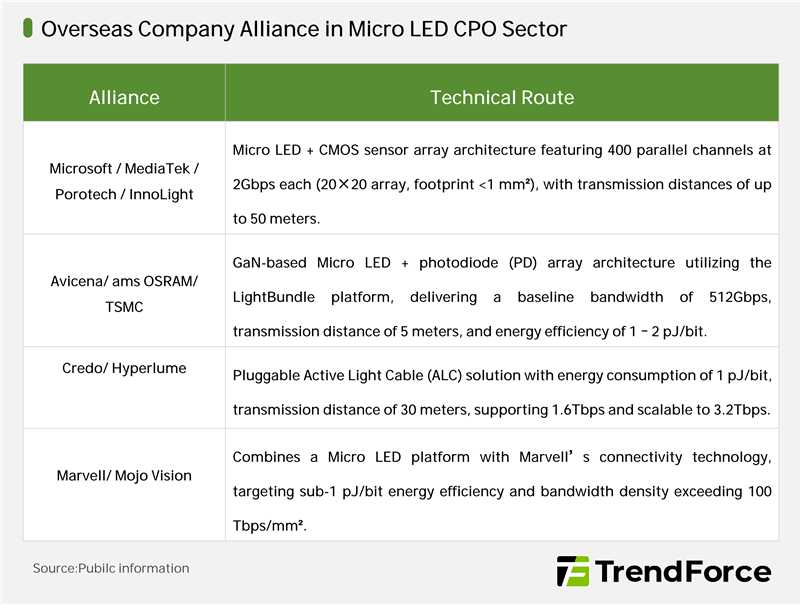
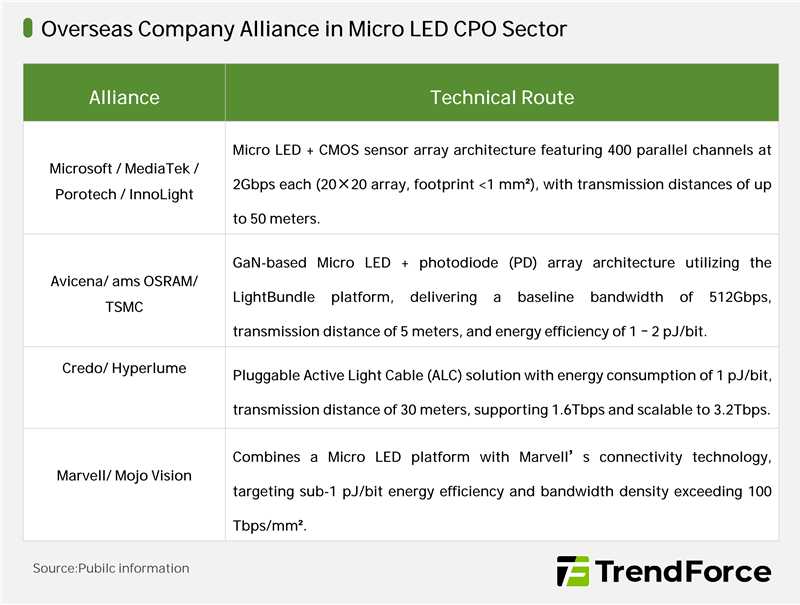
Microsoft’s MOSAIC architecture exemplifies the “wide-and-slow” philosophy. While a conventional 800Gbps optical link typically consists of eight 100Gbps channels, MOSAIC distributes data across 400 parallel 2Gbps optical channels arranged in a 20×20 array occupying less than 1 mm².

The lower per-channel data rate significantly simplifies signal equalization requirements and eliminates the need for DSPs, ADC/DACs, and CDRs. Power consumption is reduced to 3.1–5.3W, representing a 56–68% improvement over mainstream optical-link solutions. The use of multicore imaging fiber further tackling wiring challenges associated with hundreds of parallel optical channels.

Avicena has taken a different approach with its LightBundle platform, pairing GaN-based Micro LED arrays with PD receivers. Leveraging advanced semiconductor manufacturing processes from TSMC, the solution delivers a baseline bandwidth of 512Gbps, scalable to 896Gbps, while maintaining energy efficiency of 1–2 pJ/bit and stable transmission over distances of up to five meters.

In March 2026, Avicena signed a joint development agreement with ams OSRAM. The partnership is expected to accelerate commercialization by combining LightBundle with ams OSRAM’s mass-production expertise in automotive Micro LED technologies.

Meanwhile, Marvell, a leading supplier of optical networking DSP, has partnered with Mojo Vision in a strategic move to maintain relevance in a future where DSPs may no longer be required in certain optical interconnect architectures.

High-speed connectivity specialist Credo directly acquired Canadian startup Hyperlume in the third quarter of 2025. The company plans to launch a new category of Active Light Cable (ALC) products offering reliability comparable to AEC copper cables while extending transmission distances to 30 meters. Sample shipments are expected in fiscal 2027, followed by volume production ramp-up in fiscal 2028.

While major technology firms and startups have collectively outlined the early framework of the Micro LED CPO ecosystem, significant differences remain in chip specifications, receiver architectures, and system integration approaches. Industry-wide standards are still several years away, making the next two to three years a critical period for specification battles and market positioning.

China’s Emerging Micro LED CPO Ecosystem

Companies in Chinese Mainland and Taiwan have adopted distinct strategies for entering the Micro LED CPO market.

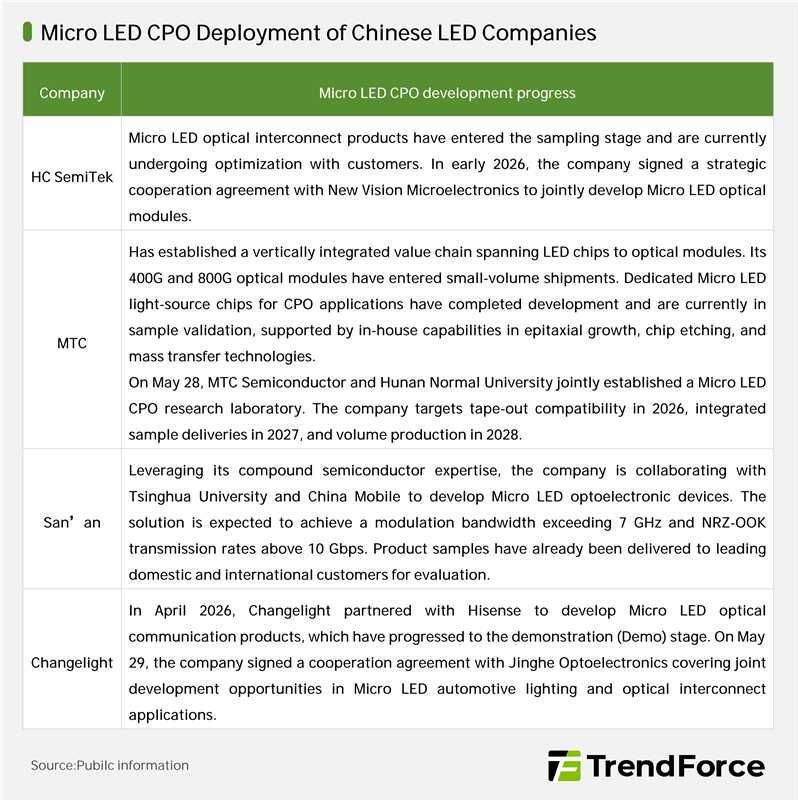
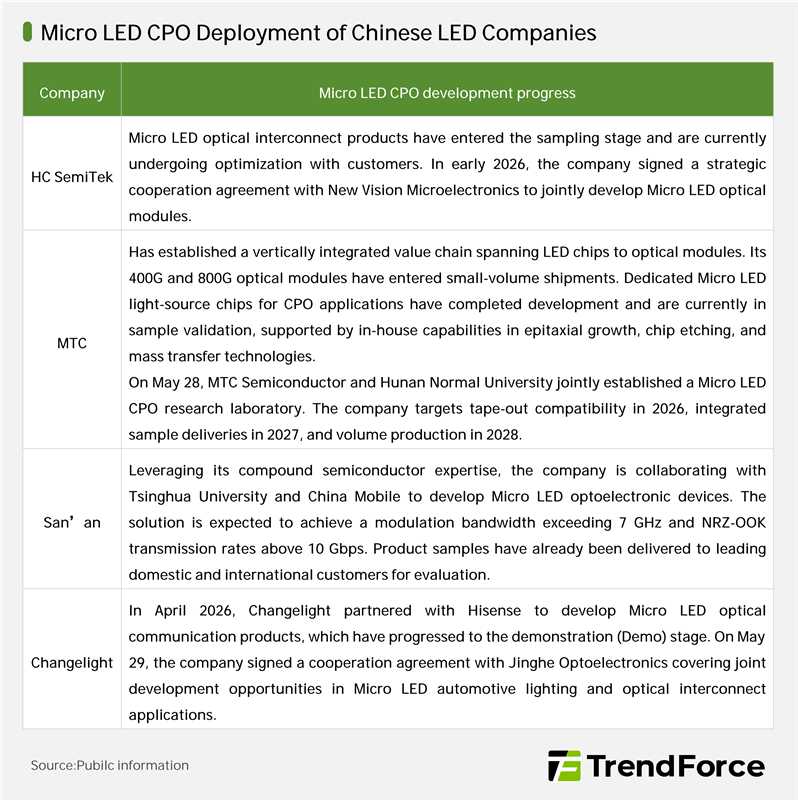
In Chinese mainland, participation has been more diversified. Traditional LED manufacturers are expanding into optical communications, while cross-industry collaborations seek to accelerate technological breakthroughs. Most projects remain in the sample-development and customer-validation stage, though commercialization efforts are steadily advancing.

Companies with active Micro LED CPO initiatives include HC SemiTek, MTC, San’an, Changelight, Chip Foundation, Leyard, Saphlux, Azure, and SmartSens.
Taiwan-based companies, by contrast, are pursuing vertically integrated strategies. Display makers and LED manufacturers are leveraging internal group resources to establish end-to-end supply chains spanning light sources, detectors, and modules before industry standards are finalized.

Among the most notable examples is AUO, which has integrated LED supplier Ennostar and photodiode maker Tyntek into its ecosystem. By adopting a glass-RDL interposer solution, AUO allows customers to deploy Micro LED CPO without investing in their own mass-transfer production lines, largely lowering adoption barriers. The company has already begun system-level CPO validation with international AI and optical communications customers and expects commercialization to progress over the next two to three years.

In late May, AUO also announced a strategic partnership with French Micro LED specialist Aledia to develop next-generation display technologies combining high brightness, low power consumption, and high resolution. The collaboration could eventually expand into optical communications applications.

PlayNitride has entered into cooperation with Brillink, while Innolux is widely viewed as a potential beneficiary of its subsidiary’s electro-optical packaging capabilities, strengthening its vertical integration strategy and competitive positioning.

CPO Reshapes the Value Proposition of Micro LED

Whether through vertical integration in Taiwan, cross-sector partnerships in Chinese mainland, or strategic alliances among overseas technology companies, Micro LED CPO deployments today remain largely focused on sampling and qualification programs. Large-scale shipments have yet to materialize. The key questions for the industry now lie in when market adoption will accelerate, how large the potential could become, and how Micro LED CPO will interact with the broader Micro LED ecosystem.

According to TrendForce, the global market for AI-focused optical transceiver modules is expected to grow from USD 16.5 billion in 2025 to USD 26 billion in 2026, representing annual growth of more than 57%. Modules operating at 800G and above are projected to account for over 60% of the market in 2026, laying a solid foundation for broader CPO adoption.

Against this backdrop, TrendForce forecasts that CPO penetration in AI data center optical modules will rise from approximately 0.5% in 2026 to nearly 35% by 2030.

Shipments of Micro LED CPO optical transceiver modules are expected to begin ramping in the second half of 2028, with the market projected to generate approximately USD 848 million in revenue by 2030.

Beyond enabling more efficient AI data-center interconnects, Micro LED CPO is expected to create meaningful spillover benefits for the display industry. Manufacturing capabilities developed for optical interconnect applications—including ultra-miniaturized Micro LED chips, higher-precision mass transfer processes, and stringent yield-management expertise—are likely to migrate into display production, helping reduce manufacturing costs and accelerate adoption in consumer markets.

Looking ahead, display and optical communication applications are expected to reinforce one another, creating a dual-engine growth model for the Micro LED industry and driving the technology toward large-scale commercialization.

(Photo credit: OSRAM)


[News] Mapping the Micro LED Optical Interconnect Ecosystem


As AI data centers continue to scale, power consumption and bandwidth bottlenecks in chip-to-chip interconnects are becoming increasingly difficult to address. Against this backdrop, Micro LED-based co-packaged optics (CPO) is emerging as a promising alternative. By replacing traditional high-speed serial architectures with a “wide-and-slow” parallel optical approach, the technology transmits data through hundreds of low-speed optical channels operating simultaneously.

This architecture eliminates the need for several power-hungry components—including DSPs, ADC/DACs, and CDRs—reducing energy consumption to just 1–2 pJ/bit. Overall system power is targeted at roughly 5% of that required by copper-cable solutions. In addition, Micro LED arrays can integrate more than 400 channels within a footprint of less than 1 mm², offering a compact structure, high reliability, and reduced sensitivity to temperature fluctuations.

Although transmission distances are currently limited to less than 10 meters, Micro LED CPO is well suited to scale-up interconnects within AI server racks—a use case that neither copper cables nor silicon-photonics-based CPO can fully address. As a result, the technology has attracted growing interest from global technology leaders and semiconductor companies, triggering a wave of partnerships and ecosystem-building efforts.

Global Players Race to Define the Micro LED CPO Market

The Micro LED CPO industry remains in an early stage, with standardization efforts progressing alongside technical development. Key specifications—including chip dimensions, per-channel data rates, transmission distances, and whether receivers should use photodiodes (PDs) or CMOS sensor arrays—have yet to be finalized.

In this context, competition today centers on influencing future standards, with alliances and resource integration emerging as the preferred strategy. Early participants range from major technology companies such as Microsoft and Marvell to startups including Avicena and Hyperlume.

Microsoft’s MOSAIC architecture exemplifies the “wide-and-slow” philosophy. While a conventional 800Gbps optical link typically consists of eight 100Gbps channels, MOSAIC distributes data across 400 parallel 2Gbps optical channels arranged in a 20×20 array occupying less than 1 mm².

The lower per-channel data rate significantly simplifies signal equalization requirements and eliminates the need for DSPs, ADC/DACs, and CDRs. Power consumption is reduced to 3.1–5.3W, representing a 56–68% improvement over mainstream optical-link solutions. The use of multicore imaging fiber further tackling wiring challenges associated with hundreds of parallel optical channels.

Avicena has taken a different approach with its LightBundle platform, pairing GaN-based Micro LED arrays with PD receivers. Leveraging advanced semiconductor manufacturing processes from TSMC, the solution delivers a baseline bandwidth of 512Gbps, scalable to 896Gbps, while maintaining energy efficiency of 1–2 pJ/bit and stable transmission over distances of up to five meters.

In March 2026, Avicena signed a joint development agreement with ams OSRAM. The partnership is expected to accelerate commercialization by combining LightBundle with ams OSRAM’s mass-production expertise in automotive Micro LED technologies.

Meanwhile, Marvell, a leading supplier of optical networking DSP, has partnered with Mojo Vision in a strategic move to maintain relevance in a future where DSPs may no longer be required in certain optical interconnect architectures.

High-speed connectivity specialist Credo directly acquired Canadian startup Hyperlume in the third quarter of 2025. The company plans to launch a new category of Active Light Cable (ALC) products offering reliability comparable to AEC copper cables while extending transmission distances to 30 meters. Sample shipments are expected in fiscal 2027, followed by volume production ramp-up in fiscal 2028.

While major technology firms and startups have collectively outlined the early framework of the Micro LED CPO ecosystem, significant differences remain in chip specifications, receiver architectures, and system integration approaches. Industry-wide standards are still several years away, making the next two to three years a critical period for specification battles and market positioning.

China’s Emerging Micro LED CPO Ecosystem

Companies in Chinese Mainland and Taiwan have adopted distinct strategies for entering the Micro LED CPO market.

In Chinese mainland, participation has been more diversified. Traditional LED manufacturers are expanding into optical communications, while cross-industry collaborations seek to accelerate technological breakthroughs. Most projects remain in the sample-development and customer-validation stage, though commercialization efforts are steadily advancing.

Companies with active Micro LED CPO initiatives include HC SemiTek, MTC, San’an, Changelight, Chip Foundation, Leyard, Saphlux, Azure, and SmartSens.

Taiwan-based companies, by contrast, are pursuing vertically integrated strategies. Display makers and LED manufacturers are leveraging internal group resources to establish end-to-end supply chains spanning light sources, detectors, and modules before industry standards are finalized.

Among the most notable examples is AUO, which has integrated LED supplier Ennostar and photodiode maker Tyntek into its ecosystem. By adopting a glass-RDL interposer solution, AUO allows customers to deploy Micro LED CPO without investing in their own mass-transfer production lines, largely lowering adoption barriers. The company has already begun system-level CPO validation with international AI and optical communications customers and expects commercialization to progress over the next two to three years.

In late May, AUO also announced a strategic partnership with French Micro LED specialist Aledia to develop next-generation display technologies combining high brightness, low power consumption, and high resolution. The collaboration could eventually expand into optical communications applications.

PlayNitride has entered into cooperation with Brillink, while Innolux is widely viewed as a potential beneficiary of its subsidiary’s electro-optical packaging capabilities, strengthening its vertical integration strategy and competitive positioning.

(Photo credit: OSRAM)

TrendForce 2026 Micro LED Display and Non-Display Application Market Analysis
Release: 30 September 2026
Format: PDF
Language: Traditional Chinese / English

If you would like to know more details , please contact: