




Our last chance in tech
There was an unusual sight at the Stanford graduation a couple of weeks ago. Along with the caps and gowns and, of course, a Silicon Valley tycoon giving the speech – this time, Netflix founder Reed Hastings – there was something in the sky. A small plane towed a cardinal-red banner, fluttering along, emblazoned with this message:
Congratulations to the Stanford Graduates
BOYCOTTING WORKING AT FACEBOOK AND GOOGLE!
Jack Herrera, there for his brother’s graduation, took a photo:
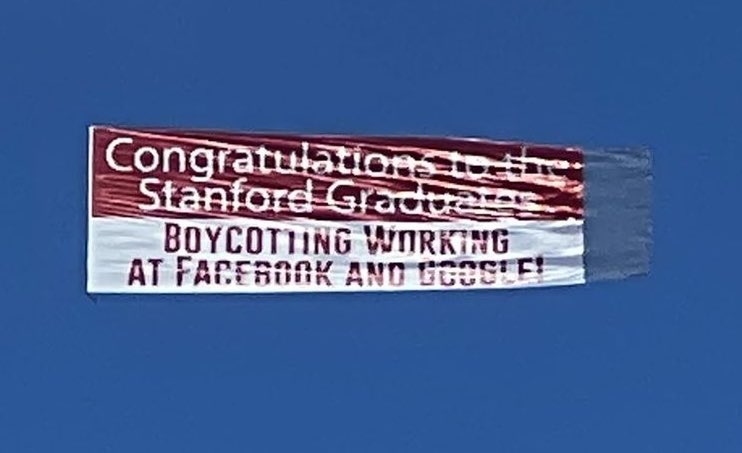
A single banner is unlikely to change many minds, of course, especially at an event where – let’s face it – many of the graduates already have offer letters from Big Tech employers. Still, it’s worth noting the suggestion: not just criticizing the companies, but boycotting them. And not just a general group of bad actors, but Facebook and Google.
My conclusion is that someone out there, whoever paid for the banner and the plane, knows exactly what Big Tech is up to. And they know that now, right now, is a crucial moment to raise awareness. Today I’m adding my voice. Amidst other important headlines about abortion, and shootings, and immigration, and Russia’s invasion of Ukraine, this is absolutely a make-or-break moment for our democracy – versus the Big Tech giants and their ability to run roughshod over our communities.
One shot at reform
Next month – July 2022 – is an important month. It’s possibly the most important month since I started warning people about Big Tech almost ten years ago. The only American institution that can mount viable resistance to the tech giants – the U.S. Congress – has two bills on deck that would drastically curtail Silicon Valley’s unethical behavior, and possibly jumpstart further reforms. But here’s the twist: The bills have to pass in July, because Congress goes on recess in August, after which the agenda will be consumed by the run-up to the November elections.
This is our one shot at reform. Let this chance slip by, and we’ll be subject to the Big Tech oligarchy for years – maybe decades – before we get another opportunity. I’ll mention this again later, but to jump to the punch line: the site antitrustsummer.com allows you to write your congresspeople and ask them to support these two bills. (It only takes a minute. I’ve filled out the form and hope you will, too.)
The bipartisan support for the two bills is the result of years of work, starting with a number of congressional hearings where Big Tech CEOs showed their contempt for the democratic process, dodging and deflecting simple questions while under oath. As I wrote in July 2019, The showdown between Big Tech and democracy has begun:
On a single day in Washington – Tuesday, July 16, 2019 – there were two Senate hearings, a House hearing, and a congressional briefing, all around the threat of Big Tech monopolies to take over, well, everything: the media, the retail economy, the financial system, our elections, and society itself.
It was a remarkable day. I watched many hours of these hearings and was struck, above all, by two things:
(1) The sense of alarm, across both parties, across all parts of the political spectrum, about the threat that our democracy faces from Big Tech.
(2) The willingness on the part of Big Tech companies to deny, deflect, and outright lie to protect their current practices, profits, and power.
This was a showdown between Big Tech and democracy. And it’s just starting.
Three years later, we have arrived at the final round of the showdown. Congress has the bills. The bills have bipartisan support. All we need to do is bring them to a vote. We have one month.
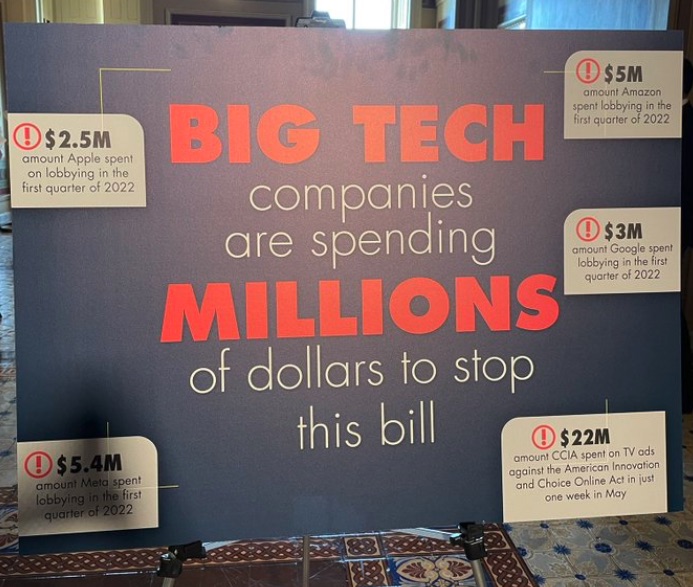
But Big Tech is fighting back, spending millions of dollars in lobbying and astroturfing. Here’s a photo from Emily Birnbaum (June 8, 2022), who writes: “Spotted @ today’s press conference on big tech antitrust legislation: a rundown of the sheer amount of money Apple, Amazon, Google and Meta have spent on lobbying this year alone.” The sign shows the more than $15 million spent by Amazon, Google/Alphabet, Apple, and Facebook/Meta just in the first three months of 2022.
Even Apple CEO Tim Cook was spotted walking through the Senate basement. When the CEOs show up in person, you know they’re really feeling threatened. Politico wrote this on June 10: “Cook’s Hill meetings are only the latest effort by Apple to deploy its CEO’s star power to wreck the bill’s prospects. He also called members of the Senate Judiciary Committee earlier this year ahead of the markup of both S.2992 and the Open App Markets Act (S.2710). Passage of either bill could fundamentally alter Apple’s business model.”
We just need Congress to bring the bills to a vote.
Creative Good is reader-supported.
You’re on a free subscription. If you want to support my writing, the best way is by joining Creative Good.
Two bipartisan bills
Below I’ve written a brief explanation of the two bills. You can also watch the recent John Oliver segment, Tech Monopolies: Last Week Tonight with John Oliver (June 12, 2022) for a good overview. The links below provide more detail:
• Bill #1: The American Innovation and Choice Online Act (S.2992, or “AICOA”) – here’s the Senate listing.
This bill would ban the self-preferencing used by the four main Big Tech giants – Apple, Amazon, Google/Alphabet, and Facebook/Meta – to direct users to their own products, rather than better products made by competitors. Without common-sense regulation like this, we’ll continue to see these monopolies kill off any innovation or improvement in digital tech.
As Axios put it: “The most-likely-to-pass of this Congress’ spate of tech antitrust bills would significantly change how giants like Apple, Amazon, Google and Meta do business by not allowing them to preference their own products.”
• Bill #2: The Open App Markets Act (S.2710, or “OAMA”) – here’s the Senate listing.
This bill would prevent Apple and Google from requiring app-makers to use their in-house app stores, their payment systems, and their outrageous and usurious 30% tax on app revenue. (After much bad PR and sustained intense pressure, Apple recently relented and allowed a tiny fraction of its app revenue to be taxed at a still-usurious 15%. Compare that with the 3% taken by credit card companies.) Like the bill above, the Open App Markets Act is an obviously needed piece of legislation to allow the possibility of competition and real improvement in tech.
As Fight for the Future put it: “The Open App Markets Act (OAMA) addresses the power shift on mobile, by banning the shenanigans that Apple and Google use to assert their power over mobile. The bill is clean, concise, and readable . . . you can read it yourself.”
• Bonus: Two other bills in development worth noting. The American Data Privacy and Protection Act is a draft bill in the House – see the official draft document – stating that companies “shall not collect, process, or transfer covered data beyond what is reasonably necessary.” That would be a hugely important corrective to the surveillance-capitalist complex, which is led by Big Tech. And in the Senate, the bipartisan Kids Online Safety Act “would require platforms to disable ‘addictive’ features for children and allow kids to opt out of algorithmic recommendations” (writes Axios), a single law that would immediately improve the education and family life of tens of millions of kids. (Here’s the Senate listing.)
Creative Good is reader-supported.
You’re on a free subscription. If you want to support my writing, the best way is by joining Creative Good.
A bottleneck named Chuck
With one month to go, the finish line in sight, all we have to do is bring the two bills to a vote. But Senator Charles Schumer, one of my senators here in New York State, is the bottleneck: he decides when, or whether, the bills will ever get a vote on the Senate floor. As the New York Post pointed out, and was echoed by John Oliver, Schumer’s daughters both work for Big Tech companies targeted by the bills: one at Facebook/Meta, the other a registered lobbyist for Amazon. Whatever the causes, the outcome we’re seeing is that Schumer has not yet brought the bills to a vote – and he may continue to stall until the August recess, when the bills are functionally dead. And we’ll lose the chance to regulate Big Tech.
If you’d like to help, go to the site antitrustsummer.com and ask your congresspeople to support these two bills. The group behind the site, Fight for the Future, has also rolled a billboard truck in front of Schumer’s Brooklyn apartment building (photos at NYPost), with giant screens listing yet another site: MakeSchumerWatchJohnOliver.com.
On my June 20 episode of Techtonic, titled “Our last chance to defeat Big Tech (for awhile),” I played excerpts of the John Oliver segment and explained the importance of this moment. I got rather animated by the end, emphasizing that now is our chance to do something about Big Tech. If you’re interested to listen, you can stream the show, or download the episode as a podcast. Here’s the episode page with links.
But most importantly, go to antitrustsummer.com. Let’s act while we have a chance.
Post a comment on this column – for Creative Good members only.
Until next time,
-mark
Creative Good is reader-supported.
You’re on a free subscription. If you want to support my writing, the best way is by joining Creative Good.
Mark Hurst, founder, Creative Good – see official announcement and join as a member
Email: mark@creativegood.com
Read my non-toxic tech reviews at Good Reports
Listen to my podcast/radio show: techtonic.fm
Subscribe to my email newsletter
Sign up for my to-do list with privacy built in, Good Todo
Twitter: @markhurst
- – -