









The gaping void in San Francisco, New York, and Cambridge
This is a story about three cities. It’s the same story in each place.
In San Francisco, as Rebecca Solnit writes in a searing essay, community is on the decline as Big Tech’s influence takes over the city. Simple acts of connection are disappearing: for example, it’s getting harder and harder to find stores where you can “build a relationship with the proprietor” or even “run into a friend or neighbour.” This is a distinct change from how the city used to be:
The San Francisco of my youth was full of small shops whose friendly eccentricity felt like part of the place. Some of them still exist but they’re rarer now. Many had old photographs of the business or the neighbourhood, some had artefacts of the past or pieces of the owner’s art. The little liquor and grocery store in my old neighbourhood had a wall of pictures of locals attending its annual barbecue and a ledger in which the proprietor recorded transactions with elderly locals who bought their groceries on credit and paid up at the end of the month.
Across the continent in Cambridge, Damon Krukowski writes about Eddy and Joe, owners of his favorite fish market, which just closed after more than a hundred years in business. Here, as in San Francisco, we see the human-scale business that can no longer survive the tech economy:
Eddy and Joe knew their customers; they gently warned people if they seemed to be wandering away from their usual budget, and might point out what was good that day which wouldn’t be too expensive. There was a handwritten sign that EBT cards were welcome. . . . Older ladies were teasingly flirted with, guys dissed now and then, and the parade of Harvard and MIT-connected professionals seemed to be judged largely on their knowledge of fish. They remembered names; jobs; asked after spouses and children. And this was just the retail part of the business – they were down at the pier buying fish in the morning, and their network of suppliers had to be equally if not even more extensive.
Here in Manhattan where I live, Jeremiah Moss wrote an entire book – Vanishing New York – about similar changes in this city. (I spoke to him about the book in a 2019 Techtonic interview.) His blog of the same name covered the closures, many of them pandemic-related, of long-beloved restaurants, bars, and delis. For example, Moss wrote about Eisenberg’s, which closed in March 2021:
Eisenberg’s sandwich shop, near the Flatiron since 1929, has closed for good. . . . I went by yesterday and talked with building manager Jackie Valiente who told me that she and the building owner would love to save Eisenberg’s, but they need someone to take it over and keep it as it is. “Someone who wants the old Eisenberg’s,” she said, “the old concept of New York.” That concept, said customer Arnold Engelman, is simple. “Eisenberg’s is what New York’s all about,” he told me. “People gathering in places they know, knowing the owners and the owners knowing them. This doesn’t exist anymore.”
Neither does it exist much any more in San Francisco, or Cambridge, or, I imagine, many other cities in the US. The response I’ve heard to closures like Eisenberg’s is that this is nothing new, New York is always changing, get over it. What’s more (the response goes), whatever disappears is replaced by something new, so rather than resisting change, we should celebrate the excitement of whatever comes next.
But what’s happening in our cities puts the lie to that response. Sure, in the distant past, a store or deli might be replaced by something new and interesting, for example when the neighborhood changed from one ethnic group to another. But that’s not what’s happening today. Instead, what’s replacing these authentic experiences is something much less interesting, much less alive. I can only describe it as a gaping void, driven by Big Tech money, spreading across the city and snuffing out anything human or creative or unique. Solnit describes how it feels in San Francisco:
the new mood of the city seems to be influenced by a kind of shrinking from human contact. The city remains the densely urban place it always was, but the way people inhabit it is increasingly suburban, looking to avoid strangers and surprises.
The “increasingly suburban” sameness is spreading in Cambridge, too, as Krukowski writes (in another recent post) about the recent closure of several independent bookstores. The neighborhood around Harvard Square used to be known for its rich variety of booksellers. Most of them have been replaced:
two are now banks; one is a cell phone store; one a real estate company; four are restaurants; one is a greeting card store; one a nail salon; two seem to be offices although with obscure purposes.
In Vanishing New York, Jeremiah Moss writes about the transformation of Manhattan – which, as the book was published in 2017, was well underway before the pandemic:
Day after day, the city’s old brick buildings and colorful hodgepodge of small business are destroyed, replaced by a seamless and smooth repetitive aesthetic. All silvery gloss and shimmer, the monotonous blocks of condos and chain stores offer a sea of mirrors into which the narcissist gazes only to see himself. . . . Maybe the city is filling up with blank structures because too many of the people are blank.
Jeremiah’s warning came to mind a few days ago when I spotted Casey Neistat’s review of Apple’s face jail, aka Vision Pro, which he demonstrated while walking around Manhattan. This is nothing against Neistat, whose videos often express the eccentric beauty of New York. (His classic 2011 Bike Lanes video brought attention to a nagging problem in the city that, per his 2022 update, still needs fixing.) But with all respect to Neistat, it was a little unnerving to watch his Vision Pro video and glimpse what could be the future of this city – and all cities.
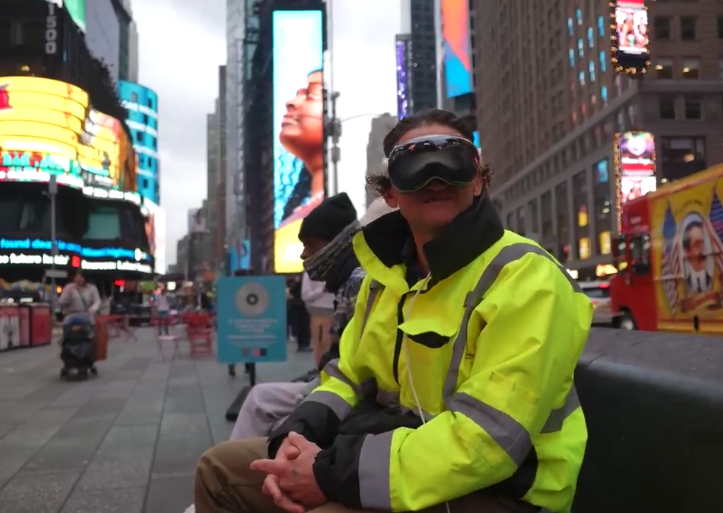
In the video, Neistat sits on a bench in Times Square, with pedestrians walking by, and marvels at the windows floating virtually in front of his face. He says:
Right now I’m like in the city, I’m in the middle of Times Square, I’ve got my virtual keyboard here, I’ve got Apple TV there, I’ve got YouTube Safari’s open here, and it all kind of works. Like this, what I’ve got going on right now, this is wild. It’s impossible for me to imagine that you can’t see what I can see. Everything seems so real.
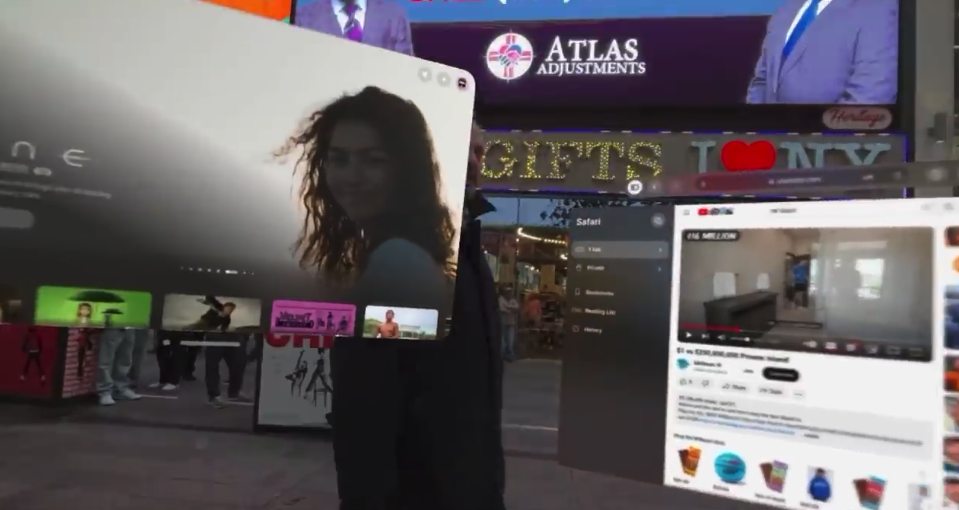
What “seems so real,” of course, is totally fake – the keyboard doesn’t actually exist in the air in front of him – while everything he sees is filtered according to the agenda of a three-trillion-dollar company. New York City is shunted aside. What Neistat raves about, inside his face jail, is the exact opposite of the authentic New York weirdness that he praises in so many of his other videos.
As it goes in New York, so it goes in San Francisco, and in Cambridge, and no doubt in many other cities in the US and beyond. Our priorities seem to be out of whack. Family-owned stores and restaurants go out of business while people strap on face jails to see what the three-trillion-dollar company wants them to see. Opportunities for connection and community-building fade as we become mesmerized by corporate screens, floating in front of our faces, literally obscuring our view of our neighbor standing right in front of us.
At a time when people feel more divided than ever, we’re spending our treasure on building a society with more isolation. We’re on the wrong track. I can only hope that enough people will reject Big Tech’s latest takeover attempt. Can you imagine what it would be like if threw all the face jails in the river, and started talking to our neighbors again?
Creative Good members can post a comment on this column on the Forum, where our community discusses hundreds of topics.
Please join as a Creative Good member. You’ll be among friends, and you’ll help keep this newsletter going.
What you’re missing on the Creative Good Forum: lots of posts this week on important topics.
• Sam Altman asked for 7 trillion dollars – yes, 7 trillion – to keep ChatGPT going.
• Intrusive biometric surveillance and how companies are trying to normalize it
• Kids and addictive tech: multiple states are mounting fights against Big Tech
• Lectures about AI, deepfakes, and distrust
• Rebecca Solnit vs. the reply guys
• A non-surveillance, non-Big Tech replacement for Alexa
• How tech normalize exploitative software, as described by Cory Doctorow
• Robocars and the privacy threat, and why protesters set fire to one in San Francisco
• Connecting DNA surveillance to facial rec
. . . as well as my list of Good Experience Games, Fun Stuff items, good explainers, and much more.
Please join as a Creative Good member and you’ll get access to all of these, and more, on the Creative Good Forum.
Until next time,
-mark
Mark Hurst, founder, Creative Good – see our services or join as a member
Email: mark@creativegood.com
Listen to my podcast/radio show: techtonic.fm
Subscribe to my email newsletter
Sign up for my to-do list with privacy built in, Good Todo
On Mastodon: @markhurst@mastodon.social
- – -