



惯性聚合 高效追踪和阅读你感兴趣的博客、新闻、科技资讯
阅读原文 在惯性聚合中打开

推荐订阅源

T
The Exploit Database - CXSecurity.com
J
Java Code Geeks
H
Help Net Security
B
Blog RSS Feed
G
Google Developers Blog
博客园 - 司徒正美
MongoDB | Blog
MongoDB | Blog
量子位
博客园 - 三生石上(FineUI控件)
The Cloudflare Blog
P
Proofpoint News Feed
小众软件
小众软件
人人都是产品经理
人人都是产品经理
云风的 BLOG
云风的 BLOG
V
V2EX
月光博客
月光博客
C
Check Point Blog
cs.AI updates on arXiv.org
A
Arctic Wolf
Help Net Security
Help Net Security
Schneier on Security
D
DataBreaches.Net
酷 壳 – CoolShell
酷 壳 – CoolShell
博客园_首页
钛媒体:引领未来商业与生活新知
钛媒体:引领未来商业与生活新知
P
Palo Alto Networks Blog
T
Tenable Blog
L
LangChain Blog
Attack and Defense Labs
Google DeepMind News
N
News and Events Feed by Topic
Forbes - Security
Forbes - Security
F
Fortinet All Blogs
Recent Announcements
Cyber Security Advisories - MS-ISAC
大猫的无限游戏
大猫的无限游戏
www.infosecurity-magazine.com
Y
Y Combinator Blog
WordPress大学
WordPress大学
Stack Overflow Blog
Stack Overflow Blog
V
Visual Studio Blog
OSCHINA 社区最新新闻
OSCHINA 社区最新新闻
Engineering at Meta
Engineering at Meta
NISL@THU
NISL@THU
GbyAI
GbyAI
博客园 - Franky
S
Secure Thoughts
有赞技术团队
有赞技术团队
PCI Perspectives
PCI Perspectives
U
Unit 42

Creative Good

Changing the address of this RSS feed Protecting elders and kids from predatory tech The garbage on our screens How it’s going in tech – without ethics AI isn’t meant for us Starlink bestows, or forces, the digital age on an Amazonian tribe Google goes bananums for AI Creative Good: Apple made a terrible mistake: it told the truth To resist the robots, get a typewriter Big Tech’s corruption was 25 years in the making Creative Good: China and TikTok Surviving the customer experience winter The gaping void in San Francisco, New York, and Cambridge Vision Pro, unscrambled, is “I Poison VR” Resisting Silicon Valley’s cult of “more” The airplane blowout came from our rotten Big Tech economy Creative Good: Instagram’s unmentionable problem Marc Andreessen is right – love doesn’t scale Facial recognition and the end of privacy – with Kashmir Hill The Luddites warned us about Google Celebrating 25 years of this newsletter – and an announcement Creative Good: Surveillance spreading Disaster alerts reveal a better way to design tech Don’t throw technology at it Creative Good: AI is spackle Hacks of the ultra-rich, as revealed by Bruce Schneier and Josh O'Kane Why car companies (still) ignore customers A walk around world raises questions about tech Three things you should listen to An addiction machine for our age Rejecting the Apple Vision Pro What you missed about Google and Amazon Why customers don’t want chat bots The giant brain suck of 2023 My 26-hour delay on Delta Air Lines Is AI a demon or what Creative Good: AI plus whatever ChatGPT’s dangers are starting to show Creative Good: A Simple Desultory Techtonic A picture of the future Where are the customers' chats? Sassy AIs are not the problem AI is creating the Play-Doh internet Who’s responsible for fixing tech? How Google profits from criminal activity ChatGPT’s drawbacks, and how to respond A new year to make tech better A few more inspiring people Why we can’t trust Apple Bonfire of the vanity project As cities embrace surveillance, we can resist A future for people doing good work A Halloween update on Big Tech Creative Good: Moralists, unite Creative Good: A song about surveillance AI is already turning against you. We can fix it. Waking up to the genetic surveillance state another reason to join Creative Good Creative Good: A “what now?” moment Creative Good: A most welcome decline An “internet for the people” or a plastic beach Our last chance in tech Jennifer Egan and a Forum update Creative Good: Citizenship and smartphones Celebrating one year of the Creative Good community Creative Good Forum Walking away from tech Where to go after Twitter An alternative to Amazon, and avoiding data brokers God, death, and tech with Sasha Stiles The web as monopolized surveillance space Human rights and digital spycraft Designing for deceit in Silicon Valley Bandcamp risks becoming an Epic failure The restart of history Why to resist Amazon by cancelling your Prime account Concentration of power is the problem We said ‘never again.’ Now look at Xinjiang Facebook patents and the comet in Don’t Look Up I founded Creative Good 25 years ago today – and learned a few things Are Facebook and Google criminal enterprises? My predictions for Apple’s smart glasses Creative Good Forum The banality of tech Big questions, answered by Big Tech Smiling in the metaverse Big Tech’s latest misbehavior calls for action Facebook’s laughable response to the whistleblower Get your community organization off of Facebook. Now. Voice surveillance must die The fall of Facebook Why we might transform computers into ‘tiles’ Explaining the last 20 years What to do when the storm arrives Public libraries are better than Google WeWork and waste How to prove vaccine status – with privacy We can’t trust tech, from A(pple) to Z(oom) On resisting emperors and their delusions Cameras and con games: Silicon Valley’s demented fun house
Microsoft Recall should make you consider Linux
2024-06-05 · via Creative Good

Microsoft Recall should make you consider Linux

It was hard to miss the irony in Microsoft’s latest product announcement. A new feature named “Recall” takes snapshots of whatever is on-screen on a Windows 11 computer, every few seconds, and then stores it locally on-disk. Unfortunately it turns out that the analyzed data is stored in plaintext, leaving users’ private activity vulnerable to hackers. As security researcher Kevin Beaumont pointed out, “Stealing everything you’ve ever typed or viewed on your own Windows PC is now possible with two lines of code.”

And yet Microsoft named it “Recall.” It’s an interesting choice, given the problems it’s likely to create:
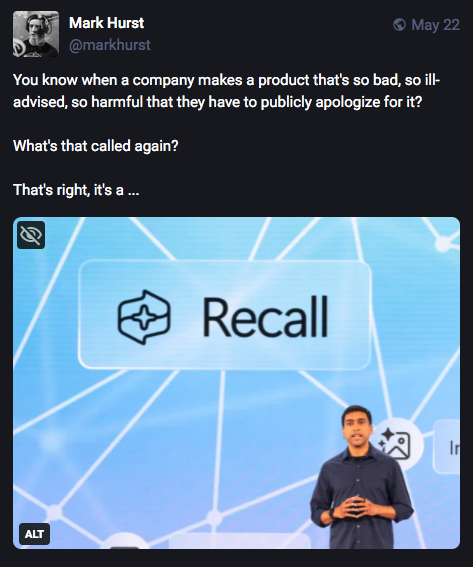
Whatever blowback Microsoft faces if and when users are hacked because of Recall, there’s no chance the feature gets killed. Even Google, after going bananums for AI (per my most recent column) and suffering a PR disaster as a result of wildly inaccurate search results, isn’t backing off from AI Overviews. Once a few tweaks are in place, the AI results will return soon. Multi-trillion-dollar Big Tech companies don’t stop a product juggernaut just because it tells people to add glue to their pizza.

Neither will Recall be recalled. It’s important to understand what’s at stake here. A feature like Recall is critical to Microsoft because it drastically increases the amount of surveillance data that the company is able to harvest and analyze. Big Tech is obsessed with finding more surveillance data, because the AI models are running out of training material. Everything online has been harvested, chewed up, and regurgitated already. As Christopher Mims puts it in The AI Revolution Is Already Losing Steam (WSJ gift link, May 31, 2024):

There aren’t 10 more internets’ worth of human-generated content for today’s AIs to inhale.

Microsoft would protest, of course, that Recall isn’t a surveillance feature, it’s for your convenience. Right. Just like all the other bossware, spyware, and malware launched by Big Tech companies in the past few years. Laptop and desktop computers are slowly, and inexorably, turning into the same kind of surveillance device that the “smartphone” [sic] has been for years: tracking your actions, claiming to keep it all private, while leaving the data available for hackers, data brokers, and Big Tech companies to use as they wish. Whatever privacy Recall might – in the best case – afford users today, it’s unlikely to be preserved once users are fully habituated to a Microsoft AI-spy watching their every move in Windows.

In my role as user advocate (and citizen advocate, patient advocate, student advocate – all of the above), as I watch the latest poisonous idea spewing from Silicon Valley’s board rooms, I think: what do we do now? What are ordinary people supposed to do, when multi-trillion-dollar companies have launched yet another type of surveillance, leaving them more vulnerable than ever to the predations of Big Tech and hackers alike?

Charlie Stross put it well. In Is Microsoft trying to commit suicide? (June 5, 2024), after discussing the many problems with Recall, Stross suggests one possible next step for users:

Some commentators are snarking that Microsoft really really wants to make 2025 the year of Linux on the Desktop, and it’s kind of hard to refute them right now.

“Linux on the Desktop.” The free, open-source operating system of Linux is not owned by any company (Big Tech or otherwise), doesn’t contain any opaque surveillance code, and enjoys a worldwide community of developers who actually want to make the software better – not, as in Microsoft’s case, worse.

My most recent Techtonic show was called We should all switch to Linux (May 27, 2024). My guest was a security and privacy expert from Switzerland who explained why, and how, to make the switch. (Stream the show / jump to the interview.) The show’s playlist contains helpful links, and there are even more pointers on the Creative Good Forum, in our resource list of Linux distributions.

Big Tech isn’t going to roll back its plans to toxify our digital lives. It’s up to us to move forward. I plan for the Creative Good community to provide resources to anyone who wants to live better with technology.

If you want to support what I’m creating, and get access to the resources the community has posted, join Creative Good. You’ll be among friends – and away from the Big Tech algorithms.

For teams out there that are trying to create digital products and services that respect the user, drop me a line. I give keynote presentations, lead workshops on UX and AI, and run research and advisory projects.

As Big Tech continues to expand its user-hostile ambitions, it’s up to us to support each other. Let’s build a better way in tech.

Until next time,

-mark

Mark Hurst, founder, Creative Good – see our services or join as a member
Email: mark@creativegood.com
Listen to my podcast/radio show: techtonic.fm
Subscribe to my email newsletter
Sign up for my to-do list with privacy built in, Good Todo
On Mastodon: @markhurst@mastodon.social

- – -

LET’S MAKE TECH BETTER: JOIN US.

Mission

Creative Good creates good experiences — for our consulting clients, our Good Todo users, our newsletter readers, and all of our fans.

Contact

Creative Good, 2808 Broadway #17, New York, NY 10025 USA
Phone: +1.646.543.3530
Email: emailus@creativegood.com