







Apple made a terrible mistake: it told the truth
In 1990, a movie called “Crazy People,” starring Dudley Moore and Daryl Hannah, arrived in theaters. Amidst the bawdy humor and 80s fashion lay an intriguing premise: what would happen if advertisements started telling the truth? The plot centers on an ad executive who delivers the straight, unvarnished truth about clients’ products. For example, in a print ad for Volvo, a man stands beside a new car surrounded by this text:
Buy Volvos.
They’re boxy but they’re good.
We know they’re not sexy.
This is not a smart time to be sexy anyway, with so many new diseases around.

The movie treats viewers to a few other concepts, including an ad for the Greek travel bureau: “Forget France. The French can be annoying. Come to Greece, we’re nicer.” Later scenes show the ad campaigns performing amazingly well – sales up, customers excited – all because advertisers told the truth.
The real world doesn’t work that way, however. This week a two-trillion-dollar company ran a high-profile experiment in telling the truth: a new video, by Apple, touting its latest iPad. The ad campaign backfired, with customers posting horrified reactions online (see Variety, NYT, WSJ, Atlantic.) But I have no complaints, because the video did us all a favor in showing us – with straight, unvarnished truth – how Apple feels about its customers.
The ad
You can watch the video here. (If you prefer to be surveilled by Google, here’s YouTube.)
The one-minute ad opens with a wide shot of an industrial warehouse, in the middle of which sits a gray metal platform filled with a colorful arrangement of musical instruments, toys, books, and various creative tools. After a closeup of a metronome and a record player, we see a second metal platform descending from the ceiling. Only then does it begin to dawn that something is very, very wrong with this scene. We’re not looking at an inviting creative display, we’re looking at an ambush. The gray metal platforms are the jaws of a hydraulic press.
The first item to get crushed is a trumpet, followed by a console video game. Then an upright piano – inexplicably topped with cans of paint – is demolished in an explosion of garish color, the piano’s inner parts exposed as the cover flies off. The metronome, a guitar, camera lenses – all get crushed. The editing is careful to show us the exact moment of destruction of each item.
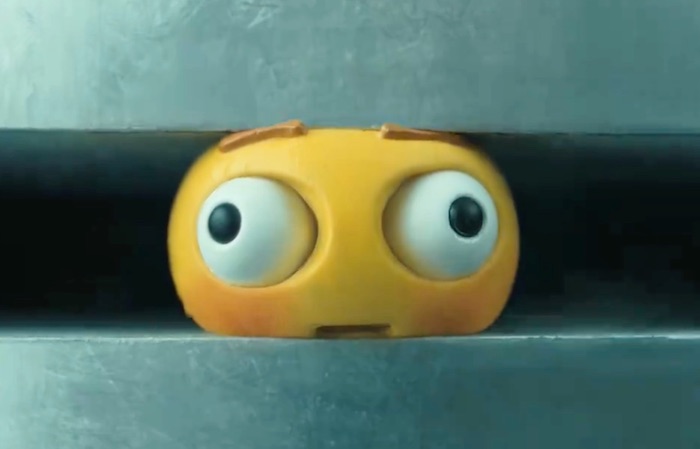
The last thing we see before the jaws snap shut is a humanoid face. A toy with two wide eyes and a mouth is crushed, the eyeballs popping out as the press completes its work. Smears of paint run down the metal to the floor. There’s a moment of silence. Finally the press opens to reveal a small glass tablet. See, Apple is saying to us, we’ll destroy everything you hold dear, we’ll remove any ability to make meaning or music or love, yea, we will even crush your head until your eyeballs pop out, but we will destroy anything and anyone who offers an alternative to our glass idol. The only thing that remains will be a screen.
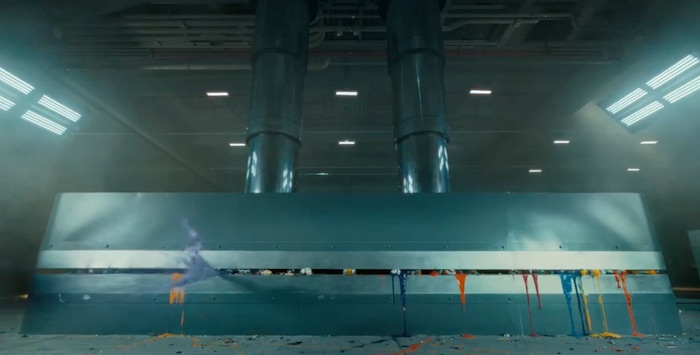
I have to give Apple credit here: the video is boldly telling us the truth. Other companies hide their true agenda, or even – if they have real competition – occasionally try to make things better for customers. But Apple’s globe-spanning monopoly gives it that walk-away scale of money and power that allows it to say – and then do – whatever it wants. For a totalizing company like Apple and the other Big Tech beasts, anything that stands in the way of the company’s dominance must be destroyed. You like playing the guitar for friends on the beach? No. Use a screen instead. You enjoy reading print books, which don’t spy on you as you read them? Not acceptable. Use a screen. Do you value being creative, or social, or just living a moment of your life off the screen? Get over it. Everything else will be destroyed. Only screens will remain.
I guess it’s like Steve Jobs always said: “We’re going to build a bicycle for the mind . . . and then we’re going to crush the bicycle in a 2-ton press, just flatten it right in front of you, so you can feel our destructive power. Take that, bicycle lovers. You all suck.”
Of course Jobs would never have said such a thing, just as he’d never have approved the “Crush” ad. But things have changed at Apple. The sheer arrogance, indeed the sadism, required to plan and execute such a campaign is indicative of the new position of the Big Tech giants. They are more than companies, now. They are acting like colonial masters.
My Techtonic show this week featured Ulises Mejias and Nick Couldry, authors of the book “Data Grab: The New Colonialism of Big Tech and How to Fight Back.” (Listen to the show / jump to the interview / see episode links.) The behavior of the British East India Company, they argue, is being mirrored in the actions of Apple, Google, Facebook, Amazon, and Microsoft. The new territory to be colonized isn’t land but data – all the data that flows from our daily lives, from waking to sleeping, every moment surveilled and harvested to enrich the tech empires.
In order to carry out their intrusion, today’s colonial Big Tech companies have to convince us that the process is “inevitable” and even beneficial. But this is nothing new. As Mejias and Couldry write,
predatory acts of colonialism . . . have always had to be disguised by more positive ‘civilising’ narratives, or ‘alibis.’
And here’s where Apple went wrong: it told the truth about its plans. Colonialists are never supposed to speak so directly. Rather than disguising its plans, Apple’s video says: “Hey look, we’re going to crush your skulls! And destroy your culture!” That’s no way to grow an empire.
It’s no wonder, then, that Tim Cook has already apologized, saying that Apple “missed the mark.” As Chris Gilliard points out, that’s like saying, “We apologize for briefly letting the mask slip and showing ourselves to be just like every tech company that’s bent on destruction and domination.”
The fight against Big Tech is going to last a long time. It’s important to keep the end goal in mind, and this is where the Apple video is especially helpful. What I’d like to see is the restoration of everything Big Tech has taken away. Something like Reza Sixo Safai’s Apple edit, which plays the video in reverse. Our objective, in the end, shouldn’t merely be to neutralize the monopolists’ power but ultimately to give us back a society that values things like guitars, pianos, books, and – most radical of all – people.
(And if you want to join me in the fight, become a Creative Good member.)
See also
My comments on three other Big Tech ad campaigns in past years:
• Let’s not forget that time a few years ago when Apple blatantly ripped off the Washington Post in a video ad. Read my column Apple’s new iPhone commercial is a rip-off (June 3, 2021).
• “40 years later, Apple turns into 1984” – Techtonic from Feb 5, 2024, in which I make the case that “the launch of Apple’s Vision Pro face jail is an inescapable sign that Apple has finally transformed into the Orwellian giant that their famous Super Bowl commercial warned about in 1984.” (Listen to the show for a disturbingly relevant audio clip from the movie “1984.”)
• For Creative Good members (reminder that you can join here), a Forum-only column I wrote about Facebook’s advertising gaffe during the Super Bowl (Feb 16, 2022).
Until next time,
-mark
Mark Hurst, founder, Creative Good – see our services or join as a member
Email: mark@creativegood.com
Listen to my podcast/radio show: techtonic.fm
Subscribe to my email newsletter
Sign up for my to-do list with privacy built in, Good Todo
On Mastodon: @markhurst@mastodon.social
- – -