



惯性聚合 高效追踪和阅读你感兴趣的博客、新闻、科技资讯
阅读原文 在惯性聚合中打开

推荐订阅源

U
Unit 42
T
Threatpost
C
CERT Recently Published Vulnerability Notes
Recent Commits to openclaw:main
Security Archives - TechRepublic
K
KPMG report finds enterprise disconnect between AI and its ROI | CIO
K
Kaspersky official blog
Application and Cybersecurity Blog
Attack and Defense Labs
N
News and Events Feed by Topic
Project Zero
Project Zero
H
Heimdal Security Blog
C
Cybersecurity and Infrastructure Security Agency CISA
Know Your Adversary
Know Your Adversary
Google Online Security Blog
W
WeLiveSecurity
D
Darknet – Hacking Tools, Hacker News & Cyber Security
Schneier on Security
Threat Intelligence Blog | Flashpoint
N
News | PayPal Newsroom
Hacker News - Newest:
Hacker News - Newest: "LLM"
H
Hacker News: Front Page
L
LINUX DO - 热门话题
Spread Privacy
Spread Privacy
T
Threat Research - Cisco Blogs
Cloudbric
Cloudbric
V
Vulnerabilities – Threatpost
Hacker News: Ask HN
Hacker News: Ask HN
S
Securelist
cs.AI updates on arXiv.org
TaoSecurity Blog
TaoSecurity Blog
NISL@THU
NISL@THU
N
News and Events Feed by Topic
S
Security Affairs
The Last Watchdog
The Last Watchdog
T
Tor Project blog
Exploit-DB.com RSS Feed
T
The Exploit Database - CXSecurity.com
Simon Willison's Weblog
P
Palo Alto Networks Blog
AWS News Blog
AWS News Blog
P
Proofpoint News Feed
C
Cisco Blogs
C
Cyber Attacks, Cyber Crime and Cyber Security
cs.CV updates on arXiv.org
L
LINUX DO - 最新话题
cs.CL updates on arXiv.org
T
Tenable Blog
C
CXSECURITY Database RSS Feed - CXSecurity.com
S
Schneier on Security

Creative Good

Changing the address of this RSS feed Protecting elders and kids from predatory tech The garbage on our screens How it’s going in tech – without ethics AI isn’t meant for us Starlink bestows, or forces, the digital age on an Amazonian tribe Microsoft Recall should make you consider Linux Google goes bananums for AI Creative Good: Apple made a terrible mistake: it told the truth To resist the robots, get a typewriter Big Tech’s corruption was 25 years in the making Creative Good: China and TikTok Surviving the customer experience winter The gaping void in San Francisco, New York, and Cambridge Vision Pro, unscrambled, is “I Poison VR” Resisting Silicon Valley’s cult of “more” The airplane blowout came from our rotten Big Tech economy Creative Good: Instagram’s unmentionable problem Marc Andreessen is right – love doesn’t scale Facial recognition and the end of privacy – with Kashmir Hill The Luddites warned us about Google Celebrating 25 years of this newsletter – and an announcement Creative Good: Surveillance spreading Disaster alerts reveal a better way to design tech Don’t throw technology at it Creative Good: AI is spackle Hacks of the ultra-rich, as revealed by Bruce Schneier and Josh O'Kane Why car companies (still) ignore customers A walk around world raises questions about tech Three things you should listen to An addiction machine for our age What you missed about Google and Amazon Why customers don’t want chat bots The giant brain suck of 2023 My 26-hour delay on Delta Air Lines Is AI a demon or what Creative Good: AI plus whatever ChatGPT’s dangers are starting to show Creative Good: A Simple Desultory Techtonic A picture of the future Where are the customers' chats? Sassy AIs are not the problem AI is creating the Play-Doh internet Who’s responsible for fixing tech? How Google profits from criminal activity ChatGPT’s drawbacks, and how to respond A new year to make tech better A few more inspiring people Why we can’t trust Apple Bonfire of the vanity project As cities embrace surveillance, we can resist A future for people doing good work A Halloween update on Big Tech Creative Good: Moralists, unite Creative Good: A song about surveillance AI is already turning against you. We can fix it. Waking up to the genetic surveillance state another reason to join Creative Good Creative Good: A “what now?” moment Creative Good: A most welcome decline An “internet for the people” or a plastic beach Our last chance in tech Jennifer Egan and a Forum update Creative Good: Citizenship and smartphones Celebrating one year of the Creative Good community Creative Good Forum Walking away from tech Where to go after Twitter An alternative to Amazon, and avoiding data brokers God, death, and tech with Sasha Stiles The web as monopolized surveillance space Human rights and digital spycraft Designing for deceit in Silicon Valley Bandcamp risks becoming an Epic failure The restart of history Why to resist Amazon by cancelling your Prime account Concentration of power is the problem We said ‘never again.’ Now look at Xinjiang Facebook patents and the comet in Don’t Look Up I founded Creative Good 25 years ago today – and learned a few things Are Facebook and Google criminal enterprises? My predictions for Apple’s smart glasses Creative Good Forum The banality of tech Big questions, answered by Big Tech Smiling in the metaverse Big Tech’s latest misbehavior calls for action Facebook’s laughable response to the whistleblower Get your community organization off of Facebook. Now. Voice surveillance must die The fall of Facebook Why we might transform computers into ‘tiles’ Explaining the last 20 years What to do when the storm arrives Public libraries are better than Google WeWork and waste How to prove vaccine status – with privacy We can’t trust tech, from A(pple) to Z(oom) On resisting emperors and their delusions Cameras and con games: Silicon Valley’s demented fun house
Rejecting the Apple Vision Pro
2023-06-09 · via Creative Good

Rejecting the Apple Vision Pro

“Where there is no vision, the people perish.” The warning from the King James Bible was oddly resonant this week as visibility fell almost to zero here in Manhattan. A smoky, orange sky made the city look like a dystopian film. Unbreathable air, signs and portents in the sky, apocalypse on people’s minds.

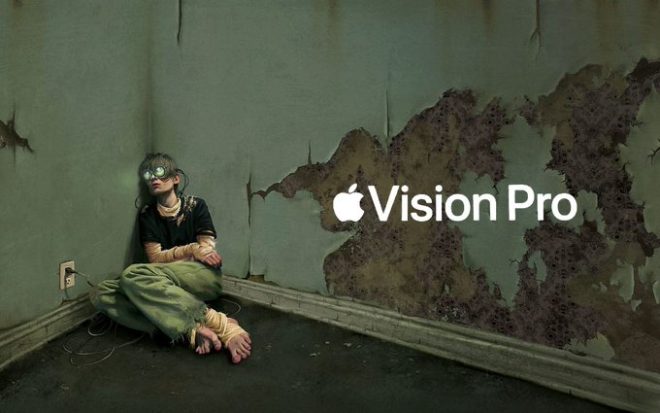
On the opposite coast, a two-trillion dollar company launched a new device that takes vision down to exactly zero. Cameras and screens strapped to your face, completely obscuring your view of the world, allowing interaction only through the filter of the device. Your sight is fully co-opted by the machine. The very name of the product tries to hide the essential fact that it obscures all vision.

A meme has floated around for years, showing a smartphone attached with tentacles to a man’s face, like something from the Alien movies:
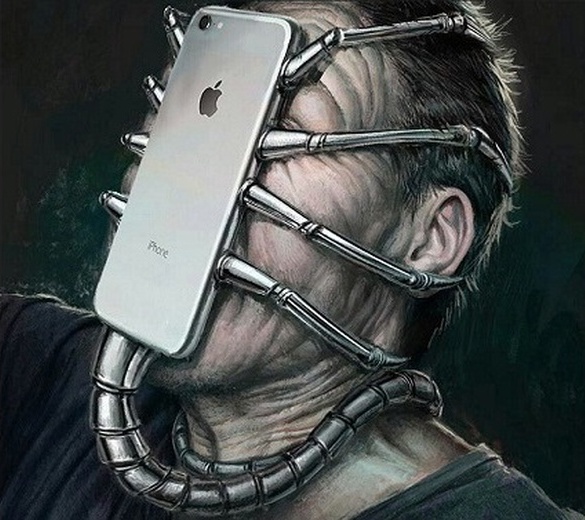
The meme image, intended as hyperbole, is immediately recognizable in the product demo from this week. People sit on a couch, talk to coworkers, play with their kids – all while blinded by the tentacled grip across their eyes. There’s nothing liberating, exciting, or hopeful in any of it. And if it looks futuristic at all, it’s because we’ve lost our sense of what the future should be. As Alan Jacobs writes, the machine “doesn’t look like something to use, it looks like something to be sentenced to – by an especially cruel judge.”

This new device, the trillion-dollar machine that takes away your vision, is the most talked-about thing in tech this week. I spotted one of the designers on LinkedIn posting about his role on the project, adding that Steve Jobs would surely be proud of the device. That’s wrong, if I know anything about Jobs. A “bicycle for the mind” was how he described the original Macintosh, referring to an enabling and empowering technology, one that amplifies people’s power to create.

In contrast, this new device, which we could perhaps call “Vision No,” offers a passive, locked-down experience. Sit back on your couch and watch a movie projected in virtual space! Turn your living room into a screensaver background! Oh, and yes, the office: soul-sucking Microsoft files from work can follow you even into virtual space, floating nightmarishly wherever you look.
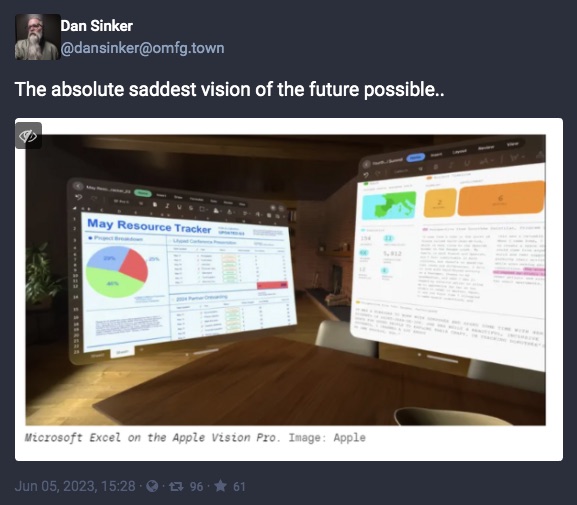
What imitation of vision there is in the device, exists only as machine vision, continually scanning both inside and out. A phalanx of cameras monitors the user’s eyes in order to display them on the device’s front panel, while other cameras spy on the room layout, the furniture, and the people nearby – as the user’s eyes are locked away inside the Vision No enclosure. The only way for users to see anything is to accept the representation of the world as offered by the corporation’s filters. I don’t know about you, but my grip on reality – incomplete and imperfect as it may be – will not improve by passing through the hidden manipulations of a two-trillion-dollar company with an insatiable need for growth.

Even if you don’t wear the thing, you’re still on camera. As I mentioned before, there are cameras on the outside of the device, scanning everything and everyone in range. Partly this is to send the visual info (perhaps touched up a bit) to the user inside the head-mounted prison. But also, no doubt, this data stream is a gold mine for any company profiting from surveillance. Which means every company in Big Tech.

A threat to personal privacy

I really hate head-mounted surveillance gear. Ten years ago I wrote The Google Glass feature no one is talking about, which went viral and helped kick off early resistance to that ungodly machine. People in 2013 were horrified by the possible loss of privacy, and the resulting tsunami of public disapproval killed the device.

Then on December 3, 2021, I wrote My predictions for Apple’s smart glasses, in which I issued a specific warning:

Within the next 18 months, Apple will launch surveillance glasses, upending all expectations of personal privacy.

The prediction was off by two days, as the official launch date was June 5. And my design mockup was totally wrong, while The Information’s sketch of the ski-goggles design was eerily accurate:

(Drawing by the Information showing what looks like ski goggles.)

Beyond those quibbles, my warning still stands about the loss of personal privacy. People walking around with this thing strapped on – or sitting near you, on a plane, in a coffee shop – are going to be surveilling you, and everyone around you, for indefinite storage in Apple’s servers.

And if you somehow think that Apple will act ethically with that data, read Why we can’t trust Apple. But also consider that if Apple succeeds here, other corporate beasts will follow close behind, with their own surveillance headgear, beholden to their privacy-destroying practices. Big Tech sees trillions of dollars of potential growth here, and it’s our job to resist, to refuse, to ridicule this thing, now, right now, this new launch, just as we did ten years ago with Google Glass. Let’s kill it dead.

I’m not alone in this sentiment: Paris Marx writes that Apple’s Vision Pro headset deserves to be ridiculed, and he’s right. And Ross Douthat writes Don’t Wear the Goggles, in which he says that “public derision” is “good” and “necessary” and that “our health as a society and species depends on sustaining it.”

So let’s get out there and ridicule these things. By rejecting the goggles, we’ll preserve our vision.
Join Creative Good to post a comment on the members-only Creative Good Forum.

Until next time,

-mark

Mark Hurst, founder, Creative Good – see official announcement and join as a member
Email: mark@creativegood.com
Read my non-toxic tech reviews at Good Reports
Listen to my podcast/radio show: techtonic.fm
Subscribe to my email newsletter
Sign up for my to-do list with privacy built in, Good Todo
On Mastodon: @markhurst@mastodon.social

- – -

LET’S MAKE TECH BETTER: JOIN US.

Mission

Creative Good creates good experiences — for our consulting clients, our Good Todo users, our newsletter readers, and all of our fans.

Contact

Creative Good, 2808 Broadway #17, New York, NY 10025 USA
Phone: +1.646.543.3530
Email: emailus@creativegood.com