








AI plus whatever
I remember a moment, not quite 15 years ago, when tech journalists adopted a new formula for news stories. Let’s call it “Twitter plus.” Every day when I opened up the New York Times, or some other major paper, I’d see excited headlines about how everything was changing forever because of some version of “Twitter plus.” Did you know that people are using Twitter... to find dates? Twitter plus dating!! Also: Twitter plus shopping! Twitter plus job searches! Twitter plus politics! Twitter plus poetry! And, of course, Twitter plus journalism! There seemed to be no end of these permutations. I couldn’t figure out why life all of a sudden was supposed to be so exciting because of this new platform, but the tech media seemed almost desperate to sell everyone on the idea.
Then it changed. When Twitter installed an algorithm similar to Zuck’s Facebook sludge machine, things started going wrong – especially “Twitter plus politics.” People realized that “Twitter plus” was not, in fact, going to make everything great. The stories stopped appearing.
But then! The stories started up again, saying: Have you heard about this new thing called... the blockchain? The rise of Bitcoin, and all things crypto, induced another round of delirium that I’ll call “blockchain plus.” Can you just imagine how exciting life will be, once we see... real estate, plus blockchain! The art industry, plus blockchain! Banking, on the blockchain! And yes, journalism, plus the blockchain! One well-known tech journalist excitedly announced that his column itself was an NFT on a blockchain. (Remember NFTs? I tried to warn everyone.)
Then crypto crashed. We stopped hearing how amazing the blockchain was going to be. There were, however, some initial stories about interesting AI tools called DALL-E, Stable Diffusion, and Midjourney. That last one famously spat out an image that won a prize at a state fair. (We started discussing this early on the Creative Good Forum: from last September, AI image generators: relevant tools and troubling risks. You should join us.) That was just the beginning.
Now we’re in the throes of yet another “plus” moment: AI plus. Let me try to feign some enthusiasm as I say: You’ll never believe how very exciting life is going to be, once we have... chat bots in every conceivable part of our lives. Yes, just as Twitter and blockchain ushered in their own utopias, you’ll want to hold on to your hat for this new, even more brilliant epoch that now dawns over the blessed hills. Say it with me: Chat bots.
I still haven’t heard why, exactly, this technology is so urgently necessary. My question remains: Where are the customers’ chats? Granted, there are some interesting new features, as I wrote about last week: handwriting recognition and summarizing large bodies of text and so on. There are also some dangers, too, that aren’t getting much attention. But I can’t shake the feeling that I’ve been through this before, with “Twitter plus” and “blockchain plus.”
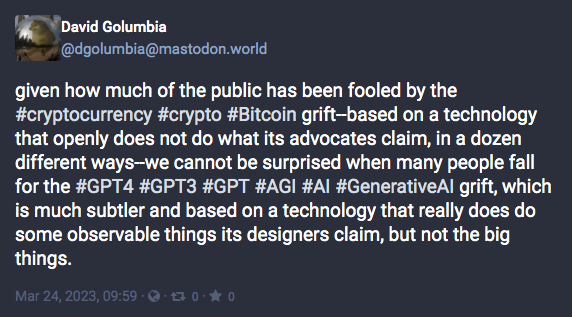
Charlie Stross writes one explanation why the AI tools might be getting so much attention:
The thing I find most suspicious/fishy/smelly about the current hype surrounding Stable Diffusion, ChatGPT, and other AI applications is that it is almost exactly six months since the bottom dropped out of the cryptocurrency scam bubble.
This is not a coincidence.
To me it looks very much as if the usual hucksters and grifters are now chasing the sweet VC/private equity money that has been flushed out of the cryptocurrency market. AI is the new hotness, all of a sudden, not because it works but because it delivers panicky investors on a platter.
Now, I’m not suggesting that this AI mania will fade out quietly, only to be replaced by some new fad. Chat bots and AI generators will affect us. Think of our past rounds of hype: Twitter did change things, just not for the better, thanks to its reliance on algorithmic amplification (among other problems). And cryptocurrency did change things, just not how the tech bros hoped. Similarly, the AI tools today are showing a surprising range of abilities that will surely usher in... something. I’m just skeptical of, for lack of a better term, the religious nature of the claims.
The tech elite are starting to use language that is strangely inflated. Microsoft researchers publicly claimed this week that they’re seeing “sparks of AGI” – that is, artificial general intelligence, the closest thing to actual human intelligence that a computer could possess. The researchers should stop sniffing their glue sticks. As Gary Marcus aptly put it: “Microsoft put out a press release yesterday, masquerading as science.”
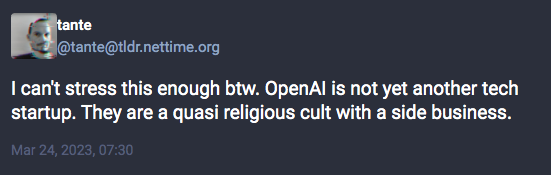
Even Bill Gates is piling on. AI is “the most revolutionary technology in decades,” he gushed in a blog post. (See the coverage.) Microsoft is heavily invested in the success of this technology, so Gates is hardly an objective observer here. And anyway we should be rooting against Microsoft’s success, given – as I wrote last September – how the company is infusing its products with ever more intrusive surveillance. (What, you thought the chat bot would be purely for your convenience? The thing is going to be watching every keystroke, every click, every facial expression you make. If anyone offers you “productivity software” with Microsoft AI inside, tell them to throw it in the river.)
It’s the concentration of power, stupid
The “AI plus” stories miss the point. While the chat bots and AI generators have some interesting features, they’re not the real story.
It’s the companies. AI plus Microsoft – is going to spy on you even more. AI plus Google – is going to be even more predatory. AI plus Facebook, plus Amazon, plus Apple – we can’t begin to imagine the problems they’ll unleash.
This is not a criticism of AI per se. Social media could have worked fine – indeed, it does work fine on a decentralized service like Mastodon, on a nonprofit platform like the WFMU comment board, and in a smaller community like our own Creative Good Forum. But when predatory companies take over, the technology turns bad. It’s the concentration of power, and Silicon Valley’s “growth at any cost” mandate, that ruin the tool for the rest of us.
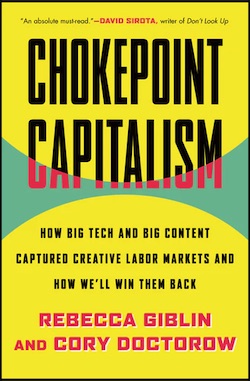
Echoing this point, Cory Doctorow was my guest on Techtonic this week, talking about his new book – co-authored with Rebecca Giblin – called “Chokepoint Capitalism: How Big Tech And Big Content Captured Creative Labor Markets And How We’ll Win Them Back.” This book details how concentration of power into fewer and fewer corporations – monopolies and monopsonies – is worse for workers, worse for customers, and basically worse for everyone except a handful of owners and major investors.
I recommend taking a listen, and reading through the episode links for more pointers:
- Download the whole show as a podcast
- Episode links & listener comments
As we move into this new age of chat bots, just remember: “AI plus” whatever is going to cause problems, if the Big Tech companies are in charge of it. So don’t be dazzled or mesmerized by the cosmic promises of the tech bros wielding this new tool. Instead, our next step should be to find a way to take their concentration of power, and throw it in the river.
Until next time,
-mark
Mark Hurst, founder, Creative Good – see official announcement and join as a member
Email: mark@creativegood.com
Read my non-toxic tech reviews at Good Reports
Listen to my podcast/radio show: techtonic.fm
Subscribe to my email newsletter
Sign up for my to-do list with privacy built in, Good Todo
On Mastodon: @markhurst@mastodon.social
- – -