








Why customers don’t want chat bots
I came across an intriguing comment recently by Sam Altman, the CEO of OpenAI and public face of ChatGPT. Altman has been in the news quite a bit during his global PR tour, including an appearance at a U.S. Senate hearing last Tuesday, during which he asked for Congressional regulation of AI.
The Senate hearing was sanitized and tame, showing off Altman as a calm and relatable technologist. At one point, Sen. Kennedy asked him if he makes a lot of money from OpenAI, allowing Altman to give an aw-shucks answer that he is only “paid enough for health insurance” and is motivated purely because he loves the work. (No mention of the five racecars Altman claims to own, including two MacLarens, as well as the “guns, gold . . . and a big patch of land in Big Sur I can fly to” he boasted of to the New Yorker – let alone his ongoing attempt, worthy of a Bond villain, to scan the iris of every person on earth with a metal orb, in exchange for some cryptocurrency he invented. I’m not making this up.)

(Above, Altman’s iris-scanning metal orb. It’s already been hacked with malware, of course.)
Anyway, Altman’s comment that caught my eye came elsewhere in his publicity tour, in which he said the following, per The Telegraph:
Customer service is one category where I expect a lot of these jobs, honestly, to just go away.
In other words, ChatGPT and other generative-AI chat bots will replace call centers in places like the Philippines and India – since the natural-language processing will be able to service customer requests without any pesky humans getting in the way of those sweet, sweet corporate profit margins. (For more, read Noami Klein’s recent column, which I quoted at length last week.)
The problem with chat bots
The corporate case for automating customer service, bringing about those attractive financial outcomes, says nothing about the customers themselves. As I wrote in Where are the customers’ chats? (Feb 24, 2023):
In all of the ChatGPT coverage, I haven’t seen why this is a good idea for customers: I mean the users, patients, students, citizens, consumers, and all others who are on the receiving end of this technology. We’ve heard about all of the handsome profits available to the Big Tech giants, and AI startups, for adopting and promoting AI chat technology. But that leaves an obvious question. If you’ll excuse a bit of wordplay, I’d like to ask: Where are the customers’ chats?
I’m serious. Everything in the hype around ChatGPT seems to center on what this means for corporations: “think of the margins, no more need to pay for researchers, writers, or editors!” Or, for articles taking the flip side: “time to freak out if you’re a researcher, writer, or editor!” All of which may be valid, but the discussion is limited to how the tools will change life inside the corporation (fatter bonuses for execs, more pink slips for employees). No one mentions the customers.
Someone did mention the customers recently, and that was Dave Mandl and me in our conversation on the May 1, 2023 Techtonic, agreeing that replacing humans with chat bots is the last thing customers want, when they’re in a situation that requires customer service.
A chat bot can handle expected, middle-of-the-road queries (as in, for a bank, “what’s my balance” and so on) – but customers can get those answers already from the app or website.
Instead, the reason people go to customer service is because of a question that’s so specific, or complicated, or gnarly in some respect, that there’s no way the app will have the answer: you need a human. For example, as Dave and I discussed: “Hey, my credit card isn’t working, and maybe it’s because of a weird charge I had on it yesterday, but then something else happened right before this purchase” – that’s the sort of complicated scenario that you don’t want to go to a chat bot for. You want a human for customer service.
Customers want humans in these situations, but Sam Altman says that he expects customer service to “honestly just go away” – to be replaced by his own platform, of course. The tech industry continues to push forward with chat bots, even though customers don’t want them – at least for customer service, the venue for problems that the regular website or app can’t handle. The tech industry’s push for profit-over-customers fits with Cory Doctorow’s argument in Chokepoint Capitalism about the gradual but inevitable decline of UX as platforms become more financialized (see more in my interview with Cory on the March 20, 2023 Techtonic).
Along the same lines, Artificial Labor by Ed Zitron (May 12, 2023) discusses the very real possibility of chat bots replacing customer service:
one might think this is impossible – that multi-billion dollar corporations could not simply remove all customer service – until you consider how companies like Twitter, Facebook and Uber have all but removed customer service.
. . . While I’m not suggesting that every company will follow this model, this feels like an inevitable consequence of artificial intelligence adoption. Companies may believe (at least, superficially) that the consumer is “important,” but they also hate the idea that their enterprise is somehow responsible for the product that they provide to them.
. . . An AI agent can mimic the abilities of a customer service agent without having any of the responsibility or empathy. A customer can still be “helped,” but not in any way that gives them progress or influence over the organization – they are trapped in an autonomous world where the rules are entirely set by the company.
While a human being might get involved, those person-to-person interactions will become increasingly rare, and as a result distance the company from any customer responsibility.
I’m with Zitron, and Doctorow, and for that matter my old friend Douglas Rushkoff, who got a well-deserved profile in Wired last week. The tech companies have too much money and power, and they’re using it to push “innovations” on us that pump up short-term financial gains while trashing the user experience. Customers don’t want the chat bots, just like they don’t want their irises scanned by a metal orb in exchange for some fraud-friendly funny money from the chief disruptor tech bro.
The only, and I mean the only, good use I’ve seen for chat bots in customer service is this example from Joshua Browder, in which he deployed a chat bot to cancel his New York Times subscription, which required dealing with customer service just to cancel. In the screenshot below, “You” is Joshua’s chat bot, giving chat botty answers to “francis,” who very well may be a bot, or a person using a bot, to give canned responses.
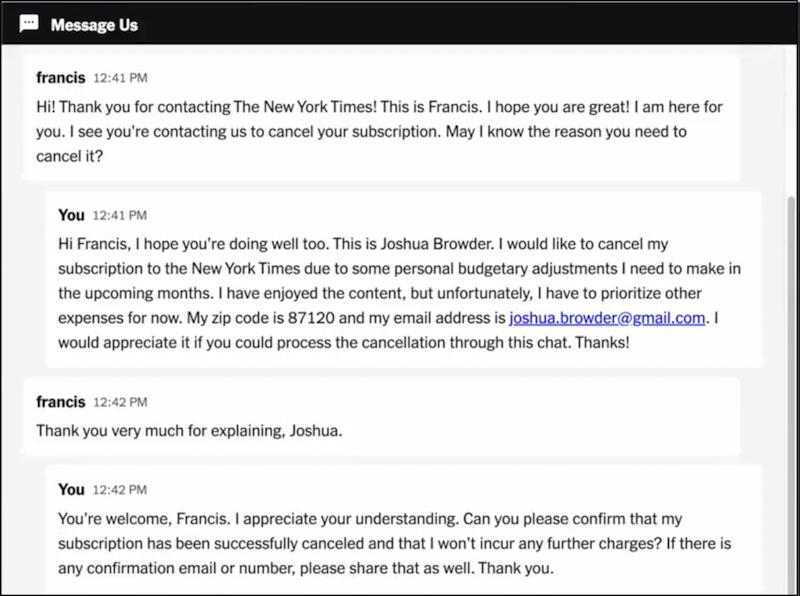
There has to be a better way. Here we are building chat bots that some customers will use to fight other chat bots from corporations. Why not – and I know this is radical – why not build technology that customers actually want, that customers can actually benefit from, that customers would actually appreciate?
In other words: why are we building technology to enable, or defend against, bad experiences – when we could build good experiences instead?
Until next time,
-mark
Mark Hurst, founder, Creative Good – see official announcement and join as a member
Email: mark@creativegood.com
Read my non-toxic tech reviews at Good Reports
Listen to my podcast/radio show: techtonic.fm
Subscribe to my email newsletter
Sign up for my to-do list with privacy built in, Good Todo
On Mastodon: @markhurst@mastodon.social
- – -