







上节课讲的是 EoS. 我们知道下面这些 EoS: xx
P=ρkBTμmP = \displaystyle{\frac{\rho k_BT}{\mu m}},这是 ideal gas EoS
对于非相对论和相对论的电子气,有
P=KNRρ5/3,P=KRρ4/3P = K_{\text{NR}}\rho^{5/3},\quad P = K_{\text{R}}\rho^{4/3}
这些又被称为 Polymeric EoS.
为了导出具体的 EoS,考虑平衡条件,也就是引力等于压力. 对于 z→z+dzz\to z+\text{d}z 的一个小气团,有
Fg=gzAρdz=AdP⟹dPdz=−ρgF_g = g_zA\rho\text{d}z = A\text{d}P\Longrightarrow \frac{\text{d}P}{\text{d}z} = -\rho g
现在把 P=Kρ1+1/nP = K\rho^{1+1/n} 代入进去,同时把 zz 改写成 rr (因为考虑的是恒星),另外把 gg 改写成引力势 Gmr/r2Gm_r/r^2,得到恒星的力学平衡方程
Kρddrρ1+1/n=−Gmrr2\frac{K}{\rho}\frac{\text{d}}{\text{d}r}\rho^{1+1/n} = -\frac{Gm_r}{r^2}
这里 RHS 写 mrm_r 是因为这个质量是 rr 的函数,rr 以内的全部质量和.
两边同时乘 r2r^2 后对 rr 求一阶导数,
1r2ddr(r2ρddrρ1+1/n)=−4πGKρ\frac{1}{r^2}\frac{\text{d}}{\text{d}r}\left(\frac{r^2}{\rho}\frac{\text{d}}{\text{d}r}\rho^{1+1/n}\right) = -\frac{4\pi G}{K}\rho
令 ρ=ρcψn\rho = \rho_c\psi^n (c = center),代入,得到
1r2ddr(r21ψnddrψn+1)=−4πGKρc1−1/nψn\frac{1}{r^2}\frac{\text{d}}{\text{d}r}\left(r^2\frac{1}{\psi^n}\frac{\text{d}}{\text{d}r}\psi^{n+1}\right) = -\frac{4\pi G}{K}\rho_c^{1-1/n}\psi^n
化简,最终形式是
1r2ddr(r2dψdr)=−4πGK(1+n)ρc1−1/nψn\frac{1}{r^2}\frac{\text{d}}{\text{d}r}\left(r^2\frac{\text{d}\psi}{\text{d}r}\right) = -\frac{4\pi G}{K(1+n)}\rho_c^{1-1/n}\psi^n
因为 ψ\psi 无量纲,因此 LHS 量纲为 L−2\text{L}^{-2},可以定义下面的 λn\lambda_n:
λn2=K(1+n)4πGρc1/n−1\lambda_n^2 =\frac{K(1+n)}{4\pi G}\rho_c^{1/n-1}
为某个长度量纲的辅助量. 这时候可以把变量改写为 r=λnξr = \lambda_n\xi,这样整个方程都无量纲化,
1ξ2ddξ(ξ2dψdξ)=−ψn\frac{1}{\xi^2}\frac{\text{d}}{\text{d}\xi}\left(\xi^2\frac{\text{d}\psi}{\text{d}\xi}\right) = -\psi^n
这就是 Lane - Emden 方程!它只有一个参数 nn,描述了所有的物态方程为 P=Kρ1+1/nP = K\rho^{1+1/n} 的恒星. 它是二阶常微分方程,我们知道它会拥有两个边界条件.
质量:
M=4πρcλn2∫ρρcr2drλn3=4πρcλn3∫ψnξ2dξM = 4\pi\rho_c\lambda_n^2\int\frac{\rho}{\rho_c}\frac{r^2\text{d}r}{\lambda_n^3} = 4\pi\rho_c\lambda_n^3\int\psi^n\xi^2\text{d}\xi
惊讶地发现利用 L-E 方程可以直接 remove the integral,获得
M=−4πρcλn3∫0ξRddξ(ξ2dψdξ)dξ=−4πρcλn3[ξ2ψ′]0ξR=−4πρcλn3ξR2ψ′(ξR)M = -4\pi\rho_c\lambda_n^3\int_0^{\xi_R}\frac{\text{d}}{\text{d}\xi}\left(\xi^2\frac{\text{d}\psi}{\text{d}\xi}\right)\text{d}\xi = -4\pi\rho_c\lambda_n^3\left[\xi^2\psi'\right]^{\xi_R}_0 = -4\pi\rho_c\lambda_n^3\xi_R^2\psi'(\xi_R)
平均密度
ρˉ=MV=−3ψ′(ξR)ξR⋅ρc≡ρcΓn\bar{\rho} = \frac{M}{V} = -\frac{3\psi'(\xi_R)}{\xi_R}\cdot\rho_c\equiv\frac{\rho_c}{\Gamma_n}
这里的 Γn\Gamma_n 是一个由 nn 确定的量,和其他物理实际都无关. 因此只要我们知道 L-E 方程的解就能确定这个值.
也可以从这里推导出 KK,有
K∝Gλn2ρc1−1/n∝GR2(MR)1−1/n⟹K=NnGM1−1/nR3/n−1K\propto G\lambda_n^2\rho_c^{1-1/n}\propto GR^2\left(\frac{M}{R}\right)^{1-1/n}\Longrightarrow K = N_nGM^{1-1/n}R^{3/n-1}
这也是由 nn 完全决定的,可以查表获得.
同理计算中心压强:
Pc=Kρc1+1/n∝(MR3)1+1/nGM1−1/nR3/n−1∝ρc4/3M2/3⟹Pc=WnGM2R4=CnGρc4/3M2/3\begin{aligned} P_c &= K\rho_c^{1+1/n}\propto\left(\frac{M}{R^3}\right)^{1+1/n}GM^{1-1/n}R^{3/n-1}\propto \rho_c^{4/3}M^{2/3}\\\\ \Longrightarrow &P_c = W_n\frac{GM^2}{R^4}=C_nG\rho_c^{4/3}M^{2/3} \end{aligned}
系数都是由 nn 决定.
中心温度并不能简单通过 L-E 方程定出,为简化计算,可以用理想气体近似一下,
Pc=ρckBTcmuμP_c = \frac{\rho_ck_BT_c}{m_u\mu}
代入极端相对论性的条件,n=3n=3,得到
KR=N3GM1/3⟹Mchandra=(KRGN3)2≈1.45M⊙K_{\text{R}} = N_3GM^{1/3} \Longrightarrow M_{\text{chandra}} = \left(\frac{K_\text{R}}{GN_3}\right)^2 \approx 1.45M_{\odot}
这是 Chandrasekhar 极限.
太阳的化学能可以简单估计一下,我们认为化学反应的能标是 1 eV1\text{ eV},因此
Echem=M⊙μmu∼103310−24⋅10−12 erg∼1045 ergE_{\text{chem}} = \frac{M_{\odot}}{\mu m_u} \sim\frac{10^{33}}{10^{-24}}\cdot 10^{-12}\text{ erg}\sim10^{45}\text{ erg}
这个看起来很大,但是,
tchem=EchemL⊙=10451034∼1011 sec∼103∼4 yr.t_{\text{chem}} = \frac{E_{\text{chem}}}{L_{\odot}} = \frac{10^{45}}{10^{34}}\sim 10^{11}\text{ sec}\sim 10^{3\sim4}\text{ yr.}
这个明显不能支撑太阳的燃烧. 如果用引力势能,那么
Egrav∼GM⊙2R⊙∼10−7(1033)21011∼1048 ergE_{\text{grav}} \sim\frac{GM_{\odot}^2}{R_{\odot}}\sim\frac{10^{-7}(10^{33})^2}{10^{11}}\sim10^{48}\text{ erg}
这个也不够.
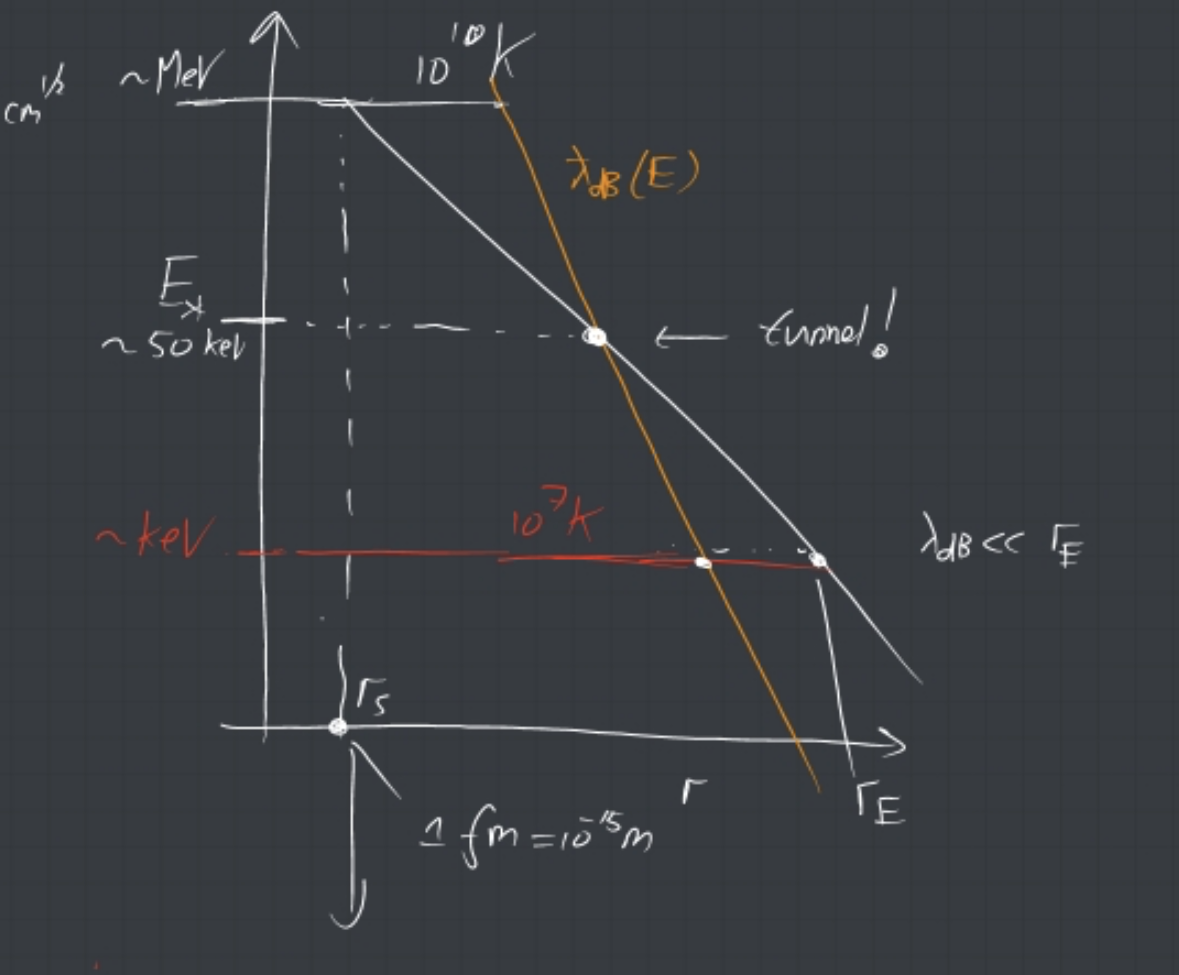
现在来计算太阳能否点火核聚变 —— 需要足够热来突破 Coulomb 势的势垒,但是这一般要 1010 K10^{10}\text{ K},而太阳的温度在 107 K10^7\text{ K} 量级. 唯一的解释是 quantum tunneling. 我们不需要把质子之间的距离降低到 fm\text{fm} 的量级,只要可能隧穿即可,
λdB=ℏ2mpE⟹E∝1λdB2\lambda_{\text{dB}} = \frac{\hbar}{\sqrt{2m_pE}}\Longrightarrow E \propto \frac{1}{\lambda_{\text{dB}}^2}
这里要说一下,dB 指的是 de Broglie... 虽然我觉得这个下标也太抽象了.
虽然这个 λdB\lambda_{\text{dB}} 仍然 ≪\ll 平均质子间距,但是已经可以实现点火. 隧穿概率:
lnPtunnel∼4πh∫rsrE∣p(r)∣dr∼−pErEh∼muEhZ1Z2e2E\ln P_{\text{tunnel}} \sim\frac{4\pi}{h}\int_{r_s}^{r_E}|p(r)|\text{d}r \sim-\frac{p_Er_E}{h}\sim\frac{\sqrt{m_uE}}{h}\frac{Z_1Z_2e^2}{E}
严格地计算表明,
E=8π2Z12Z22e4muh2E = \frac{8\pi^2Z_1^2Z_2^2e^4m_u}{h^2}
当然我们只需要了解其中的物理即可.
提示
老师上课画的图:
此内容由惯性聚合(RSS阅读器)自动聚合整理,仅供阅读参考。 原文来自 — 版权归原作者所有。