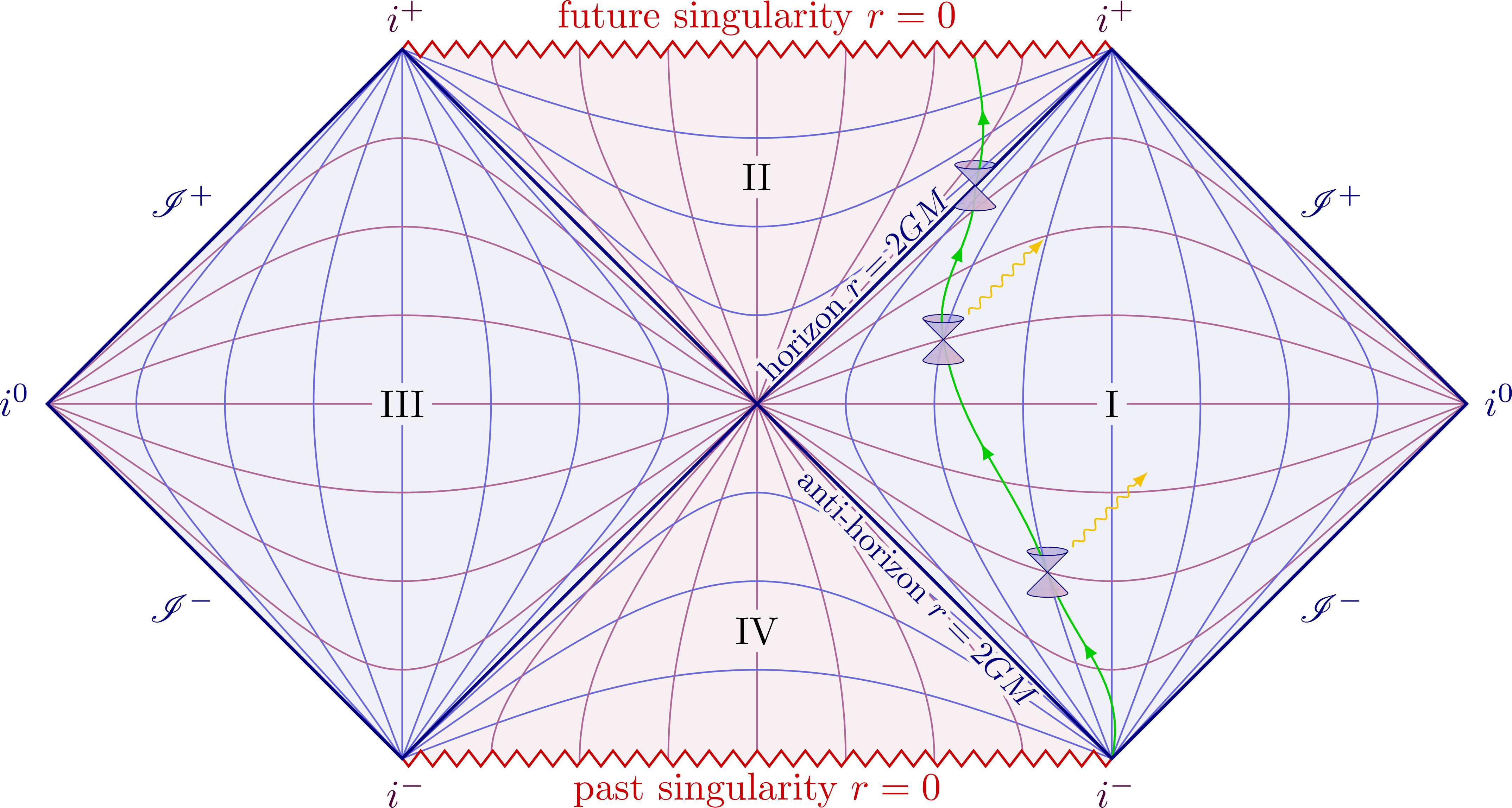









上节课说到凑出 Kruskal 坐标,
dτ2=32(GM)3re−r/(2GM)dUdV−r2dΩ2\text{d}\tau^2 = \frac{32(GM)^3}{r}e^{-r/(2GM)}\text{d}U\text{d}V-r^2\text{d}\Omega^2
考虑做一个拉回 (保角的),将无穷远拉近到研究范围内,变换为
U′=arctanU,V′=arctanVU'=\arctan U,\quad V'=\arctan V
当然也可以用 tanh−1\tanh^{-1},区别只是 (−∞,∞)(-\infty,\infty) 拉回到 (−π/2,π/2)(-\pi/2,\pi/2) 还是 (−1,1)(-1,1) 而已. 新的图称为 Penrose 图,在新的图中所有的双曲线都变成直线,之前的奇点 r=0r=0 对应的双曲线也变为直线. 原来的类时未来和类时过去分别集中于两个点,
回头来看 Minkowski 时空,
dτ2=dt2−dr2−⋯=(dt+dr)(dt−dr)−⋯=dUdV−⋯\text{d}\tau^2=\text{d}t^2-\text{d}r^2-\cdots=(\text{d}t+\text{d}r)(\text{d}t-\text{d}r)-\cdots=\text{d}U\text{d}V-\cdots
也可以得到所有类时无穷远分别集中在几点,无穷的未来称为 i+i^+,无穷的过去称为 i−i^-;类光的无穷远集中在两条线段上,分别为 I±\mathscr{I}^{\pm};类空的无穷远集中在 i0i^0 一点. I\text{I} 区域和 III\text{III} 区域没有因果的连接,只能通过奇点相互连接,所以理论上我们可以说黑洞和白洞连接着两个本来无法相交的世界. 但是现实中的黑洞都是塌缩形成的,而不是一个原生的结构,因此不应该存在 III\text{III} 这个区域 (因为一开始就没有这个区域).
为了研究坍缩中的黑洞,考虑一个动态的解. 仍然有球对称的性质,但是现在度规和 tt 有关系,
dτ2=C(r,t)dt2−D(r,t)dr2−2E(r,t)drdt−F(r,t)r2(dθ2+sin2θdϕ2)\text{d}\tau^2=C(r,t)\text{d}t^2-D(r,t)\text{d}r^2-2E(r,t)\text{d}r\text{d}t-F(r,t)r^2(\text{d}\theta^2+\sin^2\theta\text{d}\phi^2)
重新定义 r′r' 就可以把 F(r,t)F(r,t) 包含进去,然后再更新 EE 和 DD 的定义即可,所以可以不去解 FF 的具体形式,直接把最后一项写成 −r2dΩ2-r^2\text{d}\Omega^2,这时候用完了 rr 的自由度;之后用 tt 的自由度,写成
dt′≡η(r,t)[C(r,t)dt−E(r,t)dr]\text{d}t' \equiv\eta(r,t)[C(r,t)\text{d}t-E(r,t)\text{d}r]
最后重新定义 C,D,EC,D,E,得到
dτ2=B(r,t)dt2−A(r,t)dr2−r2dΩ2\text{d}\tau^2=B(r,t)\text{d}t^2-A(r,t)\text{d}r^2-r^2\text{d}\Omega^2
也就是说即使度规和 tt 有关,还是可以写成球对称的这个形式.
下一步还是算联络,
Γrrt=Γrtr=A˙2A,Γtrt=Γttr=B˙2B\Gamma^r{}_{rt}=\Gamma^r{}_{tr}=\frac{\dot{A}}{2A},\quad \Gamma^t{}_{rt}=\Gamma^t{}_{tr}=\frac{\dot{B}}{2B}
然后 Ricci 张量分量
Rrr=Rrrstatic−A¨2B+A˙B˙4B2+A˙24ABRθθ=RθθstaticRϕϕ=Rθθsin2θRtt=Rttstatic+A¨2A−A˙24A2−B˙A˙4AB\begin{aligned} &R_{rr} = R_{rr}^{\text{static}}-\frac{\ddot{A}}{2B}+\frac{\dot{A}\dot{B}}{4B^2}+\frac{\dot{A}^2}{4AB}\\\\ &R_{\theta\theta} = R_{\theta\theta}^{\text{static}}\\\\ &R_{\phi\phi}=R_{\theta\theta}\sin^2\theta\\\\ &R_{tt} = R_{tt}^{\text{static}} + \frac{\ddot{A}}{2A}-\frac{\dot{A}^2}{4A^2}-\frac{\dot{B}\dot{A}}{4AB} \end{aligned}
其中 static 结果见:Lesson 6(在新窗口打开).
这些直接解并不容易,但是考虑到一个分量
Rtr=−A˙Ar=0⟹A˙=0R_{tr} = -\frac{\dot{A}}{Ar}=0\Longrightarrow \dot{A}=0
这极大简化了过程,解得
dτ2=f(t)(1−2GMr)dt2−(1−2GMr)−1dr2−r2dΩ2\text{d}\tau^2=f(t)\left(1-\frac{2GM}{r}\right)\text{d}t^2-\left(1-\frac{2GM}{r}\right)^{-1}\text{d}r^2-r^2\text{d}\Omega^2
重新标度一下时间又得到 Schwarzschild 解,也就是说在真空区域还是静态的时空.
/Theorem/ (Birkhoff's Theorem)
球对称真空解必静态.
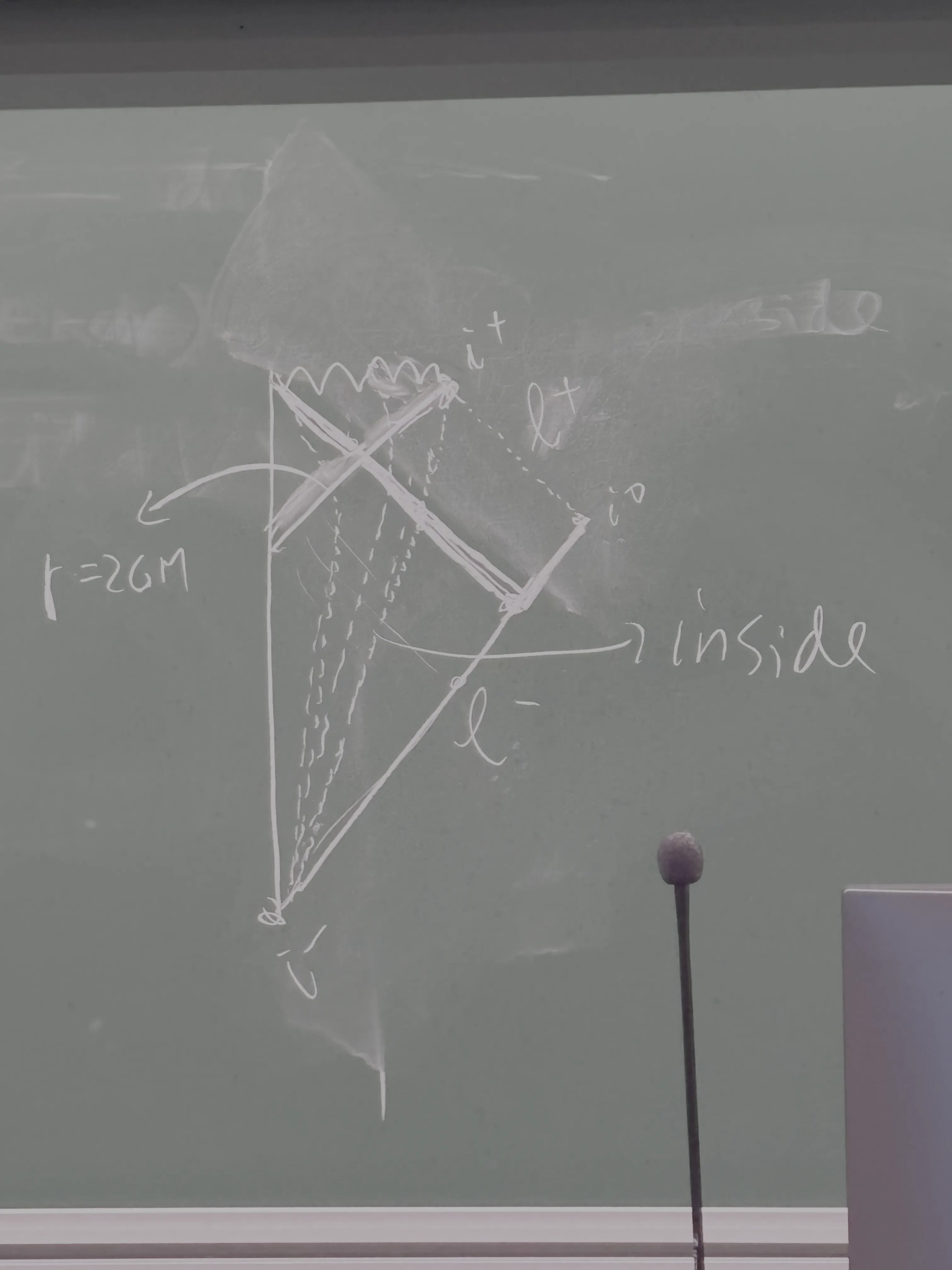
观测者在 outside 看到的是这个 Schwarzschild 时空,但是在 inside 看到的是 Minkowski 时空,因此必须把两半 Penrose 图拼在一起. 现在我们假设的是 shell 以光速坍缩,因此两个图都是按照 45°45\degree 剪开,然后拼接,如图:
下面尝试推导带电的 RN 黑洞. 在此之前,我们需要先把电磁场的能动张量写出来. 在不知道作用量原理的情况下,我们只能通过写出分量的形式来确定最终的能动张量.
提示
如果知道作用量原理,可以写出作用量再对坐标微分得到能动张量. 当然我们默认是不知道这个事情的,因为还没有学用 Hamilton 力学推导 Einstein 方程.
首先看能量密度,正比于 E⃗⋅E⃗+B⃗⋅B⃗\vec{E}\cdot\vec{E}+\vec{B}\cdot\vec{B};然后能流密度矢量是 E⃗×B⃗\vec{E}\times\vec{B} 的倍数…… 观察下来发现它们都是电磁场的二次项,因此用电磁场张量构造能动张量:
Tμν=αFμρFρν+βημνFρσFρσT^{\mu\nu} = \alpha F^{\mu\rho}F_\rho{}^\nu+\beta\eta^{\mu\nu}F_{\rho\sigma}F^{\rho\sigma}
实际上 FρσFρσF_{\rho\sigma}F^{\rho\sigma} 就是作用量了.
然后对每个分量求一下系数 α,β\alpha,\beta 等等即可. 最终得到
Tμν=FμρFρν−14gμνFρσFρσT^{\mu\nu} = F^{\mu\rho}F_\rho{}^\nu-\frac{1}{4}g^{\mu\nu}F_{\rho\sigma}F^{\rho\sigma}
度规
dτ2=e2ψ(r)f(r)dt2−f−1(r)dr2−r2dΩ2\text{d}\tau^2=e^{2\psi(r)}f(r)\text{d}t^2-f^{-1}(r)\text{d}r^2-r^2\text{d}\Omega^2
假设坍缩之后电荷集中在 r=0r=0 的点. 为了代入 Einstein 方程,考虑
Fμν;μ=1g∂(gFμν)∂xμ=0⟹ddr(eψr2Ftr)=0⟹Ftr=e−ψQ4πr2F^{\mu\nu}{}_{;\mu}=\frac{1}{\sqrt{g}}\frac{\partial(\sqrt{g} F^{\mu\nu})}{\partial x^\mu} = 0\Longrightarrow\frac{\text{d}}{\text{d}r}(e^\psi r^2F^{\text{tr}}) = 0\Longrightarrow F^{\text{tr}} = e^{-\psi}\frac{Q}{4\pi r^2}
能动张量
Tμν=Q28πr2(−1−111)T^\mu{}_\nu=\frac{Q^2}{8\pi r^2}\begin{pmatrix} -1&&&\\ &-1&&\\ &&1&\\ &&&1 \end{pmatrix}
解得度规
dτ2=(1−2GMr+Q2r2)dt2−(1−2GMr+Q2r2)−1dr2−r2dΩ2\text{d}\tau^2=\left(1-\frac{2GM}{r}+\frac{Q^2}{r^2}\right)\text{d}t^2-\left(1-\frac{2GM}{r}+\frac{Q^2}{r^2}\right)^{-1}\text{d}r^2-r^2\text{d}\Omega^2
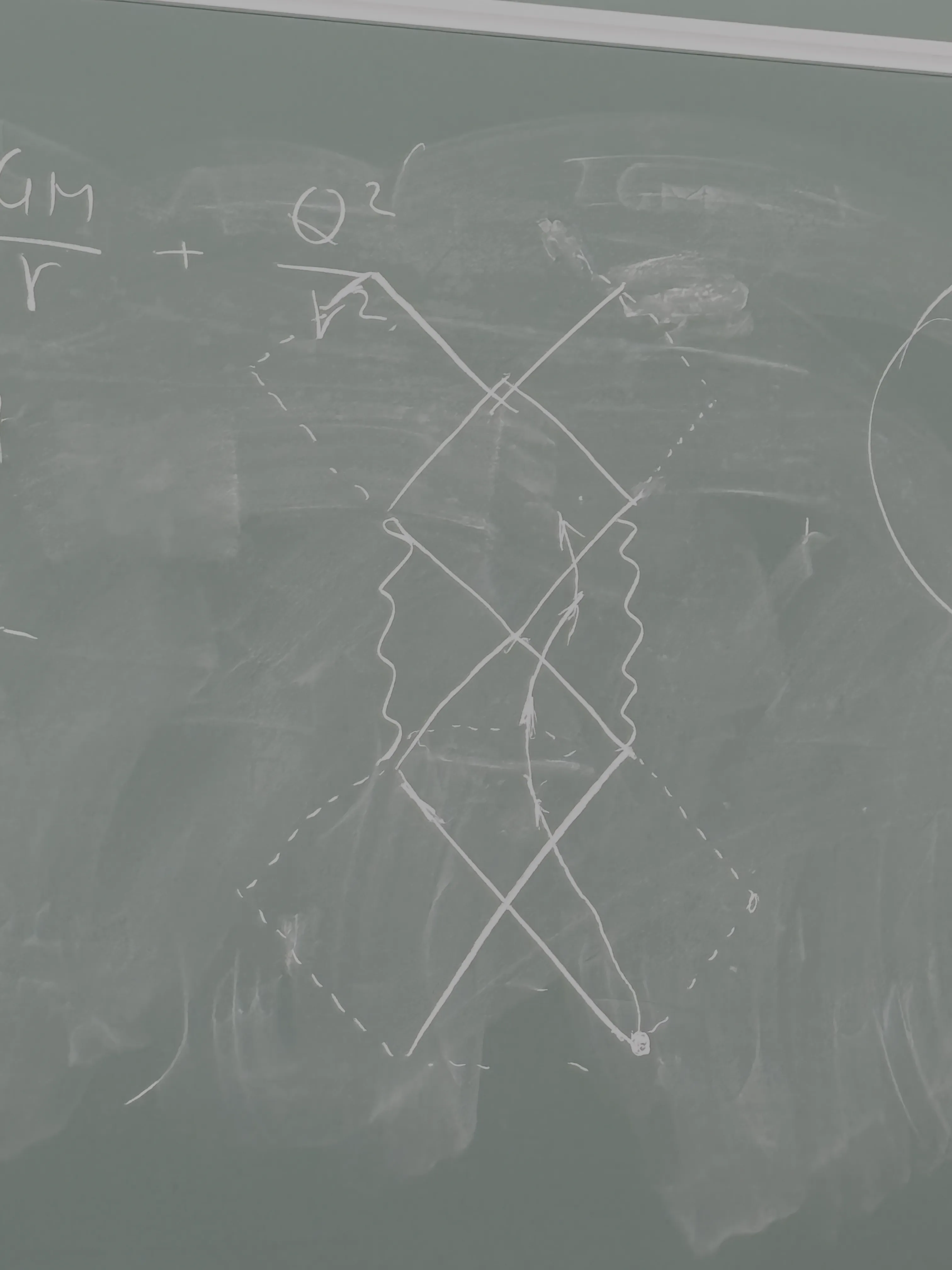
这意味着电荷也构成黑洞能量的一部分,而且电荷过大会无法形成黑洞. 但是比较难理解的点是 dr2\text{d}r^2 前的系数 →∞\to\infty 对应着两个解,也就是两个「视界」,我们需要理解这件事. 这两个解分别是
r±=GM±(GM)2−Q2r_{\pm}=GM\pm\sqrt{(GM)^2-Q^2}
此内容由惯性聚合(RSS阅读器)自动聚合整理,仅供阅读参考。 原文来自 — 版权归原作者所有。