











FLAGSHIP REPORT
New Energy Outlook
BloombergNEF’s long-term energy and climate scenarios for the transition to a low-carbon economy.

FLAGSHIP REPORT
New Energy Outlook
BloombergNEF’s long-term energy and climate scenarios for the transition to a low-carbon economy.
Key takeaways
- Anchored in real-world sector and country transitions, the NEO provides an independent set of credible scenarios covering electricity, industry, buildings and transport, and the key drivers shaping these sectors until 2050.
- The 2025 edition presents a new, updated base-case scenario and a deep dive into key trends affecting the energy transition in the next 10 years to support corporations, financial institutions and policymakers navigating the energy transition.
- Read on for a high-level preview or download the NEO 2025 Executive Summary.
Strong fundamentals underpin growth in renewables and EVs
Oil and coal face decline, though the speed is uncertain
Oil demand in the report’s base-case ‘Economic Transition Scenario’ peaks in 2032 at 104 million barrels per day, with road fuel peaking a few years earlier. Demand ultimately drops to 88 million barrels per day by 2050 – a significant decline from today, but far from the drop required to get on track for net zero. Outside of road transport, oil consumption remains resilient, with a doubling of demand for aviation and strong growth in petrochemicals through 2050.
Coal demand in the Economic Transition Scenario falls rapidly as cost-competitive renewables and gas displace its use in the power sector. Natural gas is the only fuel that sees long-term growth. Global demand increases 25% from 2024 to 2050, reaching 5,449 billion cubic meters due to lower long-term fuel price expectations and higher electricity demand from data centers.
The base-case outlook contrasts sharply with the Net Zero Scenario from 2024, which sees gas demand dropping steeply in the near term and roughly halving by mid-century. There are thus highly divergent futures possible for natural gas, and its role in the energy transition will look very different depending on which kind of transition trajectory is in play in a given region.
Fossil-fuel demand by sector, Economic Transition Scenario
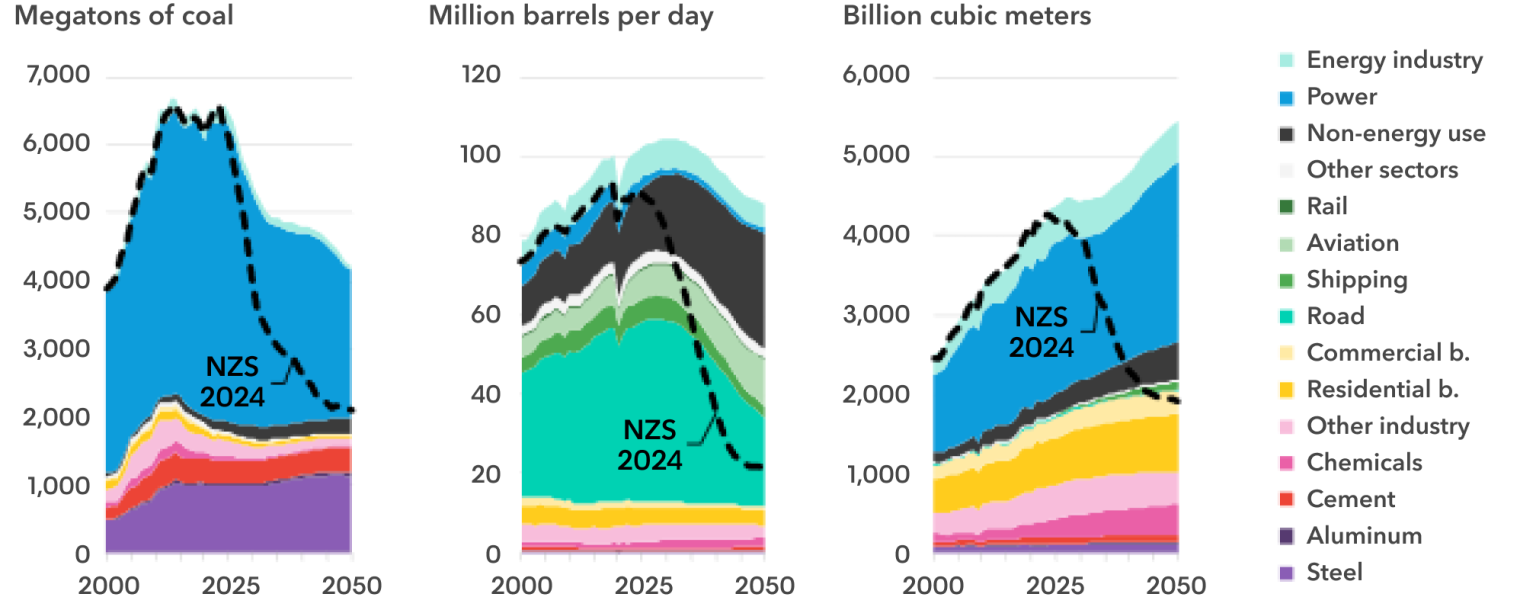
Source: BloombergNEF. Note: ‘NZS 2024’ is the Net Zero Scenario from NEO 2024. Megatons are metric and assume a 6,000kcal/kilogram energy content. ‘b.’ refers to buildings. We have revised upward historical oil demand in NEO 2025 compared to NEO 2024 scenarios, as we now account more accurately for oil use for non-energy purposes outside the petrochemical industry.
Global emissions set to begin their long descent
Energy-related CO2 emissions have risen globally in most years since the 1950s, but clean energy additions appear finally to have caught up with energy-demand growth. Our modeling indicates that 2024 may have been the peak year for emissions, meaning that 2025 could be the first year of structural emissions decline (excepting unusual years such as 2020 or 2009). While many individual advanced economies have already seen structural emissions declines induced by the growth of clean energy, this would be the first time such a moment has been observed at the global level.
CO2 emissions reductions from fuel combustion by measures adopted, Economic Transition Scenario versus ‘no-transition’ scenario and Net Zero Scenario
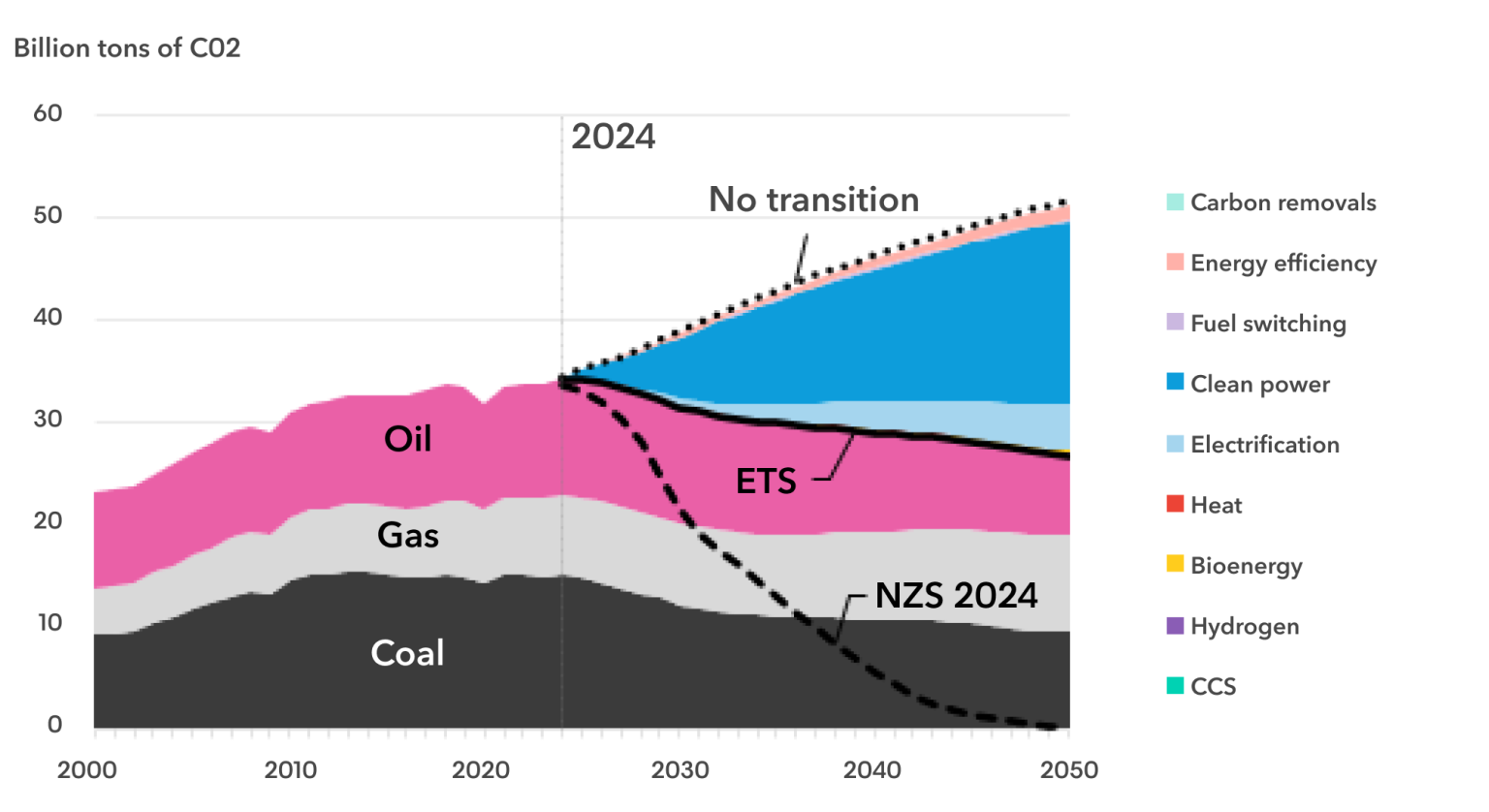
Source: BloombergNEF. Note: The ‘no transition’ scenario is a hypothetical counterfactual that models no further improvement in decarbonization and energy efficiency. In power and transport, it assumes that the future fuel mix does not evolve from 2023 (2027 in shipping). ‘Clean power’ includes renewables and nuclear, and excludes carbon capture and storage (CCS), hydrogen and bioenergy, which are allocated to their respective categories. ‘Energy efficiency’ includes demand-side efficiency gains. ‘NZS 2024’ is the Net Zero Scenario from NEO 2024.
Download the executive summary and sample data

Enter your details

David Hostert
Head of Economics & Modeling, Lead author

Matthias Kimmel
Head of Energy Economics

Dr. Ian Berryman
Lead Energy Systems Modeler

Kostas Pegios
Energy Systems Modelling

Rodrigo Quintero
Energy Economics

Seohee Song
Energy Economics

Anushka Verma
Energy Economics

Amar Vasdev
Energy Economics

Jenny Chase
Renewables

Albert Cheung
Deputy CEO

Brynne Merkley
NDCs

Jinghong Lyu
Data Centers
Meredith Annex
Clean Power
Tushna Antia
Australia
Adithya Bhashyam
Hydrogen
Allen Tom Abraham
Industry
Natalia Castilhos Rypl
Latin America
Emma Champion
Europe
Abdullah Alkattan
Middle East
Felicia Aminoff
Grids
David Doherty
Oil
Ryan Fisher
Electric Vehicle Charging
Forbes Chanthorn
Southeast Asia
Caroline Chua
Australia
Chris Gadomski
Nuclear
Philip Geurts
Oil
Andrew Grant
Electric Vehicles
Lara Hayim
Solar
Dr. Ali Izadi-Najafabadi
Asia-Pacific
Shantanu Jaiswal
India and Southeast Asia
David Kang
Japan
Mark Daly
Data centers
Nannan Kou
China
Mbongeni Dube
Europe
Laura Foroni
Power data
Enrique Gonzales
Gas
Sofia Maia
Power data
Fauziah Marzuki
Gas
Colin McKerracher
Transport
Oliver Metcalfe
Wind
Tara Narayanan
US
Vinicius Nunes
Latin America
Rose Oates
Renewable Fuels
Sofia Perelli-Rocco
Heat Pumps
Hanh Phan
Vietnam
Leonard Quong
Australia
Abhishek Rohatgi
Gas
Luxi Hong
Petrochemicals
Dr. Tom Rowlands-Rees
Americas
Kesavarthiniy Savarimuthu
Europe
Kamala Schelling
Editorial
Felix Kosasih
Southeast Asia
Yayoi Sekine
Batteries
Ashish Sethia
Commodities
Siddarth Shetty
India
Sahaj Sood
Asia-Pacific
Analeigh Suh
South Korea
Sisi Tang
Petrochemicals
Helen Kou
Data centers
Claudio Lubis
Aviation
Mohith Velamala
Shipping
Nelson Nsitem
Batteries
Aleksandra O’Donovan
Electric vehicles
Shige Ogawa
Japan
Umer Sadiq
Japan
Iryna Sereda
Gas
Dr. Nikolas Soulopoulos
Commercial transport
Daisy Robinson
Renewable Fuels
William Young
Strategy
Kokona Ota
Japan
Kate Power
Europe