







Rejecting the Apple Vision Pro
“Where there is no vision, the people perish.” The warning from the King James Bible was oddly resonant this week as visibility fell almost to zero here in Manhattan. A smoky, orange sky made the city look like a dystopian film. Unbreathable air, signs and portents in the sky, apocalypse on people’s minds.
On the opposite coast, a two-trillion dollar company launched a new device that takes vision down to exactly zero. Cameras and screens strapped to your face, completely obscuring your view of the world, allowing interaction only through the filter of the device. Your sight is fully co-opted by the machine. The very name of the product tries to hide the essential fact that it obscures all vision.
A meme has floated around for years, showing a smartphone attached with tentacles to a man’s face, like something from the Alien movies:
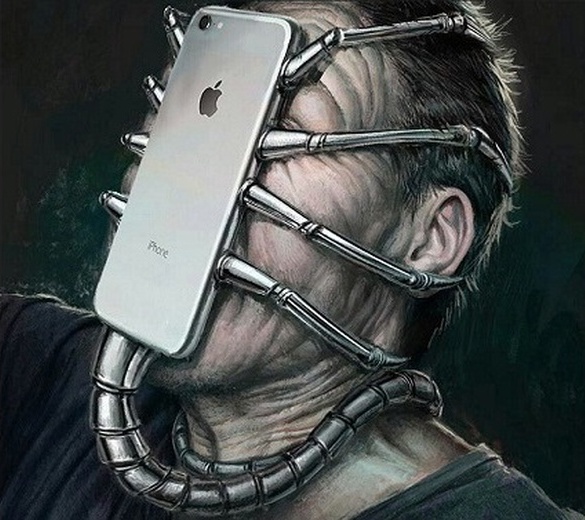
The meme image, intended as hyperbole, is immediately recognizable in the product demo from this week. People sit on a couch, talk to coworkers, play with their kids – all while blinded by the tentacled grip across their eyes. There’s nothing liberating, exciting, or hopeful in any of it. And if it looks futuristic at all, it’s because we’ve lost our sense of what the future should be. As Alan Jacobs writes, the machine “doesn’t look like something to use, it looks like something to be sentenced to – by an especially cruel judge.”
This new device, the trillion-dollar machine that takes away your vision, is the most talked-about thing in tech this week. I spotted one of the designers on LinkedIn posting about his role on the project, adding that Steve Jobs would surely be proud of the device. That’s wrong, if I know anything about Jobs. A “bicycle for the mind” was how he described the original Macintosh, referring to an enabling and empowering technology, one that amplifies people’s power to create.
In contrast, this new device, which we could perhaps call “Vision No,” offers a passive, locked-down experience. Sit back on your couch and watch a movie projected in virtual space! Turn your living room into a screensaver background! Oh, and yes, the office: soul-sucking Microsoft files from work can follow you even into virtual space, floating nightmarishly wherever you look.
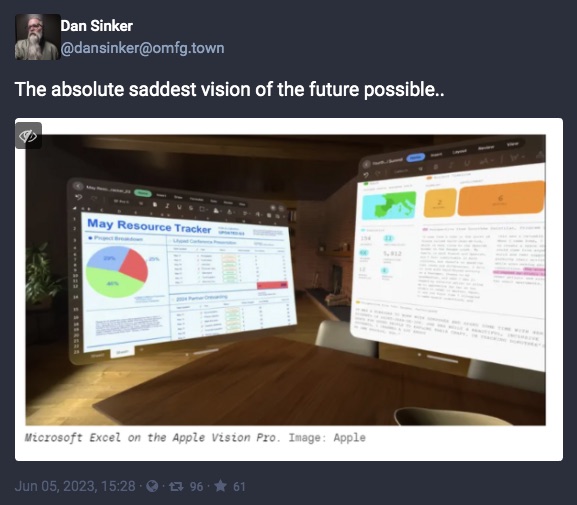
What imitation of vision there is in the device, exists only as machine vision, continually scanning both inside and out. A phalanx of cameras monitors the user’s eyes in order to display them on the device’s front panel, while other cameras spy on the room layout, the furniture, and the people nearby – as the user’s eyes are locked away inside the Vision No enclosure. The only way for users to see anything is to accept the representation of the world as offered by the corporation’s filters. I don’t know about you, but my grip on reality – incomplete and imperfect as it may be – will not improve by passing through the hidden manipulations of a two-trillion-dollar company with an insatiable need for growth.
Even if you don’t wear the thing, you’re still on camera. As I mentioned before, there are cameras on the outside of the device, scanning everything and everyone in range. Partly this is to send the visual info (perhaps touched up a bit) to the user inside the head-mounted prison. But also, no doubt, this data stream is a gold mine for any company profiting from surveillance. Which means every company in Big Tech.
A threat to personal privacy
I really hate head-mounted surveillance gear. Ten years ago I wrote The Google Glass feature no one is talking about, which went viral and helped kick off early resistance to that ungodly machine. People in 2013 were horrified by the possible loss of privacy, and the resulting tsunami of public disapproval killed the device.
Then on December 3, 2021, I wrote My predictions for Apple’s smart glasses, in which I issued a specific warning:
Within the next 18 months, Apple will launch surveillance glasses, upending all expectations of personal privacy.
The prediction was off by two days, as the official launch date was June 5. And my design mockup was totally wrong, while The Information’s sketch of the ski-goggles design was eerily accurate:
(Drawing by the Information showing what looks like ski goggles.)Beyond those quibbles, my warning still stands about the loss of personal privacy. People walking around with this thing strapped on – or sitting near you, on a plane, in a coffee shop – are going to be surveilling you, and everyone around you, for indefinite storage in Apple’s servers.
And if you somehow think that Apple will act ethically with that data, read Why we can’t trust Apple. But also consider that if Apple succeeds here, other corporate beasts will follow close behind, with their own surveillance headgear, beholden to their privacy-destroying practices. Big Tech sees trillions of dollars of potential growth here, and it’s our job to resist, to refuse, to ridicule this thing, now, right now, this new launch, just as we did ten years ago with Google Glass. Let’s kill it dead.
I’m not alone in this sentiment: Paris Marx writes that Apple’s Vision Pro headset deserves to be ridiculed, and he’s right. And Ross Douthat writes Don’t Wear the Goggles, in which he says that “public derision” is “good” and “necessary” and that “our health as a society and species depends on sustaining it.”
So let’s get out there and ridicule these things. By rejecting the goggles, we’ll preserve our vision.
Join Creative Good to post a comment on the members-only Creative Good Forum.
Until next time,
-mark
Mark Hurst, founder, Creative Good – see official announcement and join as a member
Email: mark@creativegood.com
Read my non-toxic tech reviews at Good Reports
Listen to my podcast/radio show: techtonic.fm
Subscribe to my email newsletter
Sign up for my to-do list with privacy built in, Good Todo
On Mastodon: @markhurst@mastodon.social
- – -