



惯性聚合 高效追踪和阅读你感兴趣的博客、新闻、科技资讯
阅读原文 在惯性聚合中打开

推荐订阅源

T
Troy Hunt's Blog
人人都是产品经理
人人都是产品经理
MongoDB | Blog
MongoDB | Blog
Stack Overflow Blog
Stack Overflow Blog
Cyber Security Advisories - MS-ISAC
Microsoft Security Blog
F
Fortinet All Blogs
博客园 - 三生石上(FineUI控件)
钛媒体:引领未来商业与生活新知
钛媒体:引领未来商业与生活新知
P
Proofpoint News Feed
freeCodeCamp Programming Tutorials: Python, JavaScript, Git & More
博客园 - Franky
H
Hackread – Cybersecurity News, Data Breaches, AI and More
Martin Fowler
Martin Fowler
V
Visual Studio Blog
奇客Solidot–传递最新科技情报
奇客Solidot–传递最新科技情报
Microsoft Azure Blog
云风的 BLOG
云风的 BLOG
G
Google Developers Blog
WordPress大学
WordPress大学
腾讯CDC
J
Java Code Geeks
T
The Blog of Author Tim Ferriss
博客园 - 司徒正美
博客园 - 【当耐特】
小众软件
小众软件
Attack and Defense Labs
宝玉的分享
宝玉的分享
Google DeepMind News
罗磊的独立博客
Schneier on Security
OSCHINA 社区最新新闻
OSCHINA 社区最新新闻
量子位
cs.AI updates on arXiv.org
O
OpenAI News
TaoSecurity Blog
TaoSecurity Blog
H
Heimdal Security Blog
Blog — PlanetScale
Blog — PlanetScale
Forbes - Security
Forbes - Security
B
Blog
I
InfoQ
D
DataBreaches.Net
月光博客
月光博客
T
Tenable Blog
S
Security Affairs
C
Check Point Blog
T
Threatpost
C
Cybersecurity and Infrastructure Security Agency CISA
cs.CL updates on arXiv.org
www.infosecurity-magazine.com

Comments for The Eclectic Light Company

Should you try Golden Gate beta? Solutions to Saturday Mac riddles 367 In the shadow: Diego Velázquez Comment on Last Week on My Mac: Freshen up your documents by David Comment on Happy 250th birthday America 2 by mac Brushstrokes: Portraits 1760-1877 Spotlight and Core Spotlight are different Comment on Sort order, collation and the Finder by eyelessjerry Comment on Apple has just released macOS 26.5.2 Tahoe by Derek Currie Great Ladies of Impressionism: Marie Bracquemond Comment on Get more from your Mac’s log by extending its duration by John Gilbert Comment on Keep your Mac cool using physics by F Portraits of trees: Coppices and pollards Comment on Firmware has become complicated again by John Woods Comment on Logistician 1.2 fixes a couple of bugs by info395288a4d1d Comment on What does Activity Monitor measure? by hoakley Last Week on My Mac: Spotlight on semantics An American in Paris: paintings of Henry Ossawa Tanner 1902-1930 An American in Paris: paintings of Henry Ossawa Tanner 1880-1902 Great Ladies of Impressionism: Berthe Morisot 1874-1891 What to do with a hot Mac Deprecations and removals from Golden Gate Brushstrokes: From El Greco to Rembrandt Portraits of trees: Dutch Golden Age How to get the most from SilentKnight 3 Comment on Hero or hooligan: Achilles becomes the warrior by Deborah J. Brasket Solutions to Saturday Mac riddles 365 Comment on SilentKnight 3.0 for Apple silicon Macs running Sequoia and later (full release) by michaelriccioli Comment on Last Week on My Mac: Uncompressed compressed files by fds Comment on Explainer: Memory by jzonedotcom Comment on Colin Campbell Cooper painting America: 1896-1910 by House of Heart Brushstrokes: 16th century What can you do when an app uses too much memory? SilentKnight 3 second beta adds text and JSON reporting In the shadow: Caravaggism What to do with your encrypted HFS+ disks First beta-test version of SilentKnight 3 for Apple silicon Macs Hero or hooligan: Jason and Medea Comment on Fix documents that won’t open as expected using Quarant2 by EcleX Last Week on My Mac: The mystery of Safari’s Web Archives Last Week on My Mac: Why is it so hard to open a document? Explainer: Disk encryption In the shadow: Caravaggio Brushstrokes: innovators of the first century Changing Paintings: 36 Theseus and the Minotaur macOS virtualisation is leaping forward in Golden Gate Why can’t Preview open that PDF? Crossing the Golden Gate, Intel support, and an update to SystHist Reading the Finder’s Get Info dialog In memoriam Mary Cassatt: 2, 1880-81 Last Week on My Mac: What’s in a name? Explainer: Getting a location Get more from Get Info and the Finder’s contextual menu Stop your photos revealing your location Have you saved thousands of versions? Versatility 1.2 might be what you need Apple has released an update to XProtect for all macOS Apple has released macOS Tahoe 26.5.1 Comment on What Location Services do in macOS by Tristan Hubsch Comment on Protect files with the Locked or Immutable flag by markbot2zero Portraits of trees: Introduction Which tasks require mains power? Comment on Online reference to external displays for Apple silicon Macs by Brian What’s in that phishing email? How to search document versions Rubens’ Peace and War Comment on Last Week on My Mac: Syncing metadata in iCloud Drive by hoakley A weekend with Misia: 2 How to search Time Machine backups? Medium and message: Pottery Hero or hooligan: Theseus and the sandals How QuickLook provides thumbnails and previews Hunting extended attributes with an update to xattred Saturday Mac riddles 360 Comment on How to preserve versions, and how to create versioned PDFs by markbot2zero Comment on What gets synced in iCloud Drive? by hoakley Solutions to Saturday Mac riddles 359 Last Week on My Mac: snapshots, the elephant in APFS How to check whether Spotlight is getting the right metadata macOS Tahoe no longer fully supports Time Capsules The bicentenary of Frederic Edwin Church: 1857-77 macOS virtual machines and audio-video syncing Comment on Use Finder tags for categories by Chuck Last Week on My Mac: Dependency and skill fade Comment on Virtualisation on Apple silicon Macs is different by AndyS Painting Pandora and her box: 1883-1919 Mac Easter eggs Painting Spring blossom 2 Comment on The macOS Natural Language framework and Nalaprop by Ingo Comment on The MACL extended attribute by hoakley On Reflection: Cézanne Privacy: Which folders are protected in Tahoe? Last Week on My Mac: Root cause analysis and ClickFix Last Week on My Mac: Root cause analysis and ClickFix Last Week on My Mac: Root cause analysis and ClickFix Last Week on My Mac: Root cause analysis and ClickFix Why you can’t trust Privacy & Security How can I now have two apps named Pages? How to survive the loss of Rosetta Use Fallback Recovery on Apple silicon Macs Clean install macOS
Happy 250th birthday America 1
Raymond Phil · 2026-07-05 · via Comments for The Eclectic Light Company

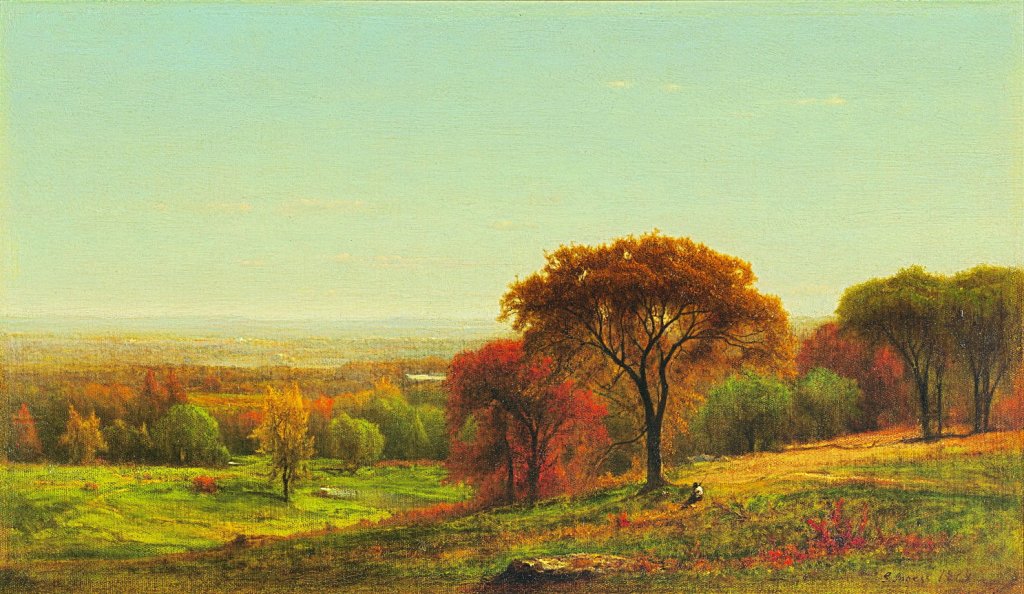
George Inness, Across the Hudson Valley in the Foothills of the Catskills (1868), oil on canvas, 38.1 x 66 cm, location not known. Wikimedia Commons.

To celebrate the two-hundred and fiftieth anniversary of American Independence, this weekend I take a grand tour of some of the nation’s finest landscape paintings.

Frederick Childe Hassam, The Fourth of July, 1916 (1916), oil on canvas, 91.4 x 66.4 cm, Private collection. WikiArt.
Frederick Childe Hassam (1859-1935), The Fourth of July, 1916 (1916), oil on canvas, 91.4 x 66.4 cm, Private collection. WikiArt.

I begin with one of a series of paintings of flag parades started by the Impressionist Frederick Childe Hassam in 1916. These show flag parades, known then as “Preparedness Parades”, which were part of the war relief effort.

Frederic Edwin Church (1826-1900), Niagara (1857), oil on canvas, 101.6 x 229.9 cm, National Gallery of Art, Washington, DC. Wikimedia Commons.

Many of Frederic Edwin Church’s epic landscapes were painted further south, well beyond the US border, but this early panoramic view made in 1857 remains one of his most important works. It’s now best read in its historical context, as a product of a time when secession of Southern states from the Union seemed imminent. Coupled with the significance of the Niagara Falls, and the unity of Church’s details, this painting became associated with the struggle to maintain that union, which broke down only four years later in the American Civil War.

Albert Bierstadt, A Storm in the Rocky Mountains, Mt. Rosalie (1866), oil on canvas, 210.8 x 361.3 cm, Brooklyn Museum, New York, NY. Wikimedia Commons.
Albert Bierstadt (1830-1902), A Storm in the Rocky Mountains, Mt. Rosalie (1866), oil on canvas, 210.8 x 361.3 cm, Brooklyn Museum, New York, NY. Wikimedia Commons.

My favourite of Albert Bierstadt’s huge paintings of apocalyptic landscapes is A Storm in the Rocky Mountains, Mt. Rosalie from 1866. Having already established a preference for painting grand views of mountains, Bierstadt first travelled west towards the Rocky Mountains in 1859. He established a pattern of sketching and photographing spectacular scenery, then returning to his studio in New York and turning that material into a series of paintings of the Burkean sublime.

He uses his full array of skills and sketches from his second expedition to the West in 1863, to express the sublime, and fill the viewer with awe and trembling. The foreground shows a pastoral valley floor with a native American camp, in mottled light. Some people and their animals are seen making haste to return from the pastures to the shelter of the camp. A small rocky outcrop has trees straggling over it, which are silhouetted against the brilliant sunlight on the lake behind, in the middle distance.

Behind the lake the land rises sharply, with rock crags also bright in the sunshine. In the background the land is blanketed by indigo and black stormclouds. Those clouds are piled high, obscuring much of Mount Rosalie (named by Bierstadt after his wife), but its ice-clad peaks show proud, high up above the storm, with patches of blue sky above and beyond them. A single large bird, an eagle perhaps, is seen in silhouette, high above the lake. Rosalie Peak, as it’s now known, is in the Colorado Rocky Mountains.
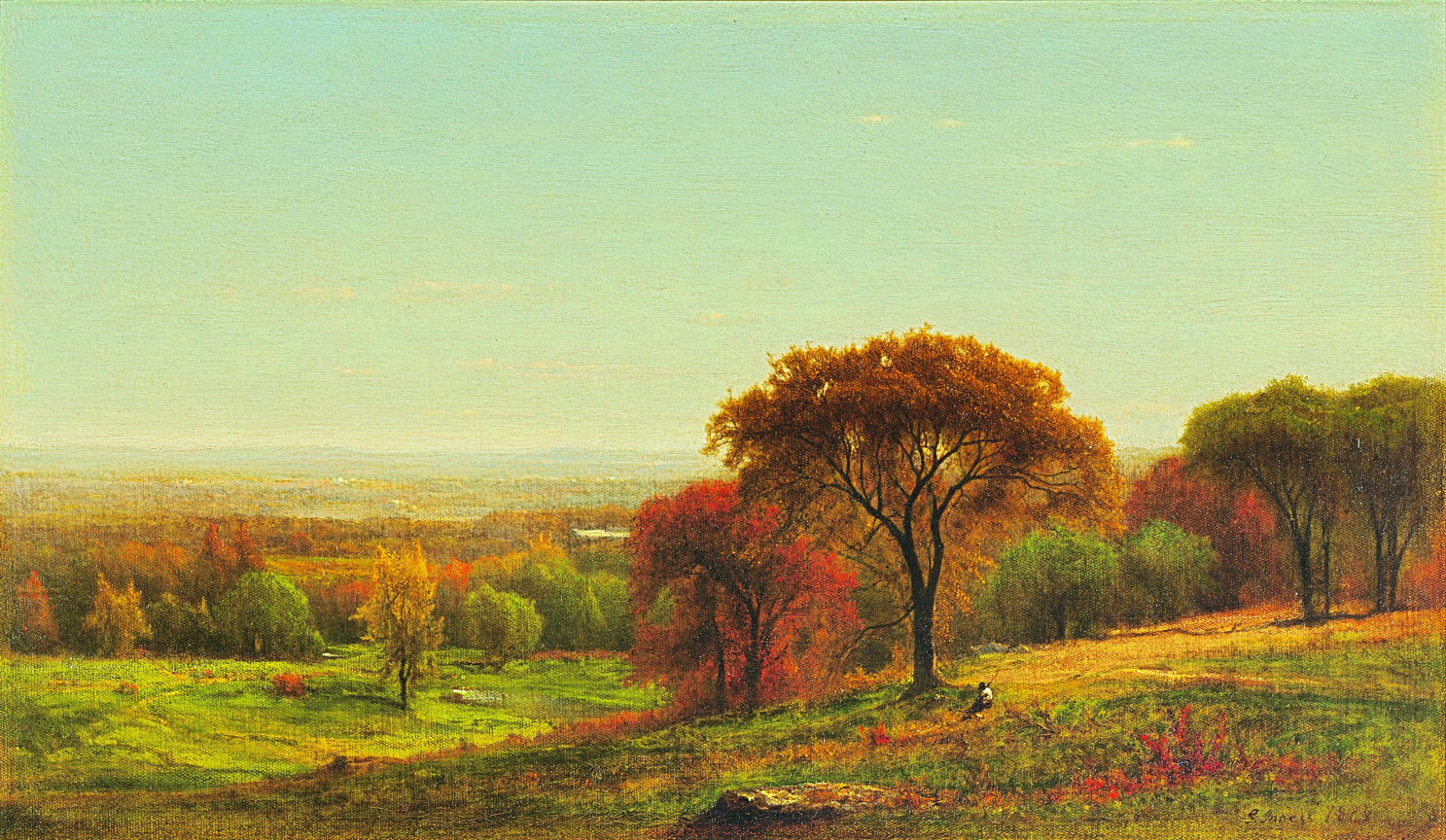
George Inness, Across the Hudson Valley in the Foothills of the Catskills (1868), oil on canvas, 38.1 x 66 cm, location not known. Wikimedia Commons.
George Inness (1825-1894), Across the Hudson Valley in the Foothills of the Catskills (1868), oil on canvas, 38.1 x 66 cm, location not known. Wikimedia Commons.

Like many artists of the time, George Inness obtained patronage to enable him to travel to Europe. He arrived in Rome in 1851, where he studied the paintings of Claude Lorrain and Poussin. He also travelled to Paris in the early 1850s, where he was influenced by the Barbizon School. He consequently developed a Barbizon style, but remained a realist. He moved his studio to Medfield, Massachusetts, in 1860, then to Eagleswood, New Jersey, in 1864, from where he painted this view over the Hudson Valley in New York State.
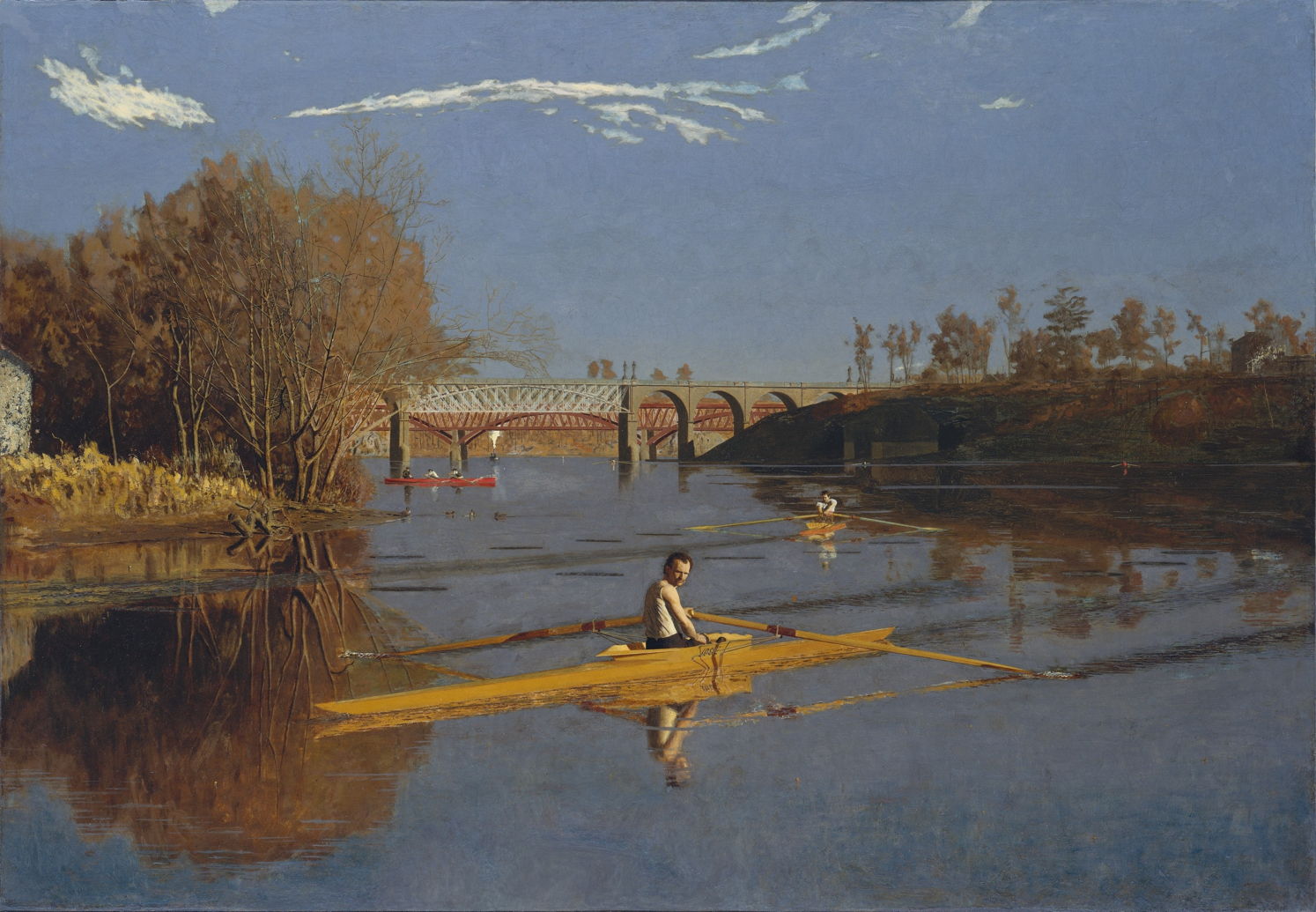
eakinsmaxschmittsinglescull
Thomas Eakins (1844–1916), The Champion Single Sculls (Max Schmitt in a Single Scull) (1871), oil on canvas, 81.9 × 117.5 cm, The Metropolitan Museum of Art, New York, NY. Wikimedia Commons.

Thomas Eakins also studied in Europe. His first painting on his return to Philadelphia in 1871 is his masterpiece, The Champion Single Sculls (Max Schmitt in a Single Scull), the first in a series showing activities on the city’s Schuylkill River. Eakins’ friend and successful rower Max Schmitt is in the nearest boat, and Eakins (a keen oarsman himself) is the figure in the further single scull. It’s meticulously detailed, even down to the puddles in the water made by Eakins’ oars as he rows into the distance, and its clouds are calligraphic.
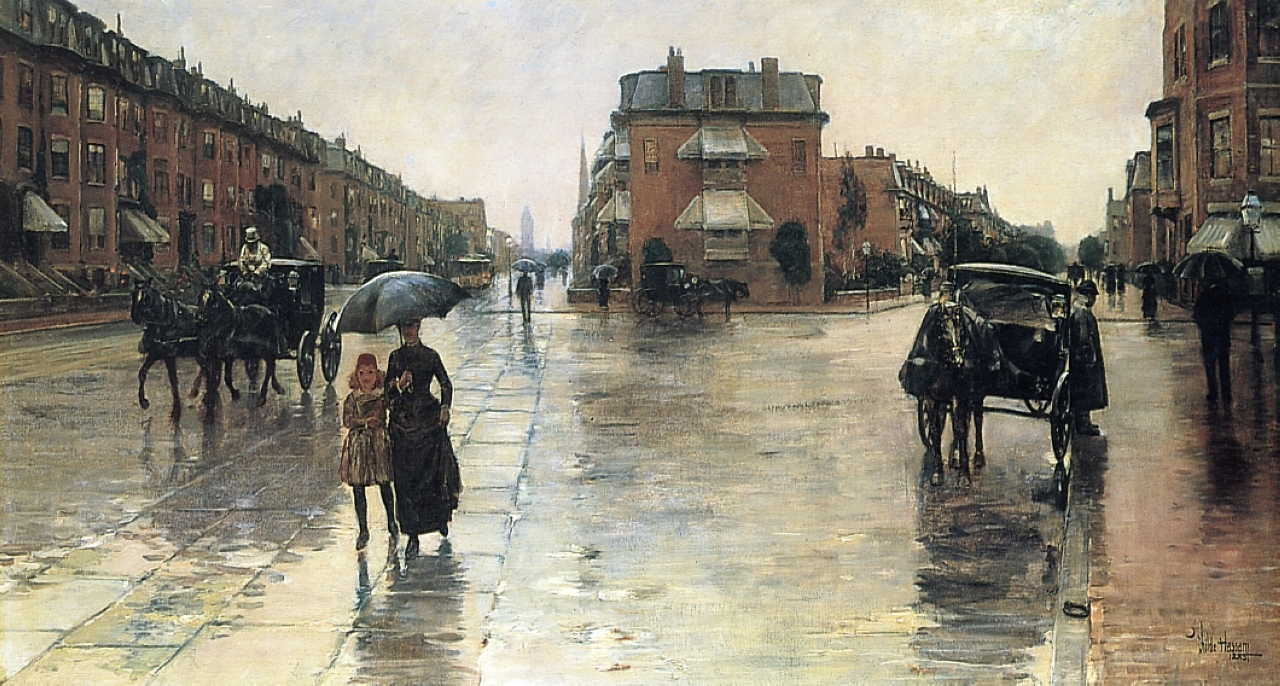
Frederick Childe Hassam, Rainy Day, Columbus Avenue, Boston (1885), oil on canvas, 66.4 x 121.9 cm, Toledo Museum of Art, Toledo, OH. WikiArt.
Frederick Childe Hassam (1859-1935), Rainy Day, Columbus Avenue, Boston (1885), oil on canvas, 66.4 x 121.9 cm, Toledo Museum of Art, Toledo, OH. WikiArt.

Throughout the early part of Childe Hassam’s career, some of his paintings appeared to borrow from those (now more famous) of the French Impressionists. For example, Rainy Day, Columbus Avenue, Boston (1885) has an uncanny resemblance to Gustave Caillebotte’s Paris, a Rainy Day (1877). However it’s not clear whether Hassam had seen the latter painting at the time, or this was mere coincidence.

Frederick Childe Hassam, Mount Vernon Street, Boston, Looking Towards the State House (c 1890), oil on canvas, 45.7 x 40.6 cm, Private collection. WikiArt.
Frederick Childe Hassam (1859-1935), Mount Vernon Street, Boston, Looking Towards the State House (c 1890), oil on canvas, 45.7 x 40.6 cm, Private collection. WikiArt.

The dome of the Massachusetts State House gives an Italian air to his wonderful view of Mount Vernon Street, Boston, Looking Towards the State House from about 1890.
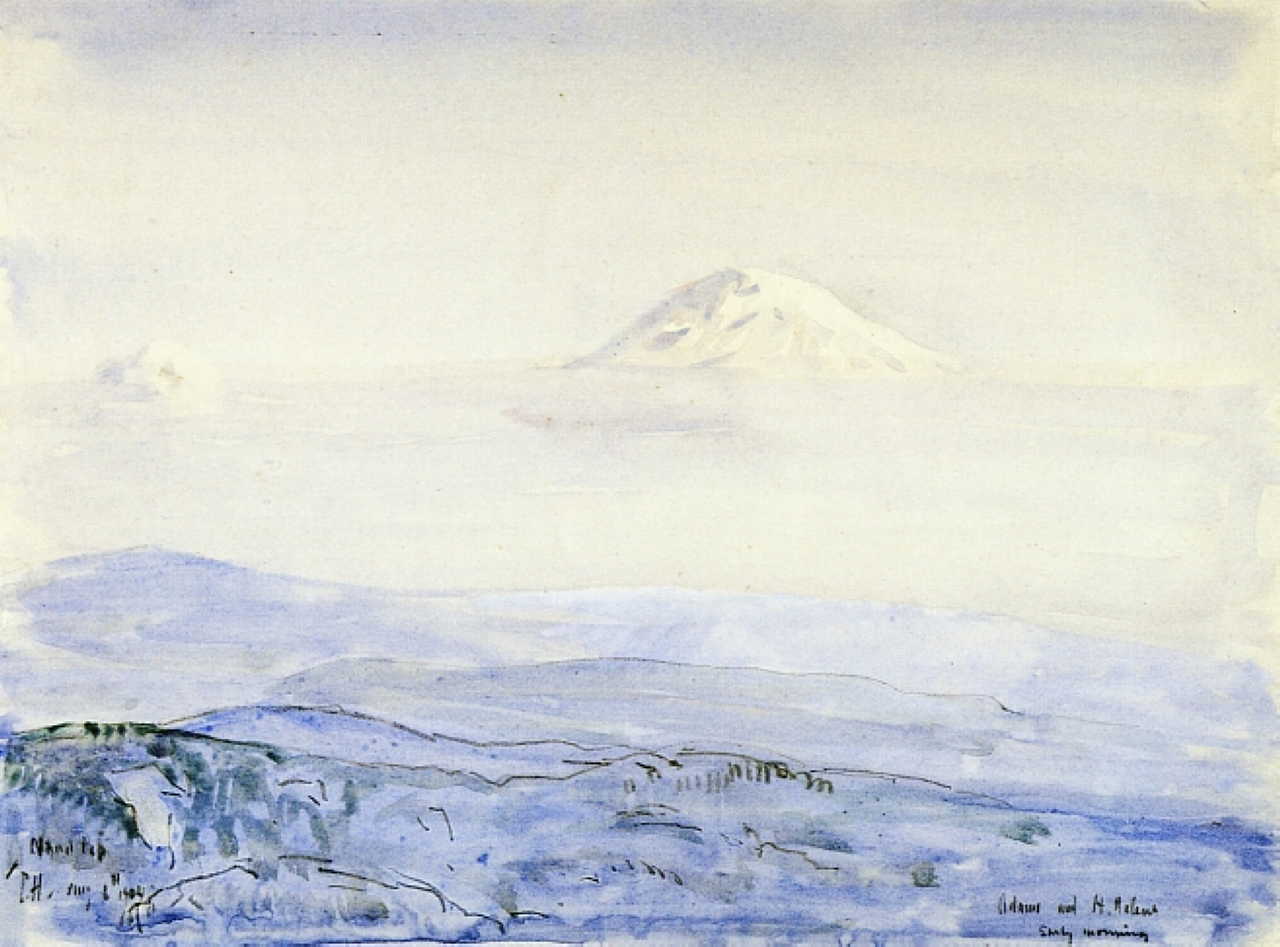
Frederick Childe Hassam, Adams and St. Helen's, Early Morning (1904), watercolour, 25.4 x 35.2 cm, Fogg Museum of Art, Harvard University, Cambridge, MA. WikiArt.
Frederick Childe Hassam (1859-1935, Adams and St. Helen’s, Early Morning (1904), watercolour, 25.4 x 35.2 cm, Fogg Museum of Art, Harvard University, Cambridge, MA. WikiArt.

My last and contrasting landscape by Childe Hassam is an example of his plein air watercolours, showing the distant peak of Mount Saint Helens, in Washington State. This view reminds me of flying (not too near) this stratovolcano, which underwent a major eruption in 1980.
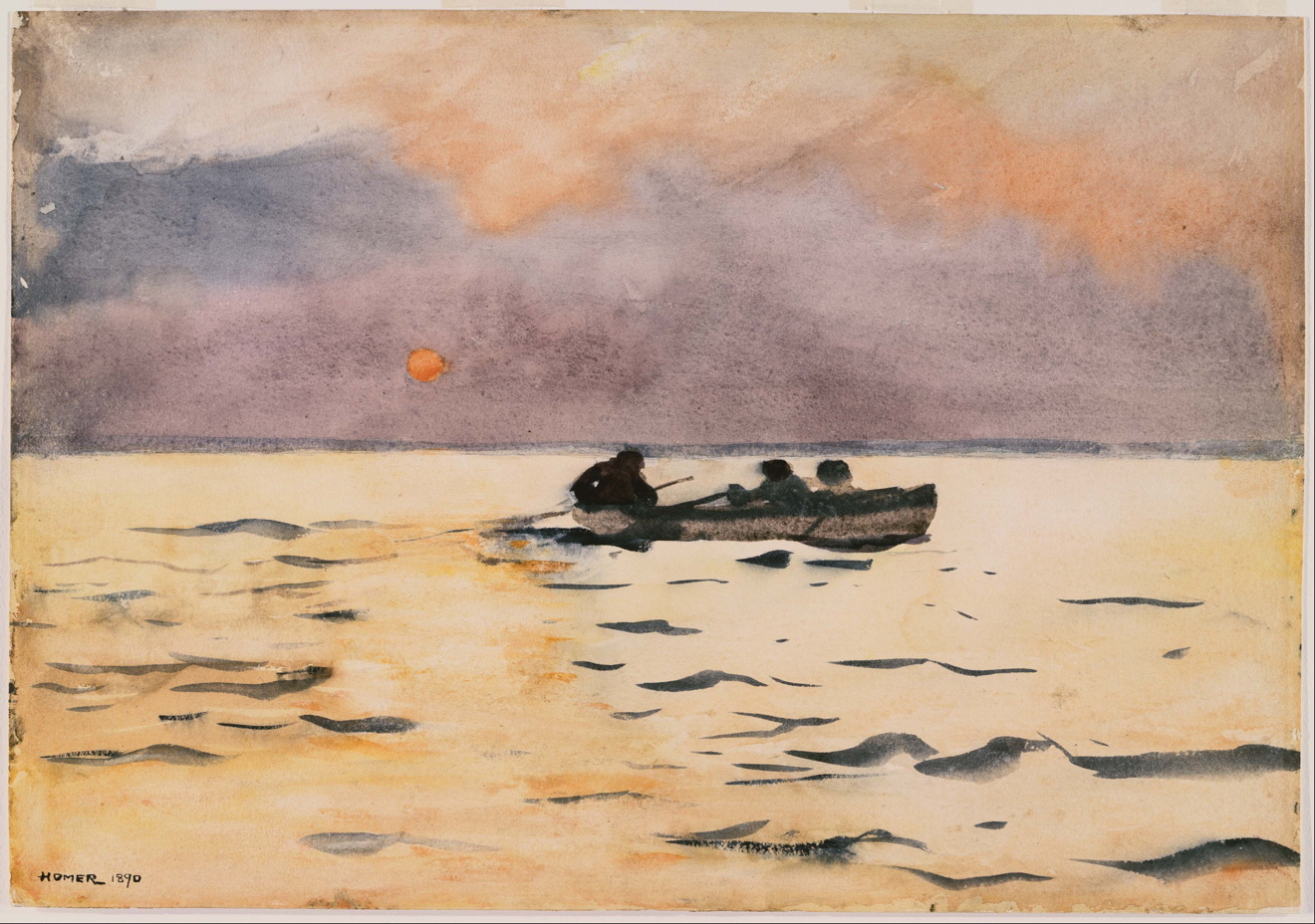
Winslow Homer, Rowing Home (1890), watercolour on paper, 13.75 x 19.88 cm, The Phillips Collection, Washington, DC. Wikimedia Commons.
Winslow Homer (1836-1910), Rowing Home (1890), watercolour on paper, 13.75 x 19.88 cm, The Phillips Collection, Washington, DC. Wikimedia Commons.

Winslow Homer was a brilliant watercolour painter of the late nineteenth century. His art was transformed by a stay in Europe, but not in the fashionable parts of France or Italy: he lived for two years in the small fishing village of Cullercoats in north-east England. This shows one of his many paintings made on the East Coast when he was living at Prouts Neck, Maine.
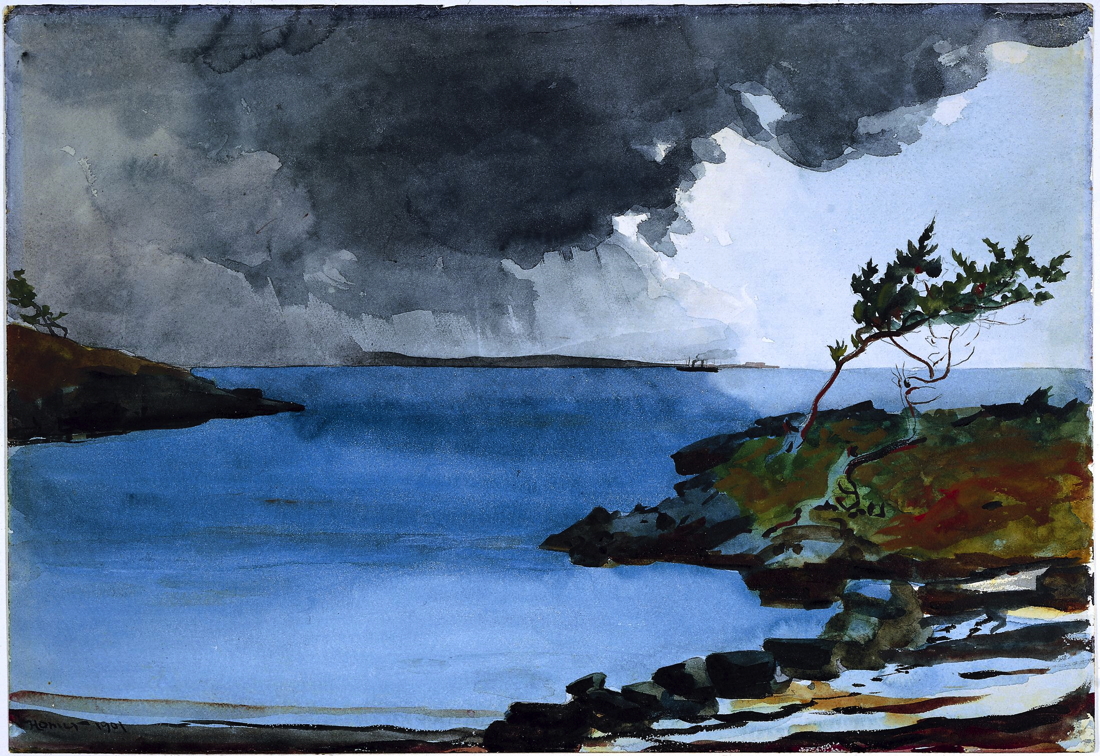
Winslow Homer, The Coming Storm (1901), watercolour over graphite on paper, 36.9 x 53.5 cm, The National Gallery of Art, Washington, DC. Wikimedia Commons.
Winslow Homer (1836-1910), The Coming Storm (1901), watercolour over graphite on paper, 36.9 x 53.5 cm, The National Gallery of Art, Washington, DC. Wikimedia Commons.

Homer’s The Coming Storm (1901) may have been painted in front of the motif when he was visiting Key West, Florida.

William Merritt Chase, The Big Bayberry Bush (c 1895), oil on canvas, 64.77 x 84.14 cm, Parrish Art Museum, Water Mill, NY. WikiArt.
William Merritt Chase (1849-1916), The Big Bayberry Bush (c 1895), oil on canvas, 64.77 x 84.14 cm, Parrish Art Museum, Water Mill, NY. WikiArt.

William Merritt Chase had studied in Munich, Germany, before settling in New York City. He bought a property in the Shinnecock Hills on eastern Long Island, New York, from where he also taught at his popular and influential Summer School for twelve years. The Big Bayberry Bush from about 1895 is one of his many views of this part of Long Island when it was still largely unpopulated.
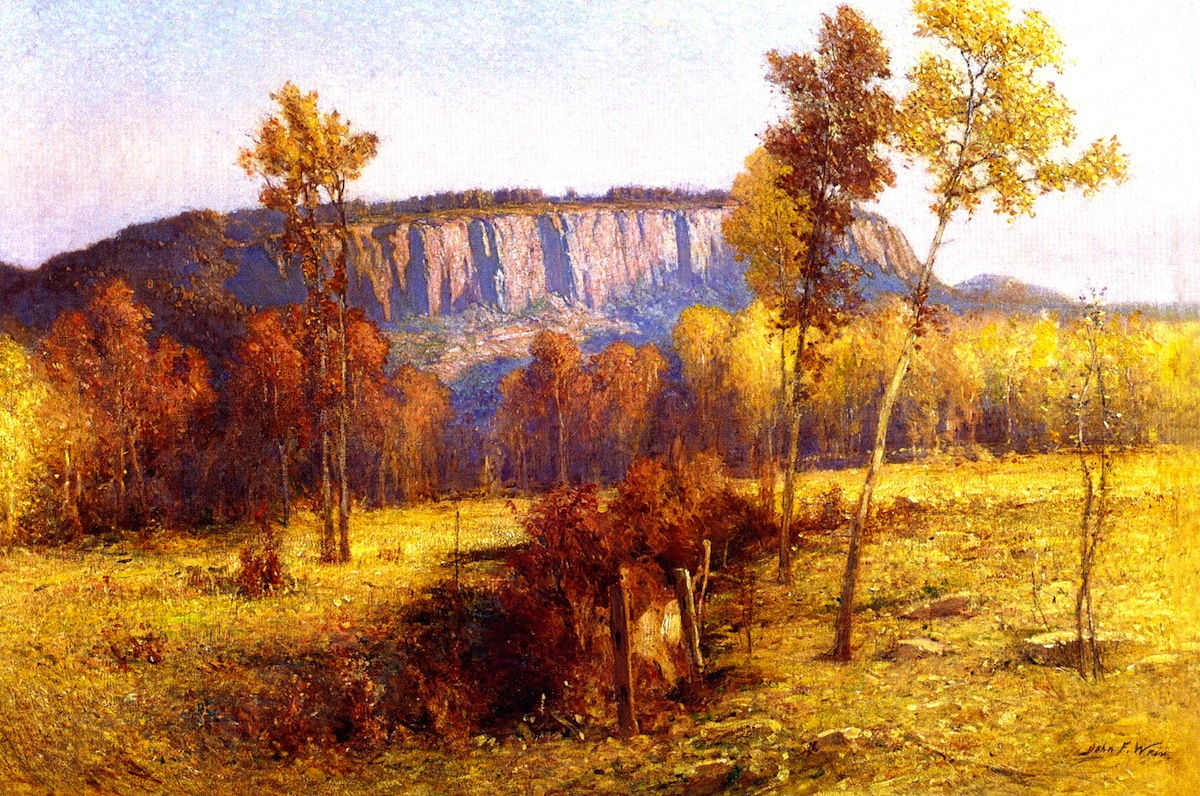
weirjfeastrocknewhaven
John Ferguson Weir (1841-1926), East Rock, New Haven (c 1901), oil on canvas, 77.5 × 113 cm, Florence Griswold Museum, Old Lyme, CT. Wikimedia Commons.

John Ferguson Weir’s vibrant painting of East Rock, New Haven from about 1901 shows the landscape not far from his home and his work as the founding Dean of the School of Fine Arts at Yale University, New Haven, Connecticut. He enlisted the help of his brother, the painter Julian Alden Weir, to model classes at Yale on the same lines as those of the École de Beaux-Arts in Paris.