


惯性聚合 高效追踪和阅读你感兴趣的博客、新闻、科技资讯
阅读原文 在惯性聚合中打开

推荐订阅源

T
Threatpost
The Hacker News
The Hacker News
AWS News Blog
AWS News Blog
Spread Privacy
Spread Privacy
T
Tenable Blog
C
CERT Recently Published Vulnerability Notes
Cisco Talos Blog
Cisco Talos Blog
Threat Intelligence Blog | Flashpoint
S
Securelist
P
Privacy & Cybersecurity Law Blog
Know Your Adversary
Know Your Adversary
T
The Exploit Database - CXSecurity.com
Latest news
Latest news
D
Darknet – Hacking Tools, Hacker News & Cyber Security
I
Intezer
F
Fortinet All Blogs
Engineering at Meta
Engineering at Meta
Simon Willison's Weblog
The Register - Security
CTFtime.org: upcoming CTF events
L
Lohrmann on Cybersecurity
C
Cyber Attacks, Cyber Crime and Cyber Security
Microsoft Azure Blog
P
Proofpoint News Feed
H
Help Net Security
T
Threat Research - Cisco Blogs
D
DataBreaches.Net
S
Schneier on Security
Cyberwarzone
Cyberwarzone
Google DeepMind News
P
Privacy International News Feed
S
Secure Thoughts
Cyber Security Advisories - MS-ISAC
Recorded Future
Recorded Future
C
Cybersecurity and Infrastructure Security Agency CISA
MyScale Blog
MyScale Blog
M
MIT News - Artificial intelligence
Stack Overflow Blog
Stack Overflow Blog
IT之家
IT之家
人人都是产品经理
人人都是产品经理
NISL@THU
NISL@THU
博客园 - Franky
T
Tor Project blog
G
GRAHAM CLULEY
博客园 - 【当耐特】
Jina AI
Jina AI
Security Archives - TechRepublic
K
KPMG report finds enterprise disconnect between AI and its ROI | CIO
A
About on SuperTechFans
Hacker News - Newest:
Hacker News - Newest: "LLM"

Comments for The Eclectic Light Company

Should you try Golden Gate beta? Solutions to Saturday Mac riddles 367 In the shadow: Diego Velázquez Comment on Last Week on My Mac: Freshen up your documents by David Comment on Happy 250th birthday America 2 by mac Happy 250th birthday America 1 Brushstrokes: Portraits 1760-1877 Spotlight and Core Spotlight are different Comment on Sort order, collation and the Finder by eyelessjerry Comment on Apple has just released macOS 26.5.2 Tahoe by Derek Currie Great Ladies of Impressionism: Marie Bracquemond Comment on Get more from your Mac’s log by extending its duration by John Gilbert Comment on Keep your Mac cool using physics by F Portraits of trees: Coppices and pollards Comment on Firmware has become complicated again by John Woods Comment on Logistician 1.2 fixes a couple of bugs by info395288a4d1d Comment on What does Activity Monitor measure? by hoakley Last Week on My Mac: Spotlight on semantics An American in Paris: paintings of Henry Ossawa Tanner 1902-1930 An American in Paris: paintings of Henry Ossawa Tanner 1880-1902 Great Ladies of Impressionism: Berthe Morisot 1874-1891 What to do with a hot Mac Deprecations and removals from Golden Gate Brushstrokes: From El Greco to Rembrandt Portraits of trees: Dutch Golden Age How to get the most from SilentKnight 3 Comment on Hero or hooligan: Achilles becomes the warrior by Deborah J. Brasket Solutions to Saturday Mac riddles 365 Comment on SilentKnight 3.0 for Apple silicon Macs running Sequoia and later (full release) by michaelriccioli Comment on Last Week on My Mac: Uncompressed compressed files by fds Comment on Explainer: Memory by jzonedotcom Comment on Colin Campbell Cooper painting America: 1896-1910 by House of Heart Brushstrokes: 16th century What can you do when an app uses too much memory? SilentKnight 3 second beta adds text and JSON reporting In the shadow: Caravaggism What to do with your encrypted HFS+ disks First beta-test version of SilentKnight 3 for Apple silicon Macs Hero or hooligan: Jason and Medea Comment on Fix documents that won’t open as expected using Quarant2 by EcleX Last Week on My Mac: The mystery of Safari’s Web Archives Last Week on My Mac: Why is it so hard to open a document? Explainer: Disk encryption In the shadow: Caravaggio Brushstrokes: innovators of the first century Changing Paintings: 36 Theseus and the Minotaur macOS virtualisation is leaping forward in Golden Gate Why can’t Preview open that PDF? Crossing the Golden Gate, Intel support, and an update to SystHist Reading the Finder’s Get Info dialog In memoriam Mary Cassatt: 2, 1880-81 Last Week on My Mac: What’s in a name? Explainer: Getting a location Get more from Get Info and the Finder’s contextual menu Stop your photos revealing your location Have you saved thousands of versions? Versatility 1.2 might be what you need Apple has released an update to XProtect for all macOS Apple has released macOS Tahoe 26.5.1 Comment on What Location Services do in macOS by Tristan Hubsch Comment on Protect files with the Locked or Immutable flag by markbot2zero Portraits of trees: Introduction Which tasks require mains power? Comment on Online reference to external displays for Apple silicon Macs by Brian What’s in that phishing email? How to search document versions Rubens’ Peace and War Comment on Last Week on My Mac: Syncing metadata in iCloud Drive by hoakley A weekend with Misia: 2 How to search Time Machine backups? Medium and message: Pottery Hero or hooligan: Theseus and the sandals How QuickLook provides thumbnails and previews Hunting extended attributes with an update to xattred Saturday Mac riddles 360 Comment on How to preserve versions, and how to create versioned PDFs by markbot2zero Comment on What gets synced in iCloud Drive? by hoakley Solutions to Saturday Mac riddles 359 Last Week on My Mac: snapshots, the elephant in APFS How to check whether Spotlight is getting the right metadata macOS Tahoe no longer fully supports Time Capsules macOS virtual machines and audio-video syncing Comment on Use Finder tags for categories by Chuck Last Week on My Mac: Dependency and skill fade Comment on Virtualisation on Apple silicon Macs is different by AndyS Painting Pandora and her box: 1883-1919 Mac Easter eggs Painting Spring blossom 2 Comment on The macOS Natural Language framework and Nalaprop by Ingo Comment on The MACL extended attribute by hoakley On Reflection: Cézanne Privacy: Which folders are protected in Tahoe? Last Week on My Mac: Root cause analysis and ClickFix Last Week on My Mac: Root cause analysis and ClickFix Last Week on My Mac: Root cause analysis and ClickFix Last Week on My Mac: Root cause analysis and ClickFix Why you can’t trust Privacy & Security How can I now have two apps named Pages? How to survive the loss of Rosetta Use Fallback Recovery on Apple silicon Macs Clean install macOS
The bicentenary of Frederic Edwin Church: 1857-77
frpsr · 2026-05-04 · via Comments for The Eclectic Light Company

Frederic Edwin Church (1826-1900), The Heart of the Andes (1859), oil on canvas, 168 x 302.9 cm, The Metropolitan Museum of Art, New York, NY. Wikimedia Commons.

Two centuries ago today, on 4 May 1826, Frederic Edwin Church was born in Hartford, CT. As one of the founding American masters, he has a pivotal place in the history of painting in North America, and is one of the great nineteenth century landscape painters. Inspired by Alexander von Humboldt’s account of central America, Church travelled to Colombia and Ecuador in 1853, and returned to depict their ‘physiognomy’ in grand landscape paintings. He went back to central America in 1857 to build on his earlier success.
churchcathedralchilloecuador
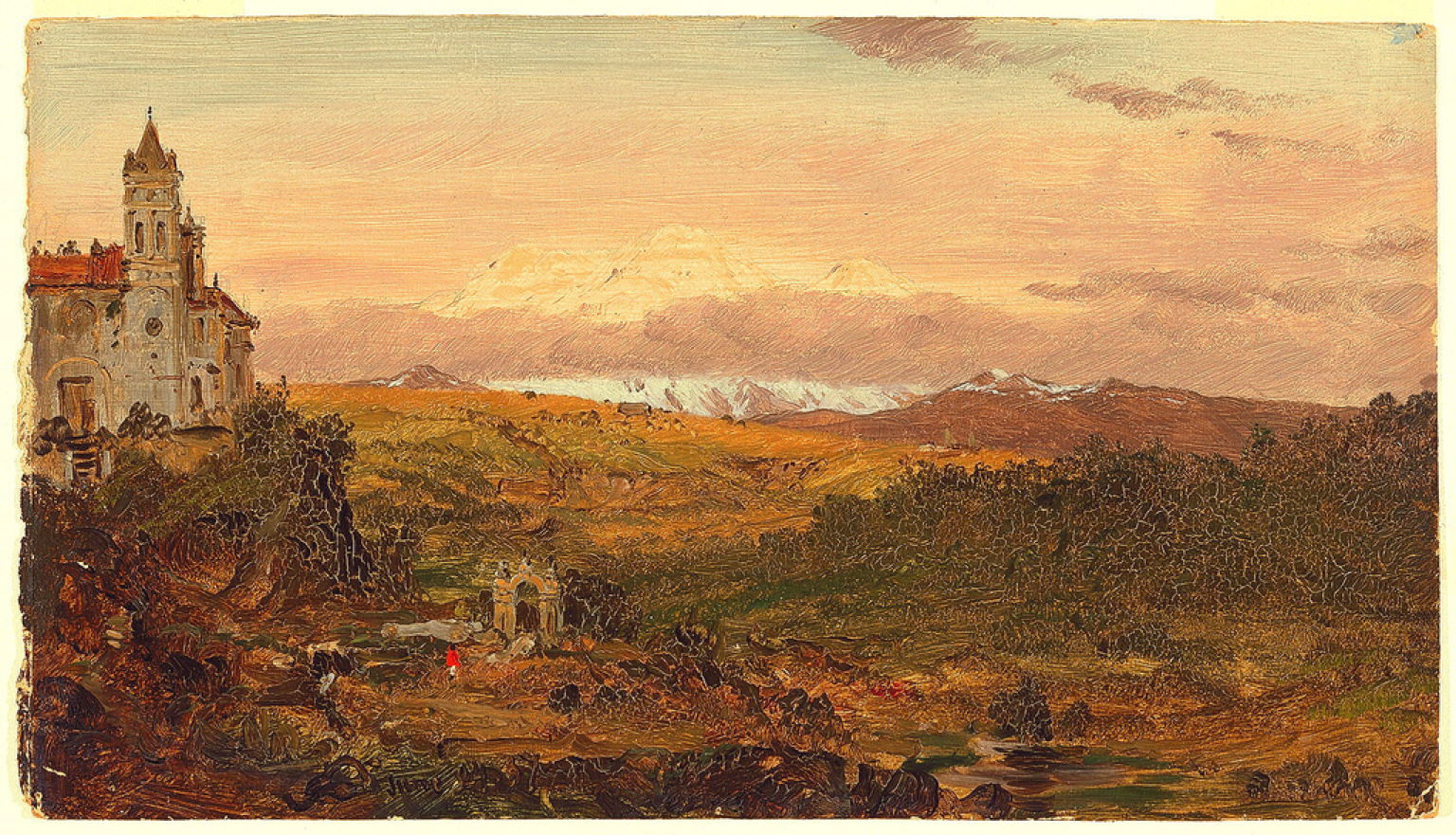
Frederic Edwin Church (1826–1900), Cathedral, Chillo, Ecuador (24 June 1857), brush and oil paint on cardboard, 16.7 x 29.2 cm, Cooper Hewitt, Smithsonian Design Museum, New York, NY. Wikimedia Commons.

Church painted this oil sketch of the cathedral in Chillo, Ecuador, on 24 June 1857. As with most of his oil sketches, it’s small and made on cardboard, which was cheap and portable but not intended to last the years.
1917-4-1296-a 001
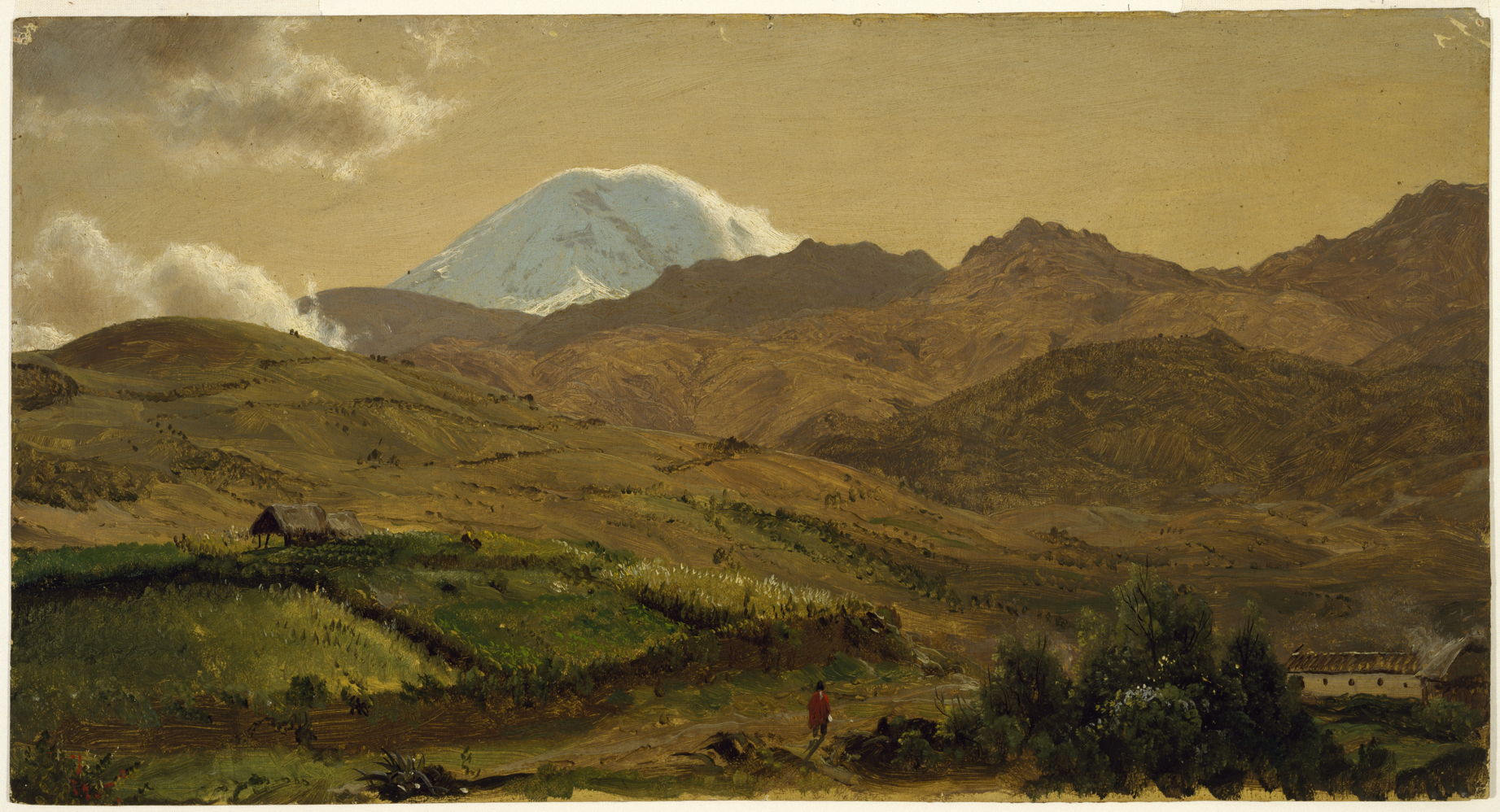
Frederic Edwin Church (1826–1900), Drawing, Mount Chimborazo, Ecuador (1857), brush and oil paint, traces of graphite on thin paperboard, 23 x 44.4 cm, Cooper Hewitt, Smithsonian Design Museum, New York, NY. Wikimedia Commons.

His larger oil sketch of Mount Chimborazo in Ecuador is rich in painstaking detail for a study never intended to be viewed by others. In comparison to his studio works, though, it’s full of fine gestural marks with some quite painterly passages.
churchmountainsmoonlight
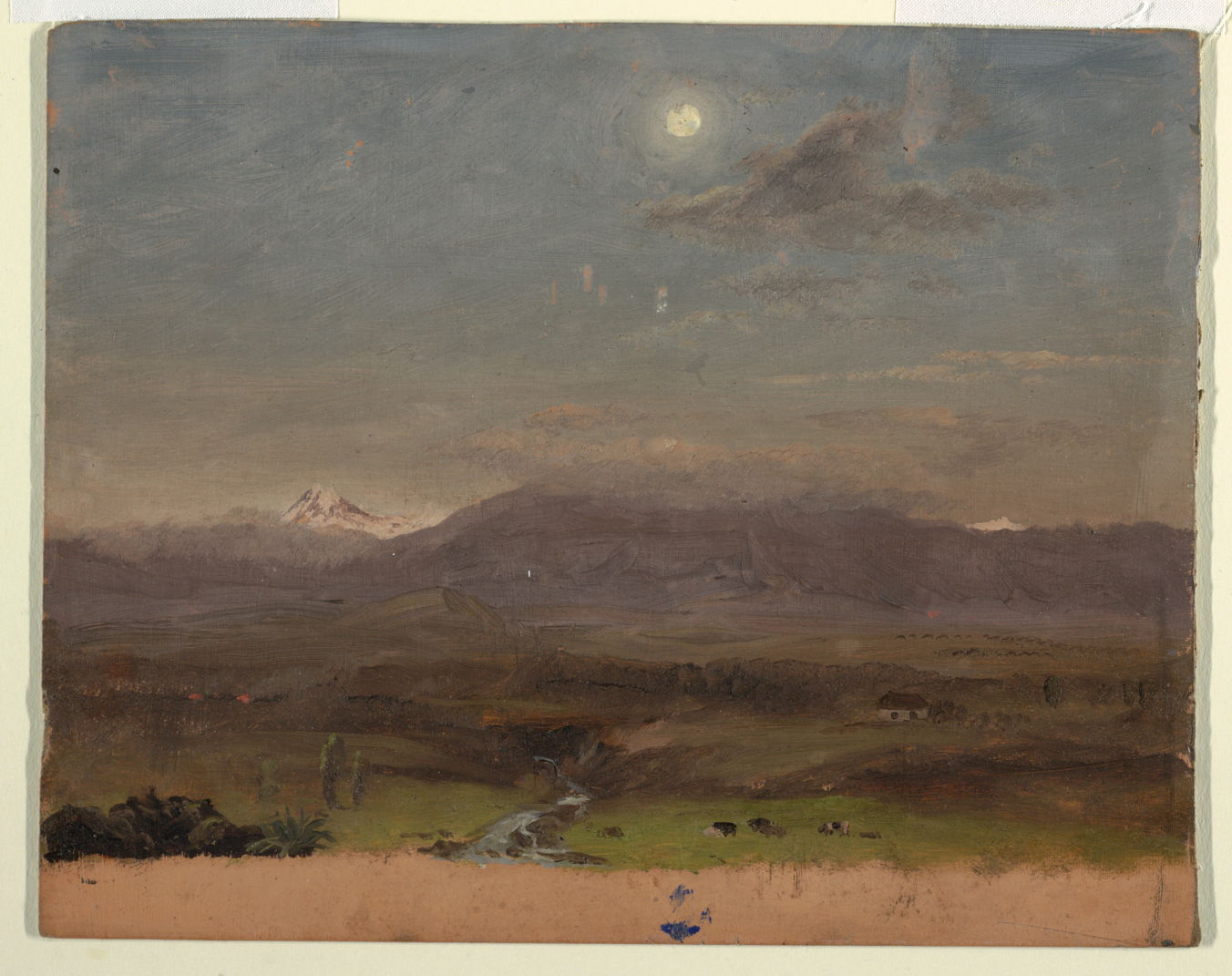
Frederic Edwin Church (1826–1900), Drawing, Colombia or Ecuador, mountains, moonlight (1853/1857), brush and oil, pencil on cardboard with gray-brown background, 22.7 x 28.4 cm, Cooper Hewitt, Smithsonian Design Museum, New York, NY. Wikimedia Commons.

He may have painted this atmospheric view of mountains in the moonlight during either of his visits to Colombia and Ecuador.

On 29 April 1859, the first of more than twelve thousand people walked into the Studio Building on West 10th Street in New York City, to stand in awe and amazement in front of Church’s huge Heart of the Andes (1859). For many, its dramatic view of a densely-vegetated plain with its backdrop of snow-capped mountains wasn’t its most impressive feature: it was the painting’s meticulous, almost overwhelming detail.
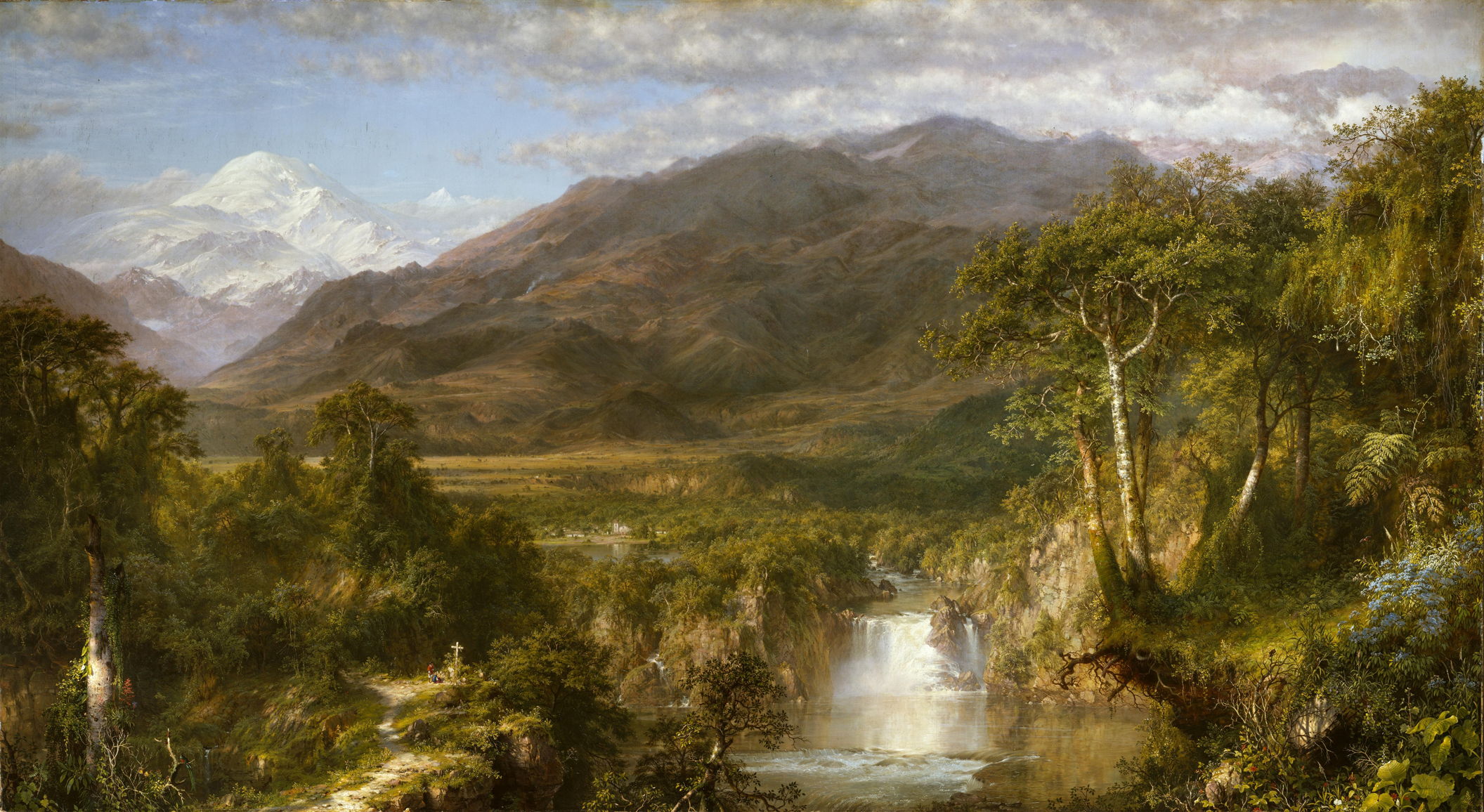
Frederic Edwin Church (1826-1900), The Heart of the Andes (1859), oil on canvas, 168 x 302.9 cm, The Metropolitan Museum of Art, New York, NY. Wikimedia Commons.

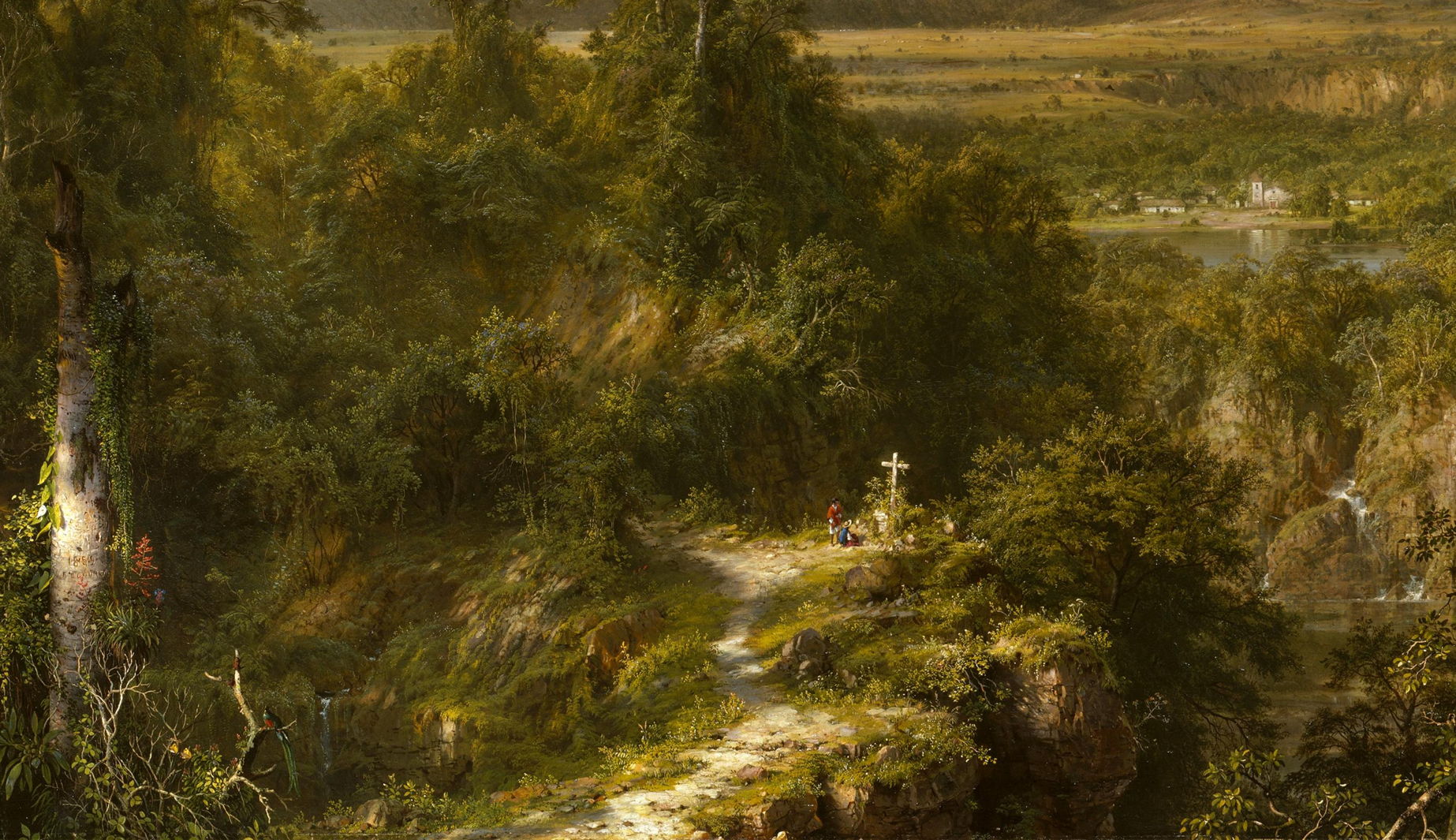
Tucked away among the brightly-coloured birds and rich plant life, at the very heart of The Heart of the Andes, is a cross, with two figures by it. Dressed as locals, one sits, facing the cross, while the other stands just behind the seated figure and looking in the same direction. The cross is made simply of wood, and appears to have been decorated with a floral garland. It’s partly obscured by the luxuriant wayside plants.

Frederic Edwin Church (1826-1900), The Heart of the Andes (detail) (1859), oil on canvas, 168 x 302.9 cm, The Metropolitan Museum of Art, New York, NY. Wikimedia Commons.

Over its five square metres of canvas, these are the only visible humans.
churchheartofandesd2
Frederic Edwin Church (1826-1900), The Heart of the Andes (detail) (1859), oil on canvas, 168 x 302.9 cm, The Metropolitan Museum of Art, New York, NY. Wikimedia Commons.

They’re part of a complex passage. The cross stands just off a path winding its way past a dead tree-trunk, seen at the left here, on which the artist has ‘carved’ the year and his name. The path then curves to the left, along the bottom of a small gully, where it disappears into the trees and undergrowth.

On the other side of the river, to the right, is a small mission-like settlement. Facing the viewer is the tower and broad frontage of a church, with its large double wooden doors. Beyond and around is the enormity of nature: open plain with scattered trees, then rising ground to the first hills, and many miles distant the soaring white peaks of the Andes proper.

Viewers were recommended to bring opera glasses in order to see these details through the crowd. Jennifer Raab argues this is a different way of seeing, as demanded by the painting, and it evoked literary responses from the likes of Mark Twain and critics.

Church was friends with Isaac Israel Hayes, a noted Arctic explorer, and once the artist had enjoyed the success of The Heart of the Andes he travelled with another friend, Louis Legrand Noble, to Newfoundland and Labrador to build himself a library of drawings and sketches for his next spectacular painting.
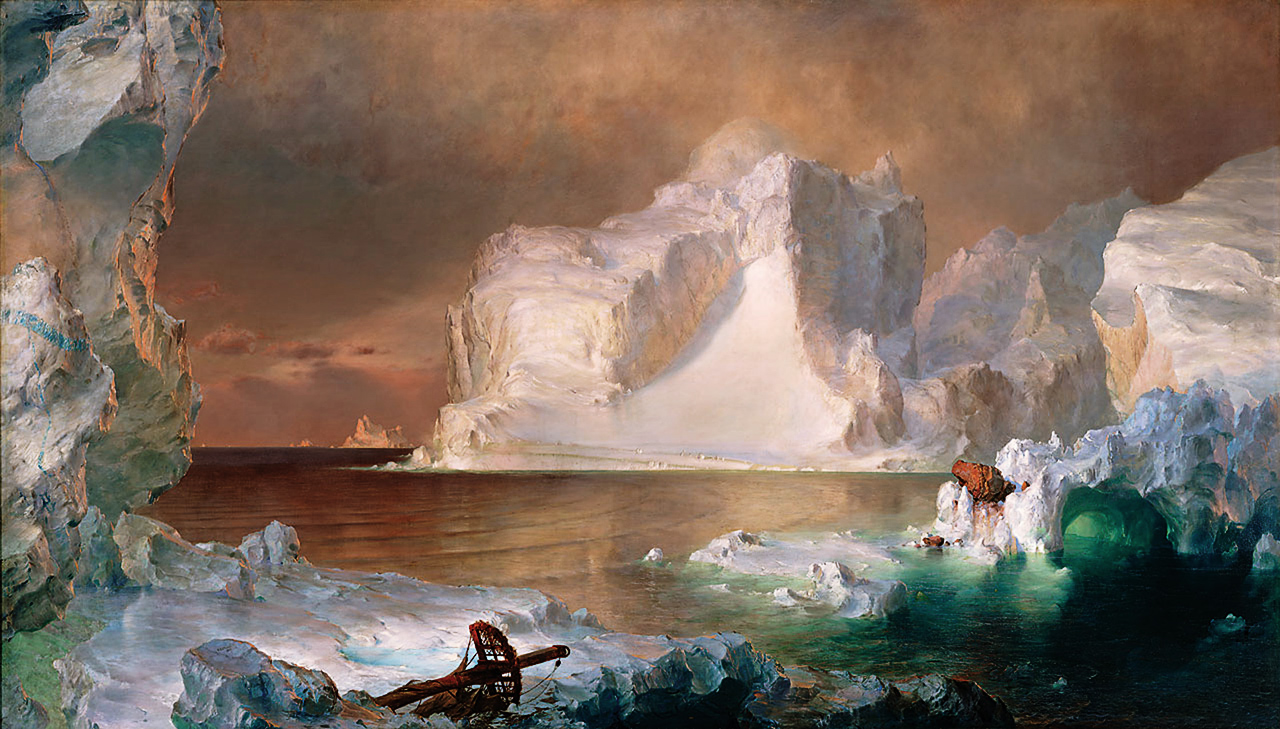
Frederic Edwin Church (1826-1900), The Icebergs (1861), oil on canvas, 163.8 x 285.8 cm, Dallas Museum of Art, Dallas, TX. Wikimedia Commons.

Church’s The Icebergs (1861) was ill-fated, though. Its solo exhibition opened just twelve days after the start of the Civil War. Then titled The North, it lacks the human glimpses and intricate details of nature that made The Heart of the Andes such a success. The broken mast now seen in the foreground was a later addition made by Church in an attempt to improve its popular appeal.
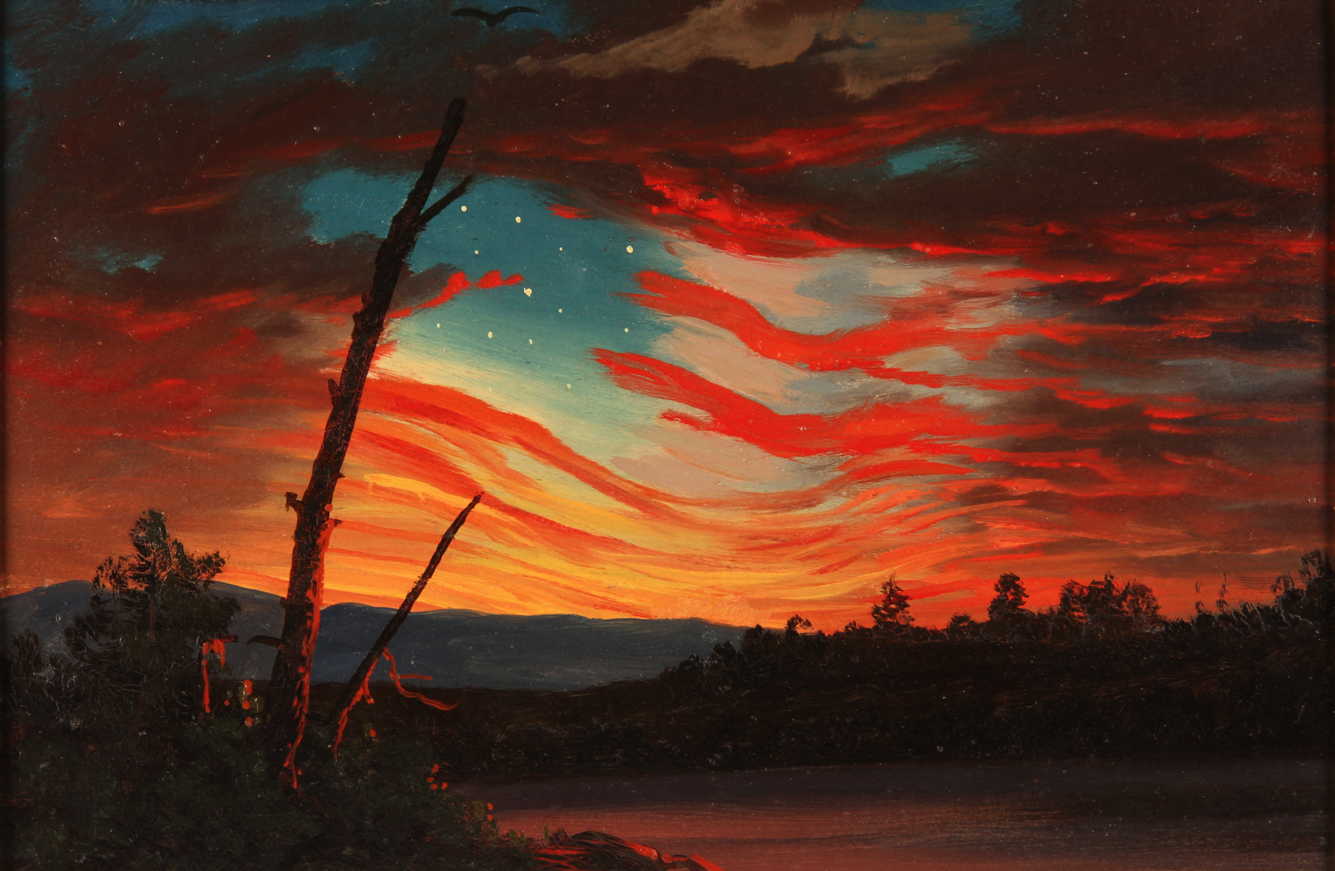
Frederic Edwin Church, Our Banner in the Sky (1861), oil on paper, 19.1 x 28.6 cm, Smithsonian Institute, Washington DC. Wikimedia Commons.

With the Civil War in progress, Church’s more successful response was Our Banner in the Sky (1861), which was turned into a lithograph, with prints being sold to benefit the families of Union soldiers.
churchrainyseasontropics
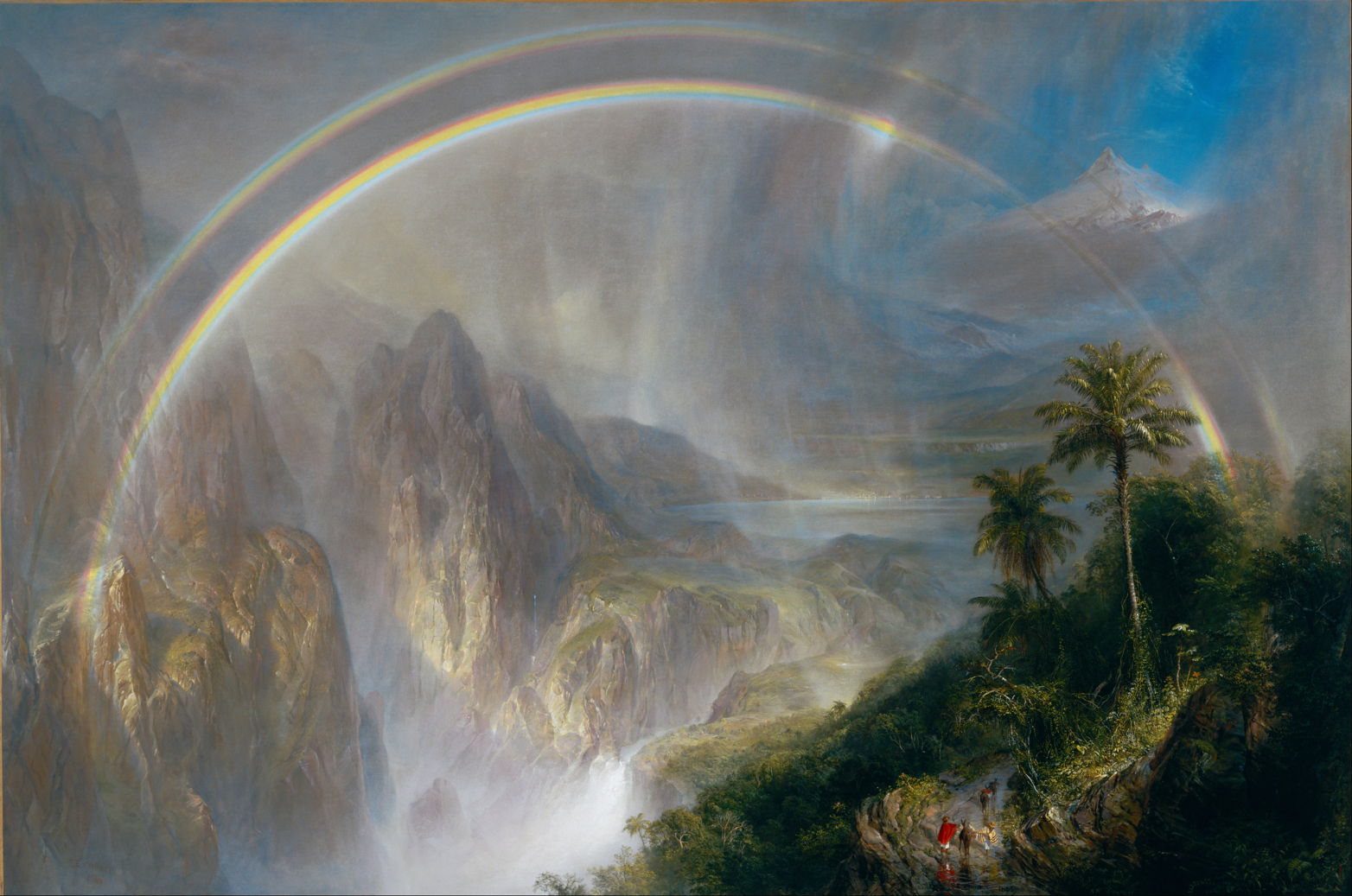
Frederic Edwin Church (1826–1900), Rainy Season in the Tropics (1866), oil on canvas, 142.9 x 214 cm, Fine Arts Museums of San Francisco, San Francisco, CA. Wikimedia Commons.

Church continued to paint finished works based on his earlier studies in front of the motif. Rainy Season in the Tropics from 1866 features a faithful depiction of a double rainbow, and again added human interest. Splashing through a rocky stream is a small train of pack animals with two drivers, who have paused for a moment to adjust a load, as shown in the detail below.
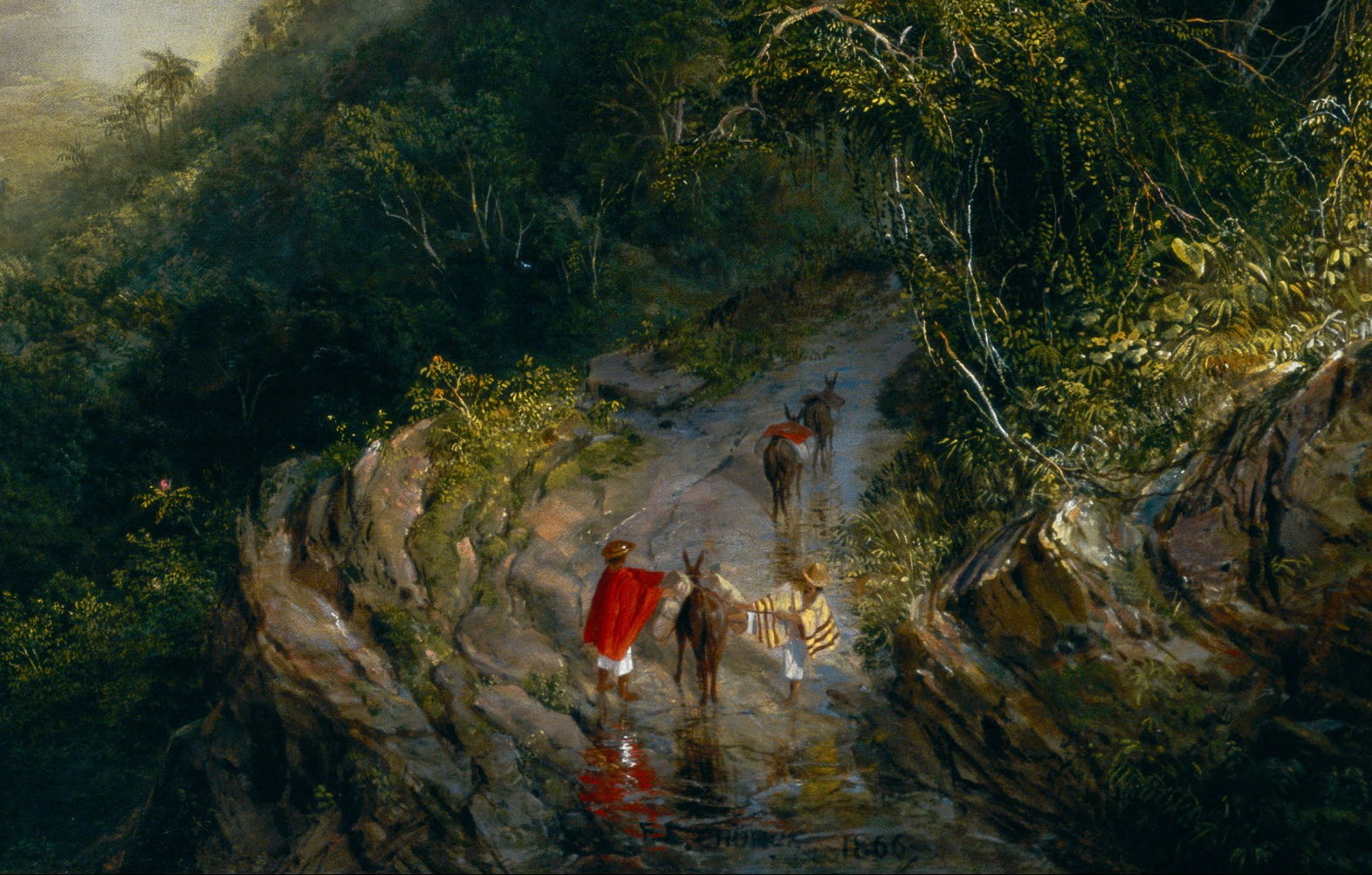
churchrainyseasontropicsd1
Frederic Edwin Church (1826–1900), Rainy Season in the Tropics (detail) (1866), oil on canvas, 142.9 x 214 cm, Fine Arts Museums of San Francisco, San Francisco, CA. Wikimedia Commons.
churchpichincha
Frederic Edwin Church (1826–1900), Pichincha (1867), oil on canvas, 78.8 x 122.5 cm,, Philadelphia Museum of Art, Philadelphia, PA. Wikimedia Commons.

Spanning much of the foreground of Church’s Pichincha (1867) is a suspended bridge, one end glowing in the early morning light. Just over half way across, a woman wearing a brilliant red blouse is riding side-saddle on a mule, which is picking its way slowly across the thin logs forming the walkway. At the left end is another mounted figure, who has just completed that terrifying crossing.

churchpichinchad1
Frederic Edwin Church (1826–1900), Pichincha (detail) (1867), oil on canvas, 78.8 x 122.5 cm,, Philadelphia Museum of Art, Philadelphia, PA. Wikimedia Commons.

Late that year, Church and his family set off on his longest journey, although much of it was undertaken in less arduous conditions than he had experienced in Ecuador. They travelled to Europe, then on to Egypt, Jaffa and to stay in Beirut. In February 1868, Church visited Jerusalem and from there travelled to the city of Petra by camel. In the Spring they returned across the Aegean Sea, and spent the remainder of the year in Rome. They finally returned across the Atlantic in June 1869.

Frederic Edwin Church, Jerusalem from the Mount of Olives (1870), oil on canvas, 138 x 214.3 cm, Nelson-Atkins Museum of Art, Kansas City, MO. Wikimedia Commons.

In Church’s studio painting of Jerusalem from the Mount of Olives (1870), the Holy City is reminiscent of John Brett’s Florence from Bellosguardo (1863) in its projection and detail. But Church’s lower vantage point allowed him ample foreground, where there are four people and two camels making their way along the dry, stony track skirting the ancient olive trees and crossing the valley to the city. Although not as brightly lit by the late afternoon sun as the Dome of the Rock in the distance, Church draws attention to the figures in the foreground by silhouetting them against the light on the track.

Church provided a detailed key to the salient features, which was engraved and printed for the edification of the viewer. It was hailed a triumph when first displayed to the public in Goupil’s New York gallery in 1871, and at the end of the century Peter Bergheim made a photo-montage showing the same view.
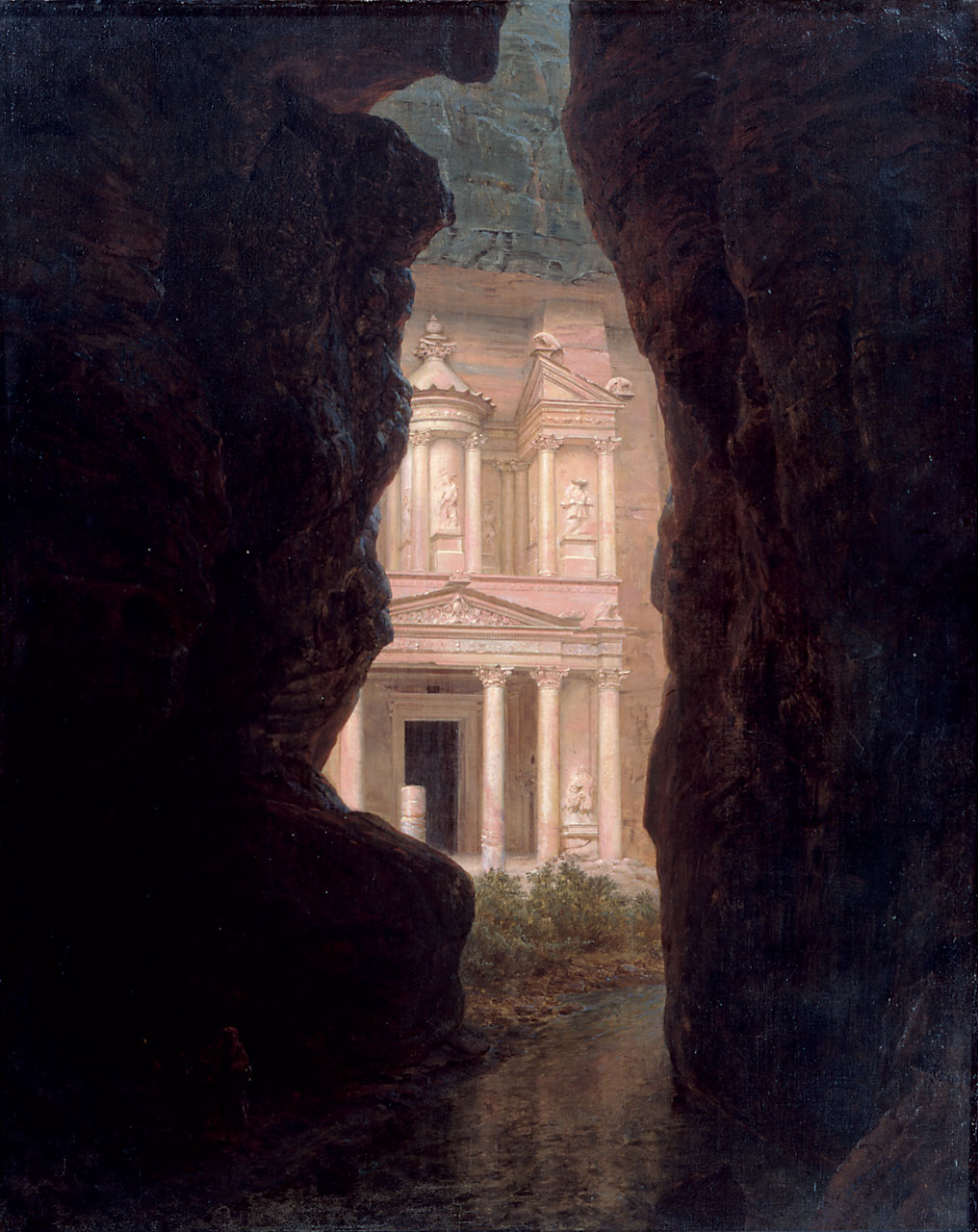
Frederic Edwin Church (1826-1900), El Khasné, Petra (1874), oil on canvas, 153.7 x 127.6 cm, Olana State Historic Site, Hudson, NY. Courtesy of Olana State Historic Site, New York State Office of Parks, Recreation, and Historic Preservation, via Wikimedia Commons.

Church’s most famous studio painting of Petra, El Khasné, Petra from 1874, is an oddity in showing an unusual view lacking sky, and frames its strongly vertical format. It’s also short on detail, and what can be discerned from the murky depths of its framing appears mysterious and unresolved.

This painting was featured as the centrepiece of the Church family sitting room in his self-designed estate at Olana. He had started work on the design of his mansion there in 1870, engaging Calvert Vaux, co-designer of New York’s Central Park, to assist. They assembled a pastiche of forms and styles into what Church termed a “Feudal Castle”.
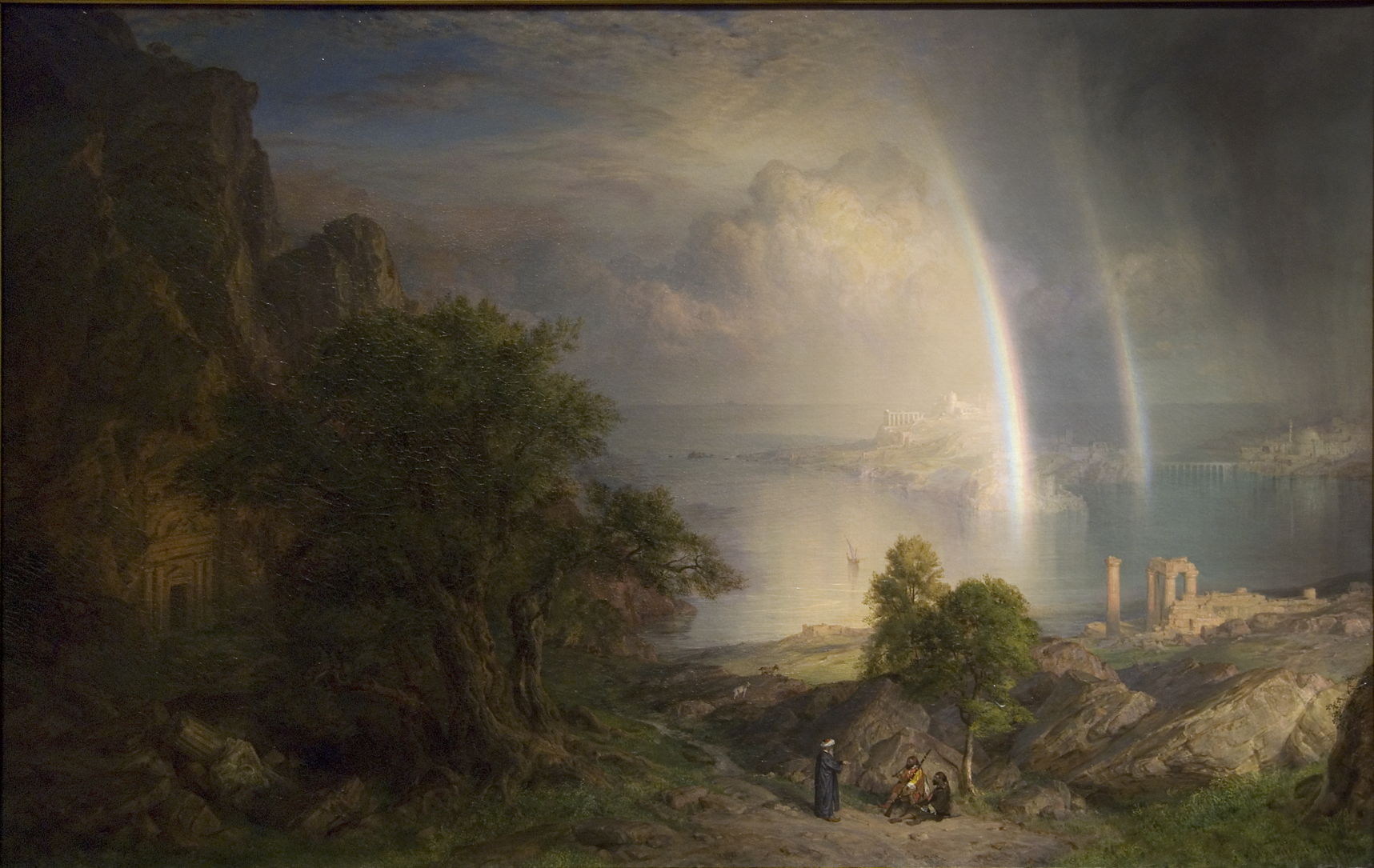
churchaegeansea
Frederic Edwin Church (1826–1900), The Aegean Sea (c 1877), oil on canvas, 137.2 x 160.7 cm, The Metropolitan Museum of Art, New York, NY. Wikimedia Commons.

By 1876, Church was finding painting increasingly difficult due to his advancing rheumatoid arthritis. This late studio work showing The Aegean Sea was completed in about 1877, following which he became almost unable to paint. He wintered in Mexico to alleviate his problems, and died in 1900, at the age of 73. By that time, Church’s finely detailed realist paintings had become reviled, and it wasn’t until the 1960s before his art was taken seriously again.

You can see more about exhibitions and publications to celebrate Church’s bicentenary on Olana’s site.

Reference

Raab, Jennifer (2015) Frederic Church, The Art and Science of Detail, Yale UP. ISBN 978 0 300 20837 5.