




惯性聚合 高效追踪和阅读你感兴趣的博客、新闻、科技资讯
阅读原文 在惯性聚合中打开

推荐订阅源

云风的 BLOG
云风的 BLOG
Security Archives - TechRepublic
V
Vulnerabilities – Threatpost
C
CXSECURITY Database RSS Feed - CXSecurity.com
P
Proofpoint News Feed
G
GRAHAM CLULEY
P
Privacy International News Feed
The Hacker News
The Hacker News
Forbes - Security
Forbes - Security
U
Unit 42
N
News and Events Feed by Topic
D
Darknet – Hacking Tools, Hacker News & Cyber Security
C
Cyber Attacks, Cyber Crime and Cyber Security
C
Cisco Blogs
A
About on SuperTechFans
cs.CV updates on arXiv.org
D
Docker
I
Intezer
Spread Privacy
Spread Privacy
The Last Watchdog
The Last Watchdog
V2EX - 技术
V2EX - 技术
S
Security @ Cisco Blogs
F
Full Disclosure
S
Secure Thoughts
M
MIT News - Artificial intelligence
Microsoft Security Blog
G
Google Developers Blog
aimingoo的专栏
aimingoo的专栏
W
WeLiveSecurity
cs.CL updates on arXiv.org
Project Zero
Project Zero
Recorded Future
Recorded Future
Cyberwarzone
Cyberwarzone
S
Security Affairs
AWS News Blog
AWS News Blog
H
Help Net Security
The GitHub Blog
The GitHub Blog
Hacker News: Ask HN
Hacker News: Ask HN
Vercel News
Vercel News
P
Proofpoint News Feed
Cyber Security Advisories - MS-ISAC
The Register - Security
S
Schneier on Security
F
Fortinet All Blogs
C
CERT Recently Published Vulnerability Notes
L
LINUX DO - 最新话题
T
Tor Project blog
T
The Exploit Database - CXSecurity.com
MongoDB | Blog
MongoDB | Blog
Webroot Blog
Webroot Blog

Comments for The Eclectic Light Company

Should you try Golden Gate beta? Solutions to Saturday Mac riddles 367 In the shadow: Diego Velázquez Comment on Last Week on My Mac: Freshen up your documents by David Comment on Happy 250th birthday America 2 by mac Happy 250th birthday America 1 Brushstrokes: Portraits 1760-1877 Spotlight and Core Spotlight are different Comment on Sort order, collation and the Finder by eyelessjerry Comment on Apple has just released macOS 26.5.2 Tahoe by Derek Currie Great Ladies of Impressionism: Marie Bracquemond Comment on Get more from your Mac’s log by extending its duration by John Gilbert Comment on Keep your Mac cool using physics by F Portraits of trees: Coppices and pollards Comment on Firmware has become complicated again by John Woods Comment on Logistician 1.2 fixes a couple of bugs by info395288a4d1d Comment on What does Activity Monitor measure? by hoakley Last Week on My Mac: Spotlight on semantics An American in Paris: paintings of Henry Ossawa Tanner 1902-1930 An American in Paris: paintings of Henry Ossawa Tanner 1880-1902 Great Ladies of Impressionism: Berthe Morisot 1874-1891 What to do with a hot Mac Deprecations and removals from Golden Gate Brushstrokes: From El Greco to Rembrandt How to get the most from SilentKnight 3 Comment on Hero or hooligan: Achilles becomes the warrior by Deborah J. Brasket Solutions to Saturday Mac riddles 365 Comment on SilentKnight 3.0 for Apple silicon Macs running Sequoia and later (full release) by michaelriccioli Comment on Last Week on My Mac: Uncompressed compressed files by fds Comment on Explainer: Memory by jzonedotcom Comment on Colin Campbell Cooper painting America: 1896-1910 by House of Heart Brushstrokes: 16th century What can you do when an app uses too much memory? SilentKnight 3 second beta adds text and JSON reporting In the shadow: Caravaggism What to do with your encrypted HFS+ disks First beta-test version of SilentKnight 3 for Apple silicon Macs Hero or hooligan: Jason and Medea Comment on Fix documents that won’t open as expected using Quarant2 by EcleX Last Week on My Mac: The mystery of Safari’s Web Archives Last Week on My Mac: Why is it so hard to open a document? Explainer: Disk encryption In the shadow: Caravaggio Brushstrokes: innovators of the first century Changing Paintings: 36 Theseus and the Minotaur macOS virtualisation is leaping forward in Golden Gate Why can’t Preview open that PDF? Crossing the Golden Gate, Intel support, and an update to SystHist Reading the Finder’s Get Info dialog In memoriam Mary Cassatt: 2, 1880-81 Last Week on My Mac: What’s in a name? Explainer: Getting a location Get more from Get Info and the Finder’s contextual menu Stop your photos revealing your location Have you saved thousands of versions? Versatility 1.2 might be what you need Apple has released an update to XProtect for all macOS Apple has released macOS Tahoe 26.5.1 Comment on What Location Services do in macOS by Tristan Hubsch Comment on Protect files with the Locked or Immutable flag by markbot2zero Portraits of trees: Introduction Which tasks require mains power? Comment on Online reference to external displays for Apple silicon Macs by Brian What’s in that phishing email? How to search document versions Rubens’ Peace and War Comment on Last Week on My Mac: Syncing metadata in iCloud Drive by hoakley A weekend with Misia: 2 How to search Time Machine backups? Medium and message: Pottery Hero or hooligan: Theseus and the sandals How QuickLook provides thumbnails and previews Hunting extended attributes with an update to xattred Saturday Mac riddles 360 Comment on How to preserve versions, and how to create versioned PDFs by markbot2zero Comment on What gets synced in iCloud Drive? by hoakley Solutions to Saturday Mac riddles 359 Last Week on My Mac: snapshots, the elephant in APFS How to check whether Spotlight is getting the right metadata macOS Tahoe no longer fully supports Time Capsules The bicentenary of Frederic Edwin Church: 1857-77 macOS virtual machines and audio-video syncing Comment on Use Finder tags for categories by Chuck Last Week on My Mac: Dependency and skill fade Comment on Virtualisation on Apple silicon Macs is different by AndyS Painting Pandora and her box: 1883-1919 Mac Easter eggs Painting Spring blossom 2 Comment on The macOS Natural Language framework and Nalaprop by Ingo Comment on The MACL extended attribute by hoakley On Reflection: Cézanne Privacy: Which folders are protected in Tahoe? Last Week on My Mac: Root cause analysis and ClickFix Last Week on My Mac: Root cause analysis and ClickFix Last Week on My Mac: Root cause analysis and ClickFix Last Week on My Mac: Root cause analysis and ClickFix Why you can’t trust Privacy & Security How can I now have two apps named Pages? How to survive the loss of Rosetta Use Fallback Recovery on Apple silicon Macs Clean install macOS
Portraits of trees: Dutch Golden Age
hoakley · 2026-06-25 · via Comments for The Eclectic Light Company

Jacob Isaakszoon van Ruisdael (1628/9–1682), A Marsh in a Forest at Dusk (c 1660), oil on canvas, 77.7 x 92.2 cm, Bilbao Fine Arts Museum, Bilbao. Wikimedia Commons.

As Poussin’s pioneering career as a landscape painter was drawing to a close, landscapes were becoming one of the most popular genres in the Dutch Golden Age. While many of those Dutch artists were producing fine depictions of trees, one of the best, and certainly the most influential on subsequent landscape artists including Gainsborough, Constable, JMW Turner and Vincent van Gogh, was Jacob van Ruisdael.

Jacob Isaackszoon van Ruisdael (1628/9-1682) was born in Haarlem, in the northern Netherlands, into a family of painters. Presumably apprenticed within the family workshop, he was admitted to the local Guild of Saint Luke in 1648, recognition of his status as a professional painter in his own right. From the outset he appears to have specialised in landscape painting.

He moved to Amsterdam in 1657, to take advantage of its growing prosperity. He appears to have travelled little, remaining within the European lowlands and venturing just over the border into Germany. His only known student was Meindert Hobbema, who became an accomplished landscape painter who also depicted trees as important elements within his works.

Following the collapse of the Dutch economy in 1672, van Ruisdael appears to have remained relatively prosperous, and continued to work in Amsterdam until his death in 1682.

vanruisdaellandscapechurch
Jacob Isaakszoon van Ruisdael (1628/9–1682), Landscape with a Church (c 1645), oil on panel, 43.7 x 53.9 cm, Dulwich Picture Gallery, London. Wikimedia Commons.

From the outset, van Ruisdael’s landscapes contained trees, as they would at a time when trees and woods were more extensive in their cover across the whole of Europe. The view in Landscape with a Church (c 1645) is familiar, as its composition was used by Gainsborough, Constable, and other later artists. Prominent at the left, and forming repoussoir, is the hulk of an old tree, younger branches sprouting from the remains: a recurrent theme in Gainsborough as well as van Ruisdael. A recession in depth on the right leads to the brighter-lit church in the middle distance.

The trees here are painstakingly constructed from the anatomy of their branches, with leaves painted individually in the foreground, but delicately en masse in the further distance. Bark colour, texture, and rich lichen growth are also shown in detail.

vanruisdaelroadthroughoakforest
Jacob Isaakszoon van Ruisdael (1628/9–1682), Road through an Oak Forest (c 1646-7), oil on canvas, 65 x 85 cm, Statens Museum for Kunst, København, Denmark. Wikimedia Commons.

Van Ruisdael demonstrates a deep understanding of the stages in the life and looks of oak trees. In Road through an Oak Forest (c 1646-7) he captures the later life of a stag-headed oak, which long ago lost its crown, on the left, a flush of new growth on a fallen trunk, and another still clinging onto life despite a great split at its base. Judging from the girth of their trunks, the oak trees shown here are around 400 years old, making it likely they were saplings in the thirteenth century, possibly even earlier, making them a window in time to the end of the Middle Ages.

vanruisdaellandscapestonebridge
Jacob Isaakszoon van Ruisdael (1628/9–1682), Landscape with a Stone Bridge (c 1647), black chalk and grey wash on paper, 16 x 20 cm, Hermitage Museum, Sanit Petersburg. Wikimedia Commons.

Some of van Ruisdael’s sketches and drawings have also survived, among them Landscape with a Stone Bridge (c 1647). This shows clearly his development of foliage from branch structure, and the fact that he did not block in that foliage, preferring gestural squiggles and other marks.

vanruisdaewoodedlandscapepond
Jacob Isaakszoon van Ruisdael (1628/9–1682), A Wooded Landscape with a Pond (c 1648), oil on panel, 34.8 x 46 cm, Museum of Fine Arts, Houston, TX. Wikimedia Commons.

Van Ruisdael was an accurate observer of the different species of tree and their forms, as shown in his timeless A Wooded Landscape with a Pond (c 1648). He has maintained careful, anatomical construction even in the prominent tree at the centre right, in the middle distance, and the canopies appear light and leafy.

vanruisdaellandscapemill-runruins
Jacob Isaakszoon van Ruisdael (1628/9–1682), Landscape with a Mill-run and Ruins (c 1653), oil on canvas, 59.3 x 66.1 cm, Art Gallery of South Australia, Adelaide. Wikimedia Commons.

Gentle rural decay is shown not only in the ruined buildings in Landscape with a Mill-run and Ruins (c 1653), but also in the stag-head tree in the centre of the painting.

vanruisdaelgreatforest
Jacob Isaakszoon van Ruisdael (1628/9–1682), The Great Forest (c 1655-60), oil on canvas, 139 x 180 cm, Kunsthistorisches Museum, Vienna. Wikimedia Commons.

Probably painted soon after he had moved to Amsterdam, The Great Forest (c 1655-60) shows travellers along a track passing at the edge of an ancient woodland, with an assortment of trees in various states of advanced age, including some reduced to stag-heads.

vanruisdaelforeststream
Jacob Isaakszoon van Ruisdael (1628/9–1682), The Forest Stream (c 1660), oil on canvas, 99.7 x 129.2 cm, Metropolitan Museum of Art, New York, NY. Wikimedia Commons.

The upland landscape shown in The Forest Stream (c 1660) was clearly not one that van Ruisdael had ever seen, but must have been composed from studying the paintings of others, and talking to those more widely travelled. His trees remain much as before, with a gnarled and twisted stag-head at the right, and at the left a near-dead trunk poised in slow-motion collapse into the stream.

vanruisdaelmarshforestdusk
Jacob Isaakszoon van Ruisdael (1628/9–1682), A Marsh in a Forest at Dusk (c 1660), oil on canvas, 77.7 x 92.2 cm, Bilbao Fine Arts Museum, Bilbao. Wikimedia Commons.

Although most of van Ruisdael’s paintings are in full daylight, as with his contemporaries he also explored more transient light effects, in A Marsh in a Forest at Dusk (c 1660). Now the ancient trees launching themselves out from the bank at the right have engaged with those growing in the marsh. The effect of the late dusk light on their canopies is spectacular, as are the thin banks of cloud above, lit by the setting sun. His careful leaf-by-leaf depiction of canopies of different tree species results in distinct textures.

vanruisdaelandscapewaterfall
Jacob Isaakszoon van Ruisdael (1628/9–1682), Landscape with Waterfall (c 1660-70), oil on canvas, 142.5 x 196 cm, Rijksmuseum, Amsterdam. Wikimedia Commons.

In Landscape with Waterfall (c 1660-70), van Ruisdael revisited the distant church framed by nearer trees theme of Landscape with a Church (c 1645) above. Perhaps this time the church is a little too far away, though still an inspiration to Constable and Gainsborough later. At the right a birch collapses off the edge, and there is a pair of ancient wizened oaks filling the centre.

vanruisdaeoakslakewaterlilies
Jacob Isaakszoon van Ruisdael (1628/9–1682), Oaks at a Lake with Water Lilies (c 1665), oil on canvas, 116.6 x 142.2 cm, Gemäldegalerie, Berlin. Wikimedia Commons.

He continued to develop the theme of old oaks and water in Oaks at a Lake with Water Lilies (c 1665). Again a dying ancient hulk stands like a prow from the bank at the left, and he shows bright flowers on the water-lilies.

vanruysdaelroadoakwood
Jacob Isaakszoon van Ruisdael (1628/9–1682), A Road through an Oak Wood (date unknown), oil on canvas, 102.5 x 127 cm, National Museum of Western Art, Tokyo. Wikimedia Commons.

Many of van Ruisdael’s woods are either unpopulated, or the few people providing staffage are barely visible against their surroundings. His undated A Road through an Oak Wood is different, with a couple of travellers on its road, and woodland activities in the form of clearing and burning at the left. The Golden Age was primarily based on prosperity from trade, not home production, but increasing demand from the affluent cities led to greater timber production for ships and buildings, and for the clearing of woods to augment farmland.

vanruisdaelwinterlandscape
Jacob Isaakszoon van Ruisdael (1628/9–1682), Winter Landscape (c 1660-70), oil on canvas, 37.3 x 32.5 cm, Royal Picture Gallery Mauritshuis, Amsterdam. Wikimedia Commons.

Van Ruisdael also painted some distinctly winter scenes, including at least two landscapes featuring trees. Both are now known by the same name, and are believed to be from the same decade. This Winter Landscape (c 1660-70), in the Mauritshuis, picks out frosted leaves in the half-light of dusk or dawn, by a hamlet at the water’s edge. In the far distance, to the left of the buildings, there is a church with a spire.

vanruisdaelwinterlandscape2
Jacob Isaakszoon van Ruisdael (1628/9–1682), Winter Landscape (c 1660-70), oil on canvas, 36.5 x 32.4 cm, Birmingham Museum of Art, Birmingham, AL. Photo by Sean Pathasema, via Wikimedia Commons.

The other version of Winter Landscape (c 1660-70) is in Birmingham, Alabama. With very similar sky, cloud, lighting, and composition, the water here appears to have frozen over. The frost on the trees is just as delicately handled.

varuisdaelthreegreattreesmountainouslandscape
Jacob Isaakszoon van Ruisdael (1628/9–1682), Three Great Trees in a Mountainous Landscape with a River (c 1665-70), oil on canvas, 138.1 x 173.1 cm, The Norton Simon Museum, Pasadena, CA. Wikimedia Commons.

Three Great Trees in a Mountainous Landscape with a River (c 1665-70) is perhaps his most detailed essay on the effects of advanced age on trees. Although the mountains are borrowed or imaginary, the three trees of the title seem almost impossibly intertwined. The nearest is struggling to survive, some remains of its former glory resting, limbs in the air, at its foot.

Other artists of the Dutch Golden Age painted perceptive portraits of trees, among them the short-lived animal artist Paulus Potter.

potterorpheusanimals
Paulus Potter (1625–1654), Orpheus and Animals (1650), oil on canvas, 67 x 89 cm, Rijksmuseum, Amsterdam. Wikimedia Commons.

Orpheus and Animals (1650) is one of Potter’s most unusual paintings with its wide range of different animal species. It’s also remarkable for the distinctive types of tree, and the lichen-encrusted and scarred trunk in the right foreground.
pottercowsgrazingfarm
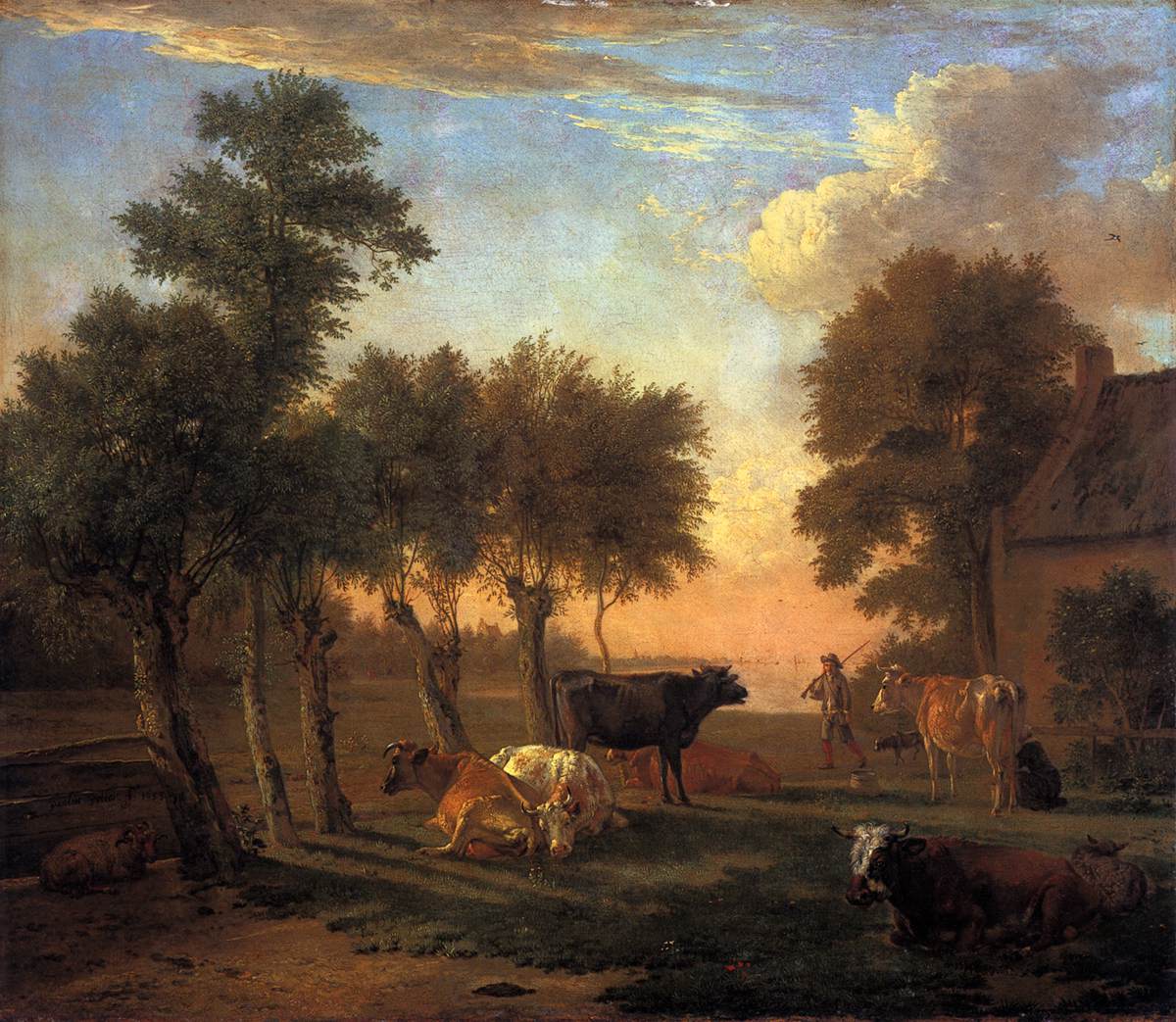
Paulus Potter (1625–1654), Cows Grazing at a Farm (1653), oil on canvas, 58 x 66.5 cm, Rijksmuseum, Amsterdam. Wikimedia Commons.

Cows Grazing at a Farm (1653) was one of Potter’s last paintings, and shows an avenue of pollarded trees, cut at a height of about three metres (ten feet) from the ground. Again those trunks are rich in surface details.
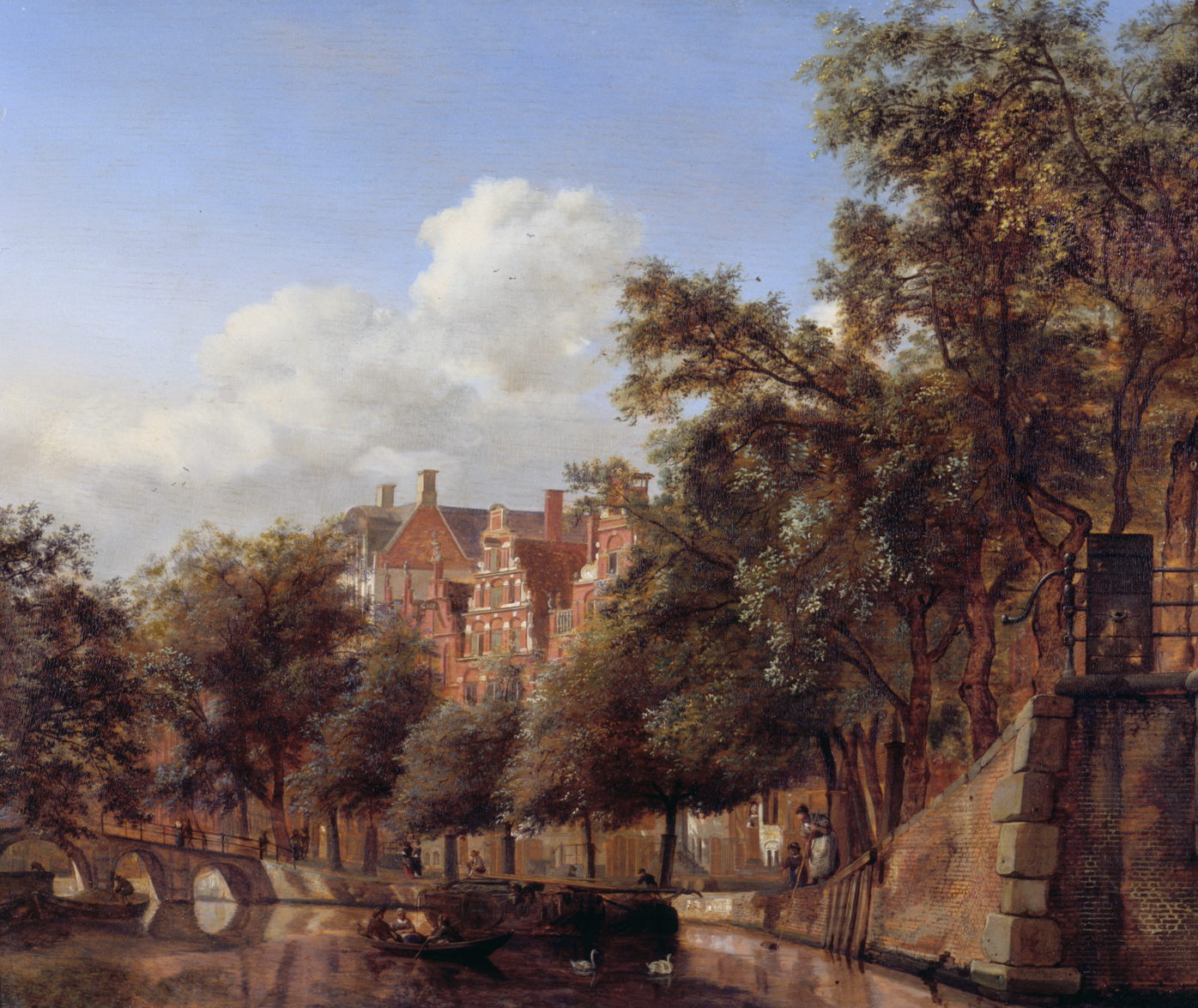
Jan van der Heyden (1637–1712), View of the Herengracht, Amsterdam (c 1670), oil on canvas, 33.5 x 39.7 cm, Private collection. Wikimedia Commons.

Even in the towns and cities there were trees to be painted. Jan van der Heyden’s View of the Herengracht, Amsterdam from about 1670 shows this canal that has become famous for its large and elegant houses. These were built from 1612, and are finest along this section known as the Golden Bend, where they have the company of an avenue of trees.

References
Wikipedia
Slive, S (2005) Jacob van Ruisdael: Master of Landscape, Royal Academy of Arts, London. ISBN 978 1 903973 24 0.
Ashton, PS, Davies, AI & Slive, S (1982). “Jacob van Ruisdael’s trees”. Arnoldia 42 (1): 2–31; available from here.